Executive Overview
In the wake of a cultural reckoning that has fundamentally reshaped conversations around workplace conduct, the spotlight on sexual harassment has largely focused on elite white-collar industries: Hollywood boardrooms, the halls of Washington D.C., and high-profile news studios. Yet, beneath the veneer of corporate compliance programs, a systemic issue persists among frontline and blue-collar workers, particularly women of color employed in massive corporate environments.
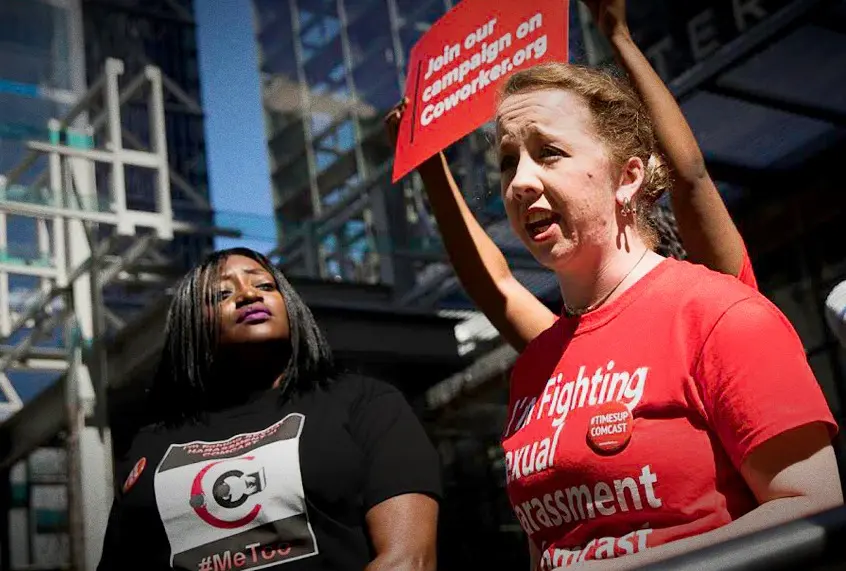
This stark reality was brought to the forefront when former Comcast employees traveled to the telecommunications giant’s Philadelphia corporate headquarters to deliver a petition signed by over 4,000 individuals. Spearheaded by former employees Laterrica Perry and Rylinda Rhodes, the petition demands that Comcast CEO Brian Roberts take decisive action to eradicate a pervasive culture of sexual harassment and retaliation.
For months, these women have detailed harrowing accounts of unwanted sexual advances, physical groping, and subsequent professional retaliation—ranging from denied sick leave and fabricated performance issues to sudden, unexplained termination. Despite submitting documented evidence, phone logs, and text messages, the complainants faced institutional stonewalling and retaliatory measures that left them grappling with severe psychological trauma. As scrutiny mounts against Comcast and its subsidiary NBCUniversal over broader workplace culture concerns, these former employees are refusing to remain silent, aiming to dismantle a system that they argue has repeatedly failed vulnerable workers.
Detailed Chronology of Allegations and Retaliation
The Ordeal of Laterrica Perry
The seeds of Laterrica Perry’s public campaign were planted in July 2017. At the time, the 30-year-old sales representative was working at a Comcast call center in Memphis, Tennessee. According to Perry, she became the target of unwanted sexual advances and inappropriate commentary from her direct supervisor.
Refusing to submit to her boss’s overtures, Perry quickly found herself subjected to professional retaliation. Her supervisor allegedly began systematically undermining her standing within the company, denying her crucial sick time and withholding a standard letter of recommendation. Seeking recourse, Perry filed an anonymous report with Comcast’s Human Resources department, supplying concrete evidence including text messages and call logs substantiating her supervisor’s predatory behavior.
Despite the clear documentation, Perry claims that HR dragged its feet, failing to terminate the supervisor until October 2017—months during which the manager allegedly continued to poison her professional reputation. The psychological toll of the harassment and subsequent retaliation was profound. Perry was diagnosed with Post-Traumatic Stress Disorder (PTSD) and placed on disability leave through March 2018. The resulting loss of income forced her into a severe financial crisis, requiring a hardship withdrawal from her 401(k) retirement account simply to stay afloat.
"I’ve been having regular therapy sessions; my psychiatrist helps, and being medically regulated has helped me for the most part," Perry shared.
However, the nightmare did not end with her medical leave. On April 30, 2018, while awaiting formal separation documentation, Perry discovered she had been completely terminated by the company.
"The only information I got was via email saying that they had proceeded with the actual separation, but I didn’t get the actual package that showed why I was separated," Perry explained. "I received everything, as far as my COBRA coverage, my 401(k) information. The only thing that I had not received is the explanation for my termination. I kind of felt like that was something suspicious."
The Precedent Set by Rylinda Rhodes
Perry’s battle mirrors that of Rylinda Rhodes, a former dispatch representative who worked across four different Comcast call centers between 2007 and 2012. Rhodes reported that she experienced verbal and physical sexual harassment at nearly every Comcast facility where she was employed.
The breaking point for Rhodes occurred when a male co-worker allegedly entered her office and groped her breasts. When Rhodes reported the incident and subsequent harassment, she says the environment swiftly turned toxic. She was forced to take short-term medical leave to undergo talk therapy for trauma induced by the workplace environment. While Comcast ostensibly investigated her claims, Rhodes was advised to apply for alternative roles within the corporation. Instead of finding safety, she was fired on August 1, 2012, with her formal termination letter citing health reasons.
Undeterred by the passage of time, Rhodes launched a digital petition on Coworker.org in November 2017—coinciding with the explosive momentum of the #MeToo movement—to demand corporate accountability from Comcast leadership.
Supporting Context and Metrics: The Invisible Struggle in Blue-Collar Sectors
While cultural dialogues surrounding workplace misconduct have successfully unseated numerous powerful executives, media personalities, and politicians, working-class environments have historically lacked the same level of institutional scrutiny and legal protection visibility. Call centers, retail operations, and telecommunications hubs often operate under high-pressure, metrics-driven environments where lower-wage employees feel uniquely vulnerable to administrative retaliation.
Data underscores the magnitude of this overlooked crisis. According to statistics from the U.S. Equal Employment Opportunity Commission (EEOC), approximately 1,200 complaints of sexual harassment were filed within the information industry—which encompasses telecommunications giants like Comcast—between 2005 and 2015.
For women of color, who make up a substantial portion of customer service and call center workforces, reporting harassment frequently triggers a double-edged sword of skepticism from management and targeted retaliation. Studies consistently show that marginalized workers face steeper socioeconomic penalties when losing employment, making them statistically less likely to report misconduct without robust institutional backing. By uniting across regional call centers, Perry, Rhodes, and their supporters are shedding light on a demographic of workers largely ignored by mainstream corporate accountability initiatives.
Official Statements and Corporate Stance
On May 2, 2018, Perry, Rhodes, and a contingent of former Comcast employees traveled to the company’s Philadelphia headquarters to hand-deliver their petition, which had garnered upwards of 4,000 signatures from former employees, active workers, and sympathetic consumers. However, Comcast executive leadership refused to meet with the delegation.
Despite being turned away at the doors, Rhodes viewed the demonstration as a milestone. "It’s still a win. It lets them know people are watching and coming forth," Rhodes asserted. "It’s also for the ones that are still suffering. To know they are not alone. We are just getting started. All women should have the freedom to be their authentic self and not a scared version because of sexual harassment."
Comcast, which also owns media giant NBCUniversal, has faced a broader corporate crisis regarding workplace culture. The conglomerate previously dealt with intense scrutiny following multiple allegations of sexual misconduct against fired Today show host Matt Lauer, as well as subsequent accusations directed at veteran anchor Tom Brokaw.
In response to the allegations raised by Perry and Rhodes, Jenni Moyer, Comcast’s Senior Director of Corporate Communications, issued a firm defense of company policy to media outlets:
"Sexual harassment, or harassment of any kind, is not tolerated at Comcast. The company was founded on a foundation of respect, integrity and trust. We have strong policies against sexual and other forms of harassment and encourage employees to report any harassing behavior. Any allegation of harassment is taken very seriously."
Despite these assurances, victims and advocates maintain that a profound disconnect exists between written corporate policy and the reality experienced by frontline workers on the ground.
Future Outlook: Empowering the Voiceless
The path forward for both complainants and the corporate entities they challenge remains fraught with tension. Rhodes remains cautiously optimistic that public pressure and collective action can force systemic changes within Comcast. She highlights that not all experiences within the corporation were negative—noting that her earliest location was a place she once felt deeply proud to represent—which gives her hope that standards can be restored.
Conversely, Perry remains skeptical that corporate leadership will voluntarily engage in meaningful reform or directly address the cultural flaws within its regional facilities. Nevertheless, neither woman regrets stepping into the public eye.
"What I’m doing is giving a voice to the voiceless. I’m also empowering people to step forward and say if something happens to them, whether it be at Comcast or any other corporation," Perry stated. She plans to channel her experience into advocacy work, helping other survivors navigate the labyrinth of reporting mechanisms, legal resources, and mental health support systems that are too often obscured from everyday workers.
For Rhodes, the ultimate metric of success is simple reach: if her story provides solace to even one isolated worker struggling with shame and self-blame, the fight is worthwhile.
"The most important thing about this is sharing this to give hope to whoever is out there that feels lost, that feels like it was their fault, that feels shame and blame," Rhodes concluded. "I want them to know it is not their fault and that there are things that they could do to feel better and to be better. This does not have to define the rest of their lives."