By Catie Owen | Regional Content & Insights Lead Published: 17 November 2026
Executive Overview
The geopolitics of subsea telecommunications infrastructure are undergoing a profound geographical shift. For decades, the primary conduits of data traffic linking the United Kingdom to mainland Europe have remained heavily concentrated across the English Channel and the southern North Sea, creating a dense, albeit vulnerable, web of interconnectivity that largely bypasses Scotland and the northern latitudes.
However, a strategic recalibration is underway. On November 10, 2026, VodafoneThree announced a comprehensive feasibility study evaluating the creation of a pioneering UK-Norway digital corridor, slated for rollout in the summer of 2027.
The proposed project aims to bridge mainland Scotland and the Shetland Islands directly with Norway via a high-capacity subsea cable routed through the North Sea. According to internal economic projections from Vodafone Business, this digital artery could generate up to £8.2 billion in cumulative economic value over the next decade. More importantly, it addresses a critical vulnerability in modern telecommunications architecture: route diversity. By establishing an alternative northern transit corridor, the system could safeguard approximately £6.6 million in economic activity for every single day of disruption avoided on legacy southern routes.
As hyperscalers, cloud providers, and telecommunications operators grapple with an intensifying AI-driven capacity crunch, shifting data routes northward is no longer merely a defensive play for redundancy—it is a proactive strategy to tap into the burgeoning Nordic data centre ecosystem.
Detailed Chronology: The Evolution of North Sea Connectivity
The momentum driving operators toward the North Sea is the culmination of years of strategic planning, regulatory shifts, and escalating security concerns across European waters. Tracing the chronology reveals how the region evolved from a peripheral transit zone into the vanguard of international digital infrastructure:
June 2025: VodafoneThree announces a preliminary feasibility study exploring a domestic subsea cable connecting mainland Scotland to the Shetland Islands. This initiative is designed to anchor wider connectivity improvements aligned with Shetland’s Local Development Plan and the UK government’s Shared Rural Network (SRN) initiative, laying the groundwork for subsequent international extensions.
2023–2025: A series of mysterious and disruptive cable incidents occur across the Baltic Sea, damaging several critical subsea links. These events ignite international alarm regarding the physical vulnerability of subsea cables to deliberate sabotage, anchor dragging, and geopolitical interference.
February 2025: In response to mounting maritime security threats, the European Union releases a sweeping Joint Communication aimed at fortifying the security and resilience of its submarine communications cables. The framework establishes four core mandates: minimizing disruption impacts, enhancing threat detection capabilities, accelerating response and recovery timeframes, and deterring hostile state and non-state actors through targeted sanctions.
April 9, 2026: UK Defence Secretary John Healey publicly reveals that the United Kingdom, Norway, and allied nations successfully tracked Russian submarines actively surveying critical subsea cable infrastructure within the North Atlantic and the UK Exclusive Economic Zone (EEZ).
August 7, 2026: Recognizing the explosive demand for sustainable, power-abundant data hosting sites, operators increasingly turn their gaze toward Scandinavia.
October 22, 2026: Prompted by ongoing maritime security incidents—such as the Russian submarine activity noted earlier—the UK government tables a critical new white paper titled Critical Undersea Infrastructure Security and Resilience: Proposals for modernising the UK’s legislation. The framework aims to completely overhaul the nation’s subsea security posture.
November 9, 2026: Signaling a dramatic policy shift regarding the Nordic data centre boom, Norway’s state-owned power grid operator, Statnett, announces an immediate freeze on new data centre grid connection reservations, effective until August 7, 2027. Concurrently, Norwegian ministers unveil rigorous new licensing frameworks, stricter grid connection rules, and proposals for state-owned data hosting sites to protect domestic energy reserves.
November 10, 2026: VodafoneThree formally announces its feasibility study for the UK-Norway digital corridor, targeting a summer 2027 deployment window to link Scotland and Shetland directly to Norway.
Supporting Context & Metrics: Why the North Sea?
To understand the strategic logic behind VodafoneThree’s venture, one must examine the topography and existing infrastructure of the North Sea basin.
Historically, submarine cable topography mapping—via platforms like Cablegraph—reveals an asymmetric distribution of digital entry points. Of the roughly 30 subsea telecommunications cables connecting the UK to mainland Europe, the vast majority make landfall along the English coastline. Scotland, despite its vast geographic footprint and proximity to northern international markets, commands a disproportionately small share of direct international landings.
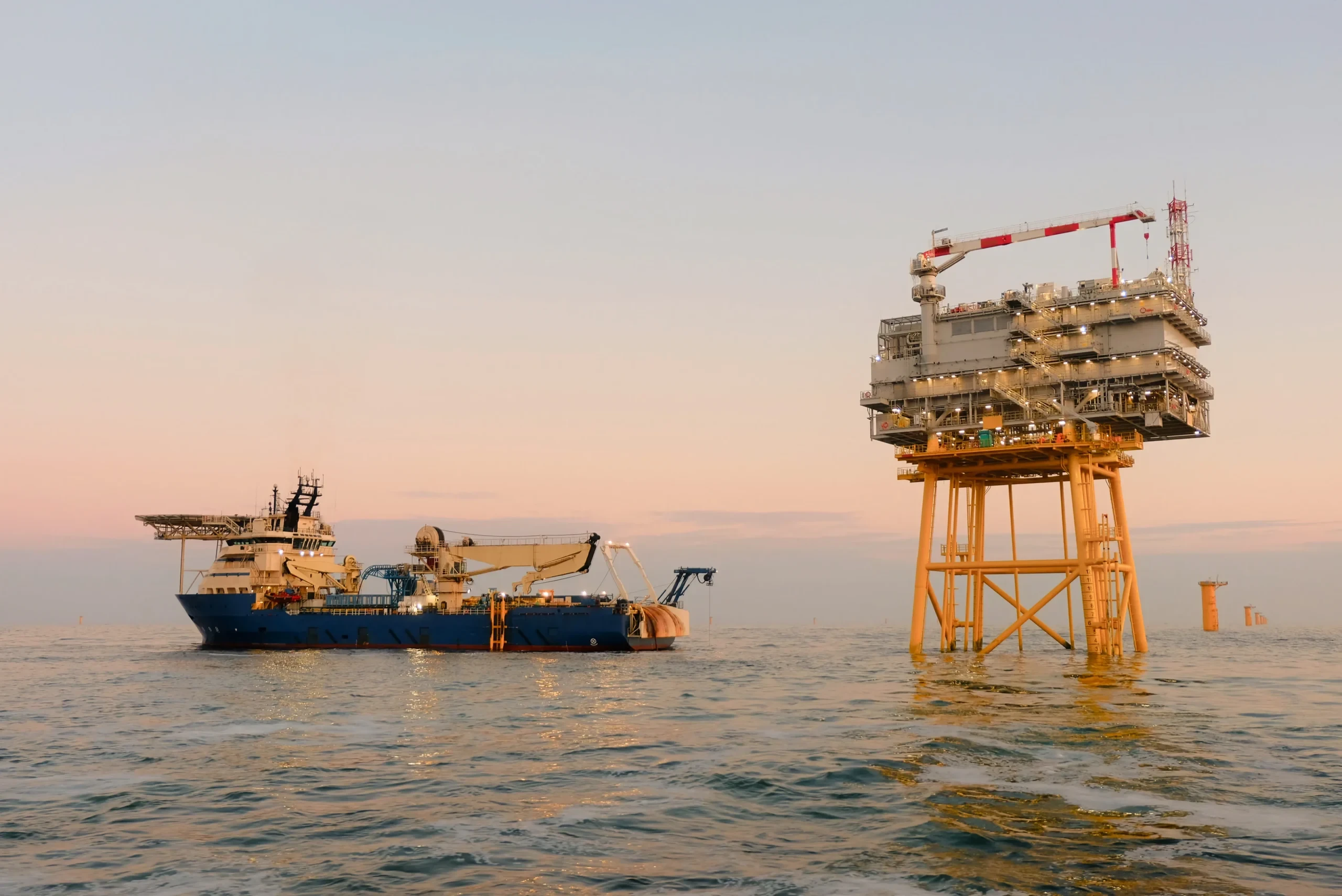
Yet, the North Sea offers a unique convergence of industrial maturity and geographical utility. Despite its reputation for turbulent waters, the basin has functioned as a mature offshore industrial hub for over half a century. Decades of oil and gas exploration have left behind an invaluable legacy of seabed survey data, established port logistics, specialized vessels, and pre-existing offshore communications platforms—exemplified by the Tampnet North and Tampnet South networks, which provide robust offshore connectivity to both UK and Norwegian energy installations.
Furthermore, existing Nordic-UK corridors demonstrate the technical viability of the region:
NO-UK System: Links Stavanger, Norway, directly to Newcastle, England, spanning a relatively concise distance of approximately 700 kilometres, thereby ensuring minimal signal latency.
North Sea Connect & Verena: The North Sea Connect links the UK directly to Denmark, a corridor soon to be augmented by Midgard Infra’s upcoming Verena system, slated to launch in 2028 between Scarborough and Esbjerg.
The Geography of Risk and Reward
The North Sea presents a distinct set of physical characteristics:
Shallow Waters: While the relatively shallow depth of the North Sea elevates the risk of mechanical damage from commercial fishing trawlers and dragging ship anchors, it simultaneously drastically simplifies the logistical engineering required for both initial cable laying and subsequent subsea repairs.
Short Crossings: The narrow profile of the basin accelerates meteorological storms originating from the west and north, but it ensures that cable routes between Scandinavia and the British Isles remain exceptionally short compared to transatlantic or long-haul European terrestrial routes. Shorter physical distance translates directly into ultra-low latency—a critical metric for high-frequency financial trading, real-time cloud computing, and artificial intelligence workloads.
Geographic Redundancy: By establishing northern corridors away from the congested English Channel and the vulnerable choke points of the southern North Sea, operators gain critical route diversity. In an era where a single severed cable in the Baltic or Channel can cripple terabits of transit capacity, northern diversification acts as an essential insurance policy for national and continental data flow.
Official Statements and Industry Perspectives
The convergence of national security imperatives, economic valuation, and digital infrastructure expansion has drawn commentary from key stakeholders across the telecommunications and defense sectors.
Announcing the feasibility initiative, Nick Gliddon, Business Director at VodafoneThree, emphasized the dual imperative of national security and economic enablement.
"Reliable international connectivity is vital to the UK’s defence," Gliddon stated in an official company release.
He elaborated that the proposed digital corridor would fundamentally reinforce physical telecommunications links between the United Kingdom and Norway, injecting "vital route diversity" into the national network topology while safeguarding critical infrastructure against localized disruptions. Crucially, Gliddon framed the initiative not merely as a defensive asset, but as an economic catalyst: "This corridor could unlock major investment in data centres and AI, creating skilled jobs and wider economic opportunities across both nations."
The urgency of this infrastructure push is heavily underpinned by governmental policy shifts. The UK Department for Science, Innovation and Technology, alongside the Ministry of Defence, has increasingly viewed subsea cables as vital national assets. The October 2026 white paper—Critical Undersea Infrastructure Security and Resilience—makes it explicitly clear that any newly laid subsea infrastructure traversing British waters will be subject to stringent modernised regulatory frameworks, ensuring heightened surveillance, mandatory resilience standards, and robust defenses against hostile state actions.
Future Outlook: Connecting to the Nordic Data Centre Boom
As the industry looks ahead toward the summer 2027 target for VodafoneThree’s feasibility study, the broader macroeconomic picture highlights a massive structural transformation.
The Nordic region—encompassing Denmark, Finland, Iceland, Norway, and Sweden—has rapidly evolved into the global epicenter for sustainable, next-generation data centre deployment. This northern migration is driven by two primary factors:
Climatic Efficiency: The naturally cool ambient temperatures of Scandinavia drastically reduce the energy overhead required for thermal management, making hyperscale data centre operations significantly more cost-effective and environmentally sustainable.
Abundant Renewable Energy: Historically, cheap and plentiful green energy—predominantly hydroelectric and wind power—drew massive international tech conglomerates to build multi-megawatt facilities across the region.
However, this rush has triggered localized growing pains. Norway’s state grid operator Statnett’s recent decision to pause new data centre connection requests until August 2027 underscores a growing tension between energy consumption and grid capacity. Governments are stepping in to regulate power usage, introduce strict licensing mandates, and manage potential energy deficits. Despite these regulatory speedbumps, the underlying appeal of the Nordic digital ecosystem remains untouched.
For mainland Scotland and the Shetland Islands, plugging into this Scandinavian network via a North Sea subsea cable represents a transformative economic opportunity. By pairing Scotland’s available land and renewable energy potential with ultra-high-capacity, low-latency connectivity straight to Norway, northern Britain can position itself as a premier destination for the next wave of artificial intelligence and cloud computing infrastructure investments.
Over the coming months, the results of VodafoneThree’s feasibility study will serve as a vital bellwether for the telecommunications industry. As operators increasingly turn their backs on congested southern channels in favor of the rugged, secure, and resource-rich waters of the North Sea, the region is poised to become the definitive digital superhighway of the late 2020s.