Executive Overview
In the rapidly evolving landscape of artificial intelligence and digital content creation, few brand resurrections are as unexpected—or as strategically ambitious—as that of LimeWire. Once universally recognized in the mid-2000s as a notorious peer-to-peer file-sharing client synonymous with the legal and cultural battles of the early digital music era, LimeWire has officially cast aside its litigation-plagued past. Today, it has re-emerged as a cutting-edge, Web3-integrated AI content publishing platform and generative studio.
The modern incarnation of LimeWire bridges the gap between decentralized digital ownership and advanced generative AI. It is no longer a tool for distributing unauthorized media, but rather a robust digital ecosystem designed to empower artists, musicians, designers, and everyday enthusiasts to create, publish, monetize, and trade AI-generated assets. By leveraging state-of-the-art foundation models—ranging from Stable Diffusion to DALL-E 2—alongside automated blockchain minting on Polygon and Algorand, LimeWire has positioned itself at the vanguard of the creator economy.
This in-depth investigative report examines LimeWire’s technological architecture, its innovative monetization frameworks (anchored by its native utility asset, the LMWR token), its tiered subscription ecosystem, and the broader implications of its pivot for the future of digital art and intellectual property.
Detailed Chronology
To understand how LimeWire successfully transitioned from a decentralized file-sharing protocol to a centralized hub for generative artificial intelligence, it is necessary to examine the chronological milestones that marked its corporate and technological rebirth.
The 2000s: The P2P Pioneer and Legal Twilight
- 2000: Mark Gorton founds LimeWire as a peer-to-peer file-sharing client utilizing the Gnutella network. The platform quickly gains immense popularity, becoming a primary competitor to Napster and Kazaa.
-
2006–2010: Facing mounting pressure from the Recording Industry Association of America (RIAA) and major
music labels, copyright infringement lawsuits sweep through federal courts. In May 2010, U.S. District Judge Kimba Wood orders a permanent injunction shutting down LimeWire’s core P2P software distribution and search functions.
- 2010–2022: The brand remains dormant, remembered chiefly as an artifact of early internet culture and digital piracy history.
The Rebirth and Web3 Pivot
- 2022: Tech entrepreneurs Julian and Paul Zehetmayr acquire the LimeWire brand rights with a vision completely detached from its file-sharing origins. The initial relaunch positions LimeWire as a mainstream digital collectible (NFT) marketplace for music and art, attracting early high-profile interest.
- Early 2023: Recognizing the seismic shift in digital art creation driven by generative AI models, leadership pivots the platform’s core focus. LimeWire transitions from a secondary marketplace into a primary creation studio, introducing prompt-based image generation tools.
- Mid-to-Late 2023: The platform launches its native utility asset, the LMWR token, enabling decentralized governance, ecosystem rewards, and frictionless in-app transactions across major cryptocurrency exchanges.
- 2024–Present: LimeWire refines its AI studio architecture, supporting advanced models like Stable Diffusion XL, introducing automated multi-blockchain NFT minting, and rolling out comprehensive revenue-sharing tiers for digital creators.
Supporting Context & Metrics
The transformation of LimeWire is underscored by a sophisticated technical framework and a well-calibrated economic model designed to incentivize user participation, content proliferation, and platform loyalty.
The AI Image Generation Engine
At its technical core, the LimeWire AI Studio is engineered for versatility. Rather than locking users into a proprietary, closed-source neural network, the platform integrates several of the industry’s most powerful open-source and commercial generative models, including:
- Stable Diffusion 2.1 & Stable Diffusion XL (SDXL): Offering high-resolution output, exceptional prompt adherence, and nuanced stylistic control.
- DALL-E 2: Providing advanced conceptual synthesis for complex user prompts.
Users can interface with these models using natural language instructions ranging from simple keyword inputs to highly granular programmatic prompts. Furthermore, LimeWire’s interface allows creators to dynamically switch between specialized visual styles, such as cinematic rendering, vector digital art, intricate pixel art, stylized anime, and vintage analog film aesthetics. Advanced users can also leverage samplers and prompt guidance sliders to fine-tune image fidelity, sharpness, and composition.
Automated Blockchain Minting
One of LimeWire’s most defining innovations is its seamless integration of Web3 infrastructure. Once a user generates an image, music track, or video clip within the studio, they are given the option to publish it. Upon publication, the platform automatically executes a smart contract, minting the creation as an NFT on either the Polygon or Algorand blockchain.
This automated process attaches a verifiable digital signature to the asset, establishing cryptographic proof of authenticity and ownership. Creators retain total control over their distribution strategy:
- Public Release: Content is discoverable across the entire LimeWire ecosystem, allowing public engagement, viewing, and secondary market trading.
- Subscriber-Only Exclusivity: Content is locked behind a paywall, accessible exclusively to dedicated followers and paying subscribers.
The LMWR Token and Revenue-Sharing Architecture
LimeWire departs from traditional creator platforms by offering a robust financial return for content generation. Under its ad-revenue-sharing model, active creators can earn up to 70% of all advertising revenue generated by users viewing their published images, music, and videos on the platform.
These earnings are distributed monthly in LMWR tokens, LimeWire’s native ERC-20/Algorand-compatible cryptocurrency. The utility of the LMWR token is threefold:
- Liquidity: Tokens can be traded on major centralized and decentralized exchanges, including Kraken, Bybit, and Uniswap.
- Platform Utility: Users can spend LMWR tokens directly within the ecosystem to purchase additional generation prompts and credits.
- Ecosystem Governance: Holding the token grants users a voice in the future development and feature rollouts of the LimeWire platform.
Official Statements and Platform Philosophy
Leadership at LimeWire has consistently emphasized that the platform’s ultimate goal is the democratization of digital creativity. By lowering the technical and financial barriers traditionally associated with digital design and software monetization, LimeWire seeks to empower a new wave of digital artists.
"LimeWire was once a symbol of the wild west of the internet. Today, our mission is to build the lawful, structured, and rewarding foundation for the next generation of digital creators," noted platform executives during the rollout of the LimeWire AI Studio. "By merging generative AI with blockchain ownership and direct ad-revenue sharing, we are ensuring that artists retain control—and financial reward—for their creative output."
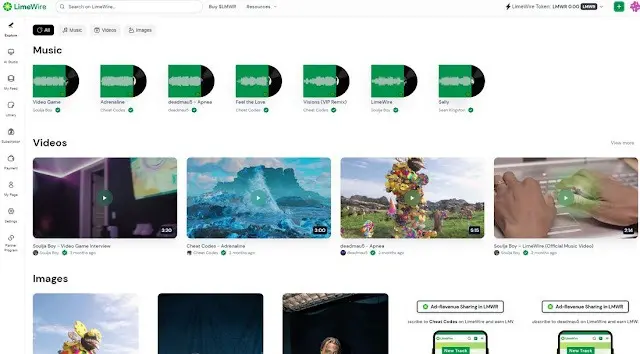
High-profile early adopters, including prominent musicians and cultural figures such as Deadmau5, Soulja Boy, and Sean Kingston, have utilized the ecosystem to launch digital collectibles and experimental multimedia projects, validating the platform’s appeal beyond amateur hobbyists.
Future Outlook & Strategic Roadmap
As the generative artificial intelligence market matures, LimeWire is positioning itself for aggressive expansion. While the platform’s current generative capabilities are anchored primarily in image creation, corporate roadmaps indicate major upcoming developments.
Expanding into Audio and Video Generation
The most anticipated milestone on LimeWire’s horizon is the introduction of dedicated AI music and video generation tools. As foundational text-to-audio and text-to-video models achieve commercial viability, LimeWire plans to integrate these capabilities directly into its studio interface. This expansion will allow musicians, filmmakers, and multimedia producers to generate complex, synchronized audio-visual assets within a single ecosystem.
Scaling the Creator Economy
LimeWire’s tiered subscription pricing structure—ranging from free entry-level tiers offering 10 daily credits to professional tiers charging $99 per month for 11,250 credits, pro profile badges, and maximum ad-revenue shares—ensures a scalable onboarding funnel. As more users adopt the platform, the liquidity of the LMWR token and the depth of the secondary NFT marketplace are projected to grow in tandem.
In summary, LimeWire has successfully navigated one of the most remarkable corporate pivots in digital history. By trading file-sharing controversy for generative AI innovation, the brand has transformed into a comprehensive, monetization-friendly studio that empowers the modern digital creator. As the platform rolls out its forthcoming audio and video tools, LimeWire stands poised to remain a dynamic force in the intersection of artificial intelligence and Web3 decentralized ownership.