Executive Overview
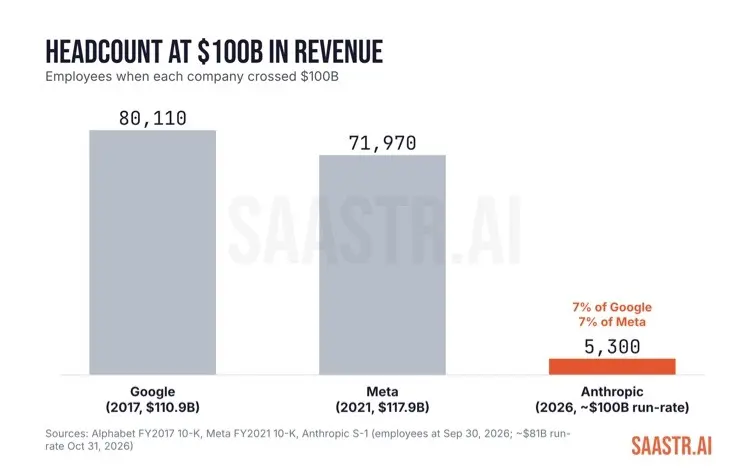
For the past three decades, the scaling playbook for hyper-growth technology companies has remained fundamentally unchanged: capital went toward people, and people drove revenue. When tech giants crossed historic financial milestones, armies of employees marched alongside them. Google required roughly 80,000 personnel to cross the $100 billion revenue threshold. Meta required nearly 72,000. These titans were rightfully celebrated as pinnacles of corporate efficiency, extracting over a million dollars in revenue per employee.
Yet, a fundamental structural pivot is underway. As highlighted by recent analyses from tech venture circles—including Brad Gerstner’s influential Anthropic thesis on TomorrowX—the modern artificial intelligence era has introduced an entirely new corporate architecture. The capital that legacy giants once allocated to human payroll is now being redirected toward raw computational power.
Nowhere is this paradigm shift more evident than at AI safety and research powerhouse Anthropic. According to its updated S-1 filing (S-1/A), Anthropic is hurtling toward a $100 billion revenue run-rate with a headcount hovering around 5,300 employees. To put this in perspective, Anthropic is on track to achieve a milestone that took Google and Meta decades to reach, but with less than 7% of their human workforce.
However, this is not a story of pure cost-cutting or frictionless automation. The money saved on human payroll has simply been swapped for colossal infrastructural expenditure. In the third quarter of 2026, Anthropic spent nearly six times as much on compute as it did on personnel, resulting in a net operating loss of $567 million. The human-light enterprise does not eliminate overhead; it shifts it from human capital to silicon. For B2B founders, enterprise leaders, and investors, this marks the dawn of the "Compute-First" operating model, where the organizational chart is increasingly managed by AI agents, and the primary line item on the balance sheet is compute.
Detailed Chronology: The Evolution of Corporate Scale
To understand just how radical Anthropic’s trajectory is, we must look backward at the most efficient hyper-growth companies in digital history. For a long time, Alphabet (Google) and Meta set the gold standard for top-line scaling relative to headcount.
The $100 Billion Club: Google and Meta
In 2017, Alphabet officially crossed the $100 billion revenue mark, posting $110.9 billion for the fiscal year. To achieve this unprecedented feat, Google built an engine powered by 80,110 employees. Four years later, Meta achieved a similar milestone, recording $117.9 billion in revenue for 2021 while closing out the year with a headcount of 71,970.
At the time, business school case studies lauded these firms. Their ability to generate massive network effects while keeping headcount under 100,000 was considered the peak of digital leverage. Each employee at Google generated roughly $1.4 million in annual revenue; at Meta, that figure was approximately $1.6 million.
The Anthropic Trajectory
Fast-forward to late 2026. Anthropic’s S-1/A filing reveals a staggering departure from historical norms. As of September 30, 2026, the company maintained a lean workforce of roughly 5,300 employees. Just one month later, by October 31, Anthropic’s annualized revenue run-rate hit $81 billion—having added a jaw-dropping $10 billion in run-rate during October alone.
At its current velocity, Anthropic is projected to surpass the $100 billion run-rate milestone by the close of the year, doing so with fewer than 6,000 employees. This means Anthropic is scaling to heights that took Google and Meta years of aggressive global recruiting to achieve, utilizing a fraction of the headcount.
| Metric / Company | Alphabet (Google) – 2017 | Meta – 2021 | Anthropic – 2026 (Run-Rate Basis) |
|---|---|---|---|
| Annual Revenue / Run-Rate | $110.9 Billion | $117.9 Billion | $81 Billion (October Run-Rate) |
| Headcount at Milestone | 80,110 Employees | 71,970 Employees | ~5,300 Employees |
| Revenue per Employee | ~$1.4 Million | ~$1.6 Million | ~$15 Million (Run-Rate Basis) |
| Primary Capital Sink | Human Talent / Salaries | Human Talent / Salaries | Compute / Cloud Infrastructure |
Supporting Context & Metrics: The Anatomy of a Silicon Enterprise
The structural divergence between traditional tech giants and AI-native enterprises becomes even starker when examining unit economics and internal expenditure breakdowns.
Revenue per Employee Explosions
On a trailing twelve-month (TTM) basis, Anthropic’s S-1 indicates a revenue-per-employee metric of $6.6 million—a dramatic leap from the $1.4 million recorded just a year prior. When evaluated on an annualized run-rate basis using current figures, that number skyrockets to approximately $15 million per employee.
This tenfold increase over historical tech giants is not merely an incremental efficiency gain; it represents a step-function transformation in how economic value is captured. Over a single twelve-month reporting period, Anthropic’s revenue grew by an astonishing 1,200%, while its headcount expanded by a comparatively modest 170%.
The Compute-to-People Spending Ratio
The traditional board deck metric of "headcount efficiency" has been replaced by an entirely new financial equation. An analysis of Anthropic’s Q3 2026 financials highlights this reallocation of capital:
- Compute Expenditures: Represented roughly 58% of total revenue during the quarter.
- Personnel Costs: Represented approximately 10% of total revenue.
In absolute terms, Anthropic spent nearly six times as much money purchasing raw compute power from infrastructure providers as it did paying its own human workforce. While personnel costs grew notably year-over-year in Q3—expanding roughly 3.5 times from $489 million to $1.71 billion—quarterly revenue exploded by more than 12 times.
Margins and the Cost of Silicon
Legacy giants enjoyed fat operating margins during their explosive growth phases. In 2017, Google posted a healthy 23.5% operating margin, earning $26.1 billion in operating income. In 2021, Meta posted a staggering 40% operating margin, pocketing $46.8 billion.
Anthropic tells a very different story. Despite generating astronomical top-line figures, the company posted a $567 million operating loss in Q3 2026.
The capital that would have historically been deployed to fund a payroll of 75,000 employees is instead flowing directly to cloud and silicon suppliers like Google, Amazon, and Broadcom. In the short term, compute costs outpace what human salaries would have been at this scale. However, this is a strategic trade-off: Anthropic is prioritizing hyper-growth and market capture over immediate bottom-line profitability, banking on the deflationary cost of inference and maturing token pricing to expand margins over time.
Official Statements and Industry Perspectives
The rapid rise of the compute-first enterprise has not gone unnoticed by venture capitalists, founders, and industry analysts. The thesis popularized by TomorrowX’s Brad Gerstner and amplified across the tech ecosystem by operators like SaaStr founder Jason Lemkin has crystallized a new consensus: the software industry is undergoing a structural reset.
Industry commentators point out that while the exact figures in early viral summaries of Gerstner’s thesis varied slightly, the underlying regulatory and financial documents—namely Anthropic’s S-1/A and Meta’s historical filings—tell an unassailable story.
"Google needed about 100,000 people to get to $100B in revenue. Anthropic will get there with about 5,000," notes the core thesis circulating among Silicon Valley investors. "The money Google spent on people, Anthropic spends on compute."
This shift challenges core assumptions held by institutional investors who historically evaluated SaaS and enterprise software companies through the lens of fully loaded employee costs, sales efficiency ratios (such as Magic Number), and traditional quota-carrying headcount models.
Even at smaller scales, the ripple effects are palpable. Companies like SaaStr are operating lean, managing core business units with micro-teams supported by dozens of autonomous AI agents in production. In these lean structures, the fastest-growing budget item is no longer health insurance or payroll taxes, but API credits and cloud infrastructure fees.
Future Outlook: What Changes for B2B Founders and Enterprise Leaders?
As the compute-first model transitions from an outlier phenomenon exhibited by frontier AI labs to a blueprint for mainstream software companies, the operational mechanics of building and scaling a business are undergoing a profound metamorphosis.
1. The Redesign of the Operating Plan
Historically, a startup or growth-stage company’s annual operating plan was anchored to headcount. Founders mapped out revenue targets based on revenue-per-rep, average sales cycle ramp times, and quota capacity. The hiring plan sat squarely at the center of the board deck.
Today, that architecture is obsolete. Modern operating plans are increasingly built around agentic capacity—evaluating how much deterministic and creative work autonomous agents can execute, and what unit economics govern that agentic labor. Headcount is no longer the primary constraint on growth; compute allocation and algorithmic efficiency are.
2. The Evolution of Go-To-Market (GTM) Strategies
As AI agents assume front-line roles in customer success, code generation, lead qualification, and content marketing, the traditional organizational pyramid is flattening. B2B founders can no longer rely on bloating their support and junior sales teams to scale ARR. Instead, GTM strategies must focus on hyper-efficient customer acquisition loops where software systems talk to software systems, driving down Customer Acquisition Costs (CAC) while pushing Lifetime Value (LTV) higher.
3. Margin Realignment and Unit Economics
The current generation of AI-native companies is proving that massive top-line scale can be achieved with ultra-lean teams, but profitability remains elusive until infrastructure costs rationalize. For B2B founders, the path forward requires careful calibration of gross margins. As the cost of inference drops and silicon efficiency improves through specialized hardware (such as custom TPUs and advanced ASICs), companies that master the balance between compute expenditure and revenue generation will unlock operating margins that make legacy tech giants look sluggish by comparison.
Conclusion
The transition from human-capital-intensive scaling to compute-intensive scaling is the defining economic narrative of the mid-2020s. Anthropic’s journey to an $81 billion run-rate with a mere 5,300 employees signals the end of an era. The corporate ledger has been rewritten: salaries have been traded for servers, and human armies have been augmented—and in many cases replaced—by silicon workforces. For those building the next generation of enterprises, the mandate is clear: learn to manage the compute, or get left behind by those who do.