Executive Overview
In the fast-evolving landscape of artificial intelligence, few corporate trajectories match the hyper-growth velocity of Anthropic. Financial disclosures and regulatory filings paint a picture of an unprecedented commercial expansion. In 2023, the company posted a modest $41 million in revenue. By 2024, that figure surged to $386 million before skyrocketing to $4.585 billion in 2025.
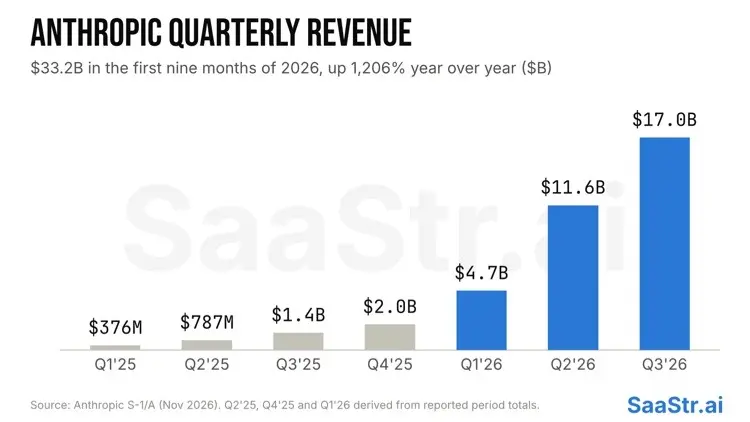
However, the most staggering leap arrived recently: Anthropic generated an astonishing $33.24 billion in revenue for the nine-month period ending September 30, representing a staggering year-over-year increase of roughly 1,200%.
While no typical business-to-business (B2B) enterprise can realistically expect to replicate this precise hyper-growth trajectory, the underlying operating metrics offer an invaluable playbook. Whether an AI startup is navigating its early milestones at $10 million in Annual Recurring Revenue (ARR) or scaling aggressively toward $100 million and beyond, Anthropic’s financial disclosures provide critical benchmarks for net revenue retention, gross margins, enterprise acquisition, and capital allocation.
Detailed Chronology: The Scale of Expansion
To understand the mechanics behind Anthropic’s ascent, one must examine the timeline of its financial milestones. The transition from a research-heavy lab to a commercial powerhouse occurred in a remarkably compressed timeframe.
The Revenue Inflection Point (2023–2026)
- 2023: The company established its foundational commercial footprint, generating $41 million. At this stage, infrastructure costs and heavy compute investments heavily outpaced incoming cash flows.
- 2024: Revenue multiplied nearly tenfold to hit $386 million, driven by the early enterprise adoption of Claude and API integrations.
- 2025: Anthropic crossed into multi-billion-dollar territory, closing the year with $4.585 billion in revenue as major global corporations began deploying LLMs for production-grade workloads.
- First Nine Months of 2026: The company achieved a monumental $33.24 billion in revenue. This period marked the true decoupling of product demand from traditional sales and marketing overhead, cementing Anthropic as a dominant tier-one software entity.
This unprecedented scaling highlights a fundamental shift in how enterprise software is consumed. Rather than relying on traditional multi-year licensing agreements negotiated by massive field sales organizations, Anthropic’s growth has been predominantly organic, driven by developer adoption and consumption-based utility.
Supporting Context & Metrics: The Top 10 B2B Learnings
Analyzing Anthropic’s financial statements reveals ten critical operating lessons for B2B and AI founders, executives, and investors.
1. Net Revenue Retention of ~900% (Excluding Flat-Fee Plans)
Anthropic reports an astonishing Net Revenue Retention (NRR) rate of roughly 900%. This means existing customers collectively generated about nine times as much revenue in the September quarter as they did twelve months prior.
To put this in perspective, historical SaaS darlings like Snowflake (158%) and GitLab (152%) were viewed as market anomalies when they filed their IPO paperwork. However, Anthropic’s 900% figure is built specifically on metered, consumption-based accounts, excluding flat-fee subscriptions like Pro and Max. Traditional seat-priced products typically top out around 120% to 130% NRR because organizations have finite human headcounts. In contrast, AI-driven, metered products scale automatically with workload volume, computation, and task automation.
2. Explosive Growth in $100K+ Enterprise Customers
Enterprise traction is best measured by large, repeatable customer cohorts. As of September 30, Anthropic counts more than 11,900 customers generating over $100,000 in trailing-12-month revenue—a massive leap from just 950 customers the year prior.
Moving further up the funnel, the numbers remain robust:
- $1M+ TTM Revenue Customers: 1,900+
- $10M+ TTM Revenue Customers: ~250
While the company also services approximately 40 million smaller accounts below the $100,000 threshold (primarily individual Pro and Max users), leading with the $100K+ enterprise metric demonstrates undeniable institutional trust. For B2B companies selling into large organizations, this cohort should anchor every board deck.
3. Gross Margins Expanding to 85.5%
According to amended prospectuses and financial footnotes, Anthropic’s cost of revenue for the first nine months of 2026 sat at $4.812 billion against $33.242 billion in revenue. This yields a gross margin of roughly 85.5%, a dramatic improvement from the 29.4% recorded just a year earlier.
While this ~85% figure typically excludes the foundational cost of training raw models, it illustrates a vital lesson for AI startups: early-stage gross margins (such as running at 50%) are temporary. Founders should avoid pricing their products using rigid cost-plus models based on nascent infrastructure inefficiencies, as unit economics naturally improve with scale and hardware optimization.
4. The Volatility of Compute Costs
Compute remains the single largest variable expense for any frontier AI lab. During the first half of 2026, revenue outpaced compute costs significantly; in Q2 alone, revenue surged 1,368% year-over-year while compute costs rose by 300%.
However, Q3 introduced a reversal: compute’s share of revenue ticked up from 48% in Q2 to 58% in Q3, matched by massive purchase commitments totaling $895.4 billion. This underscores a crucial reality: inference costs do not drop in a linear, predictable fashion. Model mix, heavy agentic workloads, and deeper enterprise usage create quarterly fluctuations that management teams must monitor tightly alongside gross margins.
5. Lean Sales & Marketing Ratios (23% of Revenue)
During the first half of 2026, Anthropic’s sales and marketing (S&M) expenditure stood at $3.808 billion, accounting for roughly 23.4% of total revenue despite maintaining a 1,000%+ growth rate. Many legacy B2B companies growing at a modest 30% clip routinely spend double that percentage on go-to-market motions.
When a product exhibits true organic pull, S&M grows at a fraction of revenue. If an AI startup finds its S&M ratio remaining flat or rising while scaling, it signals underlying friction in product-market fit or pricing efficiency rather than a pure execution challenge.
6. Consumption vs. Subscription Dynamics
The revenue mix heavily favors consumption-based models. In the first nine months of 2026, consumption-based usage brought in $26.3 billion (79% of revenue), while subscriptions accounted for $6.9 billion (21%).
However, pure consumption models introduce seasonal vulnerabilities. For instance, Anthropic’s disclosures noted a roughly 20% drop in customer spending during the two-week holiday period ending January 2, 2026, compared to mid-December. This highlights why blended contracts—combining committed enterprise spend with metered overages—are essential to maintaining predictable financial forecasts.
7. The Power of Cloud Marketplaces
Nearly half (48%) of Anthropic’s first-half 2026 revenue was transacted on a gross basis through major cloud marketplaces (AWS, Google Cloud, and Azure). Furthermore, these marketplaces account for 58% of the company’s receivables.
For enterprise B2B sellers, listing products within major cloud provider ecosystems is no longer optional. Large corporations prefer drawing down pre-committed cloud budgets to purchase specialized software, drastically shortening procurement cycles.
8. Penetrating the Fortune 500 Operating Budget
Anthropic’s customer base includes more than half of the Fortune 500 generating at least $100,000 annually. Yet, among publicly traded entities within this group, spending with Anthropic averages less than one dollar for every one thousand dollars of total enterprise expenses.
Crucially, this denominator encompasses total corporate expenses—including headcount, services, and operational overhead—rather than merely the traditional IT software budget. This dynamic defines the true promise of agentic AI: capturing non-software operational spend to unlock deal sizes multiples higher than legacy SaaS competitors.
9. Multi-Product Adoption Driving Expansion
Product diversification acts as a powerful retention multiplier. By the September quarter, more than half of Anthropic’s $100K+ customers utilized both the Claude Platform (API) and at least one proprietary Anthropic application, up sharply from roughly 30% in Q4 2025.
As API developers discover native applications, and app users transition to building custom workflows via the API, cross-product adoption emerges as a primary catalyst for expanding net revenue retention.
10. Maturing Revenue Concentration
Early-stage high-growth companies often suffer from severe customer concentration. For Anthropic, early traction was heavily anchored by a few major players (such as "Customer C," which accounted for 43% of revenue in 2023).
By the first half of 2026, that concentration had normalized significantly: the top five customers made up roughly 25% of revenue, while customers outside the top five generated 79% of September-quarter revenue. Early-stage customer concentration is entirely survivable provided the broader customer base expands at a faster velocity than core anchor accounts.
Future Outlook
Anthropic’s financial evolution offers a panoramic view of the future of enterprise software. As artificial intelligence transitions from a novelty tool to core enterprise infrastructure, the metrics that matter are shifting. Consumption-based pricing, hyper-efficient sales motions, gross margin expansion, and deep integration into non-IT operational budgets are the new hallmarks of category-defining companies.
While few organizations will ever replicate a 1,200% year-over-year revenue leap to reach tens of billions of dollars in a matter of quarters, the structural lessons embedded within Anthropic’s disclosures serve as an enduring masterclass. Founders and investors who align their internal operating metrics with these realities will be best positioned to capture the immense value of the AI era.