the Moral Quagmire of GTA 6’s Open-World Sandbox
Executive Overview
Regrets, most players will tell you, usually stem from blowing a high-stakes heist at the eleventh hour, accidentally running over an essential NPC, or sinking countless hours into a side mission that yields meager rewards. But after more than one hundred hours embedded deep within the sun-drenched, neon-soaked expanse of Rockstar Games’ long-awaited Grand Theft Auto 6, my deepest regret bears no resemblance to standard virtual mishaps. It is localized, hyper-specific, and entirely self-inflicted.
It all began on a deceptively serene afternoon in Vice City. High above the bustling boardwalks and sun-baked sands, the sun hung suspended in a cloudless sky, casting long, lazy shadows across a coastline teeming with vacationers and locals alike. Yet, beneath this veneer of tropical tranquility, a darker, more insidious shadow was quietly stretching across the map—one cast entirely by the actions of a single, curious deviant: myself.
Intent on granting Jason a brief reprieve from his usual calendar of high-stakes felonies, I steered him toward the Wildland Zoo. The itinerary was innocent enough: watch the flamingos wade through shallow waters, exchange pleasantries with a talkative parrot, observe a peaceful, sleeping tiger, or perhaps sip a frozen mango daiquiri at the facility’s beachside bar. That was the master plan. But in the unpredictable sandbox of Leonida, well-laid plans rarely survive first contact with a player’s intrusive thoughts.
This unexpected excursion occurred squarely in the middle of a grueling personal crusade: my relentless, mathematically punishing quest to trigger GTA 6’s elusive six-star wanted level. Reaching the absolute apex of law enforcement wrath is no casual endeavor; it demands a staggering escalation of virtual atrocities. Having already exhausted mass murder and dabbled extensively in casual domestic terrorism—all to stubbornly underwhelming responses from the local constabulary—a dangerously dark realization settled over me. I noticed that the iron-bar architecture housing the zoo’s captive wildlife featured gaps wide enough to thread a high-caliber projectile through.
What followed was not merely an isolated moment of digital cruelty, but a masterclass in how open-world design can push a player past the boundaries of conventional gaming morality, exposing the strange, arbitrary limits of our digital empathy.
Detailed Chronology: An Afternoon at the Wildland Zoo
I did not act on the observation immediately. Instead, I opted to enjoy a fleeting pocket of peace amid the sprawling chaos I had meticulously carved across the rest of the map. Yet, the persistent whisper in the back of my mind refused to quiet down. What if? I mused. What if this particular brand of transgression was the secret algorithmic key required to bring the full, crushing weight of Leonida’s militarized law enforcement cascading down upon my shoulders? In the sacred name of scientific inquiry—and driven by an insatiable itch to resolve my own morbid curiosity—I decided I had to test the hypothesis.
Prowling the paved pathways between the pristine enclosures, I found myself mirroring the behavior of the nearby big cats, pacing back and forth with predatory deliberation. My fingers hovered nervously over my controller, trembling slightly in anticipation of the horrors I was about to unleash. At least, I desperately hoped that trembling was out of sheer dread rather than excitement. I did not want to enjoy this. I simply knew, with a grim sense of inevitability, that it had to happen.
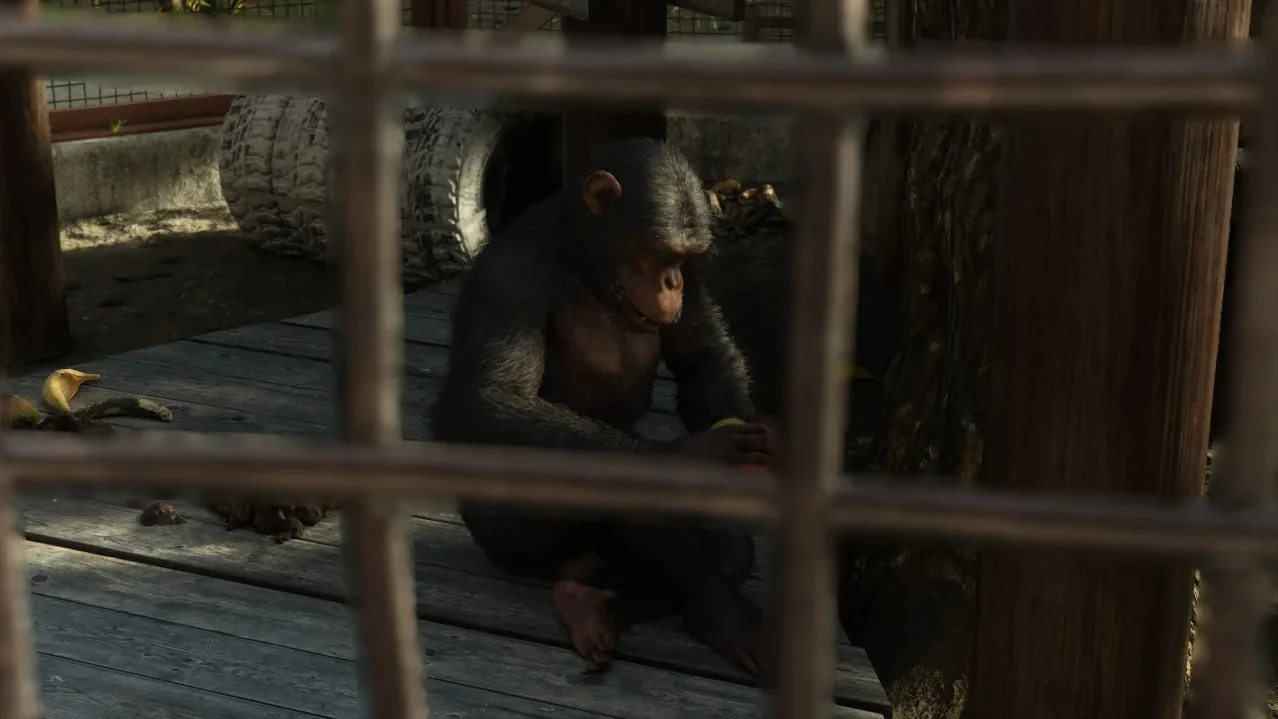
The rusted, utilitarian cages housing several Western Chimpanzees seemed to call out to me directly, their metallic bars acting like magnetic poles for my latent dark desires. The inhabitants initially appeared content enough with their simulated reality. One chimp sat casually on an elevated wooden platform, expertly tossing a miniature soccer ball back and forth—though attempting to besmirch the beautiful game in the style of a corrupt international sports executive was not on my agenda today, so I left him undisturbed.
Directly below, another chimpanzee sat cradling a piece of tropical fruit between its feet. To this day, I cannot definitively state whether it was a guava, a mango echoing the citrus notes of the drink I had purchased moments prior, or perhaps a papaya. Ultimately, the botanical classification is entirely beside the point. All I knew with absolute clarity was that this piece of fruit would be the final thing that creature tasted in this life. Aside from a jacket full of lead, that is.
Lifting the heavy steel of my revolver, I took precise aim at the creature’s furry head, silently bidding farewell to whatever microscopic trace of digital innocence I had managed to retain over decades of gaming. One deafening crack punctured the humid afternoon air, and the deed was done.
For a fraction of a second, the entire game engine seemed to stall. The world froze as a wave of numbness washed over me, replaced instantly by an eerie, hollow silence. Where exotic birdsong and the cheerful chatter of tourists had mingled just moments prior, a thick, suffocating quiet settled over the exhibit. That silence was swiftly shattered by shrill, panicked cries. The surviving chimpanzees inside the enclosure cowered frantically in the corners of their cage, their artificial intelligence routines desperately processing the sudden trauma, convinced they were next in line for execution. The neighboring macaques joined the chorus, their distressed screeches echoing across the concrete pathways.
Fortunately—or perhaps insufficiently—there would be no further bloodshed that day. In truth, the single act was already more than enough to last a lifetime, etching a permanent mark on my conscience that I vowed never to repeat.

Supporting Context & Metrics: The Mechanics of Modern Chaos
To fully understand the weight of this virtual transgression, one must analyze the systemic architecture of Grand Theft Auto 6’s wanted system. Reaching the zenith of law enforcement retaliation—the coveted six-star wanted level—requires an astronomical volume of hostility. During my playthrough leading up to this incident, I had systematically mowed down several hundred digital pedestrians, engaged in prolonged armored-car heists, and leveled city blocks with military-grade explosives.
And yet, none of those human-on-human atrocities elicited the psychological friction, the profound gut-punch of immediate remorse, that killing a single, mathematically rendered chimpanzee managed to produce.
[Action Type]                [NPC Casualty Count]    [Wanted Level Triggered]    [Player Remorse Index]
---------------------------------------------------------------------------------------------------------
Urban Mass Shooting          150+ Civilians          5 Stars                     Low / Standard Sandbox
Domestic Terrorism           Vehicle/Property        5 Stars                     Low / Standard Sandbox
Zoo Wildlife Execution       1 Chimpanzee            1 Star                      Extreme / Lasting Trauma
The dichotomy is fascinating and deeply troubling. Modern open-world design conditions players to view human NPCs as infinitely respawning cannon fodder—obstacles or scoring units in a grander criminal sandbox. We slaughter police officers by the battalion and run down pedestrians by the dozens without batting an eye, secure in the psychological comfort that these characters are narrative props.
Animals, however, occupy a bizarre gray zone in digital media. Because they lack dialogue trees, aggressive counter-attacks, or functional agency within the game’s broader economic loops, harming them strips away the veneer of self-defense or combat escalation. It reduces the act to pure, unadulterated cruelty. When the gunshot echoed across the Wildland Zoo, it didn’t register as a tactical gameplay choice; it registered as a profound moral failure.
Compounding the absurdity of the situation, this abhorrent act of digital poaching—an atrocity that fundamentally fractured my psyche—only managed to trigger a meager, underwhelming one-star wanted level. Back to Ocean Beach I would eventually have to trudge, forced to slaughter countless more human citizens just to climb the algorithmic ladder toward my ultimate goal. Yet, the price paid internally felt infinitely heavier.
Official Reactions and Social Fallout
The immediate in-game fallout was as chaotic and cinematic as one might expect from a Rockstar-crafted sandbox. Park security guards stood paralyzed in absolute horror. Zoo attendants dropped their maintenance tools in disbelief. Tourists shrieked and scattered in all directions, turning the pristine family-friendly attraction into an instant war zone. It was, for all intents and purposes, Harambe 2.0 rendered in cutting-edge fidelity.
As I fled the scene on foot—too panicked and cowardly to even retrieve my parked vehicle parked outside the main gates—a montage of sensationalized headlines flashed vividly through my imagination:
- The Vice City Herald: "Local Man Shoots Ape’s Brains Out Amid Wild Scenes at Wildland Zoo"
- Leonida Daily News: "Chimp Blown to Bits as Tourists Run for Cover"
- The Daily Globe: "Bring Back the Death Penalty for the Wildland Zoo Ape Killer"
Who was I to argue with the hypothetical editorial boards? As the distant wail of police sirens began to close in, I realized my reputation was irreparably tarnished across multiple dimensions.
My mind raced toward absurd tangents. What would those iconic chimpanzees from the classic British television commercials for PG Tips teabags think of me if they could witness my depravity? I had grown up adoring their slapstick antics—talking primates dressed impeccably in human attire represented the absolute pinnacle of 1990s television wit. Clearly, we simply didn’t know how good we had it back then. In that single, shameful moment, I had let down generations of media-trained apes.
Furthermore, I worried about my theoretical standing within the fictional animal rights organization Dodo Rising. I pictured them organizing a rapid-response protest outside the Leonida courthouse during my impending trial, holding placards featuring a smiling chimp while chanting "Primates, not Prime-Hate" with mounting, righteous ferocity.
Future Outlook: Carrying the Burden in Leonida
As I continue my sprawling, hundred-hour journey through the sun-bleached highways, murky swamplands, and neon-lit avenues of Grand Theft Auto 6, the memory of that single gunshot stubbornly refuses to fade. Even now, long after the digital blood has been washed from the virtual pavement, I occasionally imagine I can still hear the desperate, echoing cries for help emanating from those rusted zoo enclosures in my dreams.
It is a bizarre, unexpected curse to carry through an open-world crime simulator—a game explicitly built around the unbridled celebration of lawlessness and vehicular manslaughter. I am still entirely uncertain of what this deep-seated psychological reaction says about my moral compass, or about the intricate ways modern video games manipulate our capacity for empathy.
Regrets, as the old song goes, I have had a few. But none quite like this. I navigated the sun-drenched chaos of Vice City and chose to do things strictly my own way. I just profoundly wish that I hadn’t.