Published: 20 November 2026
Estimated Reading Time: 6 minutes
Executive Overview
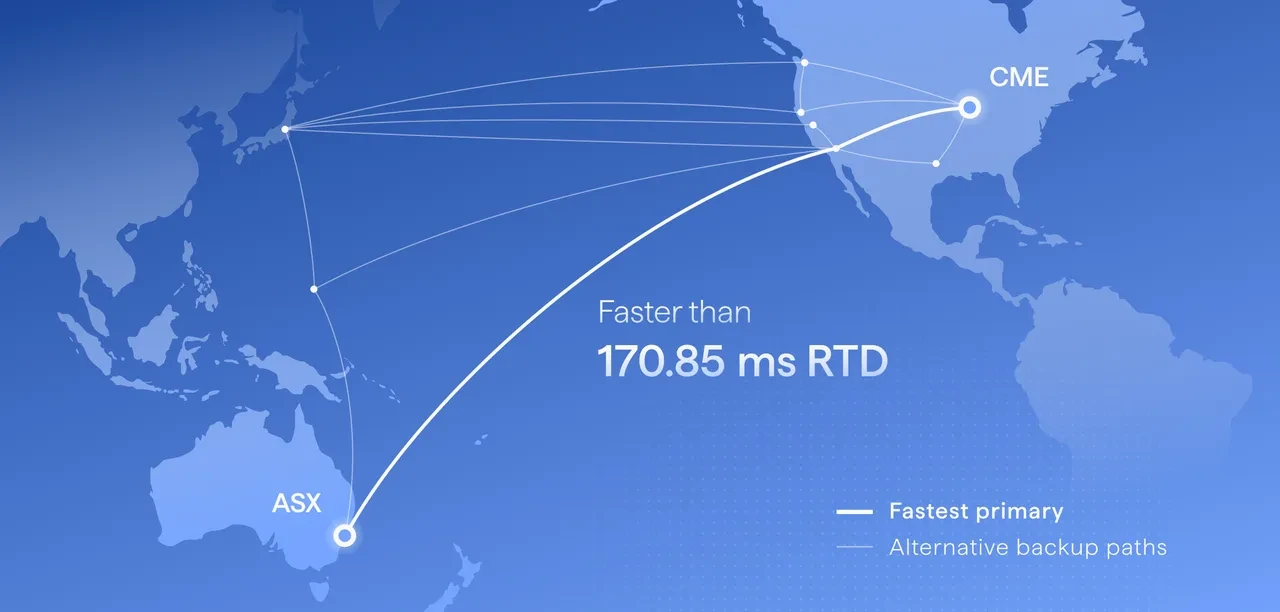
In the high-stakes world of electronic financial markets, milliseconds are an eternity, and network architecture can make the difference between immense profitability and catastrophic slippage. Avelacom, a leading provider of low-latency connectivity and IT infrastructure solutions, has officially rolled out a premier fibre-optic route connecting the Australian Securities Exchange’s (ASX) Australian Liquidity Centre in Sydney directly to CME Group’s Aurora data centre in Illinois.
Achieving a ground-breaking round-trip delay (RTD) of just 170.85 milliseconds, this newly optimized path represents what the company claims is the fastest fibre route currently commercially available between these two critical financial hubs.
Announced on 19 November 2026, the rollout leverages a strategically positioned, confidential North American point of presence (PoP) to eliminate redundant optical loops and streamline the journey of market data. Yet, as capital markets face increasingly complex geopolitical and technical risk landscapes, Avelacom’s latest launch highlights a broader, defining tension in global telecommunications: how financial trading firms continually balance the relentless pursuit of lower latency with the non-negotiable imperative for route diversity and resilience.
Detailed Chronology & Technical Milestones
The unveiling of the Sydney-to-Illinois ultra-low-latency circuit is the culmination of meticulous network engineering and incremental optimizations.
- Late 2023 – October: Google announces its South Pacific Connect initiative, featuring the Tabua and Honomoana subsea cable projects designed to inject multi-path redundancy and geographical diversity into transpacific data corridors.
- January 2026: SUBCO unveils APX East, a massive 16-fibre-pair subsea cable system designed to link Sydney directly to San Diego, California, targeting a Q4 2028 service entry with a continuous optical path free of intermediate regeneration facilities.
- April 2026: TeleGeography publishes Building Tomorrow’s Internet: A 2026 Update on Cable Investment, forecasting over US$3 billion in construction expenditures for new transpacific subsea cables entering service between 2026 and 2029—nearly double the US$1.7 billion spent over the preceding three-year cycle.
- September 2026: Global international internet bandwidth officially hits 2,259 Tbps (a 23% year-on-year increase), while Oceania registers a compound annual growth rate of 25% between 2022 and 2026. Simultaneously, Australian AI infrastructure firm Firmus commits roughly US$300 million to secure 150 Tbps of dedicated transpacific capacity across APX East over 25 years.
- September 2026: A specialized study by the China Strategic Risks Institute, China’s Gray Zone Threats to Trans-Pacific Undersea Cables, brings geopolitical vulnerabilities into sharp focus, demonstrating how severe cable disruptions can inflate transpacific latencies and bottleneck traffic.
- 19 November 2026: Avelacom officially launches its Sydney-to-Illinois route, shaving approximately 1 millisecond off existing transit times to achieve a benchmark round-trip delay of 170.85 milliseconds via its newly established, confidential North American PoP.
Supporting Context & Market Metrics
To appreciate the gravity of Avelacom’s infrastructure upgrade, one must examine the macro-economic forces currently reshaping transpacific data flows. According to TeleGeography data cited in the OECD’s Digital Economy and Society Outlook 2026, content and cloud providers commanded a staggering 80.2% of used transpacific bandwidth in 2024. Hyperscalers continue to dictate the massive volume-driven expansion of global networks, pouring billions of dollars into subsea arteries.
However, while hyperscalers prioritize sheer capacity and high-throughput data hauls, proprietary trading firms, global market makers, and institutional investment banks operate under an entirely different set of operational imperatives. For these financial entities, end-to-end latency—coupled with the fail-safe performance of alternative backup paths—is paramount.

The Cross-Market Arbitrage Dilemma
Operating across time zones introduces unique macroeconomic risks. For instance, firms making markets in ASX SPI 200 futures (contracts tracking Australia’s benchmark S&P/ASX 200 share index) cannot afford to operate in a vacuum while the North American markets dictate global sentiment.
If US equity futures experience a sharp, unexpected movement during Sydney’s night session, local market makers must instantaneously update their Australian quotes. Failing to do so within milliseconds leaves them dangerously exposed to algorithmic counterparties trading against stale prices. A similar dynamic governs international interest rate trading desks. Fluctuations in US Treasury futures prompt rapid adjustments across US-Australia yield spreads. In these high-frequency environments, the speed of light through fibre is the ultimate arbiter of commercial survival.
Official Insights & Strategic Perspectives
Speaking on the strategic motivations behind the deployment, Lorenz Voss, Managing Director for the US at Avelacom, emphasized the high-stakes calculations financial institutions make when structuring their connectivity portfolios.
"If US equity futures move sharply, the firm may need to update its Australian quotes before someone trades against a stale price," Voss explained to Capacity. "That’s where low latency matters. It shortens the time between seeing the move in one market and acting on it in the other."
Beyond raw speed, however, Voss highlighted that modern risk management demands equal scrutiny of alternative, secondary pathways. When primary transpacific lines suffer cuts—whether due to natural disasters, anchor drags, or geopolitical friction—the architecture of backup routes becomes critical.
"Two circuits can still share a subsea cable, a landing station, or a stretch of terrestrial fibre," Voss noted. "Customers want to understand where those paths overlap and how much latency the backup adds."
Rather than demanding that backup routes match primary speeds tick-for-tick, modern trading desks focus on predictability. According to Voss, firms want to know precisely what latency and capacity parameters will remain operational during an outage so they can automatically shed non-essential loads while keeping core pricing engines alive.

To address these redundancy needs, Avelacom underpins its primary 170.85ms connection with geographically diverse alternative loops routed through Guam and Tokyo, alongside expanded North American connectivity terminating in Los Angeles, Seattle, Hillsboro, and San Jose.
The Rising Spectre of Route Vulnerability
The demand for robust, transparent disaster recovery mechanisms has been sharply reinforced by recent geopolitical analyses. A notable September 2026 report titled China’s Gray Zone Threats to Trans-Pacific Undersea Cables—prepared by the China Strategic Risks Institute for the US-China Economic and Security Review Commission—underscored the fragility of transpacific subsea arteries.
The study modeled various outage scenarios, noting that disruptions to direct pathways (such as Taiwan-US routes) could force traffic onto congested detours, inflating round-trip delays dramatically and causing severe performance degradation for latency-sensitive applications. While the study centered primarily on US-Asia corridors rather than the Sydney-Illinois link, the systemic takeaway for financial institutions is clear: single-path dependency is an existential business risk.
Consequently, network providers are racing to deploy geographically distinct infrastructure. Google’s ongoing South Pacific Connect initiative—encompassing the Tabua cable (linking Australia and California via Hawaii and Fiji) and the Honomoana cable (routing through French Polynesia and New Zealand)—epitomizes this push for network resilience. Similarly, upcoming multi-billion-dollar investments, including SUBCO’s APX East project, signal an era where high-capacity corridors are being engineered from the ground up to withstand localized disruptions.
Future Outlook
As the telecommunications and financial sectors look toward the late 2020s, the convergence of artificial intelligence, high-frequency trading, and massive cloud migration will continue to strain existing transpacific capacity. With over US$3 billion in capital earmarked for new subsea cable deployments between 2026 and 2029, the physical backbone of the global internet is undergoing its most aggressive modernization phase in decades.
For Avelacom and its financial clientele, the path forward is defined by a dual mandate. The race to trim fractional milliseconds from primary routes like Sydney-to-Illinois will undoubtedly persist as algorithmic trading strategies grow ever more sophisticated. Yet, as network vulnerabilities become more apparent, the true competitive differentiator for infrastructure providers will not just be how fast their primary connection runs, but how transparent, resilient, and reliable their backup systems remain when the unexpected occurs.
In the words of Lorenz Voss, trading firms will continue measuring network value through two uncompromising metrics: "How fast is the connection from exchange to exchange, and what performance can we expect if the primary path goes down?" As upcoming multi-billion-dollar subsea systems come online over the next three years, answering those two questions will dictate the hierarchy of global financial markets.