Executive Overview
The clue has always been right there in the title. Since its inception, the Grand Theft Auto franchise has maintained a passionate, borderline obsessive relationship with the automobile. It is a series defined by the thrill of the heist, the screech of burning rubber, the tactical evasion of flashing police lights, and the soulful soundtrack bouncing off the dashboard during long highway stretches between narrative milestones. Players have spent decades stealing, racing, modding, and abandoning cars by the thousands.
Yet, even within a catalog so entirely built around car culture, Rockstar Games has fundamentally redefined the paradigm with Grand Theft Auto VI.
This is not merely a matter of vehicle variety—though the roster spans everything from battered mobility scooters to roaring, supercharged muscle cars that grunt and whine with mechanical authenticity. It goes far beyond deeper customization options that let gearheads tweak everything from upholstery fabrics to transmission ratios. In GTA 6, the automobile ceases to be a disposable transport tool. Instead, your vehicle is elevated to a fully realized mobile base of operations—an extension of your character’s very identity that anchors the game’s overhauled, interconnected survival and crime systems.
Without a car—specifically, without an owned car rather than a hot-wired wreck pulled haphazardly from the roadside—you are functionally naked in the humid sprawl of Leonida. This journalistic deep-dive examines how GTA 6 elevates vehicular mechanics from a core gameplay loop into a brilliant simulation of criminal logistics, forever changing how open-world veterans interact with their garage.
Detailed Chronology: The Evolution of the Mobile Base
To understand why the personal vehicle feels so transformative in GTA 6, one must trace the logistical hurdles introduced by the game’s more grounded, realistic design philosophy. Past entries allowed players to carry an entire localized armory inside their trousers, conjuring rocket launchers and miniguns out of thin air. GTA 6 rips away that magical inventory system, replacing it with a physically grounded reality that turns your trunk into the ultimate lifeline.
Phase One: Tactical Weaponry and the Death of Magic Pockets
In GTA 6, you physically carry what your hands and back can support. The era of the bottomless inventory is gone. Players are restricted to wielding a maximum of two "longarms"—rifles, shotguns, and heavy tactical weapons—at any given time. One is slung across your back, while the other is clutched in your hands. Furthermore, the game actively discourages walking around like a walking militarized zone; double-packing heavy firearms instantly triggers suspicion from Leonida’s hyper-vigilant, no-nonsense police force.
This is where the owned vehicle steps in as an indispensable tactical asset. The trunk of your personal car serves as a secure armory. Whenever you are planning a high-risk venture—such as executing lucrative gang hideout robberies—taking your personal vehicle ensures you have immediate access to your entire arsenal.
Interestingly, the mechanics of opportunity extend even to the roadside: players can covertly slip up to parked police cruisers and jimmy their boots to scavenge fresh firearms in an absolute pinch. But for sustained criminal enterprise, nothing beats returning to the trunk of your customized ride.
Phase Two: Contraband Logistics and Pack-Mule Economy
Beyond weaponry, the criminal underworld of GTA 6 runs on physical contraband. Drugs, marked bills, high-end electronics, and stolen jewelry cannot simply be absorbed into a digital wallet; they must be physically packed into duffel bags slung across your shoulder. Just as with longarms, your human carrying capacity is severely limited by the number of arms you possess.
Enter your car, which acts as a heavy-duty pack mule capable of stacking multiple stash bags simultaneously. This single design choice revolutionizes crime sprees. Instead of interrupting your momentum to run a bag to a fence after every single successful heist, you can hit a string of targets, pack the trunk, and operate efficiently over extended periods.
Crucially, owned vehicles maintain these stashes indefinitely across game sessions. You can raid a drug den under the cover of night, drive your packed car back to your safehouse, sleep off the adrenaline, log off for the evening, and boot the game up hours later knowing your hard-earned contraband remains safely tucked away. Even if law enforcement manages to bust you, your personal wheels are sent to the local impound—setting up one of GTA 6‘s most thrilling emergent activities: sneaking into the impound lot to reclaim your property.
Phase Three: The Mobile Wardrobe and the Art of the Evasion
Perhaps the most ingenious mechanic tied to your vehicle is its dual-purpose role as a mobile closet. Your trunk holds up to five complete outfits alongside a rotating collection of hats and accessories.

In GTA 6, police response systems have evolved past simple line-of-sight timers. When you are clocked committing a felony, authorities operate on a physical description of your person. Swapping your clothes, slapping on a new hat, and throwing on a pair of sunglasses completely diffuses the scent of your crimes. While you can purchase fresh threads at local boutiques, doing so requires cash and a convenient retail location. Grabbing a pre-planned change of clothes directly from your trunk on the fly and driving past bewildered cops as an entirely "new" citizen is infinitely faster, cheaper, and more exhilarating.
Supporting Context & Metrics: Driving Dynamics and World-Building
These interconnected gameplay pillars fundamentally alter how players view driving. In Grand Theft Auto V, vehicles like Franklin’s Bravado Buffalo S often functioned as disposable transit vectors. Players swapped stolen cars endlessly, treating them as interchangeable boxes on four wheels.
GTA 6 actively fights against this disposable mindset. Because your owned vehicle carries your guns, your stolen stashes, and your wardrobe, you quickly develop a genuine bond with your ride.
Mastery of Weight and Physics
The game’s handling engine rewards this investment. Drivers must learn the distinct mechanical nuances and quirks of their garage inventory. For instance:
- Throttle Control: Players quickly learn precisely how many degrees of throttle Jason’s Ganado pickup truck can handle before the rear tires lose traction and kick into a tailslide.
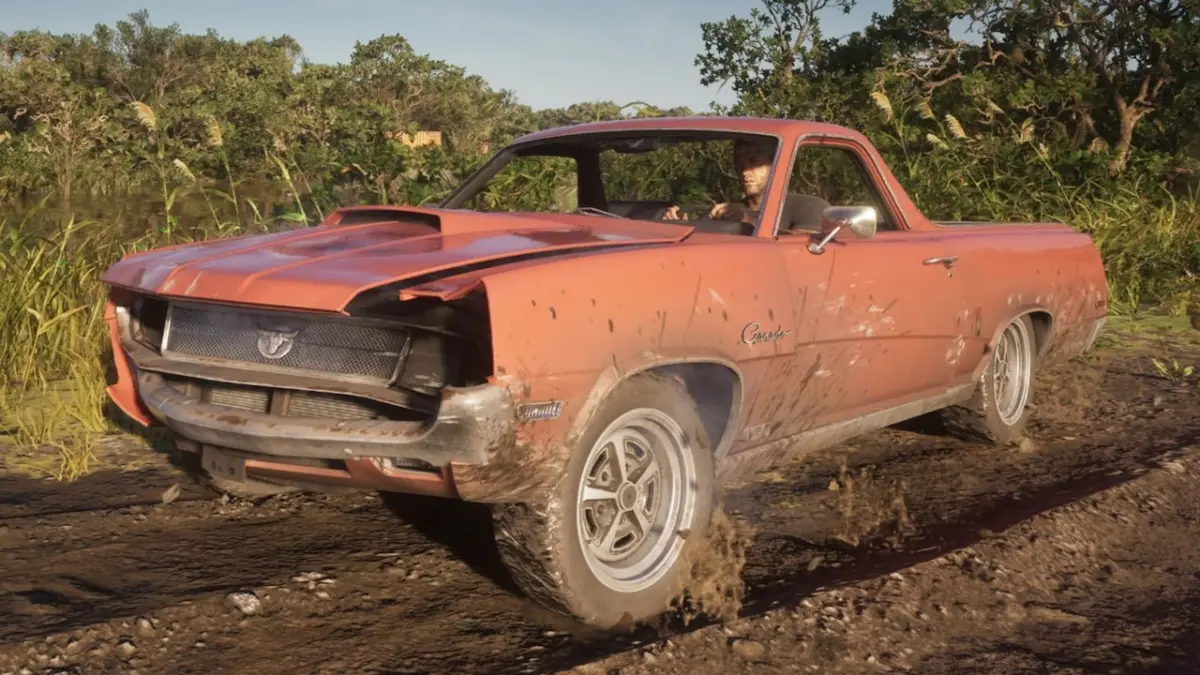
- Terrain Navigation: Negotiating swampy, overgrown backcountry corners requires mastering precise steering angles to slide through mud without wrapping the chassis around a tendrilled tree.
- Vulnerability & Damage: Because crashing in GTA 6 features significantly more advanced soft-body physics—peeling off fenders, caving in doors, and crumpling bumpers at the slightest high-speed miscalculation—drivers take far more care when weaving through dense urban traffic.
Even when forced to temporarily dump an owned vehicle to throw off a high-heat police pursuit, that momentary sense of vulnerability is palpable. Fortunately, retrieving your primary ride is integrated smoothly into the narrative and gameplay loop via contacts like Joey in Chapter 1, or through the unlockable ScooterBros mobile application later in the campaign.
Official Statements and Design Philosophy
While Rockstar Games has historically kept its post-launch commentary measured, the design philosophy behind GTA 6 points toward a deliberate shift away from arcade convenience toward systemic immersion.
Industry analysts and early preview reports have noted that the studio’s overarching goal for Leonida was to create a living ecosystem where player choices carry physical weight. By tying survival, inventory management, law enforcement response, and economic progression directly to the physical automobile, Rockstar has answered a long-standing critique of modern open-world design: making the player care about their gear.
As developers noted in early framework discussions regarding the game’s simulation density, every object in the world—from a duffel bag of stolen bearer bonds to a spare shotgun—needs a physical home. By making that home a customizable, upgradeable, and stealable automobile, the developers have successfully turned every transit route into a high-stakes management puzzle.
Future Outlook
As players push deep into Chapter 2 and beyond, the automotive ecosystem of GTA 6 continues to expand. The introduction of advanced garage registration, vehicle storage management, and high-stakes vehicle trafficking (allowing players to systematically steal, chop, and sell cars through dedicated networks) ensures that the motoring obsession will only deepen as the narrative unfolds.
There is a famous comparison to be made here. If Rockstar’s previous masterwork, Red Dead Redemption 2, earned its reputation as the definitive horse simulator—famously rendering equine anatomy down to environmental temperature physics—then Grand Theft Auto VI has firmly claimed the crown as the definitive car game.
It is an achievement born not just from horsepower and paint jobs, but from making the automobile the literal heart, soul, and trunk of your criminal empire.