In the volatile ecosystem of contemporary fashion, true cultural disruption is a rare commodity. Most emerging brands rely on predictable cycles of social media seeding, algorithmic trend-forecasting, and safe, commercial silhouettes to secure their foothold. Yet, every few years, a singular moment bypasses the traditional filters of the industry entirely, creating a fault line that irrevocably alters the trajectory of an independent designer.
For Briah Taubman, founder of the burgeoning label Briah Artemis, that moment arrived on a desert highway outside Palm Springs during the height of a cultural phenomenon. When pop icon Charli XCX stepped out at a Coachella afterparty wearing a custom, tongue-in-cheek "Miss Should Be Headliner" sash dress, she didn’t just make a fashion statement—she ignited a viral tempest.
This unexpected union of underground subversion and pop superstardom propelled Taubman from a solitary apartment studio into the crosshairs of the global fashion consciousness. Fast forward to her Spring/Summer 2027 (SS27) collection, and Taubman is no longer just an industry insider’s best-kept secret. She is a defining voice of a new generation of designers who weaponize clothing as emotional armor, narrative commentary, and cultural critique.
This report investigates the rise of Briah Artemis, chronicling the meteoric trajectory from a Parsons student interning in the frantic ateliers of New York to an independent powerhouse. We examine the socio-cultural fallout of the Coachella viral storm, dissect the utilitarian morbidity of the SS27 collection inspired by nineteenth-century butchers, and explore the indomitable personal history of a designer whose very brand name honors a legacy of tenacity.
Detailed Chronology: From Apartment Stitches to Global Headlines
The Genesis of Briah Artemis (2021–2025)
The foundation of Briah Artemis was not laid on a polished runway, but in the quiet, nocturnal hours of a New York apartment. Long before launching her eponymous label in 2025, Taubman was paying her dues through the grueling ranks of the fashion industry. A proud alumna of the Parsons School of Design class of 2021, Taubman’s academic tenure was defined by a relentless work ethic. She balanced her demanding studies with hands-on apprenticeships at some of the most conceptually rigorous houses in American fashion, including Anna Sui, Eckhaus Latta, and Proenza Schouler, alongside a pivotal stint at Dazed Media handling editorial styling and design tasks.
Despite gaining invaluable technical and commercial insights from these institutional giants, Taubman felt an underlying creative void.
"Creating my own brand has always been my dream," Taubman reflects. "After countless jobs styling and executing the vision of other people, I realised there was something deeply missing."
In 2025, operating with a lean team consisting solely of herself and a single intern working after-hours, Taubman officially incorporated Briah Artemis. The label’s debut offerings immediately captured the attention of industry purists, drawing praise from legendary photographers like Drew Jarrett. By the time her first fully produced collection—SS26—debuted with a campaign captured by Hart Leshkina, the industry realized that Briah Artemis was operating on a different frequency. The clothes were sharp, intellectual, and deeply autobiographical, blending structural tailoring with an unyielding edge.
The Coachella Catalyst: The "Miss Should Be Headliner" Incident
The true watershed moment for Briah Artemis occurred during the second consecutive wave of "Brat Summer" last year. Charli XCX, riding the monumental success of her sixth studio album, found herself booked as a support act for Coachella rather than commanding the headline slot her cultural dominance warranted.
When Chris Horan, Charli’s stylist, reached out to Taubman’s team, the synergy was instant. Taubman’s upcoming SS25 collection was already exploring themes of success, utilizing pageant sashes and ironic rosettes to critique the modern aesthetics of achievement.
"Chris’s team reached out about my SS25 collection, which explored different ideas of success," Taubman recalls. "The collection’s focus on the aesthetics of achievement — all pageant sashes and ironic rosettes — was a fitting comment on Charli’s narrative at the time: the overlooked artiste who’d finally hit the big leagues."
Capitalizing on this thematic alignment, Taubman personalized one of her signature "Miss Universe" sash dresses. Channeling the collective frustration of the pop star’s fan base, the sash was emblazoned with a provocative, custom slogan: "Miss Should Be Headliner."
[Timeline of the Coachella Fashion Storm]
-------------------------------------------------------------------------
• April (Pre-Festival): Charli XCX's camp contacts Briah Taubman.
• April (Coachella Weekend): Charli debuts the "Miss Should Be Headliner" dress.
• April (Immediate Aftermath): Green Day fans ignite a social media firestorm.
• April (Retaliation): Tré Cool parodies the look with a toilet paper sash.
• Present Day: The piece cements its status as a defining artifact of 2020s pop culture.
-------------------------------------------------------------------------
The resulting viral storm was swift and polarizing. While legions of Charli fans celebrated the cheeky subversion, loyalists of Green Day—the Saturday night headliners—took immediate umbrage at the perceived disrespect. The internet discourse reached a satirical climax when Tré Cool, the drummer of Green Day, posted a parody of Taubman’s design, wearing a makeshift sash fashioned from toilet paper scribbled with the words "Actual Headliner."
Rather than shying away from the controversy, Taubman leaned into the cultural friction.
"I honestly loved the storm," she admits with a smile. "I always want my pieces to start a conversation. To be a talking point in the cultural zeitgeist felt like a pinch-me moment."
Supporting Context & Metrics: The Anatomy of SS27
If the early collections established Briah Artemis as a master of pop-cultural commentary, the Spring/Summer 2027 (SS27) collection demonstrates a profound maturation in conceptual depth and material manipulation.
The Butchers of Yesteryear: A Study in Macabre Utility
For SS27, Taubman turned her creative lens toward an unexpected source of inspiration: a routine visit to a local butcher shop. Fixated on the colloquialism and visceral imagery of the phrase "spill your guts," the designer embarked on a deep historical dive into late 19th- and early 20th-century butchers’ uniforms.
[Key Design Elements of Briah Artemis SS27]
┌─────────────────────────┬──────────────────────────────────────────┐
│ GARMENT / FEATURE       │ CONCEPTUAL INTENT                        │
├─────────────────────────┼──────────────────────────────────────────┤
│ Layered Tank Tops       │ Workwear utility fused with criss-cross  │
│                         │ strapping systems.                       │
├─────────────────────────┼──────────────────────────────────────────┤
│ Protective Blousons     │ Industrial barrier aesthetics paired     │
│                         │ with heavy leather gloves.               │
├─────────────────────────┼──────────────────────────────────────────┤
│ Wide-Placket Shirts     │ Buttoned strictly to the top, symbolizing│
│                         │ psychological suppression.               │
├─────────────────────────┼──────────────────────────────────────────┤
│ Heavy Fringe            │ Representing the "guts," spilling out    │
│                         │ as emotional and visual fault lines.     │
└─────────────────────────┴──────────────────────────────────────────┘
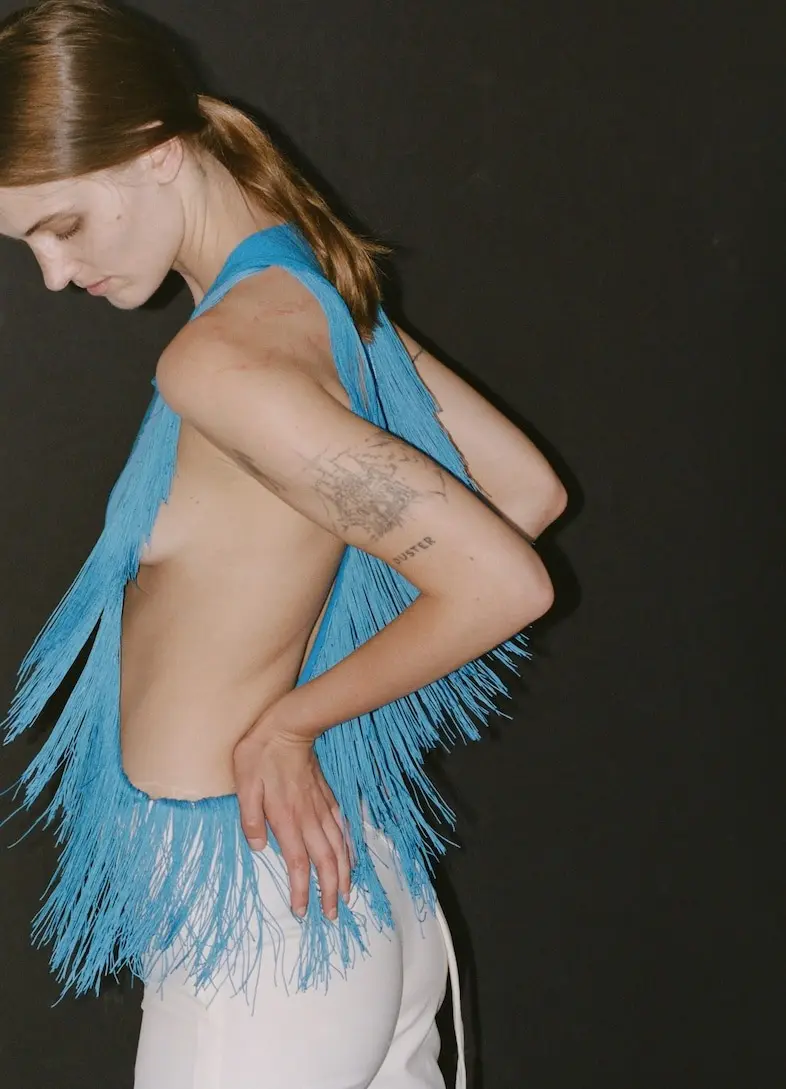
The resulting collection is a masterclass in tension. Utilitarian garments—layered tank tops criss-crossed with structural workwear straps, protective blouson jackets paired with heavy leather work gloves, and sheer separates featuring exaggerated, buttoned-to-the-top plackets—form the rigid structural skeleton of the collection.
However, these clinical, protective layers are deliberately compromised by the cascading addition of heavy fringe. In a purely functional context, fringe would be a structural nightmare for a working uniform. For Taubman, it serves a higher symbolic purpose.
"It felt like the perfect conduit for exploring emotional armour," Taubman explains.
Acting as the metaphorical "guts," the fringe spills out from beneath the familiar, buttoned-up silhouettes, creating an explicit visual and emotional fault line. The collection succeeds precisely by holding this uncomfortable tension: the friction between absolute, clinical control and the messy, chaotic reality of human vulnerability.
Official Statements & Personal Narrative: The Roots of Artemis
To understand the tenacity embedded within every seam of a Briah Artemis garment, one must trace Briah Taubman’s personal evolution from a withdrawn child to an uncompromising creative force.
A Taciturn Beginning
Growing up, Taubman found little comfort in spoken language. Describing herself as a quiet child, she sought refuge in the visual arts. Classically trained as a painter, she initially viewed canvas and oil as her primary mediums for emotional output. Yet, as she entered her teenage years, painting began to feel restrictive, failing to capture the dynamic, lived experience she craved.
"I was a quiet kid, and clothes always energised me creatively because of the ability to express myself tacitly," she notes.
Inspirational pillars shifted rapidly toward the deconstructive genius of Helmut Lang and the sculptural minimalism of Nicolas Ghesquière during his tenure at Balenciaga. Recognizing that fashion offered a three-dimensional canvas capable of movement, protection, and social signaling, Taubman pivoted decisively toward design. By the age of 14, she was spending her summers navigating the labyrinthine streets of New York City, crashing with her grandmother during the week and securing formative internships across the city’s premier fashion houses.
The Mythology of the Name
The brand’s moniker carries a profound familial and mythological weight. Artemis is not merely a stylistic flourish; it is Taubman’s middle name, chosen as a direct tribute to her great-grandfather Arthur, who passed away just before she was born.
Yet, the journey to embracing the name was not without its trials.
"Although I was bullied for the name in middle school, I came to learn more about who Artemis was, the Greek goddess of the hunt," Taubman shares. "Her name and story aligned with my own and served as a reminder of strength and tenacity."
This duality—the gentle, honoring remembrance of familial roots fused with the fierce, predatory independence of the mythological huntress—perfectly encapsulates the ethos of Briah Artemis. The clothes do not simply dress the body; they arm it for the modern hunt.
Future Outlook: Navigating the Independent Landscape
As Briah Artemis transitions from a viral sensation to an established fixture of the international fashion calendar, the challenges facing independent designers have never been more pronounced. Rising production costs, global supply chain volatility, and the relentless pressure of the digital algorithm demand an extraordinary level of resilience.
Yet, Taubman’s trajectory suggests that authenticity remains the ultimate currency. By maintaining absolute editorial control, resisting commercial dilution, and viewing clothing as a vehicle for cultural critique rather than mere commodity, Briah Artemis has carved out a distinct and defensible niche.
The success of the SS27 collection proves that the brand’s resonance extends far beyond a fleeting viral moment with a pop superstar. Whether she is weaponizing pageant sashes against institutional structures or translating industrial butcher uniforms into psychological armor, Briah Taubman is proving that independent design can be both deeply personal and globally disruptive.
For an industry constantly searching for its next true visionary, the hunt has only just begun. And if the tenacity of Artemis is any indication, Briah Taubman is poised to lead the pack for years to come.