Executive Overview
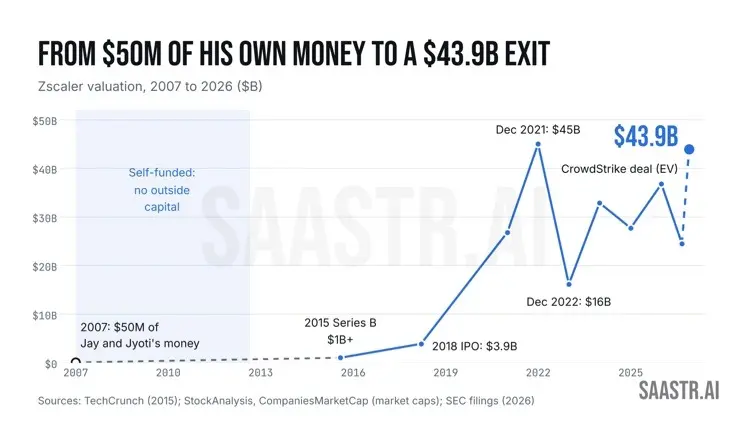
In what marks the largest cybersecurity acquisition in corporate history, CrowdStrike’s blockbuster deal to acquire Zscaler at an enterprise value of approximately $43.9 billion has sent shockwaves through the enterprise technology sector. Under the terms of the agreement, Zscaler shareholders will receive 1.135 shares of CrowdStrike for every share of Zscaler they own. While theheadline figure is staggering, the true anomaly of this transaction lies within the cap table.
For nearly two decades, the venture capital ecosystem has preached a standardized playbook: raise early, scale fast, dilute aggressively, and let institutional funds dictate the strategic timeline of a company. Jay Chaudhry, the visionary founder and CEO of Zscaler, tore up that playbook entirely.
Where a typical venture-backed founder walks away from a $40 billion-plus exit owning low single-digit equity, the Chaudhry family retains between a third and 40% of Zscaler’s staggering valuation—equating to well over $10 billion in value. This generational windfall was not a product of luck; it was engineered through a series of deliberate, contrarian decisions made during Zscaler’s foundational years.
This article investigates the strategic masterclass behind Zscaler’s rise, examining how self-funding, operational discipline, and unwavering autonomy allowed Chaudhry to reject multi-billion-dollar acquisition offers, maintain ironclad control, and ultimately command the negotiating table in the biggest cybersecurity buyout ever recorded.
Detailed Chronology: From Bootstrapped Vision to Historic Exit
To understand how Zscaler achieved its historic cap table structure, one must trace the timeline of its genesis and the strategic inflection points that separated it from the standard Silicon Valley trajectory.
Phase 1: Self-Reliance and the 2007–2012 Wilderness Years
Long before launching Zscaler in 2007, Jay Chaudhry and his wife, Jyoti, had already built a proven track record as serial entrepreneurs. Their previous venture, SecureIT, was acquired for roughly $70 million in stock. Rather than retiring or instantly courting institutional venture capital for their next venture, the Chaudhrys deployed approximately $50 million of their own capital to bootstrap Zscaler out of the gate.
This self-funding mechanism proved vital when external macroeconomic forces turned hostile. Zscaler entered the market right as the 2008 financial crisis decimated global enterprise spending. At the time, Amazon Web Services (AWS) was barely two years old, and Microsoft Azure was years away from commercial viability; the concept of enterprise cloud security was a radical, unproven frontier.
If Zscaler had been heavily reliant on traditional venture capital during those lean years, the company likely would not have survived. As Chaudhry later noted:
"If Zscaler was largely owned by VCs, they probably could have shut it down. It took us a few years to really start getting traction in the market, and VCs can write you off and move on."
By holding the purse strings, Chaudhry insulated his engineering and product teams from the panicked board meetings and forced pivots that killed countless other startups during the Great Recession.
Phase 2: Crossing the Chasm and the 2012 Inflection Point
By 2012, five years after its inception, Zscaler had systematically built a bulletproof product and achieved true product-market fit. Only then did Chaudhry open the door to outside capital.
Zscaler raised a $38 million funding round led by an undisclosed institutional investor, with participation from Lightspeed Venture Partners. Crucially, Zscaler was already cash-flow positive when this money hit the bank. The capital was not used for survival; it was deployed strictly as rocket fuel to accelerate global go-to-market strategies, expand sales pipelines, and scale marketing efforts. At that juncture, the company was already serving 2,500 enterprise customers, protecting roughly 8 million users across 160 countries.
By raising capital from a position of profound financial strength, Chaudhry commanded unmatched leverage. He secured preferential terms, pristine governance structures, and avoided the suffocating dilution that cripples early-stage founders.
Phase 3: The 2018 IPO and the Defiance of Cisco
Leading up to its initial public offering in 2018, Zscaler had raised a cumulative total of just over $148 million in outside capital—an astonishingly modest sum for a company of its global scale. Consequently, outside investors owned only about 16% of the company at the time of its public debut.
This pristine cap table preservation shielded Chaudhry from external pressure during pivotal moments of temptation. Prior to the 2018 IPO, technology titan Cisco approached Zscaler with an acquisition offer valued at approximately $2 billion.
For most founders—and certainly for institutional investors eager for an 8-year fund liquidity cycle—a $2 billion cash-out is an irresistible outcome. However, because Chaudhry and his family maintained absolute voting control, and because outside investors were a distinct minority on the cap table, Chaudhry was able to reject the offer outright. He envisioned Zscaler as an enduring, independent powerhouse. By holding the line, Chaudhry positioned the company to be acquired years later by CrowdStrike for more than twenty times that initial Cisco bid.
Phase 4: The CrowdStrike Merger and Strategic Realignment
Fast forward to the present day: the cybersecurity landscape has shifted toward platform consolidation. Facing a maturation curve where annual recurring revenue (ARR) growth was projected to moderate from the mid-20s into the high teens, Zscaler’s leadership recognized the compounding value of joining forces with an undisputed endpoint and cloud-security leader.
Under the definitive terms, CrowdStrike is acquiring Zscaler in an all-stock transaction. Following the close of the deal, legacy CrowdStrike shareholders will own roughly 84.1% of the combined entity, while Zscaler shareholders will hold the remainder. Jay Chaudhry will remain at the helm to run Zscaler as an integrated division, ensuring operational continuity for customers worldwide.
Supporting Context & Metrics
An analysis of Zscaler’s financial trajectory and the mechanics of the CrowdStrike merger reveals critical insights into why this transaction represents a watershed moment for enterprise software valuations.
Financial Health and Growth Metrics at the Crossroads
Zscaler’s decision to merge with CrowdStrike was underpinned by rock-solid financial performance, even as growth rates naturally normalized due to law-of-large-numbers effects:
- Fiscal Year Revenue: Zscaler reported fiscal year revenue of $3.35 billion, representing a robust 25% year-over-year growth rate.
- Annual Recurring Revenue (ARR): The company’s ARR scaled to an impressive $3.771 billion, cementing its status as an enterprise infrastructure titan.
- Forward Guidance Realities: Projected fiscal year revenue growth was slated to decelerate to a range of 16.6% to 17.5%. Joining CrowdStrike’s massive global distribution network bridges this growth gap.
- Synergy Projections: CrowdStrike leadership anticipates capturing approximately $1 billion in total revenue synergies within the first 30 months following the close of the transaction.
Market Reaction and Stock Mechanics
On the day of the announcement, CrowdStrike’s stock (CRWD) experienced a 9.6% pullback, contrasted against a 6.5% rise in the Nasdaq. Analysts attribute this temporary dip to standard arbitrage behavior and investor digestion of massive share dilution, alongside the integration complexities inherent in merging two multi-billion-dollar security ecosystems.
Nevertheless, the transaction creates an absolute juggernaut. By combining CrowdStrike’s industry-leading endpoint detection and response (EDR) capabilities with Zscaler’s pioneering Zero Trust cloud security architecture, the combined company commands an unassailable defensive moat across corporate networks, endpoints, and cloud workloads.
Official Statements & Industry Perspectives
The monumental nature of the deal has drawn commentary from across the technology sector, illuminating the strategic calculus behind the merger.
While corporate communications teams have emphasized the technological harmony of the union, industry insiders have focused intensely on the unique governance model championed by Jay Chaudhry.
Venture capital veterans and startup founders alike have pointed to Zscaler’s cap table as a masterclass in long-term value creation. In public breakdowns of the deal, commentators emphasized that the traditional Silicon Valley narrative—where founders are routinely diluted down to single digits by Series C or D—is a choice rather than an absolute law of nature.
By financing early product iterations independently, Chaudhry proved that capital efficiency is the ultimate weapon against external dilution. When asked about his philosophy on outside investment during Zscaler’s formative years, Chaudhry maintained a consistent stance:
"To date, we have resisted outside investment despite inquiries from top-tier investors. You raise capital to accelerate a validated go-to-market engine, not to discover what your business actually is."
This philosophy enabled Chaudhry to sit across the table from tech giants like Cisco and say "no" without fearing a shareholder revolt. It is a level of founder sovereignty that few executives ever attain.
Future Outlook: What the CrowdStrike-Zscaler Mega-Deal Means for Tech
The integration of Zscaler into CrowdStrike signals several profound shifts for the enterprise software and cybersecurity landscapes over the next decade.
1. The Era of the Security Super-Platform
Enterprise Chief Information Security Officers (CISOs) have long suffered from "tool fatigue," managing dozens of disparate point solutions across their IT stacks. The consolidation of CrowdStrike and Zscaler accelerates the industry-wide migration toward unified, cloud-native security platforms. Enterprises no longer want to stitch together disjointed zero-trust network access (ZTNA) and endpoint security agents; they demand holistic visibility from the user’s laptop to the cloud data lake. This mega-deal sets a high watermark that competitors will struggle to match.
2. A Shift in Founder Psychology
The unprecedented equity retention achieved by the Chaudhry family ($10B+ from a single exit) is already rewriting the playbook for early-stage tech founders. For years, the prevailing wisdom dictated hyper-growth at all costs, funded by continuous rounds of venture capital. Zscaler’s triumph provides a blueprint for bootstrapping through market uncertainty, proving that capital discipline and delayed institutional dilution can yield disproportionate generational wealth. Future founders are increasingly likely to question traditional venture timelines, opting instead to preserve equity until product-market fit is indisputably proven.
3. Regulatory and Antitrust Scrutiny
Given the combined market capitalization and dominance of the post-merger entity in cloud and endpoint security, regulatory bodies in the United States and the European Union will undoubtedly scrutinize the transaction closely. Antitrust analysis will focus on whether the fusion of CrowdStrike’s threat intelligence ecosystem with Zscaler’s secure web gateway infrastructure creates insurmountable barriers to entry for emerging cybersecurity startups. However, market observers remain cautiously optimistic that the deal will clear regulatory hurdles, given the rapidly evolving and increasingly sophisticated global threat landscape that demands enterprise-scale defense systems.
Summary: The Ultimate Founder Takeaway
Jay Chaudhry’s journey from self-funding a vision during a global economic crisis to orchestrating the largest cybersecurity acquisition in history offers a timeless lesson for entrepreneurs: Patience is a strategic asset. By building a product that the market desperately needed—and retaining the equity required to dictate their own terms—the Chaudhrys turned a 20-year entrepreneurial marathon into the defining tech transaction of the decade.