Date: November 25, 2026 Author: Saf Malik, Head of Content & Insights (Enriched and Expanded)
Executive Overview
As the global data centre industry races to keep pace with the insatiable computational demands of artificial intelligence, high-performance computing (HPC), and next-generation silicon architectures, a hidden operational inefficiency is silently draining power grids and driving up carbon emissions. According to Tuan Hoang, Head of Cooling Technology and Product Development at Schneider Electric, modern data centres are systematically overcooling their infrastructure.
The root cause? An accumulation of redundant safety margins stacked across every tier of the modern technology value chain. From silicon manufacturers and server original equipment manufacturers (OEMs) to colocation end-users and service-level agreement (SLA) arbiters, each stakeholder adds an extra layer of thermal buffer to mitigate personal liability and protect warranties. The cumulative effect of these compounding safety buffers severely restricts the implementation of energy-saving "free cooling" techniques, forcing facilities to consume vastly more electricity than their core hardware actually demands.
Simultaneously, Schneider Electric is aggressively scaling its European manufacturing footprint to meet the structural shift toward liquid cooling. Bolstered by its strategic $850 million acquisition of Motivair, the energy management and automation giant is ramping up production at its flagship Conselve facility in Italy. By doubling its coolant distribution unit (CDU) manufacturing capacity and expanding large-scale chiller production, Schneider is positioning itself at the epicentre of the liquid-cooling revolution—even as the industry grapples with community resistance, water consumption anxieties, and the imperative to optimize existing thermal footprints.
Detailed Chronology: The Anatomy of Cumulative Thermal Buffering
To understand how modern digital infrastructure arrived at this juncture of systemic overcooling, it is vital to trace the lifecycle of a thermal specification from the semiconductor fab to the data centre floor. Speaking to Capacity at Schneider Electric’s Conselve cooling research and manufacturing hub in Italy, Hoang detailed how well-intentioned risk aversion systematically erodes efficiency.
Phase 1: Silicon Specifications and the Fabrication Baseline
The process begins at the semiconductor level. Chipmakers—such as NVIDIA, AMD, and Intel—rigorously test their silicon architectures and officially specify that their processors can operate safely and reliably when supplied with cooling liquid at temperatures of up to 45°C. In theory, this relatively high threshold opens a massive window for energy-efficient heat rejection, allowing facilities to leverage outside air and ambient temperatures (free cooling) for a significant portion of the year.
Phase 2: Server OEM Interventions
However, the specifications rarely translate directly to the data centre floor. Server OEMs, tasked with guaranteeing system performance, stability, and hardware longevity across thousands of distinct enterprise deployments, rarely design right up to the semiconductor maker’s absolute ceiling. To protect their own hardware guarantees and minimize RMA (Return Merchandise Authorization) rates, OEMs routinely trim a few degrees off the target temperature, designing server chassis that demand colder fluid inputs.
Phase 3: The End-User and Enterprise Layer
Moving further down the chain, the enterprise customer or cloud service provider steps in. Driven by an innate fear of catastrophic hardware failure, unexpected downtime, or voided corporate warranties, these organizations frequently impose their own arbitrary thermal buffers. If the OEM suggests a safe operating limit, the end-user will often demand an even lower baseline "just to be safe."
Phase 4: SLA Penalties and Colocation Realities
Finally, the colocation data centre operator enters the equation. Bound by strict Service Level Agreements (SLAs) with heavy financial penalty clauses for thermal excursions or downtime, operators layer on yet another tier of conservatism.
"By the time the data centre actually operates, there may be three to five layers of buffer," Hoang explained. Every single layer forces the design set point lower, shrinking the thermodynamic delta required for free cooling. Because free cooling relies on high ambient rejection temperatures, dragging down the fluid temperature virtually eliminates the operational hours during which a facility can reject heat without mechanically chilling water—a process that incurs heavy energy penalties.
Supporting Context & Metrics: Manufacturing Expansion in Conselve
While optimizing thermal software and engineering mindset remains a long-term cultural challenge, the physical hardware transformation is happening at breakneck speed. Schneider Electric’s operational response to the liquid-cooling boom is anchored in its massive manufacturing expansion at the Conselve facility in Italy.
Scaling Up the Conselve Hub
The facility transformation is underscored by a series of aggressive production targets:
CDU Manufacturing Capacity: Effective January 2027, Schneider Electric will officially double its Coolant Distribution Unit (CDU) manufacturing output at the Conselve plant. This scaling directly follows the integration of Motivair’s North American engineering expertise and product portfolio following Schneider’s $850 million buyout.
Chiller Production Growth: Large chiller manufacturing capacity at the site—already Schneider’s premier cooling factory in Europe—is slated for a 50% increase by the end of 2026.
Next-Generation Testing Laboratory: Scheduled to open its doors in December 2027, a brand-new, state-of-the-art test laboratory will triple the facility’s validation capabilities. The lab will possess the infrastructure required to rigorously test and validate CDUs rated up to 5 megawatts (MW) and industrial chillers scaling up to 4 MW.
Despite the rapid pivot toward liquid cooling, Hoang noted that air cooling is far from obsolete. Traditional air-handling units and airflow architectures remain vital for cooling peripheral electrical infrastructure, power distribution units, and the non-silicon components housed within server racks. Consequently, new liquid-cooling production lines are strategically being woven into spaces previously dedicated exclusively to air-handling equipment.
Official Statements and Industry Perspectives: Debunking Cooling Myths
Beyond the mechanical metrics, industry leaders are confronting deep-seated misconceptions regarding how data centre cooling loops actually consume resources.
Demystifying "Closed Loop" versus Open Systems
A persistent debate in sustainable infrastructure circles centres on closed-loop versus open-loop liquid cooling designs. Hoang firmly pushed back against the narrative that closed-loop configurations are a niche or experimental choice.
"It’s all closed loop," Hoang asserted.
To illustrate his point, Hoang drew an analogy from the automotive industry. A traditional, air-cooled data centre is structurally comparable to a vintage Volkswagen Beetle, relying strictly on airflow across engine blocks. Modern liquid-cooled data facilities, by contrast, function precisely like a modern automobile: an internal fluid loop absorbs heat from the engine (or server chips) and routes it to a radiator, which ultimately rejects that thermal energy safely into the atmosphere.
Water consumption, Hoang clarified, is not an inherent byproduct of liquid cooling; rather, it is a localized operational choice. Operators only consume water when they deliberately switch on evaporative cooling systems—essentially the equivalent of spraying water over a car radiator to accelerate heat dissipation during extreme heatwaves.
"You could if you wanted to, but you don’t have to," he noted. Even massive facilities utilizing traditional cooling towers are operating closed internal loops; external water consumption only occurs when operators elect to leverage evaporation rather than investing in higher-capacity air-moving infrastructure.
The Social License to Operate
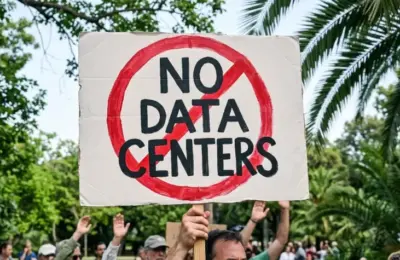
As hyperscale campuses and high-density AI clusters proliferate across suburban and rural landscapes, public scrutiny has evolved from passive observation to active resistance. Hoang emphasized that the general public is "no longer passive" regarding local utility consumption, grid strain, and water utilization.
He issued a call to action for transparent, unvarnished dialogues between data centre developers, municipal planners, and local communities. Because Schneider Electric acts as an infrastructure enabler rather than a direct facility operator or owner, the company focuses on publishing rigorous, peer-reviewed white papers detailing exact water and power consumption metrics to elevate the public discourse.
Future Outlook: Engineering for Today While Awaiting Tomorrow
Looking toward the horizon, the data centre sector is routinely captivated by speculative technologies—ranging from speculative quantum computing architectures to radical new chip designs. However, Hoang believes the industry’s most urgent financial and environmental gains lie not in waiting for future scientific breakthroughs, but in aggressively optimizing the infrastructure that already exists today.
By systematically addressing the three-to-five layers of redundant thermal safety margins, educating enterprise clients on actual silicon tolerances, and scaling regional manufacturing hubs like Conselve to cut shipping emissions and secure supply chains, the industry can unlock unprecedented efficiency gains.
The Path Forward:
Cultural and Risk Realignment: Industry stakeholders must collaborate to build transparency around thermal tolerances, slowly raising operating set points to safely re-engage free-cooling parameters.
Regionalized Supply Chains: Leveraging localized engineering and manufacturing hubs—such as integrating Motivair’s design methodologies into European plants—ensures business continuity and dramatically reduces transit-related carbon footprints.
Proactive Community Engagement: As highlighted ahead of upcoming industry gatherings like the Datacloud Global Congress in Cannes (June 2–4, 2027), securing the social "license to operate" will require absolute honesty regarding power and water utilization metrics.
Ultimately, solving the cooling crisis is not solely a matter of inventing colder fluids or denser heat exchangers. It requires the discipline to trust the engineering data, strip away unnecessary caution, and design data centres that operate as intelligently as the silicon humming inside them.