Executive Overview
In the modern digital ecosystem, websites are rarely built from scratch. Instead, they are cobbled together like modular LEGO sets, relying on a vast, interconnected web of third-party vendors, analytics tools
, advertising networks, and user-experience optimization scripts. This modern architectural dependence, while accelerating feature deployment, has created a sprawling attack surface.
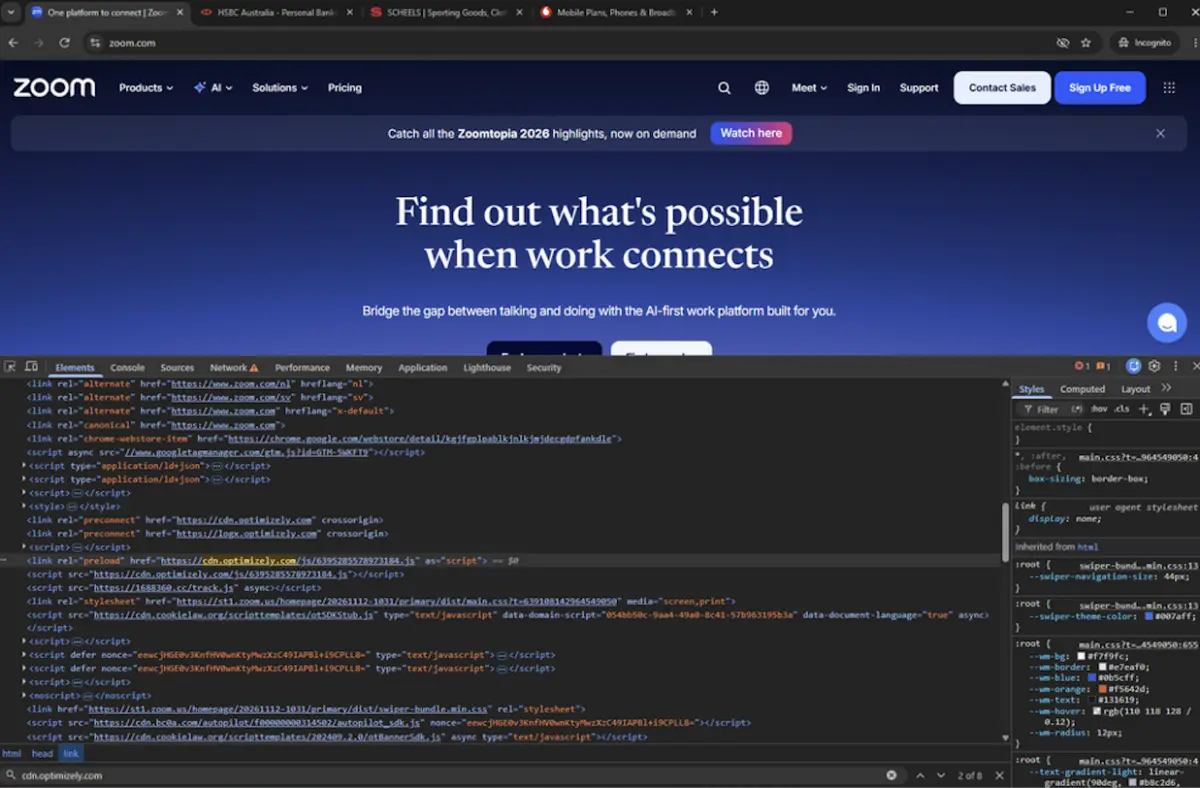
On November 16, 2026, the fragility of this reliance was exposed on a global scale. At least 178 top-tier web destinations—including household names like the BBC, CNN, Equifax, Ledger, and Zoom—inwittingly served sophisticated malware exploits to unsuspecting visitors over a 24-hour period. The root cause of this massive breach was not a failure in the internal infrastructure of these media outlets or financial giants, but a security vulnerability within Optimizely, a ubiquitous digital experience platform utilized by enterprises to customize user journeys and execute A/B testing.
Security researchers tracking the incident revealed that the malicious code was deliberately designed for silent, instantaneous execution. Because Optimizely’s JavaScript snippets are positioned near the top of target web pages to render critical testing features immediately, the malicious payload fired upon page load—requiring no user interaction, zero-click confirmation, or consent-banner acceptance.
The resulting supply chain attack underscores a terrifying reality of the contemporary web: trusted JavaScript does not always remain trustworthy, and a business can experience a catastrophic data breach without its own networks ever being directly compromised. This comprehensive post-mortem examines the anatomy of the Optimizely zero-day event, the mechanics of the deployed malware payloads, the widespread failure of Content Security Policies (CSPs), and what this watershed moment means for the future of web security.
Detailed Chronology: The 24-Hour Optimizely Compromise
The incident unfolded rapidly across a single day, catching enterprise security teams and third-party monitoring services off guard.
The Ingress Point: November 16, 2026
According to a detailed technical analysis published by the security firm Report URI, the breach began when an unauthorized threat actor successfully exploited a vulnerability within the Optimizely Experimentation platform. By breaching this vendor environment, the attackers were able to inject malicious JavaScript code directly into customer projects hosted and served through Optimizely’s content delivery infrastructure.
Rather than static malware, the threat actors deployed a dynamic, highly adaptable payload. Report URI researcher Scott Helme documented that the malicious JavaScript script was rebuilt and recompiled no less than 26 times over the course of the 24-hour window. This iterative refinement allowed the attackers to evade signature-based detection systems and optimize the malware’s efficiency as defensive alarms began to sound across the security community.
The Payload: Multi-Purpose Theft and Zero-Click Exploits
The injected JavaScript was engineered to act as a Swiss Army knife for cybercriminals. Once executed within a visitor’s browser, the multi-purpose malware kit was capable of:
- Harvesting sensitive financial records, including payment card data entered into e-commerce checkouts.
- Stealing session cookies and authentication tokens to facilitate account takeovers.
- Capturing screenshots of user activity.
- Executing automated clipboard-hijacking routines that covertly swapped cryptocurrency payment addresses with destinations controlled by the attackers.
Compounding the severity of the threat, the affected websites were weaponized to serve custom exploit code targeting known vulnerabilities in older Apple iPhone and iPad devices. Referred to in the security industry by names such as "DarkSword" and "Coruna," these zero-click exploit kits chain together up to a half-dozen distinct vulnerabilities. Their primary objective: to achieve complete, kernel-level control over outdated mobile devices and silently exfiltrate private data without the user ever interacting with a malicious link.
By the time Optimizely identified the breach and neutralized the vector, the malware had swept across 178 major organizational websites, impacting millions of anonymous web visitors worldwide.
Supporting Context & Metrics: The Architectural Flaw of the Modern Web
To understand how a compromise at a single marketing vendor could ripple through 178 of the world’s most heavily trafficked domains, one must examine the fundamental mechanics of contemporary web development.
The JavaScript Dependency Crisis
Modern web pages are heavy consumers of external code. According to the 2025 Web Almanac published by HTTP Archive, the median homepage loads at least 22 distinct JavaScript files. These scripts dictate everything from font rendering and analytics tracking to targeted advertising and user-experience experimentation.
Because scripts like Optimizely are built to measure user interactions instantly, they are embedded as close to the top of the HTML document (<head>) as possible. Zach Edwards, a researcher at Infoblox and co-founder of the ad-tracking service DecryptAds, highlighted why this architectural necessity maximizes risk:
"To make the product work as expected, this code is setup to fire immediately on-page load, and not restrict rendering behind a consent dialog box. This means that this supply chain attack didn’t require any clicking or consent to trigger — most of the impacted clients would immediately serve up the payload as soon as someone loaded the page."
When a vendor responsible for executing code before a consent banner even renders is compromised, the downstream impact is absolute. The visitor’s browser blindly trusts the third-party source, executing the injected code with the full privileges of the host domain.

The Failure of Content Security Policies (CSPs)
Web standards do provide a robust defense against these exact scenarios: Content Security Policies (CSPs). A well-configured CSP acts as a strict digital bouncer, defining precisely which domains are authorized to load scripts and fetch resources on a website.
However, the aftermath of the Optimizely attack revealed a startling industry-wide negligence regarding CSP deployment. According to data compiled by Report URI:
- 68 of the 178 affected websites had no CSP at all, leaving their users completely exposed to arbitrary script injection.
- 50 affected sites deployed a CSP, but configuration flaws were so severe that the policy still permitted the malware payload and data theft to execute.
- Only 24 sites (roughly 15 percent) possessed CSP configurations robust enough to fully block the malicious payload.
Broader web telemetry reinforces this bleak picture. Data from crawler.ninja, a daily scanning tool operated by Scott Helme that analyzes the top one million websites globally, indicates that comprehensive CSP adoption across the web’s busiest properties sits at a dismal 10 percent.
Many organizations avoid deploying strict CSPs for fear of breaking complex marketing integrations, third-party widgets, or tracking tools. As a result, the web remains caught in what Helme describes as the "Wild West" era of digital development—an environment where organizations execute millions of lines of foreign code daily without auditing their true behavior.
Official Statements & Industry Response
As forensic investigations continued, both the affected vendors and independent security analysts weighed in on the cascading failures that enabled the attack.
Optimizely’s Remediation Efforts
In a formal statement released following the containment of the incident, Optimizely acknowledged the gravity of the breach and outlined the aggressive remediation steps taken by its engineering teams:
"On November 16, 2026, Optimizely identified a security incident in which an unauthorized party exploited a vulnerability in the Optimizely Experimentation to add malicious JavaScript to some customer projects. We acted swiftly to contain the incident and have fully remediated the identified vulnerability."
The company confirmed that its containment protocol included:
- Immediately blocking access to the vulnerable code path.
- Deploying a permanent software fix to its experimentation infrastructure.
- Purging all injected malicious code from affected customer projects.
- Terminating active user sessions, revoking API tokens, and forcing credential resets for compromised accounts.
- Implementing additional threat-mitigation layers in partnership with Cloudflare to block anomalous code delivery.
On November 18, 2026, Optimizely published a comprehensive incident report (PDF) detailing the initial findings of its internal post-mortem, working alongside third-party forensic specialists.
The Economics and Mechanics of the Attack
Despite the massive scale—touching media outlets, financial institutions, and communication giants—financial forensics suggest the primary attackers reaped relatively modest direct monetary rewards during this specific deployment. Report URI estimates that the threat actors managed to siphon roughly $7,500 worth of virtual currency via cryptocurrency address-swapping, alongside an undetermined volume of harvested payment card records and identity data.
However, security analysts warn that judging such attacks solely by immediate financial yield misses the point. Supply chain compromises of this magnitude serve as high-yield intelligence-gathering operations, vacuuming up massive datasets of enterprise session cookies, authentication tokens, and zero-click mobile exploits that can be monetized later or leveraged in secondary targeted intrusions.
Future Outlook: Reinforcing the Fragile Supply Chain
The Optimizely zero-day incident serves as a critical inflection point for enterprise cybersecurity, forcing a hard look at how organizations manage third-party software dependencies.
The Rise of AI-Driven Threat Actors
In an interview with KrebsOnSecurity, Scott Helme emphasized that the barriers to executing sophisticated supply chain attacks are collapsing, largely due to advancements in artificial intelligence:
"Organizations are running all this code, but they don’t know what it’s doing. This is why we keep seeing such large-scale breaches in places where there are no checks and rules in place on the code we’re running, so this was kind of inevitable. Once an attacker gets to the point of running code on your site, the question is what do they want to do with that and can they write the script to do it. Now with AI, that’s not a problem anymore."
Defensive Strategies for the Future
To prevent future occurrences from cascading into industry-wide crises, security experts recommend a multi-layered remediation framework:
- Mandatory CSP Adoption: Enterprises must prioritize the deployment and rigorous maintenance of Content Security Policies. While initial configuration can be complex, failing to lock down script execution sources leaves organizations legally and reputationally exposed to upstream vendor breaches.
- Vendor Risk Management (VRM): Third-party platforms must be subjected to continuous runtime monitoring, subresource integrity (SRI) checks where applicable, and rigorous third-party security audits.
- End-User Defense Evolution: For everyday web users, relying solely on traditional security software is no longer sufficient. Ten years ago, standard advice centered on installing antivirus programs and enabling firewalls. In the modern web landscape, ad-blocking and script-blocking software effectively function as the new browser firewall, stripping away malicious third-party trackers and unauthorized scripts before execution can occur.
Ultimately, the Optimizely incident demonstrates that trust in the digital supply chain is a quantified risk, not a guarantee. Until organizations take structural ownership over every line of code executing within their users’ browsers, the next supply chain disaster is not a matter of if, but when.