Executive Overview
The modern landscape of indie game development is characterized by unprecedented accessibility. Armed with modern web technologies, JavaScript frameworks, and an increasingly sophisticated ecosystem of generative AI coding assistants, solo developers can conceptualize, build, and ship fully interactive experiences faster than ever before. However, while technical hurdles—such as state management, responsive UI design, and backend latency—have seen their friction significantly reduced, the human and structural challenges of scaling a project globally remain as stubborn as they were decades ago.
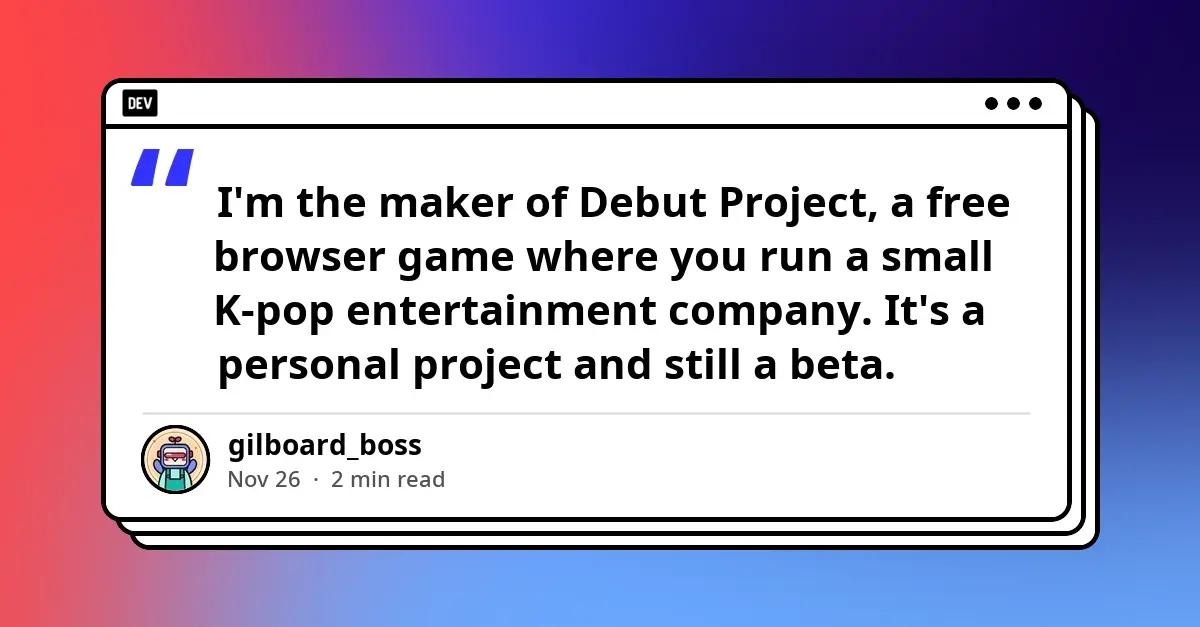
Localization (l10n) and internationalization (i18n) are classic examples of seemingly straightforward engineering tasks that rapidly metastasize into complex operational overhead. For developers operating on razor-thin margins of time and energy—such as gilboard_boss, the creator of Debut Project, a free-to-play browser game simulating the high-stakes world of managing a K-pop entertainment company—multilingual support is often treated as a checklist feature. Implemented across Korean, English, and Spanish during its beta phase, the game’s UI was designed to bridge cultural divides and capture an international audience of music fans.
Yet, a routine community post on the popular Reddit forum r/kpoppers exposed a stark reality: code does not care about missing dictionaries. When a dedicated player returned not with superficial praise, but with a precise, curated list of untranslated UI strings leaking native Korean text into the English interface, it served as a masterclass in the invisible failure modes of software internationalization.
This article explores the anatomy of that localization breakdown, examining the technical debt inherent in indie development, the hidden pitfalls of falling back to default languages, the limitations of modern AI-assisted workflows, and the broader industry practices required to build truly global-ready web applications.
Detailed Chronology: From Beta Launch to the Reddit Reality Check
Genesis of the Debut Project
The journey of Debut Project began as a passion project born from a convergence of web development and a fascination with the global K-pop phenomenon. Designed as a browser-based simulation game, it puts players in the shoes of an entertainment agency executive tasked with scouting talent, training trainees, managing schedules, and launching successful idol groups.
Recognizing that the target demographic for K-pop content is inherently international, the developer made an early architectural decision to incorporate multi-language support. From its inception, the game was framed to support Korean (its native developmental language), English, and Spanish. To accelerate development, the creator leaned heavily on modern AI coding tools, utilizing them to scaffold UI components, manage state transitions, and generate boilerplate code.
The Beta Release and the r/kpoppers Catalyst
As the beta matured, the developer sought out organic communities where the game’s niche subject matter would find an enthusiastic audience. Reddit’s r/kpoppers community—a vibrant hub for fans of Korean pop music discussion—stood out as an ideal testing ground.
Posting the game to the subreddit generated immediate traffic, bringing a wave of curious users eager to try a management sim themed around their favorite musical genre. Among these early adopters was a player who took the experience beyond a casual playthrough. Rather than merely closing the tab upon encountering a UI glitch or dropping a generic comment, this user meticulously documented instances where the illusion of a fully translated English interface broke down, presenting the developer with a targeted bug list.
The Nature of the "Non-Bugs"
Crucially, none of the reported issues were traditional software bugs. The game’s execution loop remained unbroken; state variables updated correctly, the JavaScript engine threw no exceptions, and the rendering pipeline functioned as intended.
Instead, the failure occurred entirely at the data layer. Specific UI elements, status notifications, and pop-up descriptions lacked corresponding entries within the English and Spanish localization JSON or dictionary files. Because the application logic was robustly designed with a fallback mechanism, whenever the localization engine failed to locate a requested key in the target language dictionary, it gracefully defaulted to the fallback string: the original Korean text.
To the end user, this manifested as a jarring linguistic patchwork—fluent English menus suddenly interrupted by untranslated Korean Hangul characters in critical gameplay screens. To the developer, it was a glaring revelation about the silent gaps in manual asset management.
Supporting Context & Metrics: The Mechanics of Modern Web i18n
To understand why a solo developer fell into this trap, one must examine the engineering paradigms governing modern browser games and the unique pressures facing indie creators.
The Anatomy of Localization Fallbacks
In traditional software and web development, internationalization relies on key-value pairs. A typical implementation might look like this:
// en.json

  "dashboard.title": "Agency Dashboard",
  "trainee.status.training": "Currently in Training"
When a game scales from a handful of prototype screens to a complex simulation with hundreds of UI states, the number of keys expands exponentially. Every new button, tooltip, modal dialog, and error message introduces a new localization dependency.
When a developer adds a feature under the pressure of rapid prototyping, the creation of the primary UI code often outpaces the creation of translation keys. In an ideal pipeline, static analysis tools or CI/CD linters flag missing keys before code is ever merged to production. However, in a solo indie project built iteratively using AI assistants, these rigorous pipelines are frequently bypassed in favor of speed.
The AI-Assisted Development Paradox
The integration of generative AI into coding workflows has fundamentally transformed solo development. Tools capable of writing complex JavaScript logic, structuring CSS, and scaffolding React or vanilla DOM components allow creators to build fully featured applications in a fraction of the historical timeline.
However, AI models operate on probabilistic text generation and context windows. When an AI tool assists in writing a UI component featuring hardcoded user-facing strings (e.g., element.innerText = "연습생 육성"), it rarely enforces internationalization best practices unless explicitly prompted. If a developer later extracts these strings into a localization function, the AI might generate the primary language key but fail to systematically populate the parallel arrays or files for secondary and tertiary languages.

Thus, AI accelerates the creation of code, which in turn accelerates the accumulation of technical debt regarding localized assets.
The Demographics and Reach of Browser Gaming
Browser games occupy a unique space in the modern gaming ecosystem. Requiring zero installation, no high-end hardware, and no friction of account creation or app store downloads, they boast an exceptionally low barrier to entry. This makes them inherently global.
As analytics from indie browser releases consistently demonstrate, traffic arrives from dozens of countries simultaneously. For a niche genre like a K-pop management sim, the player base is geographically dispersed across North America, Latin America, Europe, and Southeast Asia. Consequently, localization is not a "nice-to-have" polish phase; it is a foundational pillar of usability. When localization fails, a significant percentage of the user base encounters friction that can lead directly to churn.
Industry Perspectives & Expert Analysis
The incident experienced by Debut Project is far from isolated. Across the software and video game industries, localization leakage remains a persistent challenge, even for AAA studios with dedicated localization QA (LQA) teams.
The Cost of Silent Failures
Software engineers often categorize bugs by severity: blockers, critical, major, and minor. An untranslated string that defaults to a source language rarely triggers a crash, placing it low on the priority hierarchy of automated error tracking tools like Sentry or LogRocket. Yet, from a UX perspective, localization fallback is a trust-breaking event.
Industry veterans note that localized string leakage shatters player immersion instantly. In a narrative or management simulation game, where atmosphere and UI clarity dictate engagement, encountering foreign text breaks the suspension of disbelief.
Strategies for Robust Internationalization
Following the community wake-up call, the developer pondered a fundamental question shared by many shipped-game creators: How do professional teams catch untranslated strings before their users do?
Industry standards point toward three primary methodologies:
-
Automated Diff Scripts and CI Pipelines:
Mature projects implement custom build scripts that parse the source code for UI strings or compare key sets across all language JSON files. Ifen.jsoncontains keys missing fromes.jsonorko.json, the build pipeline fails or emits a warning. This shifts the detection phase left, catching gaps before deployment. -
Pseudo-Localization (Pseudo-loc):
A standard enterprise practice involves generating a "pseudo-locale" file during development. In a pseudo-locale, all English strings are automatically transformed (e.g., wrapped in brackets, accented, or expanded by 30% to test layout stretching). If a developer runs the game in the pseudo-locale and sees normal text, they instantly spot hardcoded strings or missing translation keys because they won’t carry the pseudo-locale modifications. -
Exhaustive Exploratory Testing (The Human Element):
While automation catches missing keys, only human playtesting can catch context failures—where a string is technically translated, but its meaning is nonsensical within the specific UI layout or gameplay moment.
Future Outlook: Iteration, Community, and the Evolution of Debut Project
As Debut Project continues its beta phase, the lessons learned from a single Reddit user’s bug list have catalyzed a deeper appreciation for the symbiotic relationship between indie developers and their communities.
Immediate Next Steps and Philosophy
The developer has chosen a transparent, pragmatic approach regarding the reported strings. Rather than issuing rushed patches or fabricating rigid roadmaps, the focus remains on internalizing the structural lesson: localization must be treated as an ongoing architectural requirement rather than a post-hoc translation exercise.
The community response also highlights the power of constructive engagement. In an online environment frequently saturated with toxic feedback or superficial critiques, receiving a precise, well-documented list of edge cases stands out as a high-value contribution that directly improves the software.
The Broader Horizon for AI and Web Gaming
Looking forward, the intersection of browser-based gaming and AI-assisted development will continue to evolve. As generative tools become more deeply integrated into integrated development environments (IDEs), future iterations of AI coding assistants will likely feature native internationalization linters—automatically flagging hardcoded text and generating multi-language keys in real-time as developers write UI logic.
Until then, indie developers navigating the complex waters of global deployment must rely on a blend of community collaboration, disciplined asset management, and rigorous verification. For Debut Project, the journey from a localized beta to a polished global release underscores a timeless truth of software engineering: no matter how sophisticated your tools are, the most valuable diagnostic instrument remains a pair of human eyes willing to look closely at your work and care enough to help you fix it.
For those interested in experiencing the simulation firsthand, Debut Project remains accessible as a free, no-sign-up browser experience supporting Korean, English, and Spanish at debut-project.com.