Executive Overview
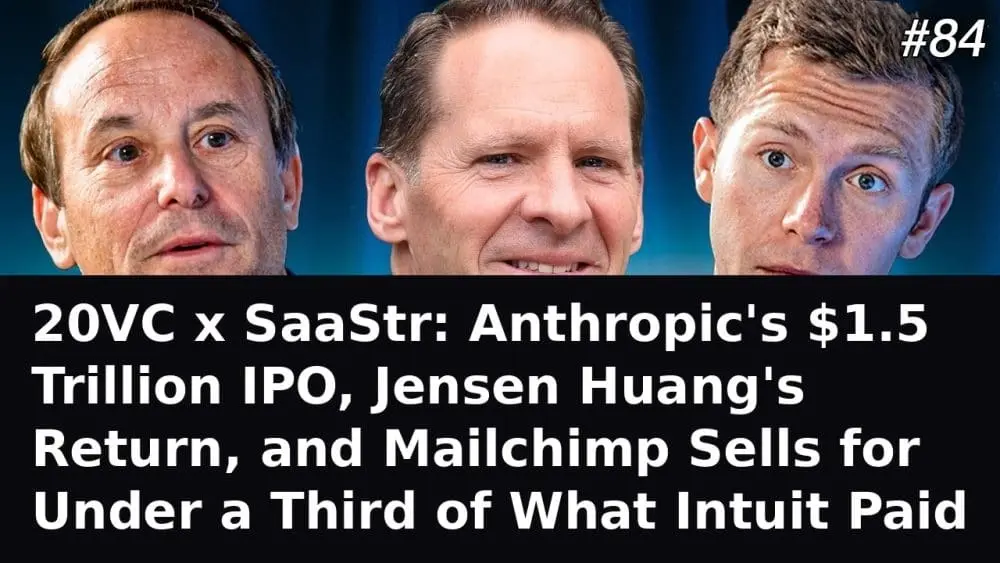
The global technology landscape is undergoing a violent structural transformation, marked by unprecedented market valuations, frantic corporate consolidation, and an existential crisis for legacy software categories. In a packed week of developments analyzed by Menlo Ventures partner Matt Murphy—stepping in for Rory O’Driscoll—alongside host Harry Stebbings and SaaS veteran Jason Lemkin, the tech sector saw historical extremes.
From Nvidia reinstating Jensen Huang mere days after a scandalous departure, to Anthropic’s breathtaking public market debut valuing the AI pioneer at over a trillion dollars, the markers of a new technological era are being violently rewritten. Simultaneously, legacy B2B mainstays are experiencing steep valuation corrections, as evidenced by Intuit’s fire-sale of Mailchimp to Bending Spoons at a fraction of its 2021 peak.
As cyber threats multiply into thousand-agent swarms and horizontal AI agents dismantle the traditional software stack, venture capital and enterprise buyers are desperately realigning their strategies. This report breaks down the critical takeaways from a defining week in global technology and finance.
Detailed Chronology & Deep-Dive Analysis
1. The Nvidia Reinstatement: Jensen Huang’s Swift Return
In one of the most volatile corporate dramas of the decade, Nvidia board members reinstated Jensen Huang as President, CEO, and board director on November 23—less than two weeks after he abruptly stepped down. Huang’s initial resignation followed explosive reports of extramarital affairs, including allegations involving a suspected Chinese spy, which triggered fierce scrutiny regarding the export of advanced AI chips to China.
- The Market Reaction: Following the announcement, Nvidia’s stock surged, adding roughly a trillion dollars in market capitalization. Commentators across financial media, including the Financial Times, labeled the move "the triumph of money over morals."
- Matt Murphy’s Read: Menlo Ventures’ Matt Murphy argued that the board acted with undue haste, driven by fear of regulatory overreach. Directors with whom Huang had built decades-long relationships should have held the line longer to weather the storm.
- Jason Lemkin’s Read: Offering a contrarian view, Lemkin noted that index-fund-heavy retail investors ultimately absorbed the outcome. Comparing the incident to Steve Jobs’ historical options-backdating saga, Lemkin suggested that the swift ouster and return had a "cleansing effect," sparing the company protracted congressional hearings. However, he warns that Huang will likely pivot heavily toward product execution, dialing back startup investments and high-profile international narratives—a marginal negative for early-stage tech venture capital.
2. Anthropic’s Blockbuster IPO
Anthropic officially priced its initial public offering at $83 per share—well above the initial $70 to $78 range—before opening at $111.50. On a fully diluted basis, including options and employee reserves, the company’s valuation touched an astonishing $1.5 trillion, placing it in an elite tier of global enterprises.
- The Market Impact: Matt Murphy, who tracked Anthropic’s meteoric ascent from an early investor’s seat, compared the trajectory to Google. While Google took 15 years to scale from $10 billion to $100 billion, Anthropic has compressed that timeline into a fraction of the duration.
- Ecosystem Breadth: Unlike previous technological waves dominated by one or two winners, Murphy emphasized that the current generative AI wave features dozens of viable contenders, establishing a broad foundation for public market liquidity.
3. The Great Valuation Reset: Mailchimp, BILL, and 2021 B2B Realities
While AI darlings command trillion-dollar valuations, the chickens have come home to roost for software assets acquired during the hyper-inflated market of 2021.
- The Mailchimp Fire Sale: Intuit agreed to offload Mailchimp to Bending Spoons for $3.68 billion—less than one-third of the $12 billion Intuit paid just years prior. With Mailchimp’s revenue declining 1% to $313 million in its final reported quarter, the sale highlights the brutal reality facing non-core software assets.
- Private Equity Consolidation: Concurrently, BILL agreed to be taken private by TPG and Corpay in an all-cash deal valuing the firm at $6 billion, while Zscaler was absorbed by CrowdStrike in a massive $43.9 billion merger.
- The Death of Marketing Automation: Jason Lemkin delivered a stark verdict on legacy marketing software: "It is anachronistic to have humans send emails." With modern AI agents, Resend, and rapid prototyping tools replacing traditional point solutions, legacy marketing automation has effectively become a dead category.
4. Cyber Week Brutality and the Failure of Static Security
A relentless wave of high-profile cyber incidents—including compromises on OpenRouter platforms, a high-profile security breach within JPMorgan Chase’s private wealth division, and subsequent regulatory crackdowns—underscored the vulnerabilities of modern software supply chains.
- The Rise of "Vibe Agents": Lemkin predicted that 2027 will witness the mass extinction of traditional B2B SaaS apps built on lax security architectures. Cheaply acquired SOC 2 certifications are proving utterly inadequate against autonomous, multi-agent cyber swarms.
- Zero Data Retention: The market is rapidly shifting away from platforms relying on opaque trust badges. True zero-data-retention guarantees must be operationally validated, severely penalizing open-weight models with unclear data provenance.
Supporting Context & Key Financial Metrics
| Company / Asset | Event | Valuation / Deal Size | Key Financial Metric / Context |
|---|---|---|---|
| Anthropic | IPO Debut | $1.08T – $1.5T (Fully Diluted) | Priced at $83, opened at $111.50 (980M shares). |
| Cognition | Late-Stage Funding | $75 Billion Valuation | Raising ~$2B, expanding from coding into full SDLC agents. |
| Sierra | Funding Talks | ~$30 Billion Valuation | Annualized revenue surpassing $400 million. |
| Ramp | Funding Talks | >$70 Billion Valuation | Continues to scale a dominant B2B financial platform. |
| Databricks | Market Evaluation | ~$190B – $225B | Run-rate revenue exceeding $7B with 80%+ growth. |
| Mailchimp | Acquisition | $3.68 Billion | Sold by Intuit to Bending Spoons (down from $12B in 2021). |
| CrowdStrike / Zscaler | M&A Deal | $43.9 Billion | Consolidating endpoint, network, and application security. |
Official Statements and Industry Insights
The discourse among high-profile venture capitalists highlights a fundamental divergence in how institutional investors view the trajectory of artificial intelligence and enterprise software:
"In a way, it is better this happened than that he did not step down, because there is a cleansing effect. If he had stayed at Nvidia while all these congressional hearings happened…"
— Harry Stebbings, reflecting on the geopolitical and governance fallout of Jensen Huang’s brief exit."What is going to happen in 2027 is SMB agents are going to do everything. Another reason vibe coding is dying is because vibe agents have just begun. Instead of trying to vibe code your app… you just tell Muse what you want."
— Harry Stebbings, on the shift from manual prototyping to autonomous horizontal agent execution."The biggest sign of a bubble of all is when we’re comfortable investing in the number six player."
— Jason Lemkin, sounding a note of caution regarding inflated late-stage valuations for secondary and tertiary AI market participants.
Future Outlook: The Next Phase of Enterprise Technology
As the industry looks toward the remainder of the decade, several macro trends are crystallizing:
- The Dominance of Horizontal Agents: Traditional horizontal application software is giving way to autonomous horizontal agents capable of executing complex, multi-step business workflows across CRM, finance, and operations without human intervention.
- Consolidation of Enterprise Security: The Fortune 5000 is increasingly intolerant of fragmented point solutions. Mega-mergers like CrowdStrike’s acquisition of Zscaler signal an era where unified, platform-level security ecosystems become mandatory.
- The Human-AI Bionic Breakthrough: As demonstrated by Claude’s assistance in tackling complex mathematical challenges like the Riemann Hypothesis, the true force multiplier of the coming years will not be standalone AI models replacing humans, but elite human operators augmented by frontier computational models.
- The Reckoning for 2021-Vintage Software: Private equity and strategic acquirers will continue to pick apart slow-growing SaaS companies. Founders and investors holding assets predicated on outdated ARR multiples must adapt to a market that prioritizes hyper-efficient, agent-driven utility over traditional seat-based licensing models.