In the contemporary landscape of underground electronic music, few acts have bridged the gap between raw, nostalgic pastiche and forward-thinking club infrastructure quite as seamlessly as The Twins. Comprising British-Pakistani brothers Omar and Jamal, the 21-year-old musical partnership has quietly evolved from a bedroom-producer project into an international touring phenomenon. Balancing higher education with relentless sonic exploration, the duo spent their formative late-teens years compartmentalizing academic rigor—Jamal studying computer science and Omar focusing on economics—while conceptualizing a sonic universe that honors their South Asian heritage alongside the chaotic, hyper-caffeinated golden age of 2010s electronic dance music (EDM).
Now firmly out of university and riding the momentum of their critically acclaimed debut album TURMERIC and the subsequent club-focused EP There&Back, the brothers find themselves caught in a whirlwind of international travel. From playing sweaty, subterranean London venues they once forged fake IDs to enter, to commanding festival-sized superclubs in Barcelona and embarking on expansive Asian tour runs, The Twins are no longer just underground hopefuls. They are the architects of a burgeoning cultural movement.
Central to their meteoric rise is Asian Paper, a radical club night and creative collective spearheaded by the duo alongside Amil Raja, Arran Ashan, and Jeremiah Jim. Designed as a platform for British-Asian trailblazers, the collective has unexpectedly transformed into one of the most culturally vital parties in London. It has even drawn the attention and attendance of industry heavyweights like Skrillex, marking a surreal full-circle moment for a pair of producers who spent their adolescence mimicking those very sounds in their Hampshire bedrooms.
As they finalize their deeply anticipated sophomore record—a project promising to lean away from abstract club tracks and into vulnerable, indie-infused storytelling—The Twins are positioning themselves as the definitive chroniclers of a new generation’s digital and physical alienation. This comprehensive profile investigates their trajectory, examining the cultural collisions that shaped their distinctive "Bollywood electronic" blueprint, the socio-political realities of their upbringing, and their strategic roadmap for global dominance.
Detailed Chronology: From Hampshire Skate Parks to Global Superclubs
The Hampshire Foundation (Pre-2024)
Long before their names were plastered across international club line-ups, Omar and Jamal were quintessential products of a specific kind of British suburban youth culture. Growing up in Aldershot, Hampshire, the brothers were, by their own retrospective definitions, "low-key hipsters." Their daily routine involved rolling up their trouser hems, reading dog-eared comic books, and spending long, unproductive afternoons hanging around the skate parks in nearby Hook with tight-knit circles of friends.
Yet, beneath the sleepy surface of Hampshire life lay a frantic digital education. Immersed in the golden era of YouTube EDM tutorials and early-2010s blog-house explosions, the brothers consumed music voraciously. They traded tracks back and forth like currency, obsessing over the structural chaos of Skrillex, the cinematic scope of Porter Robinson, the meticulously engineered soundscapes of deadmau5, and Virtual Riot’s heavy bass design.
A formative milestone arrived when Jamal unearthed an iPod belonging to their father, loading up MGMT’s generational anthem "Kids." The vibrant, world-building aesthetic of the band’s debut LP, Oracular Spectacular, permanently imprinted upon them. It planted the seed for a philosophy that music should never merely be heard; it should construct a living, breathing alternate reality. Other touchstones quickly followed: Jai Paul’s elusive, paradigm-shifting leaked MySpace demos, the frantic post-punk-meets-electronic assault of Test Icicles, and the abrasive, SOPHIE-produced genius of Vince Staples’ Big Fish Theory.
While Jamal gravitated toward production—initially cutting his teeth beating out tracks for local rappers—Omar developed a parallel rhythm-driven vocabulary behind the drum kit. For years, as the realities of university life pulled them geographically apart, music-making became a fractured exercise. They squeezed collaborative sessions into narrow windows of shared time, passing project files back and forth across university networks.
The Breakout and TURMERIC (2024–2025)
By 2024, the informal experimentation solidified into a unified artistic front under the moniker The Twins. Operating with a relentless work ethic, they began carving out a niche that felt entirely distinct from the saturated London club underground.
The culmination of this era arrived in August 2025 with the release of their 12-track debut album, TURMERIC. The project introduced a genre-defying sonic blueprint that the brothers wryly dubbed "Bollywood electronic." TURMERIC functioned as a high-speed collision of worlds: traditional South Asian instrumentation—including weeping sitars, hypnotic dhol drums, and instantly recognizable vocal samples pulled from classic Bollywood cinema—was violently filtered through blown-out, distorted sub-bass and shrill, glitching digital synths.
The album’s breakout single, "FUCKERSBY," featuring avant-pop artist fakemink, became an instant fixture in underground club sets across Europe. It proved that abrasive sound design and rich cultural heritage were not mutually exclusive, but rather deeply complementary forces.
Building on the momentum of TURMERIC, the brothers quickly pivoted to expand their sonic parameters. In May of the following year, they dropped There&Back, a high-octane EP that straddled the razor-thin line between euphoric electroclash and crushing, industrial club music. Featuring high-profile collaborations with RADA and Drain Gang affiliate Varg²™—an artist known for his frosty, dystopian electronic soundscapes—the EP cemented The Twins’ reputation as restless chameleons incapable of being pigeonholed into a single scene.
The Full-Circle Metamorphosis (Mid-2025–Present)
The dividing line between their past aspirations and their present reality crystallized in May, just hours before their headline show at London’s Colour Factory. Sitting in the venue’s backstage area while threading pink plastic pendants onto handmade merchandise necklaces, the brothers reflected on the venue’s profound personal significance.
Years earlier, as underage 15-year-olds desperate to absorb London’s burgeoning electronic music culture, the venue was forbidden territory. To gain entry, Omar had manually crafted fraudulent IDs—a rite of passage that served as their sole gateway into the capital’s nightlife. Standing on that same stage as headliners years later, surrounded by boxes of custom merchandise and international flight itineraries, the symmetry was impossible to ignore.
Today, their schedule dictates a frantic rhythm of movement. Crashing on friends’ couches in London between intensive studio blocks, the brothers spend their days reviewing audio stems in transit, moving effortlessly from Asian festival stages to European superclubs.
Supporting Context & Metrics: Cultural Impact and Collective Power
The Anatomy of the Sound
The production methodology of The Twins relies heavily on world-building. Eschewing the impulsive, on-the-fly beat-making common in modern trap and hyperpop production, the brothers approach songcraft through exhaustive cinematic preparation.
According to Jamal, their best material is forged during isolated, two-person studio locks that follow weeks of intense media consumption. Before laying down a single MIDI note, the duo spend days watching arthouse and mainstream cinema, listening to esoteric albums, and curating sprawling visual mood boards.
"Usually, whenever we make music, we have this entire world in our head," Jamal explains. “We make the best music when it’s just me and him.”
This meticulous approach yields an auditory landscape defined by sensory overload. By marrying the structural sheen of 2010s progressive house with the tactile crunch of underground club music and the rich, nostalgic cadence of their Pakistani heritage, they have tapped into a generational hunger for music that honors identity without falling into the trap of tired cultural tokenism.
Asian Paper: Redefining the Capital’s Nightlife
Beyond their output as recording artists, The Twins have emerged as vital cultural organizers. Alongside peers Amil Raja, Arran Ashan, and Jeremiah Jim, they founded Asian Paper, a radical club collective and party series designed to platform South Asian and broader Asian creative trailblazers within the UK music ecosystem.
What began as an informal gathering of like-minded artists has rapidly metastasized into one of London’s most sought-after tickets. Following a successful run of four packed-out shows across Asia earlier in the year, Asian Paper events in London have begun drawing capacity crowds that spill out onto the streets.
"Asian Paper’s accidentally become the best party in London," Jamal notes with a laugh, reflecting on the community’s explosive growth.
This momentum reached a surreal fever pitch during a recent London event, which featured a surprise, unannounced performance from electronic music royalty: Skrillex. For the brothers, sharing a bill—and subsequently having a private heart-to-heart—with the very producer whose records they dissected in their bedrooms a decade prior underscored the validity of their movement.
“Me and him had a heart-to-heart at our show,” Jamal shares, recounting how he confessed to the producer that he used to frantically pace his childhood bedroom to his tracks. “He’s such a great role model for me and for all of our peoples because he’s maintained his swag and his peace of mind. He’s a really nice guy.”
Official Statements & Direct Perspectives
Navigating Dual Realities: Identity and Small-Town Alienation
Despite their rapid ascent into cosmopolitan club culture, The Twins remain deeply anchored by the psychological complexities of their upbringing in Aldershot. While urban centers like London provide the infrastructure for their art, the inspiration for their more introspective work frequently traces back to the bittersweet realities of returning to their hometown to visit childhood friends.
The relationship with their roots is uniquely fraught. On one hand, isolation within a sleepy Hampshire town forged their bond and provided the quietude necessary to dream up expansive sonic worlds. On the other hand, the socio-political climate of provincial Britain presents acute challenges.
"There’s so much racist shit going on in our hometown right now," Jamal states candidly, addressing the dark undercurrents of growing up as British-Pakistani youths in a predominantly white, provincial garrison town.
Yet, this adversity has fostered a fierce, impenetrable resilience between the brothers.
“But sometimes we feel indestructible when we’re there,” Omar adds, capturing the paradoxical nature of returning to the site of both youthful alienation and foundational strength.
Artistic Evolution: Moving Toward Vulnerability
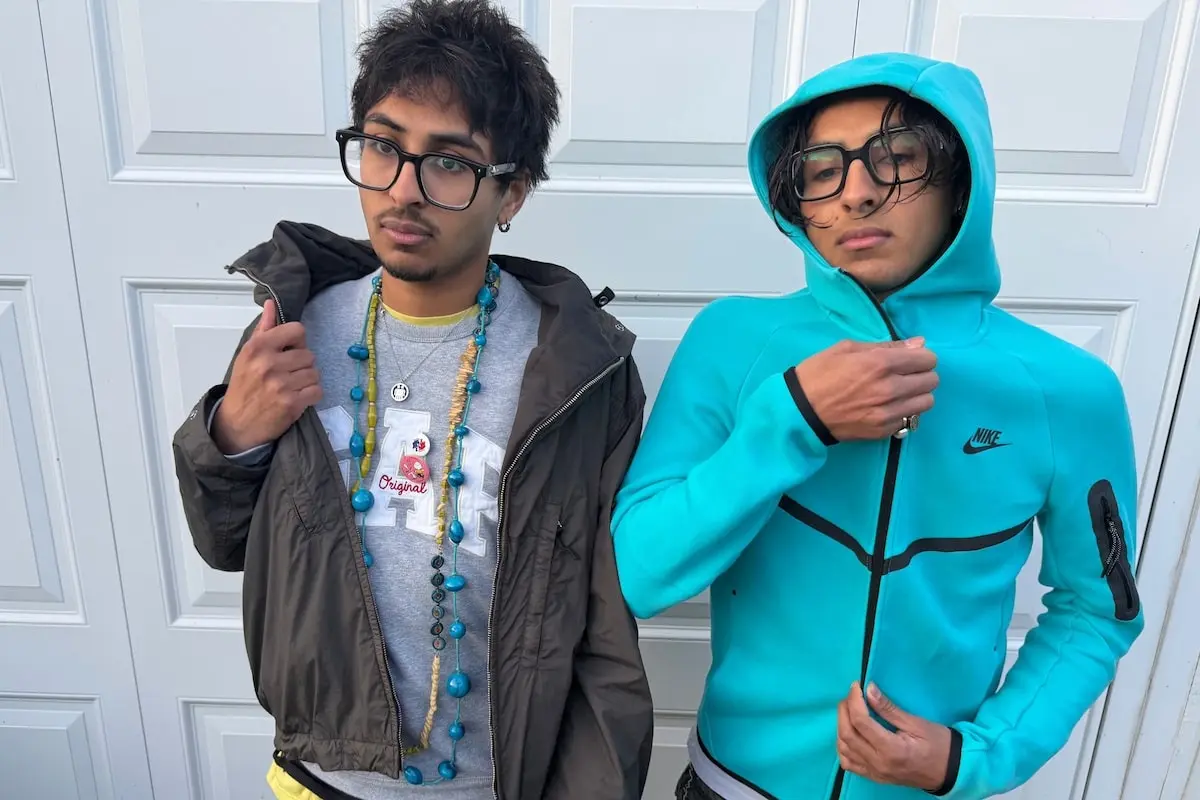
Stylistically, the brothers project an unmistakable visual and interpersonal synergy. Dressed in coordinated, multi-layered outfits featuring patterned fits, heavy dog tags, beaded chains, and thick-rimmed glasses, they speak in near-perfect synchronization—frequently finishing each other’s sentences with an ease that only identical twins can muster. When gently pressed about what differentiates them from one another, they pause, deliberate, and offer a cryptic grin: "I guess one of the twins goes a lot harder than the other," though neither will confess which one holds the crown.
This unified front is translating directly into their upcoming sophomore album. Having officially put university behind them—Jamal closing out his computer science degree and Omar wrapping up economics—their focus is entirely locked onto the studio.
Future Outlook: The 2027 Roadmap and Beyond
As The Twins sit in the back of a car hurtling toward a Barcelona airport—bound for yet another grueling weekend of international performances—they are acutely aware that their artistic journey is only just beginning.
Their immediate focus is squarely fixed on completing their forthcoming sophomore album. Moving away from the abstract, high-concept club tracks that defined their early career, the record is slated to be their most vulnerable and direct statement to date.
“We’re in making music mode right now,” Jamal says over the static-laced mobile connection. “We’re hoping to be pulling on your heartstrings. It’s a lot more indie than what I think everyone’s expecting. It’s a lot more personal and more intimate. We have both gone through some shit. It’s not telling our story as vaguely — it’s telling our story quite specifically.”
This pivot toward a confessional, indie-inflected songwriting style promises to bridge the gap between their electronic club foundations and the emotional resonance of alternative rock and left-field pop. By refusing to rest on the stylistic laurels of TURMERIC and There&Back, they are actively inoculating themselves against the fleeting nature of internet micro-genres.
Looking further ahead, the brothers have cast their gaze toward the horizon with a clear, uncompromising mandate.
“We’ve made so much music since we last spoke,” they reflect, surveying the massive catalogue of unreleased material sitting on their hard drives. “In 2027, we want to find our feet in this world that we’re trying to build.”
For Omar and Jamal, the bedroom-producer era is officially dead. In its place stands a formidable, globally-minded sonic enterprise—one meticulously engineered to reshape the boundaries of electronic music, one heavy bassline, sitar sample, and deeply personal lyric at a time.