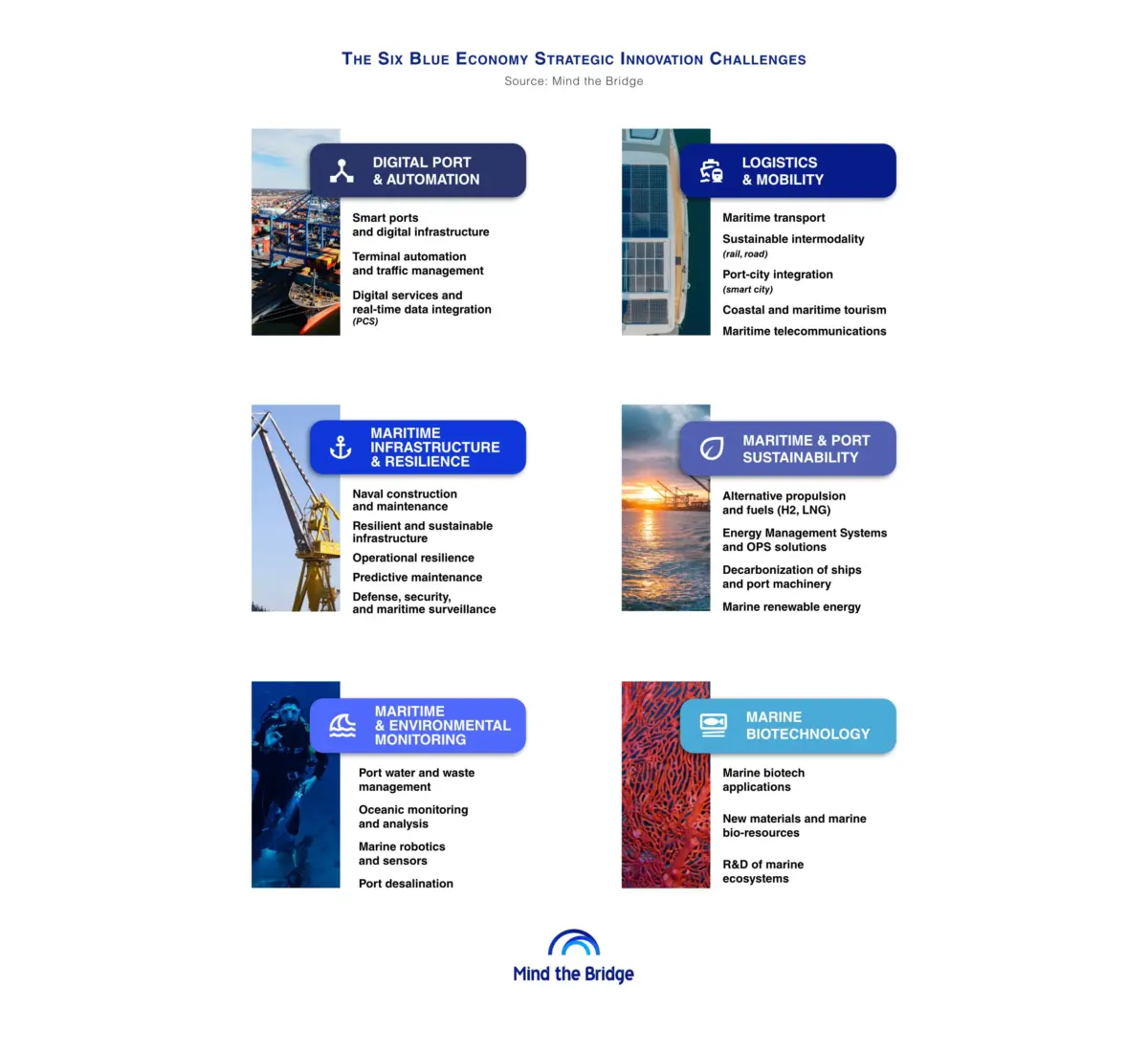
By Alberto Onetti, Chairman of Mind the Bridge and Professor at the University of Insubria
Executive Overview
For decades, the global economic narrative has been dominated by terrestrial frontiers: software revolutions, artificial intelligence breakthroughs, space exploration, and urban tech hubs. Yet, spanning the oceans, seas, and coastal shelves of our planet lies an industry network so massive that, if it were considered an independent nation, it would rank as the fifth-largest economy on earth.
Known collectively as the "blue economy," this sector encompasses everything from maritime shipping, commercial fisheries, and coastal tourism to offshore energy generation and cutting-edge marine biotechnology. It is an industrial giant that generates an estimated $2.6 trillion in value annually, having quietly doubled in size over a mere 25-year span.
Despite its staggering scale, the blue economy has traditionally functioned as one of the least visible engines of global commerce. That reality is rapidly changing. Faced with compounding geopolitical instabilities, volatile energy markets, and an accelerating climate crisis, governments and corporations alike are turning their gaze back to the sea.
Simultaneously, a potent wave of disruption—dubbed "blue tech"—is sweeping across maritime industries. Driven by rapid digitalization, process automation, aggressive environmental pressures, and unprecedented breakthroughs in marine biotechnology, startups and scaleups are fundamentally redefining how humanity moves goods, extracts energy, and manages fragile marine resources.
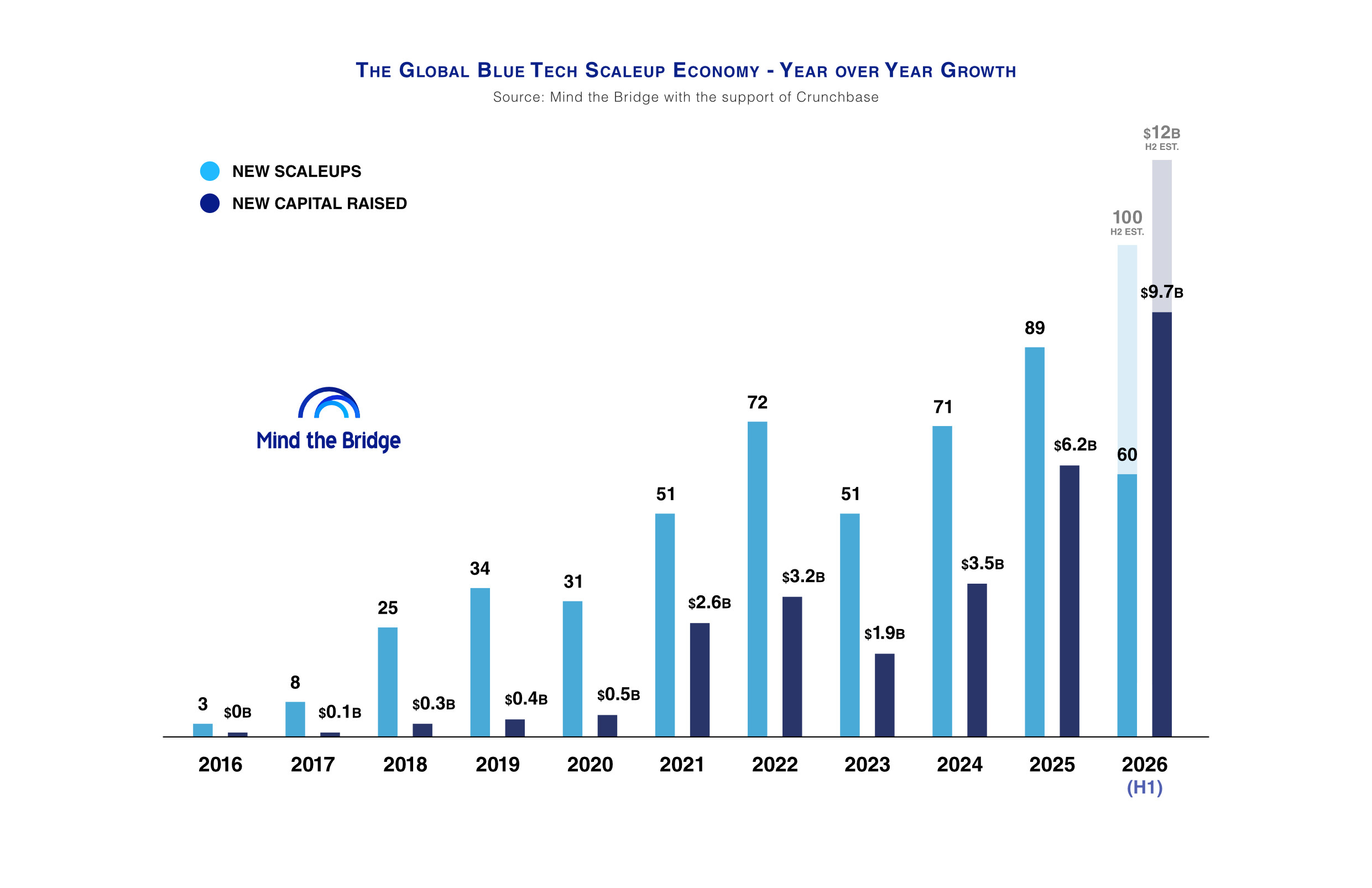
According to data compiled in the recent “Rethinking the Blue Economy” report by Mind the Bridge, produced in partnership with Crunchbase, this sector is not merely growing—it is dramatically defying broader global economic cooling trends. Blue tech scaleups raised nearly $10 billion in capital through the third quarter of 2026, already eclipsing the $6.2 billion recorded across the entirety of 2025. As this dynamic ecosystem matures, the question facing investors, policymakers, and industry leaders is no longer whether the blue economy will transform, but who will successfully steer its course.

Detailed Chronology: The Rapid Ascent of Blue Tech
To understand the current explosive growth of maritime innovation, one must examine the trajectory of the ecosystem over the past half-decade. While many traditional venture capital sectors experienced funding contractions and valuation corrections following the post-pandemic peak of 2021, blue tech has charted an unbroken, upward-sloping trajectory.
2021–2024: Laying the Foundation
During the immediate post-pandemic era, as global supply chain bottlenecks crippled international trade, the vulnerabilities of legacy maritime logistics were laid bare. Ports became choked, shipping costs spiked, and energy grids strained under fossil fuel dependencies. This period catalyzed the formation of a distinct "blue tech" venture category. Rather than viewing maritime operations as rigid, immutable infrastructure, early-stage investors began backing founders applying artificial intelligence, IoT sensors, and advanced robotics to shipyards, shipping routes, and aquaculture.
During these formative years, the sector consistently spawned roughly 70 new scaleups annually. While individual funding rounds were modest compared to enterprise SaaS or consumer fintech, the foundational building blocks for a modern marine economy were being established.
2025: The Tipping Point
By 2025, the sector experienced a dramatic acceleration. Global blue tech funding doubled year-over-year, vaulting to a remarkable $6.2 billion. The market demonstrated that capital was eager to flow into tangible assets capable of securing supply chains and mitigating environmental degradation. Green shipping corridors, autonomous surface vessels (ASVs), and next-generation ocean-based renewable energy projects moved out of R&D labs and into commercial deployment.
2026: The Defense and Infrastructure Boom
The current year has witnessed an unprecedented surge in capital deployment. Propelled by escalating geopolitical tensions and maritime security imperatives, blue tech funding shattered previous records, accumulating nearly $10 billion by the end of Q3 2026. Preliminary projections indicate the sector is on track to cross the $12 billion threshold by year-end, with the creation of roughly 100 new blue tech scaleups.
This meteoric rise has been heavily buoyed by massive funding rounds secured by dual-use defense and maritime infrastructure giants. Companies developing critical security, surveillance, and autonomous navigation technologies for the high seas have drawn immense institutional backing, fundamentally altering the risk-reward profile of ocean-focused investments.

Supporting Context & Metrics: A Sector Defying Global Slowdown
To appreciate the structural health of the blue economy, one must look beyond macroeconomic headwinds and examine the granular data points defining the sector’s evolution.
The Funding Surge and Its Key Drivers
The sheer velocity of capital flowing into blue tech is best illustrated by the sheer scale of its top-tier participants. The sector’s record-breaking 2026 performance is significantly anchored by high-stakes maritime resilience and defense deals. For instance, advanced defense technology titan Anduril Industries pulled in a staggering $5 billion in 2026 alone, leveraging its autonomous capabilities for maritime domain awareness. Similarly, Helsing, a pioneer in AI-powered defense and security systems, secured $1.8 billion.
These massive transactions highlight a broader convergence: the security of oceanic trade routes, underwater communications cables, and offshore energy installations is now viewed as an existential national security priority. Consequently, venture capital and private equity firms are deploying institutional checks into maritime tech at an unprecedented clip.
Categorizing the Blue Tech Matrix
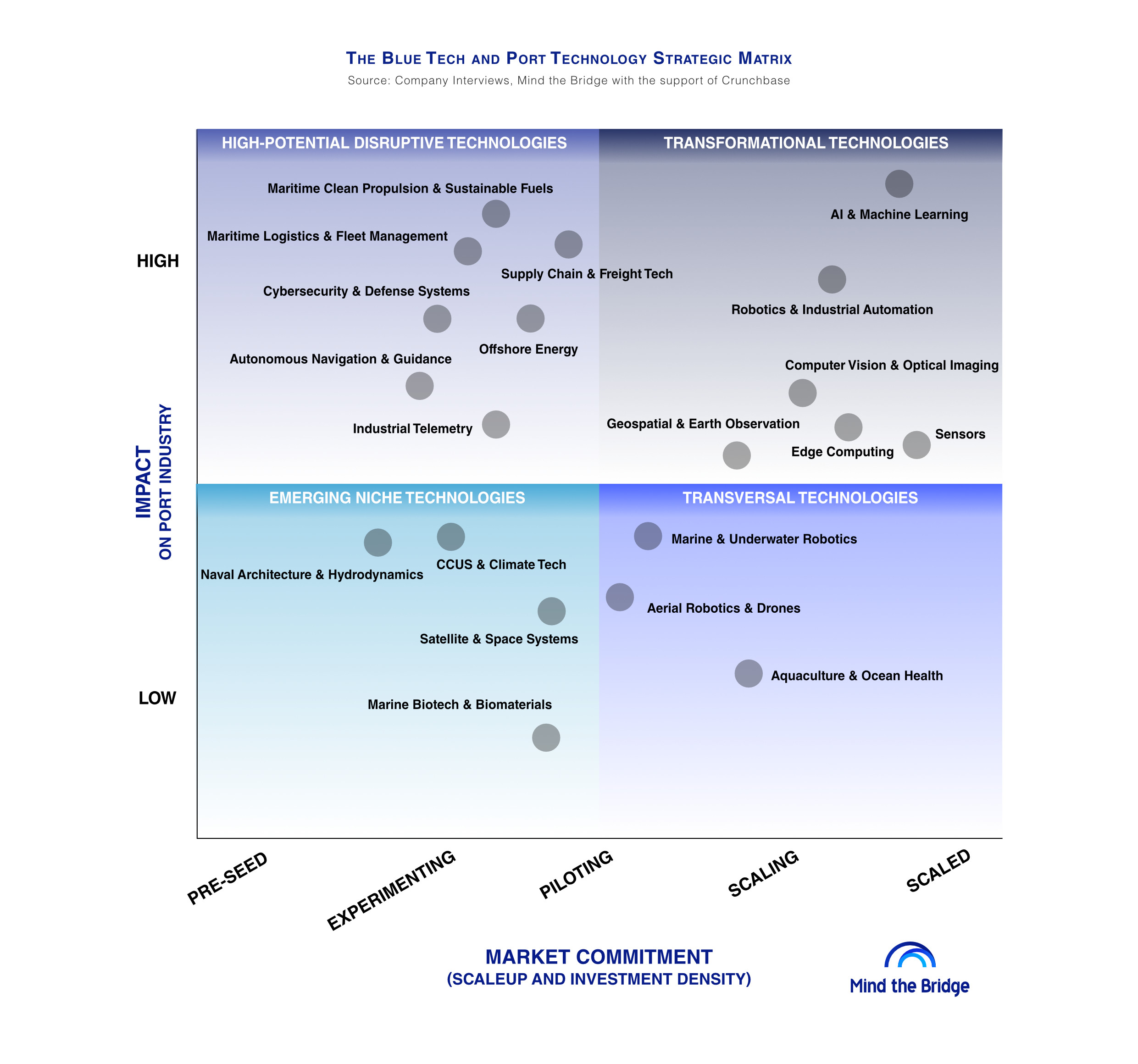
However, not all blue tech is created equal. The ecosystem is broad, encompassing technologies ranging from hyper-mature digital freight forwarders to speculative, early-stage marine biotechnology solutions. To bring analytical clarity to this fragmented landscape, researchers at Mind the Bridge categorized every unique technology developed by global blue tech scaleups into 20 distinct groups.
These groups were evaluated across two critical dimensions:
- Industry Impact: The magnitude of operational or economic disruption the technology introduces to traditional maritime sectors.
- Market Commitment: A composite metric measuring the density of active scaleups and the volume of capital invested within that specific sub-sector.
While heavy infrastructure, digitalization platforms, and defense-related marine hardware dominate the quadrants representing high market commitment and deep industry impact, a constellation of transversal technologies—such as predictive analytics for vessel maintenance and eco-friendly antifouling coatings—are rapidly maturing in adjacent quadrants.

Ports: The "Smartest Smart Cities"
If the blue economy is an industrial titan, ports are its beating heart.
When analyzing who will ultimately capture and direct the immense value being unlocked by the blue economy, the short answer is ports. Modern ports are far more than mere docking points for cargo ships; they are complex, high-density ecosystems where energy grids, supply chain logistics, big data, surface mobility, and human capital converge. In essence, ports function as miniature blue economies.
In many ways, ports represent the ultimate smart cities. They face the exact same infrastructural, environmental, and technological integration challenges as metropolitan areas, but within a tightly compressed, highly regulated industrial footprint. Because they operate at the intersection of land and sea, ports serve as the ideal sandbox where innovations can be tested, piloted, and validated at scale before rippling outward into the broader global economy.
Much like urban smart cities a decade ago, port authorities today are actively searching for a definitive playbook to navigate digital transformation.
Global Blueprints: Learning from the Best
To understand the evolving priorities and persistent barriers to port-led innovation, researchers conducted in-depth interviews with ten of the world’s leading port authorities. The resulting case studies—drawing on pioneering strategies from the Ports of Barcelona, Bergen, Seattle, Rotterdam, and Los Angeles—offer invaluable blueprints for modern port management.
These forward-thinking authorities are proving that open innovation is no longer optional. To "ride the wave" of the blue economy, major ports are deploying structured open innovation tools, establishing dedicated corporate venture units, and creating physical collaboration hubs.
Official Statements & Industry Collaboration
Realizing the full economic and environmental potential of the oceans requires more than isolated technological breakthroughs; it demands coordinated action across the entire maritime value chain. Port authorities, terminal operators, adventurous startups, institutional investors, and global policymakers must operate from a shared strategic agenda.
A prime example of this collaborative ethos in action is BlueTechPort, spearheaded by the Port of Barcelona. Designed as an international collaborative innovation hub, BlueTechPort physically connects entrepreneurs, cutting-edge technology providers, academic researchers, and established maritime businesses under one roof. The initiative—featured extensively as a masterclass in open innovation within the Mind the Bridge report—is scaling its global footprint through international acceleration pipelines like the Lighthouse International Acceleration Program.
As leaders in the space have emphasized, the trajectory of maritime innovation has already been charted. The imperative for stakeholders today is not hesitation, but execution—identifying the most favorable economic and environmental winds and deploying the right tools to harness them.
Future Outlook: Catching the Favorable Winds
Looking ahead, the blue economy stands at a historic inflection point. As global trade routes face mounting geopolitical friction, and as the imperative to decarbonize heavy shipping becomes legally and morally binding, the reliance on oceans as our primary ecological and economic frontier will only deepen.
We can anticipate several defining trends shaping the blue tech landscape over the coming decade:
- Decarbonization at Scale: Regulatory pressure from bodies like the International Maritime Organization (IMO) will force shipping fleets to transition toward green ammonia, hydrogen, and wind-assisted propulsion systems, creating an immense market for clean-tech hardware startups.
- Autonomous Operations: Driven by persistent labor shortages and safety concerns, autonomous cargo handling, remote-piloted tugboats, and AI-driven vessel routing will transition from experimental trials to industry standard practice.
- Deep-Sea and Coastal Resilience: Climate adaptation technologies—ranging from coastal protection infrastructure to automated ocean-monitoring sensor arrays—will attract substantial public-private partnerships.
- The Rise of Port-Centric Venture Hubs: Following the success of models like Barcelona’s BlueTechPort, coastal cities globally will establish localized blue tech clusters, transforming ports into permanent incubators for ocean-positive innovation.
To the startup founders, investors, and policymakers bold enough to look seaward, the course is set. The deep blue sea is no longer just a watery expanse separating continents; it is the most vibrant, high-potential economic frontier of the 21st century.
To dive deeper into the data, explore the full technology matrix, and review exclusive case studies from the world’s leading port authorities, download the complete Mind the Bridge "Rethinking the Blue Economy" report.