Executive Overview
The PC gaming hardware landscape has long been defined by an escalating fiscal arms race. For years, securing a true, uncompromising 4K gaming experience meant resigning oneself to four-figure investments solely for a graphics processing unit (GPU). As flagship silicon from industry titans like Nvidia commands astronomical pricing—with standalone cards frequently eclipsing the $1,500 threshold—PC enthusiasts have increasingly found themselves priced out of the high-end tier.
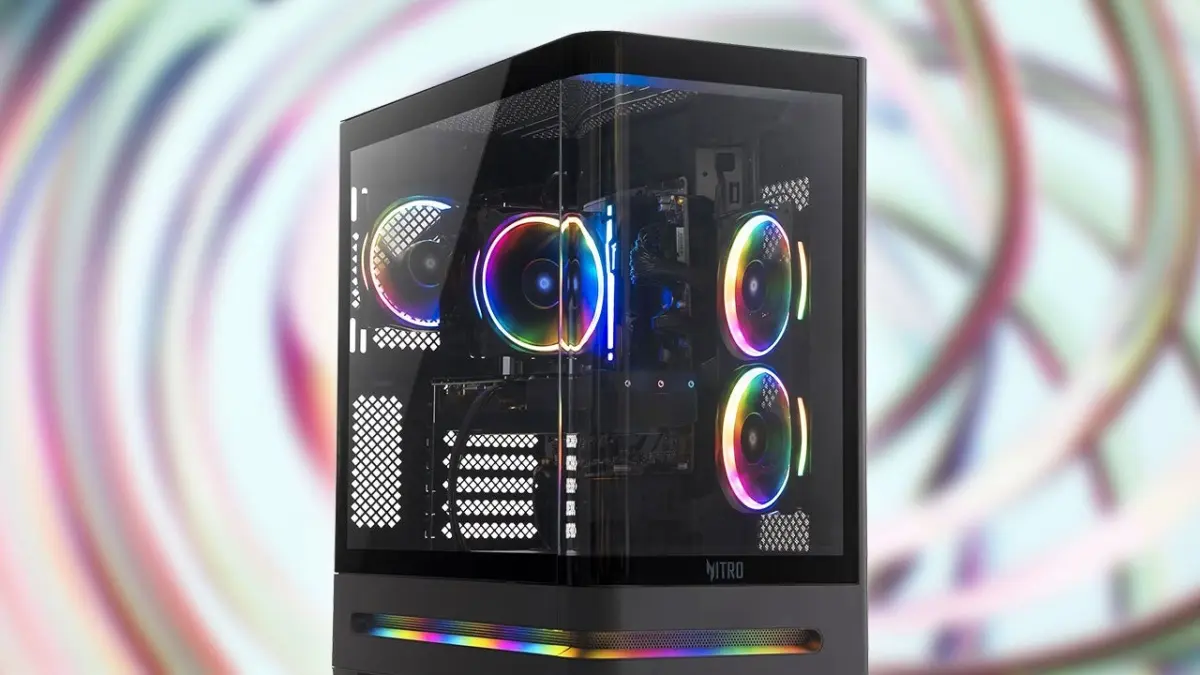
However, a significant market correction is underway, highlighted by aggressive seasonal promotions that challenge the status quo. Leading the charge this Black Friday is a standout offer on Amazon: the Acer Nitro 85 prebuilt gaming desktop, featuring the powerhouse pairing of an AMD Ryzen 9 9900X processor and the critically acclaimed AMD Radeon RX 9070 XT graphics card.
Originally listed at a higher tier, this formidable 4K-ready machine has received a massive $400 instant discount, bringing its net price down to $1,899.99 with free shipping. When contextualized against current component pricing—where rival cards like Nvidia’s GeForce RTX 5070 Ti command upwards of $1,500 for the GPU alone—the Acer Nitro 85 emerges not merely as a discounted retail product, but as an exceptional architectural achievement in price-to-performance parity. This report examines the technical specifications, market dynamics, architectural trade-offs, and broader industry implications of one of the most compelling prebuilt system offers of the holiday shopping season.
Detailed Chronology & Market Context
The trajectory leading to this pivotal hardware valuation began taking shape throughout the preceding fiscal cycles, marked by surging component demand, constrained foundry allocations, and shifting consumer expectations.
The Evolution of 4K Accessibility
Historically, true 4K gaming at native refresh rates above 60 frames per second (fps) was the exclusive domain of top-tier enthusiast rigs costing well north of $3,000. As game developers leveraged advanced rendering pipelines, complex geometry, and high-resolution texture packs, system memory requirements and GPU computational loads scaled exponentially.
By mid-to-late 2025, the release of next-generation GPU architectures introduced remarkable leaps in rasterization and power efficiency. Yet, market forces—including supply chain bottlenecks and high demand for AI-adjacent compute hardware—pushed retail pricing for upper-mid-range and high-end discrete graphics cards to unprecedented heights. Nvidia’s GeForce RTX 5070 Ti, while demonstrating undeniable technical prowess, launched into a volatile retail environment where scalping, localized shortages, and inflated distributor margins pushed standalone card prices past $1,500.
The Rise of AMD’s RDNA-Based Powerhouse
Amidst these fiscal barriers, Advanced Micro Devices (AMD) positioned its Radeon RX 9070 XT as a disruptive force. Upon its release, the card quickly captured the attention of reviewers and consumers alike. Notably, it secured a rare and coveted 10/10 rating in comprehensive hardware evaluations, lauded as the definitive baseline card for uncompromised 4K gaming without the punishing financial penalty demanded by competitors.

Capitalizing on this critical momentum, system integrators and original equipment manufacturers (OEMs) like Acer sought to harness the 9070 XT’s disruptive value proposition. By pairing the GPU with high-end Zen 5 architecture processors, manufacturers built balanced systems capable of clearing the $2,000 psychological threshold. The culmination of this strategy is the current Black Friday promotion on Amazon, where the Acer Nitro 85 has been aggressively marked down by $400, establishing a new benchmark for accessible, high-performance prebuilt desktop computing.
Supporting Context & Architectural Metrics
To fully appreciate the value proposition of the Acer Nitro 85 at its current promotional price point, a rigorous examination of its internal component ecosystem is necessary. Far from being a mismatched system utilizing budget components to offset a single headline-grabbing GPU, the Nitro 85 boasts a cohesive, high-performance configuration.
+-----------------------------------------------------------------+
|                  ACER NITRO 85: CORE SPECIFICATIONS             |
+-----------------------------------------------------------------+
| Component             | Specification                           |
+-----------------------------------------------------------------+
| Central Processing Unit | AMD Ryzen 9 9900X (12 Cores / 24 Threads)|
|                         | Max Boost: 5.6 GHz, Zen 5 Architecture  |
+-----------------------------------------------------------------+
| Graphics Processing   | AMD Radeon RX 9070 XT                   |
| Unit (GPU)            | VRAM: 16GB GDDR6                        |
+-----------------------------------------------------------------+
| System Memory (RAM)   | 32GB DDR5                               |
+-----------------------------------------------------------------+
| Primary Storage       | 1TB NVMe Solid State Drive (SSD)        |
+-----------------------------------------------------------------+
| Power Supply Unit     | 850W High-Efficiency Power Supply       |
+-----------------------------------------------------------------+
| Thermal Solutions     | Tower Heatsink Air-Cooled CPU Design    |
+-----------------------------------------------------------------+
The CPU Engine: AMD Ryzen 9 9900X
At the heart of the system lies the AMD Ryzen 9 9900X, a formidable 12-core, 24-thread processor built on the advanced Zen 5 microarchitecture. Capable of achieving a maximum turbo boost frequency of 5.6 GHz, the 9900X bridges the gap between high-end gaming and heavy workstation productivity. Whether executing multithreaded rendering tasks, compiling complex code, handling professional video editing workflows, or managing demanding background applications while gaming, this CPU ensures zero structural bottlenecks. Furthermore, its efficiency profile makes it exceptionally well-suited for modern localized AI workloads and heavy data processing.
The Graphics Engine: Radeon RX 9070 XT vs. GeForce RTX 5070 Ti
The centerpiece of the system is the AMD Radeon RX 9070 XT, equipped with a generous 16GB frame buffer. In standard rasterized gaming benchmarks, the 9070 XT punches well above its weight class, frequently matching—and in certain game engines, surpassing—the performance metrics delivered by Nvidia’s considerably more expensive GeForce RTX 5070 Ti.
However, an objective architectural comparison must account for feature sets:
- Rasterization & Raw Performance: In traditional rendering pipelines at 4K resolution, the 9070 XT delivers smooth, consistent 60+ fps performance across the vast majority of AAA titles. It stands as the most cost-effective recommendation for players refusing to compromise on visual fidelity.
- Ray Tracing & Frame Generation: Nvidia maintains a distinct hardware and software advantage in heavy ray-traced workloads and advanced proprietary frame generation technologies (DLSS ecosystem). The RTX 5070 Ti excels when these cutting-edge lighting models are maximized.
- The Cost-to-Benefit Ratio: The critical differentiator is economic. To access Nvidia’s superior ray tracing implementation via the 5070 Ti, consumers must absorb a standalone GPU cost exceeding $1,500. By contrast, the Acer Nitro 85 provides near-identical rasterized performance, a high-tier Zen 5 CPU, 32GB of RAM, and a complete chassis setup for a total package price of $1,899.99.
Supporting Hardware Infrastructure
A high-performance system requires robust supporting infrastructure to maintain stability under thermal and electrical loads:
- System Memory: Equipped with 32GB of high-speed DDR5 RAM, the Nitro 85 provides ample headroom for modern memory-intensive titles, eliminating stuttering and ensuring fluid multitasking.
- Storage: A 1TB NVMe SSD serves as the primary boot drive, offering rapid operating system load times, near-instantaneous application launches, and rapid asset streaming for open-world games. (Users with extensive game libraries may wish to supplement this with an auxiliary secondary drive).
- Power & Cooling: The system draws stable power from an 850W power supply unit (PSU), ensuring sufficient electrical overhead for transient power spikes and future component upgrades. Thermal management is handled by an efficient tower heatsink air-cooled CPU design, keeping operating temperatures within optimal thresholds during extended gaming sessions.
Official Statements & Industry Expert Perspectives
Hardware analysts and industry reviewers have closely monitored the market disruption caused by the pairing of AMD’s RDNA architecture with aggressive prebuilt pricing structures.

Eric Song, Commerce Manager and hardware deals authority, emphasizes the paradigm shift represented by this pricing tier:
"The AMD Radeon RX 9070 XT was the only 2025-released GPU that earned a definitive 10/10 score in our evaluations. It stands as the least expensive graphics card from either major manufacturer that we can comfortably and universally recommend for playing the latest, most demanding games in native 4K at 60fps and beyond. While Nvidia’s GeForce RTX 5070 Ti demonstrates clear advantages in specialized ray tracing and proprietary frame generation frameworks, securing those technologies requires a punishing financial premium. For the vast majority of gamers prioritizing raw performance and fiscal prudence, systems like the Acer Nitro 85 rewrite the value equation."
Industry economists note that promotional windows like Black Friday serve as a crucial pressure valve for consumer hardware adoption. OEMs are increasingly collaborating with component manufacturers to bypass inflated single-part retail pricing, delivering fully assembled, turnkey ecosystems that cost less than the sum of their individual parts if sourced piecemeal at peak market rates.
Future Outlook & Consumer Guidance
As the PC gaming landscape looks toward upcoming software developments—including heavily anticipated engine optimizations, expanded path-traced game titles, and the steady maturation of AI-assisted upscaling technologies—the hardware calculus continues to evolve.
Long-Term Viability
For consumers evaluating purchases in the sub-$2,000 market segment, the Acer Nitro 85 represents a remarkably future-proof investment:
- VRAM Longevity: The inclusion of 16GB of VRAM on the Radeon RX 9070 XT ensures that the GPU is well-equipped to handle increasingly demanding VRAM allocations in upcoming AAA game releases over the next several years.
- Platform Stability: Built upon modern DDR5 memory standards and a high-end Zen 5 multi-core processor (Ryzen 9 9900X), the motherboard and CPU foundation will remain relevant for heavy multitasking, productivity, and gaming well into the latter half of the decade.
- Upgrade Headroom: With a robust 850W power supply, users retain the electrical capacity to perform targeted upgrades—such as adding secondary NVMe storage or upgrading cooling solutions—without requiring a foundational power overhaul.
Strategic Buying Recommendations
Shoppers navigating the Black Friday retail space should exercise prudent timing. Promotional pricing structures on high-demand prebuilt systems are frequently tied to limited inventory allotments and regional fulfillment windows. For prospective PC builders and buyers seeking an out-of-the-box solution capable of handling high-refresh-rate 4K gaming without the financial burden of inflated standalone GPU pricing, systems matching the configuration and discount level of the Acer Nitro 85 warrant immediate consideration.
Ultimately, the convergence of top-tier component performance, critical industry acclaim, and aggressive seasonal discounting proves that high-end 4K PC gaming no longer necessitates an unconstrained budget—shifting the power back to the discerning consumer.