Executive Overview
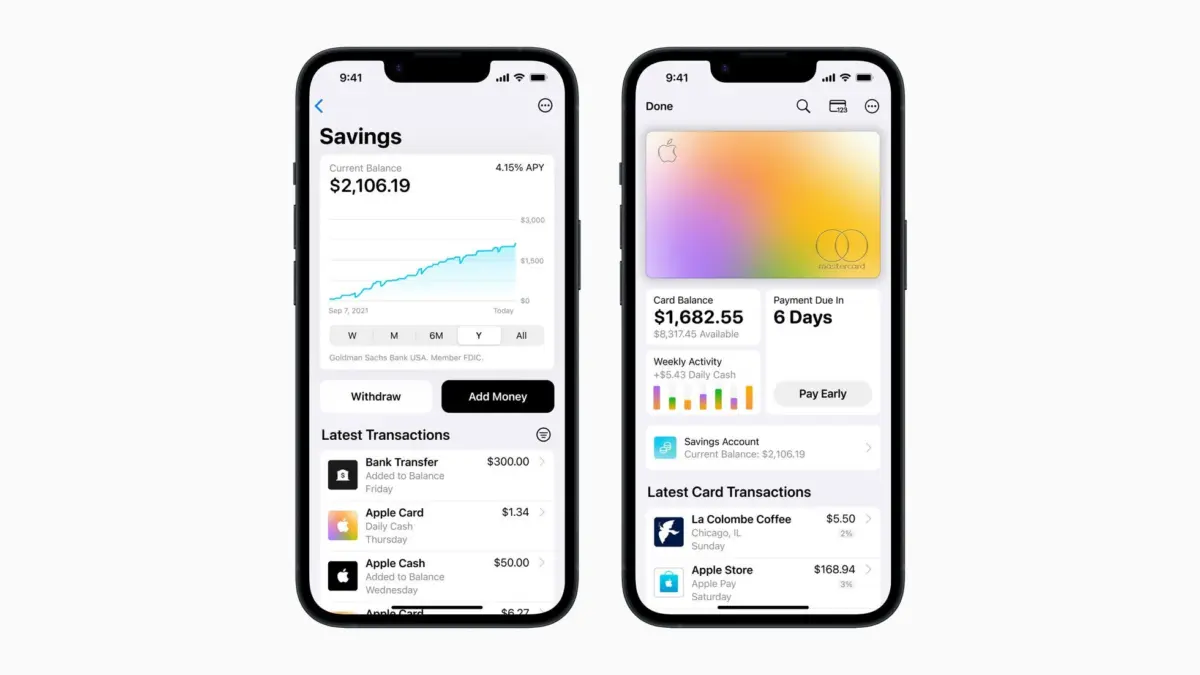
In a strategic maneuvering that continues to blur the once-rigid boundaries between Silicon Valley and Wall Street, Apple—in a powerful partnership with banking giant Goldman Sachs—officially launched a high-yield savings account tailored exclusively for Apple Card users. Announced on a Monday that sent immediate ripples through the traditional banking sector, the new product allows consumers to seamlessly deposit their "Daily Cash" rewards into an interest-bearing account yielding an impressive 4.15% Annual Percentage Yield (APY).
To put this figure into perspective, the national average for standard savings accounts hovers well below 0.50%, with legacy brick-and-mortar institutions like Bank of America offering a paltry 0.01% APY. By comparison, Apple’s offering is more than 400 times more lucrative than traditional retail banking accounts, positioning the tech titan as an unexpectedly aggressive contender in personal finance.
Yet, the mechanism goes far beyond merely stashing away pocket change earned from purchasing morning lattes or consumer electronics. Apple is also permitting users to fund these accounts directly from external linked bank accounts up to a substantial $250,000 deposit limit, effectively transforming the iPhone’s native Wallet app into a pseudo-digital bank branch.
This rollout represents the latest in a rapid-fire succession of financial services integrations from Apple. It arrives on the heels of the company’s recent "Buy Now, Pay Later" (BNPL) feature—a zero-interest, installment-based service that directly challenges established fintech giants like Klarna and Affirm.
While the 4.15% APY is not technically the absolute ceiling of what can be found on the broader market—where competitive neobanks and specialized high-yield instruments occasionally push past 5%—the frictionless integration into the Apple ecosystem makes it an exceptionally compelling proposition. For the hundreds of millions of active iPhone users worldwide, the evolution of the smartphone into a central hub for wealth management is no longer a distant theoretical future; it is unfolding in real time.
Detailed Chronology: The Evolution of Apple Financial Services
To fully grasp the significance of Apple’s high-yield savings account, it is essential to trace the deliberate, methodical evolution of Apple’s footprint in the financial technology (FinTech) sector. What began as a hardware-adjacent convenience has transformed into a comprehensive financial ecosystem.
Phase 1: The Genesis of Apple Pay (2014)
Long before consumers could earn interest or finance purchases through their iPhones, Apple introduced Apple Pay in October 2014. Initially met with skepticism by traditional credit card processors and skeptical merchants alike, the service revolutionized contactless payments by leveraging NFC (Near Field Communication) technology and tokenization to secure transactions without exposing raw credit card numbers. This foundational infrastructure proved that Apple could successfully intermediate the relationship between consumer and merchant at the point of sale.
Phase 2: The Apple Card Debut (2019)
In partnership with Goldman Sachs and Mastercard, Apple launched the physical and digital Apple Card in the summer of 2019. Promoted as a credit card "created by Apple, not a bank," the product emphasized radical transparency, zero hidden fees, and an intuitive user interface built directly into the iOS Wallet app. Crucially, the card introduced "Daily Cash"—an instant cashback reward system that paid users up to 3% back on purchases, immediately deposited onto a virtual Apple Cash card rather than accumulating as statement credits weeks later.
Phase 3: The Installment Revolution and BNPL (Early 2023)
As economic headwinds shifted and consumer spending habits adapted to inflationary pressures, Apple expanded its credit utility. In early 2023, the company rolled out "Apple Pay Later," enabling users to split purchases into four equal payments spread over six weeks with zero interest and zero fees. This direct foray into the explosive BNPL market positioned Apple directly against entrenched digital lenders, signaling that the company intended to capture value at every stage of the consumer spending lifecycle.
Phase 4: The High-Yield Savings Integration (Spring 2023)
The logical culmination of these iterative steps arrived with the April 2023 launch of the high-yield savings account. By closing the loop between spending, earning rewards, and preserving wealth, Apple effectively built a closed-loop financial ecosystem. Users no longer needed to transfer their Daily Cash rewards to an external checking account to earn interest; they could keep the capital entirely within the Apple-Goldman Sachs umbrella, dramatically reducing the friction of personal saving and wealth accumulation.
Supporting Context & Metrics: Banking on the iPhone
The partnership between Apple and Goldman Sachs is built upon a stark contrast between modern software-driven financial products and legacy banking institutions. To understand why consumers are eagerly moving capital into their iPhones, one must analyze the macroeconomic landscape and the metrics driving contemporary retail banking.
The Great APY Disparity
For decades, traditional retail banks have relied on customer inertia. Millions of Americans leave their emergency funds and liquid savings in checking or traditional savings accounts yielding near-zero returns, subsidizing the profit margins of legacy institutions.
| Financial Institution / Product | Average APY (Annual Percentage Yield) |
|---|---|
| Traditional Bank (e.g., Bank of America Savings) | 0.01% |
| US National Average Savings Rate | ~0.45% |
| Apple Card High-Yield Savings (via Goldman Sachs) | 4.15% |
| Top-Tier Neobank Competitors | 4.50% – 5.25% |
As illustrated above, Apple’s 4.15% APY—backed by Goldman Sachs Bank USA (Member FDIC)—dwarfs standard brick-and-mortar offerings. While specialized high-yield savings accounts from online-only institutions occasionally surpass Apple’s rate by a fraction of a percentage point, none can match the contextual convenience of managing those funds natively through the iOS interface.
The Mechanics of Daily Cash Accumulation
The psychological power of Daily Cash lies in micro-behavioral finance. When a consumer receives cash back once a month as a statement credit, it often blends into the broader balance sheet, treated as abstract accounting rather than tangible wealth.
By contrast, depositing Daily Cash automatically into a 4.15% APY savings account gamifies the saving process. Every swipe of the Apple Card quietly compounds wealth in the background. Furthermore, the capacity to deposit up to $250,000—fully protected by Federal Deposit Insurance Corporation (FDIC) pass-through insurance—elevates the product from a novelty rewards catcher to a legitimate, high-capacity wealth preservation vehicle.
The Goldman Sachs Nexus
Behind the consumer-facing simplicity of the Apple interface lies a complex institutional partnership. Goldman Sachs, traditionally known for high-end investment banking, underwriting, and wealth management for ultra-high-net-worth individuals, has faced a challenging pivot into mass-market consumer banking through its Marcus platform and the Apple Card partnership.
By leveraging Apple’s unparalleled distribution network (over two billion active iOS devices globally), Goldman Sachs secures a massive influx of retail deposits. These deposits provide the banking giant with stable, low-cost liquidity, creating a symbiotic relationship where Apple provides the software interface and customer engagement, while Goldman supplies the regulatory charter, banking infrastructure, and balance sheet strength.
Official Statements & Industry Reactions
The announcement elicited immediate commentary from industry executives, financial analysts, and consumer advocates alike, highlighting the profound implications of Big Tech’s deeper encroachment into regulated financial territory.
In an official corporate statement released alongside the launch, Jennifer Bailey, Apple’s vice president of Apple Pay and Apple Wallet, underscored the philosophical underpinnings of the product:
"Our goal is to build tools that help users lead healthier financial lives, and building Savings into Apple Card in Wallet enables them to spend, send, and save Daily Cash directly and seamlessly — all from one place."
Financial analysts were quick to dissect the broader market implications. Many noted that while Apple insists it is not becoming a bank—relying strictly on its chartered banking partner, Goldman Sachs, to handle the regulatory burdens—the user experience is indistinguishable from a next-generation consumer bank.
Industry observers pointed out that the true genius of the strategy is customer retention. By locking consumers into an ecosystem where their spending earns rewards, their rewards earn high-yield interest, and their installments are managed effortlessly within the same application, switching costs become astronomically high. Leaving the iPhone ecosystem suddenly means sacrificing not just a preferred smartphone interface, but an integrated, high-performing financial dashboard.
Consumer advocacy groups, meanwhile, praised the transparency and lack of fees associated with the product—noting zero monthly maintenance fees, zero minimum balance requirements, and zero transfer fees—while gently reminding consumers that Apple’s variable APY is subject to change based on Federal Reserve rate adjustments and partnership agreements.
Future Outlook: The Horizon of Embedded Finance
As we look toward the future of global commerce and personal finance, Apple’s high-yield savings account serves as a major milestone in the evolution of "embedded finance"—the integration of financial services into non-financial software platforms.
1. International Expansion and Localization
Currently, the high-yield savings account is restricted to users within the United States. However, the underlying architecture provides a clear blueprint for international scale. Expanding similar financial products into Europe, Asia-Pacific, and Latin America will require navigating a labyrinth of localized regulatory frameworks, central bank compliance, and varying partnership agreements with regional financial institutions. Yet, the immense profitability and user-acquisition power of the model make international expansion an inevitable next frontier.
2. Deepening Wealth Management and Investment Products
With billions of dollars in consumer deposits potentially flowing into the Apple-Goldman Sachs ecosystem, the natural evolution of the platform points toward broader wealth management services. Could automated micro-investing, fractional share trading, and retirement account integrations (such as IRAs or brokerage accounts) be far behind? By capturing liquid savings, Apple is positioning itself as the primary custodian of the modern digital consumer’s net worth, creating fertile ground for future wealth-tech products.
3. The Counter-Offensive from Legacy Banks and Fintechs
The traditional banking sector can no longer afford to ignore the existential threat posed by Big Tech. Major financial institutions are being forced to aggressively upgrade their own mobile applications, streamline account opening procedures, and raise deposit rates to stem the outflow of capital toward tech-driven alternatives. Simultaneously, standalone neobanks and fintech applications must find innovative ways to differentiate their offerings in a market increasingly dominated by Apple’s ubiquitous hardware and software integration.
Conclusion
Apple’s high-yield savings account is far more than a minor software update or a clever perk for credit card enthusiasts. It is a calculated masterclass in ecosystem lock-in and a bold declaration that the future of banking will be defined not by marble-columned institutions, but by the devices we carry in our pockets. As millions of users watch their Daily Cash compound at 4.15% APY directly from their iOS Wallet, the traditional bank branch fades further into the background, replaced by the quiet, efficient brilliance of digital convenience.