Executive Overview
For the better part of the past decade, venture capitalists and enterprise software investors viewed the adtech sector with deep skepticism. Constrained by historically low valuation multiples, battered by continuous privacy overhauls implemented by Apple and Google, and haunted by the perception that a single algorithmic shift could wipe out their business models, adtech companies were routinely written off. Founders avoided pitching it; institutional investors skipped the meetings.
Then came Q3 2026.
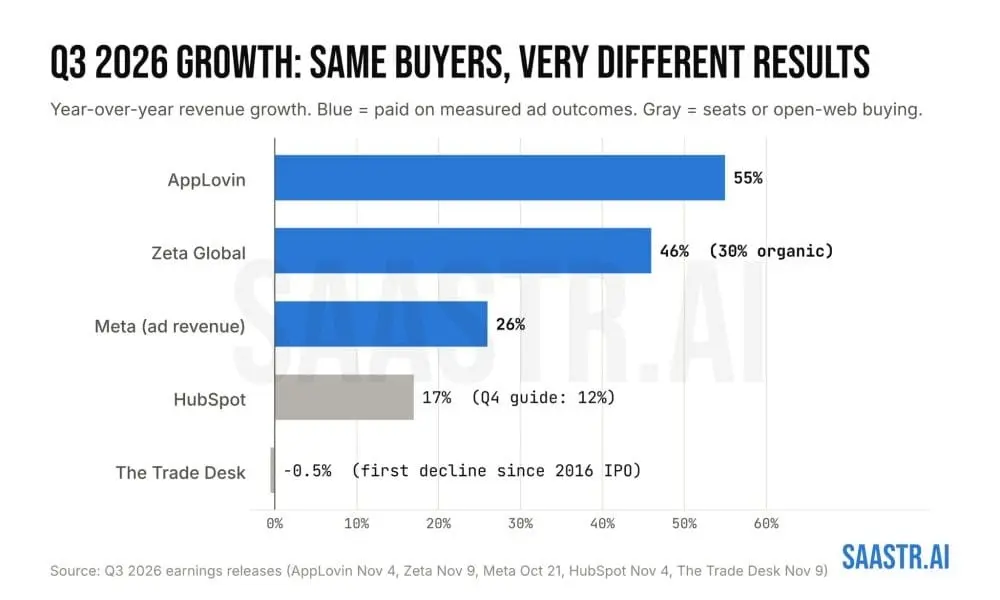
While the broader B2B software sector fought a grueling battle just to maintain historical growth rates—exemplified by HubSpot guiding down to a modest 12% growth—a select group of adtech platforms posted some of the most staggering financial metrics in public software history. AppLovin shattered expectations with a staggering 55% year-over-year revenue growth paired with an eye-watering 66% net income margin. Zeta Global accelerated to 46% growth, turning fully GAAP profitable as organic growth surged to 30%.
Yet, this was not a rising tide lifting all boats. The sector’s darling of the early 2020s, The Trade Desk, actually shrank during the exact same period.
The divergence reveals a profound structural evolution: the adtech winners of 2026 are not traditional software companies. They are performance-driven engines defined by three core traits: proprietary AI models sitting at the exact center of the product architecture, radical transparency where customers can audit the return on every single dollar spent, and revenue streams sourced directly from corporate marketing budgets rather than restrictive IT software budgets.
Detailed Chronology: The Q3 2026 Earnings Shocker
The stark operational contrasts materialized over a frantic few weeks in November 2026, redefining how Wall Street values modern enterprise technology platforms.
AppLovin: Hyper-Efficiency at Scale
AppLovin’s Q3 2026 report shocked analysts by breaking records across virtually every financial metric. The company generated $2.2 billion in quarterly revenue, blowing past the top end of its $2.055B–$2.085B guidance range by nearly $100 million. This marked the largest sequential quarterly dollar step in the company’s history over a 12-quarter span.
Even more remarkable was the company’s profitability structure. Operating income reached $1.71 billion—up 58% year-over-year—translating to a jaw-dropping 78% operating margin at an $8 billion-plus annual run rate. Full-year 2026 projections pointed toward approximately $8.33 billion in total revenue, representing roughly 52% annual growth.
Perhaps most astonishingly, AppLovin achieved these figures with a headcount of just 898 employees as of mid-November 2026. This equates to more than $9 million in revenue per employee. By comparison, hyper-efficient traditional B2B software companies typically max out between $500,000 and $1 million per employee. Cash conversion followed suit: Q3 free cash flow hit $1.4 billion, representing 77% of adjusted EBITDA and roughly 65% of total revenue.
Zeta Global: The Enterprise Scale Engine
While AppLovin dominated headlines in the app ecosystem, Zeta Global proved that similar mechanics could be successfully deployed across enterprise-level B2B marketing platforms. Zeta reported 46% overall revenue growth, with organic growth accelerating from 28% to 30%. Total quarterly revenue exceeded the midpoint of management’s guidance by $22 million, driving adjusted EBITDA to $121 million and expanding margins by 140 basis points year-over-year to 24.6%.
Zeta’s management raised full-year guidance for the 21st consecutive quarter, forecasting total annual revenue of $1.855 billion (a 42% year-over-year increase). Concurrently, go-to-market efficiency improved: sales and marketing expenses fell to approximately 22% of revenue ($109.4M), down from roughly 25% the prior year, highlighting strong enterprise adoption driven by AI-powered automation.
Supporting Context & Metrics: Price vs. Volume, and the Budget Wars
To understand why AppLovin and Zeta are thriving while traditional SaaS slows, industry analysts must examine two critical vectors: the mechanics of AI pricing and the architecture of enterprise budgets.
The Power of Pricing Over Volume
The most actionable takeaway for modern software founders lies in how these companies grew. AppLovin did not expand by artificially inflating user acquisition volume. In fact, over a nine-month tracking period, its raw volume contracted: install volume fell 7%, while revenue per install surged by 68%. In Q3 2026 alone, installs grew a meager 2%, whereas revenue per install spiked by 55%.
The entire growth engine was fueled by advanced AI predictive models determining precisely which user would install, monetize, and retain. Because the predictive accuracy increased, each individual outcome became exponentially more valuable to the advertiser, allowing AppLovin to command a higher price per transaction.
Meta mirrored this dynamic at an even grander scale, reporting a 26% year-over-year surge in advertising revenue to $63.1 billion, driven by a 10% increase in ad impressions and a 14% climb in average pricing.
This creates a stark contrast with traditional seat-based B2B software + AI. At HubSpot, for instance, subscription revenue rose 18% while the cost of subscription revenue climbed 28%, driven heavily by the increased compute and hosting costs of running generative AI features. In traditional SaaS, a better AI model increases the Cost of Goods Sold (COGS) to serve the exact same customer. In outcome-priced performance adtech, a better AI model extracts higher revenue from the exact same customer interaction.
Marketing Budgets vs. IT Software Budgets
The ultimate ceiling for enterprise software is the corporate IT budget. When chief information officers face economic pressure, software seat licenses are systematically scrutinized, consolidated, or cut to fund mandatory infrastructure tokens.
Adtech platforms like Zeta and AppLovin bypass this constraint entirely. They draw directly from corporate marketing budgets—pots of capital that dwarf standard software budgets and expand aggressively when a vendor proves a direct, measurable return on investment.
Zeta’s super-scaled customers (those spending over $2 million annually) grew to 212 accounts, up 18% year-over-year, with average revenue per user (ARPU) among this tier climbing 22% to $2.0 million. Advertisers no longer view these platforms as discretionary cost centers; they treat them as core revenue generation centers.
Official Statements and Industry Commentary
The strategic pivot toward outcome-based monetization was a central theme among executive leadership during the Q3 earnings cycle.
Addressing AppLovin’s product roadmap, CEO Adam Foroughi noted that the company’s core gaming business "grew nearly 50% year-over-year, re-accelerating right alongside the rollout" of next-generation ad models that have only been partially deployed. "Most companies at an $8B run rate are guiding toward deceleration," industry observers noted. "AppLovin is telling Wall Street that its primary algorithmic engine upgrades are still ahead of them."
However, Foroughi also offered a pragmatic caveat regarding enterprise expansion. While AppLovin’s gaming infrastructure operates at a hyper-efficient 3.1% sales and marketing expense ratio, its newer e-commerce expansion remains high-touch. Customers working directly with AppLovin’s internal support teams achieve significantly higher success rates than those utilizing unassisted self-serve channels, proving that pure algorithmic autonomy still requires strategic partnership at enterprise scales.
Zeta CEO David Steinberg emphasized the macro-budget shift during his earnings call:
"Marketers are recognizing the strong return on investment delivered by Zeta and increasingly view us as a revenue center for their business, not a cost center."
This sentiment was echoed by Zeta CFO Chris Greiner, who credited the platform’s proprietary AI agents for doubling multi-use-case enterprise adoption year-over-year.
Future Outlook: Winners, Losers, and Strategic Lessons for B2B Founders
The divergent fortunes of Q3 2026 paint a clear picture of future market bifurcation. While Zeta trades near its 52-week high of $37.74 (representing a 2.6x increase from its lows) and AppLovin rebounds toward a $134 billion market cap following a mid-year correction, legacy models are faltering.
Consider The Trade Desk: once the undisputed darling of programmatic adtech, the company actually contracted by 0.5% in Q3 2026, with operating margins slumping to 12.6% from 21.8% a year prior. Unlike AppLovin or Meta, which own closed-loop ecosystems where their AI models directly observe user transaction data, The Trade Desk operates as an open-internet buying platform. Without direct ownership of the final conversion loop, its algorithms lack the continuous feedback loop required to dominate modern performance marketing.
Similarly, HubSpot’s guidance toward 12% growth highlights the structural limits of seat-based SaaS facing constrained software budgets.
Strategic Takeaways for Founders:
- Tap into Expanding Budgets: Build products that secure funding from revenue-generating department budgets (like marketing or sales operations) rather than competing for defensive IT and software seat budgets.
- Monetize Outcomes, Not Seats: Align your pricing architecture directly with the unit of value your AI model improves. If your model drives efficiency, price based on outcomes, ensuring that technological improvements immediately translate to top-line revenue expansion rather than inflated COGS.
- Own the Data Loop: Ensure your software architecture retains visibility over the end-result of the work executed. Without an ownership stake in the feedback loop, your AI models cannot compound their competitive advantage.
As the enterprise software landscape matures past the initial hype cycle of generative AI, Q3 2026 served as a definitive turning point. The market is no longer paying for theoretical software efficiency; it is heavily rewarding tangible, measurable, and outcome-verified financial returns.