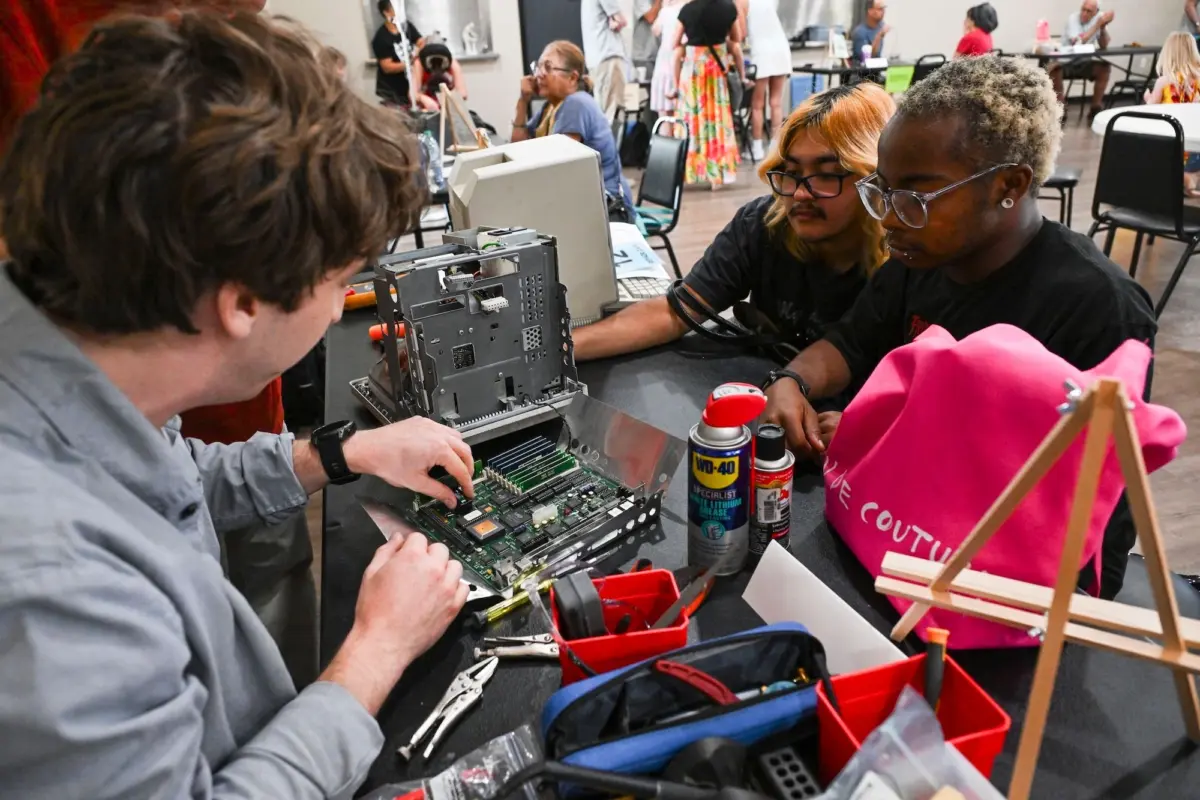
On a cool, rainy Saturday morning in Decatur, Georgia, a steady stream of residents filed into a utilitarian warehouse behind a church parking lot. They carried items that a convenience-driven society would readily dismiss as trash: glitching electronics, wobbly lamps, cracked furniture, and appliances past their prime. Meanwhile, volunteers—outfitted in bright green t-shirts emblazoned with the mantra, “I can probably fix that”—unloaded toolboxes, multimeters, extension cords, and cans of WD-40.
Scenes like this are unfolding with increasing frequency across the United States. Driven by rising inflation, stagnant wages, an urgent ecological awakening, and widespread frustration with corporate planned obsolescence, Americans are flocking to community "repair cafés." These grassroots meetups offer more than just free labor and salvaged belongings; they represent a quiet, determined insurgency against a global "throwaway economy."
While multi-billion-dollar technology and manufacturing conglomerates push a relentless narrative of replacement over repair—locking down software, hoarding spare parts, and designing products to fail—repair cafés are rewriting the social contract. By breathing new life into broken household items, these spaces are fostering human connection, challenging regulatory frameworks, and confronting the staggering carbon footprint of modern consumerism.
Detailed Chronology: A Weekend of Reclamation in Greater Atlanta
Saturday Morning: The Decatur Workshop
The atmosphere inside the Decatur warehouse hummed with a mix of industrial focus and neighborhood camaraderie. Beneath extension cords dangling from exposed rafters, attendees sorted themselves into ad-hoc workshops. Volunteer electricians, tailors, luthiers, carpenters, and even a professional cutler (knife sharpener) commandeered worktables, welcoming curious onlookers into their diagnostic processes.
Among the participants was Lilly Pettus, who found herself standing shoulder-to-shoulder with three strangers. Together, their hands pressed tightly against the fractured joints of a family dining room chair as wood glue set and a volunteer secured a heavy metal clamp.
"This is so interesting," Pettus said, marveling as she inspected the inner mechanics of the chair she had owned for decades. "You never even know how furniture is put together."
The chair held a deep family history. Purchased shortly after Pettus and her husband married in 1996, it was originally chosen to accommodate her exceptionally tall family—including a brother nearly seven feet tall. After sitting broken and forgotten in a corner for months, cluttering her home, Pettus happened to drive past the repair café while running errands. Remembering her child’s environmental internships at the Environmental Protection Agency (EPA) and the family’s shared anxiety over climate change, she turned the car around, fetched the chair, and gave it a second chance.
Elsewhere in the room, a young father watched intently as a volunteer soldered a new switch into a mid-century modern lamp, worn out by the enthusiastic clicking of his toddler. Murmurs of satisfaction swept through the crowd, accompanied by the sharp, familiar scent of spot-welding.
Sunday Afternoon: The Collier Heights Gathering
A half-hour drive away in Atlanta’s predominantly Black Collier Heights neighborhood, the Sunday afternoon repair café carried a different socio-economic reality. Set up in the basement of a Seventh-Day Adventist church against a backdrop of light pink carpeting, volunteers arrived carrying their own toolkits.
While Decatur’s café often drew patrons motivated by sentimentality or ecological hobbyism, Collier Heights reflected a community where economic necessity frequently dictated participation. With a median annual household income roughly $40,000 lower than Decatur’s, residents here frequently sought out repairs simply to keep essential appliances running.
Gale Pines, a recent nursing school graduate, brought in a red air fryer that had short-circuited after being used to dehydrate ginger. Living through grueling nursing school schedules, Pines had relied on the air fryer to cook evening meals because using the conventional oven heated up the entire apartment. Now graduated, facing a tough job market, and unable to afford a new $100 replacement, Pines turned to the local network.
"It’s just hard to exist," Pines admitted. "I don’t really have a very big support network outside of my friends. Being in the height of climate collapse, we can’t just keep buying new stuff all the time, both for the economy and for our material scarcity."
A volunteer quickly diagnosed the problem: a blown capacitor. Another volunteer produced a compatible replacement part from an auxiliary stash, executing the repair in minutes. Although Pines did not master the technical repair firsthand, the value of the interaction resonated deeply. For Pines, the community exchange served as a two-way street of mutual aid—offering medical and health guidance to neighbors in exchange for mechanical salvation.
Supporting Context & Metrics: The Scale of the Throwaway Culture
To understand why community repair cafés have struck such a powerful chord, one must examine the macro-economic and environmental forces shaping modern manufacturing.
The Loneliness of Consumer Disposal
According to Martine Postma, director of Repair Café International—a Netherlands-based network overseeing roughly 4,000 global chapters—the modern consumer market is plagued by isolation.
"When a product breaks and you have to throw it away, it’s very lonely," Postma explains. "It’s easier to just go on the internet and order a new item which will come to your doorstep in 24 hours, but that’s also a very lonely, disconnected activity."
Postma, a former journalist, founded the international organization in 2010 following the birth of her second child. The milestone heightened her anxieties regarding ecological degradation. "Markets are flooded with trash—with cheap products that we don’t need and that do not work," she noted. "They break, and they contribute nothing to our well-being. They just contribute waste."
Environmental Toll and Quantifiable Impact
The environmental repercussions of this "throwaway economy" are catastrophic. Manufacturing new consumer goods drives industrial greenhouse gas emissions, depletes raw earth minerals, and fills landfills at an unsustainable rate.
However, grassroots resistance is yielding measurable results:
Waste Diversion: In 2025 alone, Repair Café International networks successfully diverted nearly 2 million pounds of waste from landfills—the volumetric equivalent of more than 100 fully loaded Boeing 747 aircraft.
Emissions Reductions: The collective repairs prevented greenhouse gas emissions equivalent to the annual energy consumption footprint of approximately 1,000 Dutch families.
Official Statements & Regulatory Battles: The "Nixing the Fix" Crisis
Despite the enthusiasm of volunteers and everyday citizens, repair advocates routinely run into systemic, legally backed roadblocks engineered by corporate manufacturers.
The Federal Trade Commission and Corporate Gatekeeping
A landmark Federal Trade Commission (FTC) report titled "Nixing the Fix" outlines the calculated strategies employed by major corporations to dissuade consumer repairs. According to the report, manufacturers frequently incentivize premature product replacement by:
Designing products with non-removable batteries or glued-shut enclosures.
Restricting the open-market availability of certified replacement parts.
Implementing software locks and digital firmware blockades that reject third-party components.
Actively disparaging independent repair shops as unsafe or unreliable.
Legislative Pushback: Right-to-Repair Laws
The political landscape is slowly shifting. In 2023, landmark "Right to Repair" legislation was enacted in California, Colorado, Minnesota, and New York, legally compelling manufacturers to provide consumers and independent technicians with diagnostic tools, manuals, and parts. A year later, the European Union adopted a sweeping legislative directive echoing similar principles.
Martine Postma and other global organizers view repair cafés as the cultural frontline of this political movement. Beyond localized fixes, Postma advocates for radical structural changes in policy—such as the imposition of heavy raw material taxes in Europe. Such fiscal penalties would artificially elevate the price of newly manufactured goods, thereby leveling the economic playing field for local repair shops and driving down industrial emissions.
"I feel for the objects around me. I feel sorry for them if they’re broken," Postma stated. "I want to make repairing a normal thing in everyday life once more."
Future Outlook: Reclaiming Human Agency in the Age of AI and Climate Collapse
As society navigates compounding crises—ranging from climate destabilization to the alienating rise of artificial intelligence—repair cafés are morphing into sanctuaries of practical self-reliance.
Lew Lefton, a volunteer technician working out of regional repair circuits, argues that humanity has largely surrendered the primal satisfaction derived from making, modifying, and fixing physical items. However, looming apocalyptic anxieties are triggering a profound cultural reversal. People are rushing to re-acquire fundamental, tactile survival skills.
"If the world ends," Lefton remarked with dry pragmatism, "at least I’ll know how to fix a motor."
For participants like Lilly Pettus, the impact extends far beyond mechanical utility. Leaving the Decatur workshop with her newly reinforced dining chair—complete with advice on where to source upholstery fabric for a future visit—she reflected on the empowerment of physical stewardship.
"The beauty of it was that I actually was able to learn more about the chair," Pettus said. "It was a great experience to know that—I’m not gonna say I birthed it, I of course did not—but I actually had something to do with helping to get it put back together."
Ultimately, repair cafés are quietly dismantling the isolation of modern consumerism. By transforming trash into repaired treasures and strangers into collaborative communities, these gatherings prove that the antidote to a throwaway culture isn’t just better recycling—it is a collective reclaiming of our shared material world.