Executive Overview
In the fast-evolving landscape of cloud-native data architecture, organizations constantly seek ways to maximize performance, reduce operational friction, and keep costs under control. Today marks a significant milestone in data lake modernization as Amazon Web Services (AWS) announces the official rollout of managed migrations for Apache Hive tables directly to Apache Iceberg via Amazon S3 Tables.
For years, migrating legacy data lake architectures built on Apache Hive to the modern open standard of Apache Iceberg required massive engineering investments. Enterprises had to design custom conversion pipelines, provision temporary compute clusters, manage complex data type mappings, and build intricate rollback systems—all while risking downtime for mission-critical production workloads.
The newly launched capability within Amazon S3 Tables fundamentally changes this paradigm. By providing a fully managed, API-driven operation, AWS enables data engineers to upgrade their storage layers seamlessly. Source workloads can continue running uninterrupted, pipelines do not need to be built from scratch, and compute resources do not require manual provisioning. Featuring automated data validation, compatibility reporting, and continuous incremental synchronization, this feature eliminates the historical overhead of data lake transformations. Available immediately across multiple global AWS regions, this launch promises to accelerate the industry-wide adoption of Apache Iceberg as the definitive open format for petabyte-scale analytics.
Detailed Chronology: From Custom Engineering to Managed Operations
To understand the weight of this announcement, one must look at the historical trajectory of data lake evolution and the operational pain points that data engineering teams have faced over the past decade.
The Era of Apache Hive and Legacy Formats
Apache Hive emerged early in the big data era as a foundational data warehousing software built on top of Apache Hadoop. It allowed organizations to query and manage large datasets residing in distributed storage using a SQL-like interface. However, as enterprise data volumes scaled into petabytes, legacy formats like Hive tables began to show structural limitations. Features such as granular time-travel queries, schema evolution, and efficient hidden partitioning were either cumbersome or entirely unsupported, prompting organizations to seek more robust, modern table formats.

The Rise of Apache Iceberg
Enter Apache Iceberg. Designed explicitly to bring SQL-like table transactions to massive analytic datasets, Iceberg rapidly ascended to become the open-source standard for large-scale analytics. By decoupling the physical data layout from the logical table structure, Iceberg enables high-performance querying across multiple engines—including Amazon Athena, Presto, Trino, and Spark—without locking enterprises into proprietary formats.
Despite its clear technical superiority, migrating petabyte-scale legacy datasets from Hive to Iceberg remained an arduous undertaking. Engineering teams were forced to write bespoke migration scripts, handle edge-case schema conversions manually, and orchestrate cutovers during tight maintenance windows.
The S3 Tables Solution
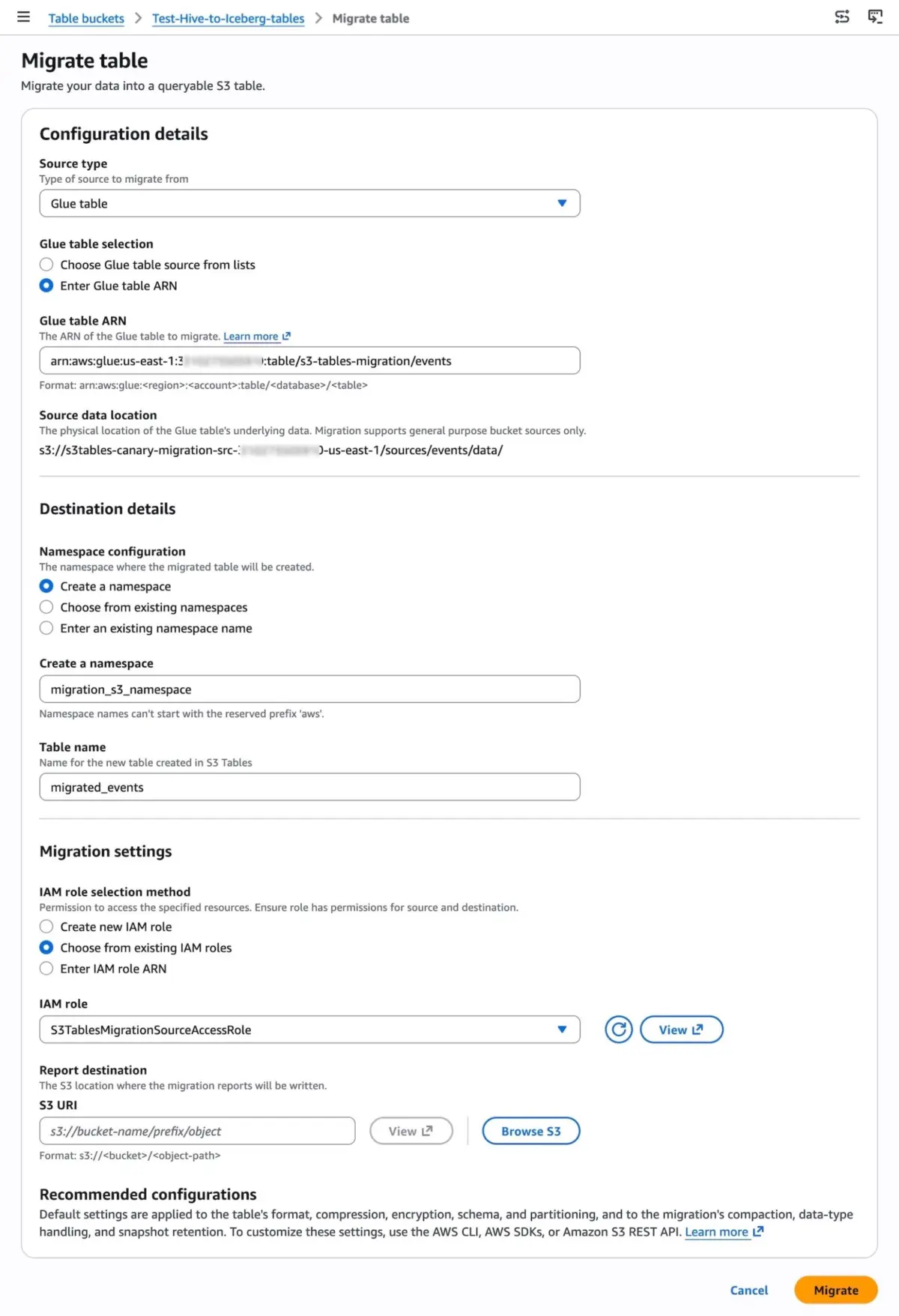
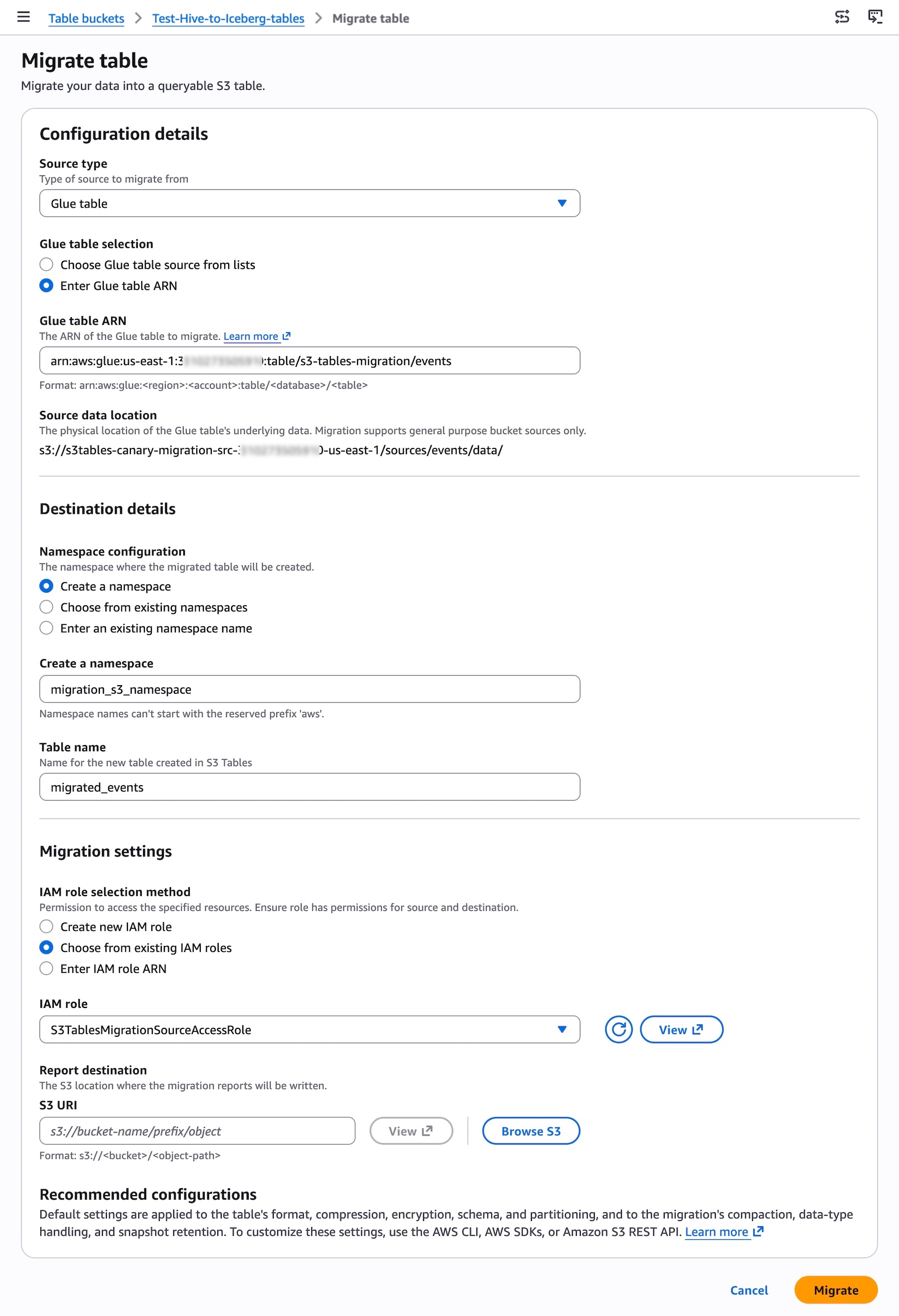
Recognizing these operational bottlenecks, AWS introduced Amazon S3 Tables—purpose-built, fully managed storage designed to keep Iceberg tables performant and cost-effective at scale. The introduction of managed migration takes this a step further. Instead of building infrastructure, teams can now trigger a streamlined, API-driven migration path.
The workflow is meticulously structured:
- Compatibility Assessment: Before any data movement occurs, S3 Tables scan the source Hive table registered in the AWS Glue Data Catalog, performing compatibility checks and generating detailed reports.
- Background Copying and Conversion: S3 Tables manage data validation, type conversions, file recompression, and compaction automatically.
- Continuous Incremental Syncing: Using the
sync-table-migrationoperation, administrators can continuously catch up the destination table with ongoing changes in the source table. Only modified data blocks are copied during each sync. - Minimal-Downtime Cutover: Production write operations to the source table continue uninterrupted until the final cutover, during which the destination Iceberg table is promoted from read-only to read-write status.
Supporting Context & Metrics: Architecture, Costs, and Developer Tooling
Migrating core enterprise data assets requires deep visibility into underlying mechanisms, financial impacts, and programmatic interfaces. The architecture of S3 Tables managed migration is built to address enterprise-grade requirements across security, economy, and scale.

Economic Efficiencies and Storage Tiers
One of the most compelling aspects of the new managed migration path is its pricing model. In traditional self-managed migration strategies, enterprises incurred significant compute charges to spin up processing clusters (such as Amazon EMR or Apache Spark) dedicated exclusively to translating formats, rewriting files, and validating schema mappings.
With S3 Tables managed migrations:
- Zero Conversion Fees: AWS does not charge for the Hive-to-Iceberg conversion process itself. Customers pay strictly for the underlying data copied to the destination table.
- Preservation of Storage Tiers: Source objects stored in Amazon S3 Intelligent-Tiering retain their current access tier throughout the migration process, avoiding unnecessary retrieval or tier-promotion costs.
- Optimized Storage Layouts: Destination tables are automatically structured using recommended default settings tuned for optimal query performance and storage efficiency, incorporating advanced features like binpack compaction and zstd compression.
Programmatic Control via AWS CLI, SDKs, and AI Tooling
Enterprise automation relies heavily on infrastructure-as-code and API integrations. The migration capability can be fully orchestrated using the AWS Command Line Interface (AWS SDKs), and modern developer toolkits.
Below is an example of the JSON configuration utilized to initiate a migration job via the AWS CLI:
  "roleARN": "arn:aws:iam::123456789012:role/S3TablesMigrationRole",
  "destinationTable":
    "tableBucketARN": "arn:aws:s3tables:us-east-1:123456789012:bucket/my-destination-bucket",
    "namespace": "mynamespace",
    "name": "my_destination_table",
    "encryptionConfiguration":
      "sseAlgorithm": "aws:kms",
      "kmsKeyArn": "arn:aws:kms:us-east-1:123456789012:key/1234abcd-12ab-34cd-56ef-1234567890ab"
    ,
    "storageClassConfiguration":  "storageClass": "INTELLIGENT_TIERING" ,
    "tags":  "team": "s3tables", "purpose": "migration" ,
    "properties":
      "writeFormat": "parquet",
      "icebergFormatVersion": 2,
      "compressionCodec": "zstd",
      "dictionaryEncoding": true
    ,
    "schema":
      "type": "struct",
      "schemaId": 0,
      "identifierFieldIds": [1],
      "fields": [
         "id": 1, "name": "id",      "type": "long",   "required": true, "doc": "primary key" ,
         "id": 2, "name": "payload", "type": "string", "required": false
      ]
    ,
    "icebergSortOrder":
      "orderId": 1,
      "fields": [  "sourceId": 1, "transform": "identity", "direction": "asc", "nullOrder": "nulls-first"  ]

  ,
  "sourceType": "glueTable",
  "source":
    "glueTable":
      "catalogId": "123456789012",
      "databaseName": "my_glue_database",
      "tableName": "my_source_table"

  ,
  "dataMigration":
    "maintenanceSettings":
      "icebergCompaction":  "targetFileSizeMB": 512, "strategy": "binpack" ,
      "icebergSnapshotManagement":  "minSnapshotsToKeep": 3, "maxSnapshotAgeHours": 168
    ,
    "migrationPolicies":
      "unmatchedSourceFieldsPolicy": "fail",
      "incompatibleValuesPolicy": "fail"

  ,
  "reviewMigrationPlan": false,
  "migrationOutput":
    "bucket": "arn:aws:s3:::my-report-bucket",
    "prefixes":
      "tableCompatibilityReport": "reports/table-compatibility/",
      "objectCompatibilityReport": "reports/object-compatibility/",
      "objectMigrationReport": "reports/object-migration/"
Executing the job via the CLI is accomplished with a single command:
aws s3tables start-table-migration --cli-input-json file:///tmp/start-migration.jsonFurthermore, for teams leveraging AI-assisted development environments and coding agents, specialized skills within the Agent Toolkit for AWS (such as the migrating-hive-tables-to-s3-tables skill) provide step-by-step guidance, built-in safety guardrails, and direct integration with the AWS MCP Server.
Official Statements and Industry Perspective
The launch reflects AWS’s ongoing commitment to open-table formats and reducing administrative toil for data architects. Industry analysts have long noted that while organizations are eager to embrace open standards like Apache Iceberg, the inertia of legacy data stores often stalls modernization initiatives.
In architectural briefings accompanying the release, AWS engineering leadership emphasized that data lakes should act as agile foundations for enterprise intelligence rather than static repositories burdened by technical debt. By abstracting the complex mechanics of format conversion, file compaction, and incremental synchronization into a managed service, AWS allows data platform teams to redirect their focus toward high-value analytics, machine learning, and business intelligence.
Future Outlook: The Next Wave of Open Data Architecture
As data ecosystems mature, the friction between legacy formats and modern analytics engines will continue to dissipate. The ability to perform frictionless, managed migrations from Apache Hive to Apache Iceberg marks a crucial inflection point in how enterprises manage their data estates.
Looking ahead, we can expect the expansion of managed migration frameworks to encompass additional legacy formats and cross-region architectures. By lowering the barrier to entry for modern table formats, AWS is solidifying Apache Iceberg’s position as the universal standard for analytical data storage. For organizations holding vast archives of historical data in older formats, the path forward is clearer—and significantly more cost-effective—than ever before.
Immediate Availability
Amazon S3 Tables managed migration is available starting today in the following AWS Regions:
- Americas: US East (N. Virginia), US East (Ohio), US West (Oregon)
- Asia Pacific: Asia Pacific (Mumbai), Asia Pacific (Singapore), Asia Pacific (Sydney), Asia Pacific (Tokyo)
- Europe: Europe (Frankfurt), Europe (Ireland), Europe (Stockholm)
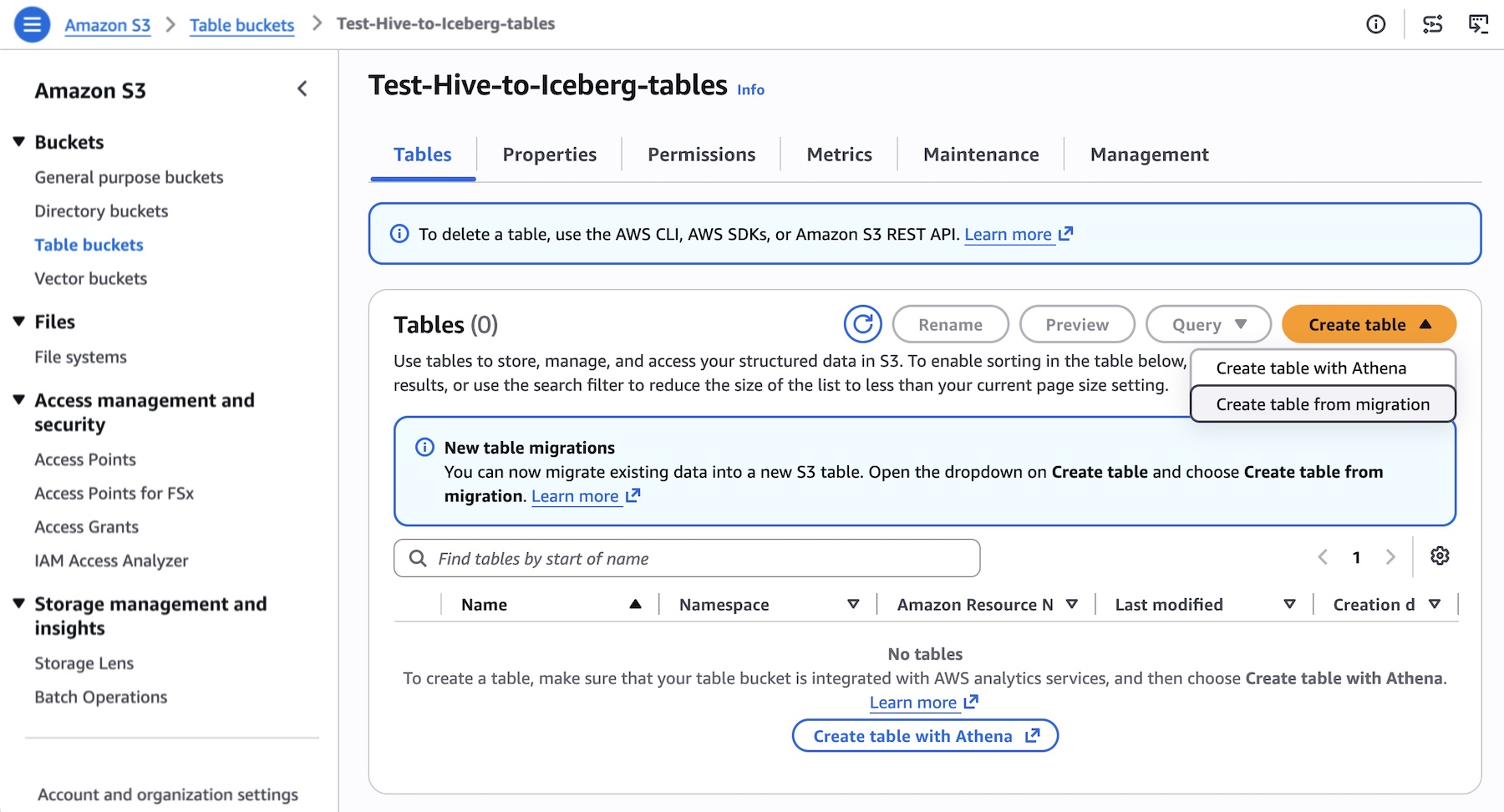
Data engineers and platform administrators can begin evaluating migration plans directly within the Amazon S3 console or by utilizing the AWS CLI, SDKs, and Agent Toolkit for AWS.