Executive Overview
For nearly two decades, Gary Larson’s syndicated single-panel comic strip, The Far Side, served as a cornerstone of modern satirical culture. Blending absurdist philosophy, biological precision, and an aggressively deadpan delivery, Larson established a universe where the boundaries between humans, animals, inanimate objects, and nourishment dissolved entirely. While the strip is frequently celebrated for its cavemen, suburban domesticity, and anthropomorphic cows, a distinct and delightfully unhinged subgenre of The Far Side relies entirely on the concept of food.
From sentient sandwiches operating within complex, organized crime syndicates to existential wilderness encounters where campers are misidentified as breakfast items, Larson’s culinary strips elevate the mundane into the metaphysical. This retrospective examines seven of the most culturally enduring and darkly comedic food-themed entries from The Far Side, evaluating their structural humor, psychological underpinnings, and lasting impact on popular culture. By exploring these panels, we gain a deeper appreciation for Larson’s unique ability to merge high-concept surrealism with lowbrow slapstick, creating an immortal legacy that continues to resonate decades after the final panel was drawn.
Detailed Chronology: The Evolution of Larson’s Culinary Canvas
To understand how food evolved from a background prop into the emotional and narrative center of The Far Side, one must examine the chronological progression of Larson’s work. Over the operational span of the comic strip from 1980 to 1995, Larson steadily pushed the envelope of what inanimate and consumable objects were allowed to experience.
July 9, 1981: The Macabre Butcher Shop
Early in the 1980s, Larson established that his fictional universe operated under قوانین (laws) entirely detached from terrestrial reality. In this early entry, Larson explores the dark underbelly of the local butcher shop. Rather than traditional cuts of meat, the panel introduces a deeply unsettling transaction that blurs the line between commerce and cannibalism. Featuring a customer negotiating over a young human employee, this strip set a high-water mark for the macabre. It demonstrated Larson’s willingness to cross the threshold into psychological horror, forcing readers to question the power dynamics of who—or what—is considered consumable.
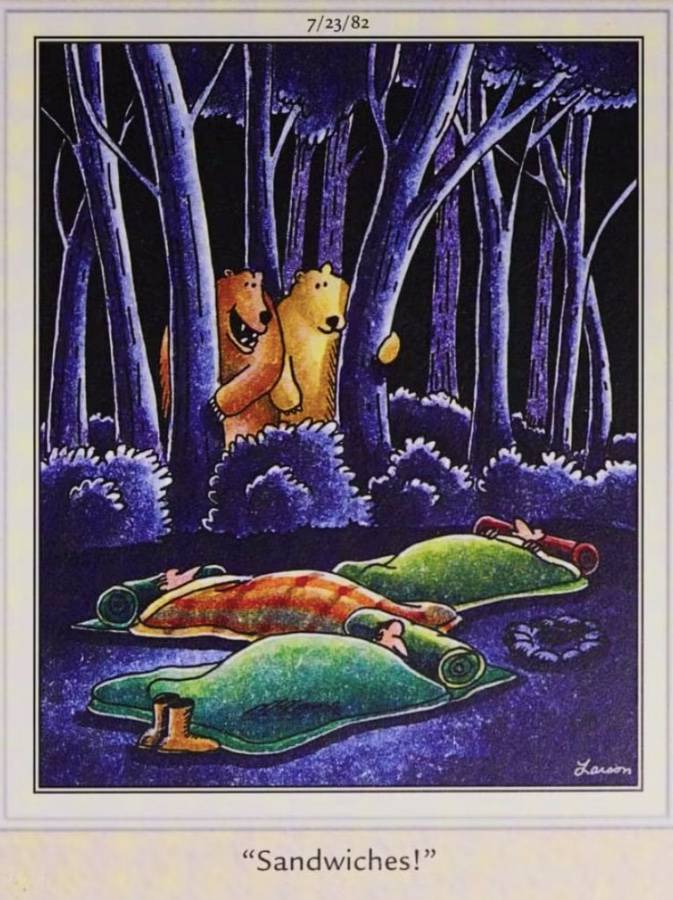
July 23, 1982: The Sleeping Bag Misidentification
As Larson refined his comedic timing, he frequently utilized mistaken identity as a narrative device. In this mid-summer panel, a pair of jovial, anthropomorphic grizzly bears stumble upon a campsite containing hikers safely zipped inside their sleeping bags. The bears’ joyful exclamation of "Sandwiches!" instantly recontextualizes the camping trip into a fast-food drive-thru. While human readers might debate whether a sleeping bag more closely resembles a burrito or a pita wrap, the joke hinges on the bear’s simplistic, apex-predator perspective. It is a masterclass in reducing complex human rituals down to basic predatory appetites.
June 11, 1984: The Highbrow-Lowbrow Soup
By the mid-1980s, Larson’s stylistic confidence allowed him to construct jokes that required active intellectual labor from his readership. The June 11, 1984 strip appears, at first glance, completely benign. Featuring the caption, "Soup of the day is ready!" a restaurant patron or chef stands proudly over a steaming kettle. However, the punchline remains entirely invisible until the reader notices a crucial detail: the chef is missing a shoe.

This strip represents the zenith of Larson’s comedic philosophy. It demands high-concept patience—requiring the audience to scan the image for anomalies—only to deliver a fundamentally lowbrow, grotesque punchline. Larson never pandered to his audience; he trusted that readers would either track down the joke or be left behind, a creative integrity that cemented The Far Side‘s longevity.
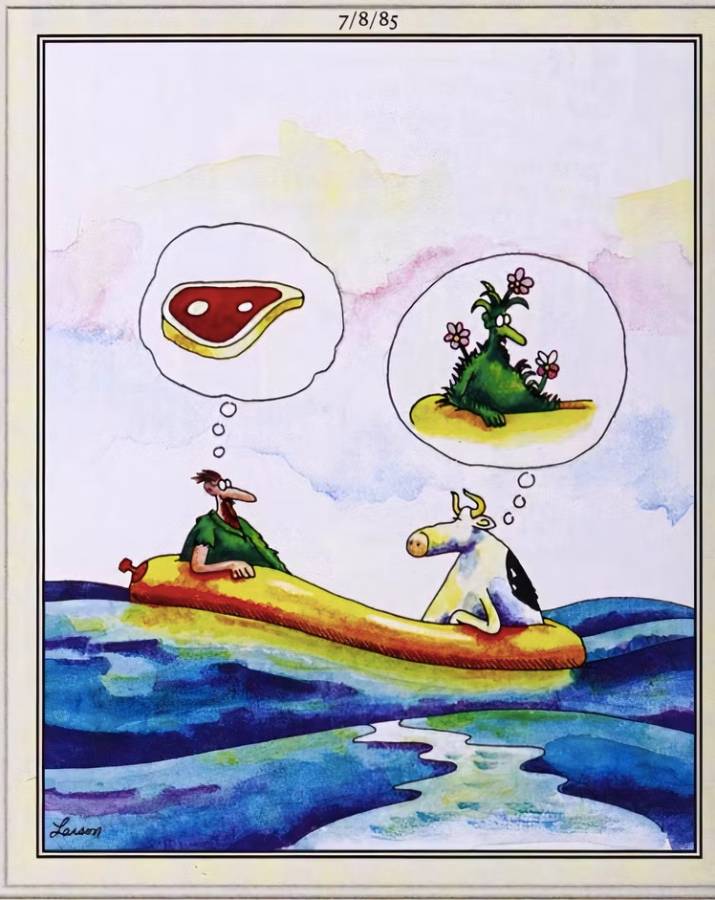
July 8, 1985: The Lifeboat Reversal
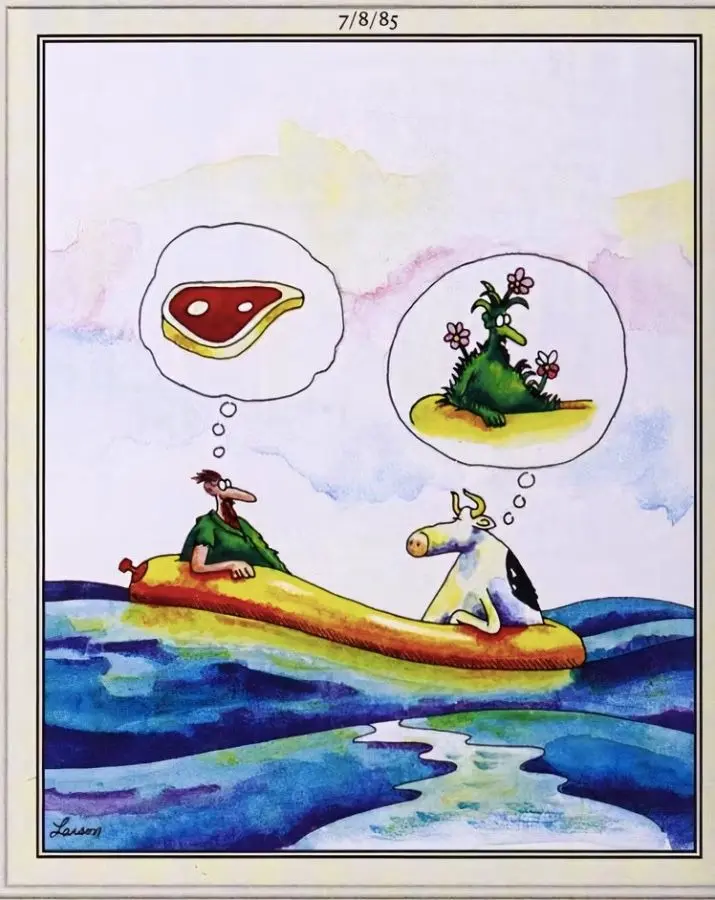
Playing on the classic desert-island or lifeboat trope where a starving person hallucinates their companion as a roasted chicken or a rack of ribs, Larson flipped the dynamic on its head. Trapped together in a tiny maritime vessel, a man and a cow stare blankly at one another. True to form, the man visualizes a thick, juicy steak. The cow, however, looks back at the human and envisions a sprawling, manicured lawn of man-shaped grass. This brilliant inversion highlights Larson’s lifelong fascination with bovine perspectives, a recurring motif that treated livestock as sentient, philosophical agents.
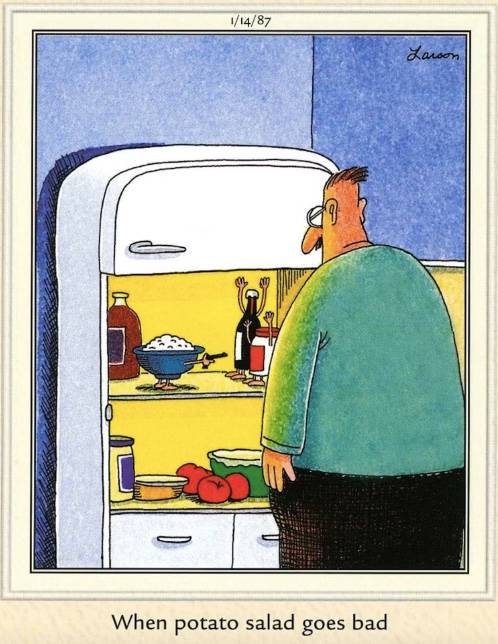
January 14, 1987: The Potato Salad Syndicate
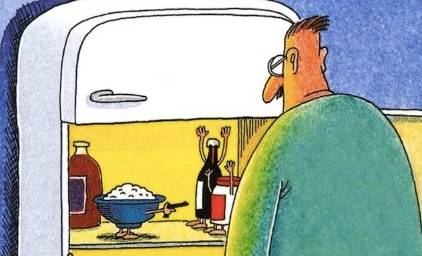
Food safety has rarely been explored through the lens of organized crime, but Larson dared to bridge the gap. In this 1987 panel, the natural degradation of picnic side dishes is personified as a criminal enterprise. Potato salad "going bad" is interpreted not as bacterial spoilage, but as a deliberate turn toward a life of illicit activity. The panel leans into the absurdity of culinary decomposition, treating food spoilage with the gravitas of a Martin Scorsese film.
February 28, 1987: The Waffle Iron Existential Dread
Few panels in the entire run of The Far Side capture the crushing weight of modern domestic routine quite like the "Slave to the waffle light" strip. Introducing us to a character named Wendell Zurkowitz, Larson captures the hypnotic, helpless state of waiting for a breakfast appliance to signal readiness. It is a piece of art that speaks to a profound, universal truth: modern humanity is frequently beholden to simple, automated indicators. Decades later, generations of home cooks still murmur variants of this phrase while standing guard over their kitchen counters.
March 16, 1994: The Sandwich Mafia
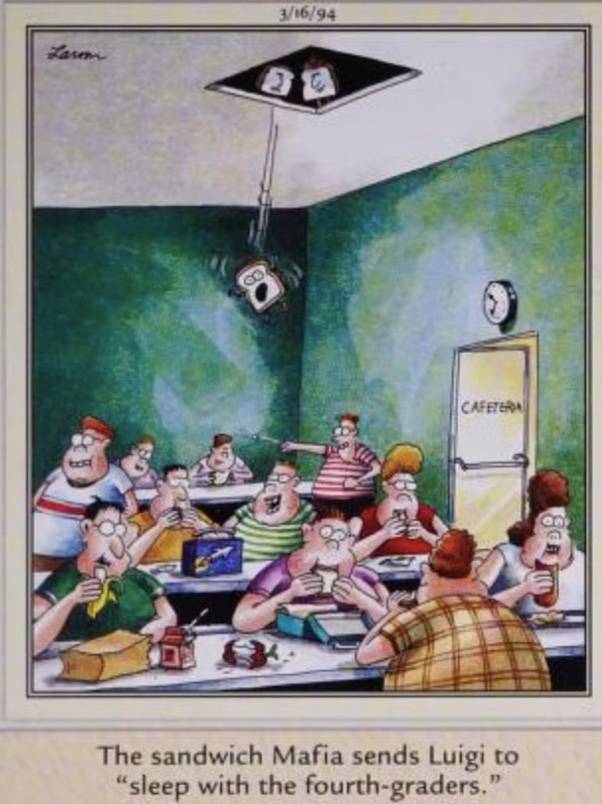
Published late in the strip’s run, the Sandwich Mafia panel stands as one of the most purely imaginative cartoons Larson ever produced. Here, sandwiches possess not only sentience and complex societal structures, but also a vicious criminal underground. The punishment inflicted by this rogue deli mafia? Being hurled mercilessly into a pit of chaotic fourth-graders. Featuring a particularly menacing youth in a green striped shirt, this strip combines nostalgic schoolyard terror with surrealist food science, creating an image that is as hilarious as it is deeply unsettling.
Supporting Context & Metrics: The Cultural Footprint of The Far Side
To fully comprehend the cultural gravity of these food-centric strips, it is necessary to examine the broader context of Gary Larson’s publishing phenomenon.
- Syndication Reach: At its peak, The Far Side was syndicated in over 1,900 daily newspapers worldwide, translating into dozens of languages and reaching millions of readers every morning.
- Book Sales: The collected editions of The Far Side, including The PreHistory of The Far Side and various thematic anthologies, sold tens of millions of copies, becoming permanent fixtures on coffee tables across the globe.
- The "Larson" Effect on Science and Nature: Beyond food, Larson’s depictions of biology, anthropology, and wildlife earned him immense respect from the scientific community. Notably, a species of chewing louse (Strigiphilus garylarsoni), a butterfly (Serratocampylia garylarsoni), and an extinct owl (Ornimegalonyx oteroi — wait, no, Strigiphilus garylarsoni is the primary example) were named in his honor.
- The Culinary Appeal: Food-themed cartoons represent roughly 5% to 8% of Larson’s total output, yet they consistently rank among the most frequently referenced panels in digital fan communities, culinary blogs, and pop-culture retrospectives.
Official Statements and Creator Philosophy
Gary Larson has famously maintained a relatively low profile since concluding The Far Side in 1995, occasionally emerging to discuss his creative process, syndication battles, and the accidental nature of his success.
In archival interviews and the forewords of his retrospective collections, Larson frequently noted that his cartoons were born out of a lifelong obsession with how things work—and how they shouldn’t work. Reflecting on his anthropomorphic subjects, Larson explained that animals and inanimate objects provided a necessary buffer against the mundane realities of human-centric cartooning.
"When you draw a human, you are bound by the rules of society, anatomy, and logic," Larson noted in retrospective commentary. "When you draw a sentient potato salad or a grizzly bear viewing a camper as a pita wrap, all those rules vanish. You are suddenly free to explore the absolute nonsense of existence."
Larson’s editor at Chronicle Books and Universal Press Syndicate frequently emphasized that the cartoonist’s refusal to explain his jokes was his greatest asset. Whether readers immediately understood the missing shoe in the soup of the day or took a moment to parse the hierarchy of the Sandwich Mafia, Larson trusted his audience’s intellect. This mutual respect fostered a deeply devoted readership that viewed The Far Side not merely as a comic strip, but as a daily intellectual exercise in surrealism.
Future Outlook: The Enduring Legacy of Larson’s Absurdism
As we look toward the future, the cultural footprint of The Far Side shows no signs of diminishing. In an era dominated by rapid digital content, algorithmic feeds, and ephemeral memes, the single-panel structural integrity of Gary Larson’s work remains a gold standard for visual humor.
The food-centric comics, in particular, have found a thriving second life in the digital age. Culinary subreddits, food-blog meme pages, and social media platforms regularly circulate panels like the Sandwich Mafia or the Waffle Iron existential dread to modern audiences who may not have been born when the ink first dried. The universality of food—combined with Larson’s completely unhinged imagination—ensures that these jokes transcend generational divides.
Ultimately, Gary Larson taught us that humor can lurk in the most unexpected places: inside a picnic cooler, at the bottom of a soup kettle, or wrapped tightly inside a down-filled sleeping bag. As long as humanity continues to cook, eat, and occasionally stare blankly at kitchen appliances, The Far Side will remain a vital, hilarious mirror reflecting the glorious absurdity of everyday life.