Executive Overview
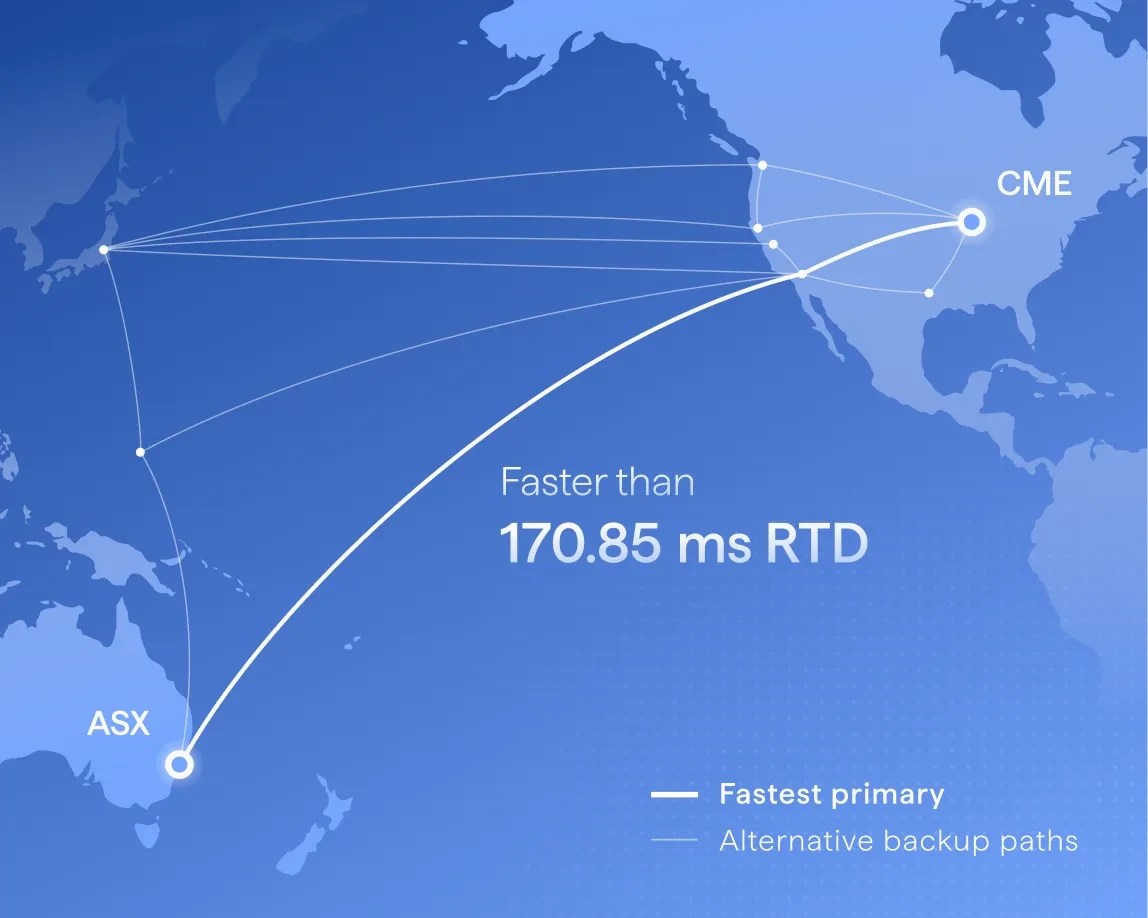
In an era where micro-seconds dictate the profitability of multi-million-dollar cross-border trades, connectivity infrastructure provider Avelacom has raised the stakes for transpacific financial communication. The company officially launched its ultra-low-latency fibre route linking the Australian Securities Exchange’s (ASX) Australian Liquidity Centre in Sydney directly with CME Group’s Aurora data centre in Illinois. Delivering a blistering round-trip delay of just 170.85 milliseconds, this newly optimized pathway shaved approximately one full millisecond off previous benchmarks, positioning it as the fastest available direct optical route between the two critical financial hubs.
Achieved through the strategic integration of a confidential North American point of presence (PoP), the development underscores a broader, high-stakes balancing act defining modern financial markets: the relentless pursuit of speed versus the non-negotiable imperative of route resilience. While cloud and content providers dominate the vast majority of transpacific bandwidth—accounting for over 80% of used capacity as of 2024—proprietary trading firms, market makers, and institutional broker-dealers view infrastructure through a different lens. For these entities, managing asynchronous price shocks across global markets requires a delicate equilibrium between ultra-fast primary paths and thoroughly vetted, physically diverse backup routes.
Against a backdrop of surging transpacific investments—projected to surpass US$3 billion in new subsea cable constructions between 2026 and 2029—Avelacom’s latest rollout provides a clear window into how financial networks are hardening their defenses. As geopolitical sensitivities and infrastructure vulnerabilities take center stage, market participants are no longer merely asking how fast a connection is; they are rigorously examining what happens when the primary line goes dark.
Detailed Chronology and Technical Architecture
The architecture behind Avelacom’s record-shattering 170.85ms round-trip connection is the culmination of meticulous network optimization, strategic routing choices, and precise deployment schedules.
- October 2023: Major tech initiatives begin reshaping the South Pacific corridor. Google announces its South Pacific Connect initiative, featuring the Tabua and Honomoana subsea cable systems designed to enhance geographic diversity and bridge Australia directly to mainland United States via intermediate hubs like Fiji, Hawaii, and French Polynesia.
- January 2026: SUBCO unveils APX East, a massive 16-fibre-pair subsea cable system linking Sydney and San Diego, California, engineered to provide an uninterrupted optical path without intermediate regeneration facilities or landing points.
- April–September 2026: Industry research by TeleGeography highlights a massive surge in global international internet bandwidth—hitting 2,259 Tbps by mid-2026 (a 23% year-on-year increase)—while forecasting that transpacific cable investments will nearly double compared to the previous three-year cycle, topping US$3 billion. Simultaneously, AI infrastructure firm Firmus injects approximately US$300 million to secure 25-year dedicated capacity on APX East.
- September 2026: Geopolitical and infrastructure risks are brought to the forefront by the China Strategic Risks Institute. A report titled China’s Gray Zone Threats to Trans-Pacific Undersea Cables models the devastating impact of physical cable cuts, illustrating how traffic rerouting can inflate round-trip latencies (such as Taiwan-US routes jumping from 231.5ms to 279.2ms) and strain global financial networks.
- 19 November 2026: Avelacom officially announces the deployment of its new Sydney-to-Illinois fibre route. By introducing a confidential, strategically placed North American PoP, the company establishes a more direct optical trajectory, dropping the round-trip latency to 170.85ms—the fastest reported fibre connection between the ASX’s liquidity center and CME Group’s Aurora facility.
The Mechanics of Low-Latency Trading
To understand the operational significance of this 1ms saving, one must examine the operational realities of cross-border derivatives and futures trading. During Sydney’s night session, market makers handling ASX SPI 200 futures—contracts that track Australia’s benchmark S&P/ASX 200 index—operate under immense pressure. Because these assets are closely correlated with US equity and index futures, a sharp, sudden movement in Chicago or New York requires immediate defensive action in Sydney.
If a trading desk experiences even a fractional delay in receiving pricing updates or executing hedging orders, its resting quotes become "stale." High-frequency arbitrageurs and automated systems can exploit these outdated prices, exposing market makers to severe financial losses. The exact same dynamics apply to interest rate trading desks managing US-Australia yield spreads. In these environments, microsecond advantages compound into massive risk-mitigation benefits, proving that optical speed is not merely a vanity metric, but a core component of risk management.
Supporting Context, Metrics, and Market Dynamics
The deployment of Avelacom’s route occurs within a rapidly evolving telecommunications ecosystem characterized by exponential bandwidth consumption and shifting investment paradigms.

According to TeleGeography data cited in the OECD’s Digital Economy and Society Outlook 2026, content and cloud providers consume an overwhelming 80.2% of used transpacific bandwidth. The Oceania region alone recorded a blistering compound annual growth rate (CAGR) of 25% between 2022 and 2026, driven by an insatiable hunger for cloud storage, video streaming, and artificial intelligence model training data.
However, while hyperscalers drive absolute volume, the financial sector dictates the bleeding edge of engineering optimization. Financial institutions operate with a unique sensitivity profile:
- Deterministic Latency: Financial systems require jitter-free, highly predictable packet delivery over absolute minimization of delay.
- Capacity Scalability vs. Speed: While hyperscalers purchase massive multi-terabit pipes (such as Firmus securing 150 Tbps on the upcoming APX East cable), financial firms demand specialized, ultra-low-latency wavelengths capable of carrying rapid-fire FIX protocol messages without queuing delays.
The Imperative of Route Diversity and Backup Paths
Speed without a safety net is an unacceptable liability in modern institutional trading. When primary transpacific lines suffer outages—whether caused by seismic activity, accidental ship anchor strikes, or geopolitical interference—trading desks face catastrophic market blind spots if their backup infrastructure fails.
To mitigate these risks, Avelacom anchors its premier 170.85ms connection with secondary and tertiary pathways. The network provides failover options transiting through Guam and Tokyo, alongside redundant North American terrestrial entry points in Los Angeles, Seattle, Hillsboro, and San Jose.
However, Lorenz Voss, Managing Director of US Operations at Avelacom, emphasizes that true redundancy goes far beyond simply having a second circuit.
"Two circuits can still share a subsea cable, a landing station, or a stretch of terrestrial fibre," Voss notes. "Customers want to understand where those paths overlap and how much latency the backup adds."
When primary routes degrade or fail, trading firms must dynamically reconfigure their algorithmic risk models. Even if a backup route introduces higher latency—and Avelacom notes that exact backup performance metrics vary based on bespoke customer configurations—knowing the exact performance parameters allows risk systems to selectively throttle certain automated strategies while keeping core hedging engines active.

Official Statements and Industry Insights
Industry leaders are increasingly vocal about the dual mandates of speed and network resilience. Lorenz Voss highlights the operational necessity of bridging geographically isolated markets during overlapping trading hours:
"If US equity futures move sharply, the firm may need to update its Australian quotes before someone trades against a stale price… That’s where low latency matters. It shortens the time between seeing the move in one market and acting on it in the other."
Addressing the critical nature of disaster recovery planning in the wake of heightened security awareness regarding subsea infrastructure, Voss points out that institutional clients now demand total transparency regarding physical infrastructure routing:
"A backup can be slower and still meet their needs if they know what performance to expect. It all comes down to two questions for trading firms: How fast is the connection from exchange to exchange, and what performance can we expect if the primary path goes down?"
This sentiment is echoed by macroeconomic trends across the Pacific. With over US$3 billion earmarked for new cable deployments over the next three years, network operators are racing to construct systems that avoid traditional bottleneck choke points. Projects like Google’s Tabua and Honomoana, alongside SUBCO’s APX East, demonstrate an industry-wide commitment to establishing independent, geographically diverse corridors that insulate global capital markets from localized disruptions.
Future Outlook: The Next Frontier of Transpacific Connectivity
As the digital economy marches toward 2030, the convergence of high-frequency finance, artificial intelligence, and cloud hyperscaling will continue to reshape transpacific telecommunications. Several key trends will dictate the evolution of routes like the Sydney-to-Illinois corridor:
- AI-Driven Traffic Management: With AI infrastructure companies investing hundreds of millions of dollars in dedicated transpacific capacity (such as Firmus’s massive commitment on APX East), network architects will increasingly deploy smart, software-defined networking (SDN) layers capable of dynamically shifting financial data packets onto priority wavelengths while routing bulk AI training loads over alternative paths.
- Mitigating Gray-Zone and Physical Threats: Following investigative warnings regarding the vulnerability of subsea cables, future transpacific builds will place unprecedented emphasis on submarine route diversity, landing station hardening, and multi-path redundancy to protect critical financial arteries from geopolitical flashpoints.
- Microsecond Optimization Limits: As fibre-optic transmission approaches the theoretical speed of light within glass (roughly two-thirds the speed of light in a vacuum), incremental latency gains will become increasingly difficult and expensive to achieve. Consequently, network providers will compete less on raw millisecond shavings and more on ultra-reliable low-latency (URLL) guarantees, zero-jitter consistency, and transparent, pre-engineered failover topologies.
Ultimately, Avelacom’s successful deployment of the Sydney-CME fibre route illustrates that the future belongs to network providers who refuse to choose between speed and security. For global financial markets, the winning formula is clear: blazing-fast primary performance backed by unshakeable, fully transparent resilience.