Executive Overview
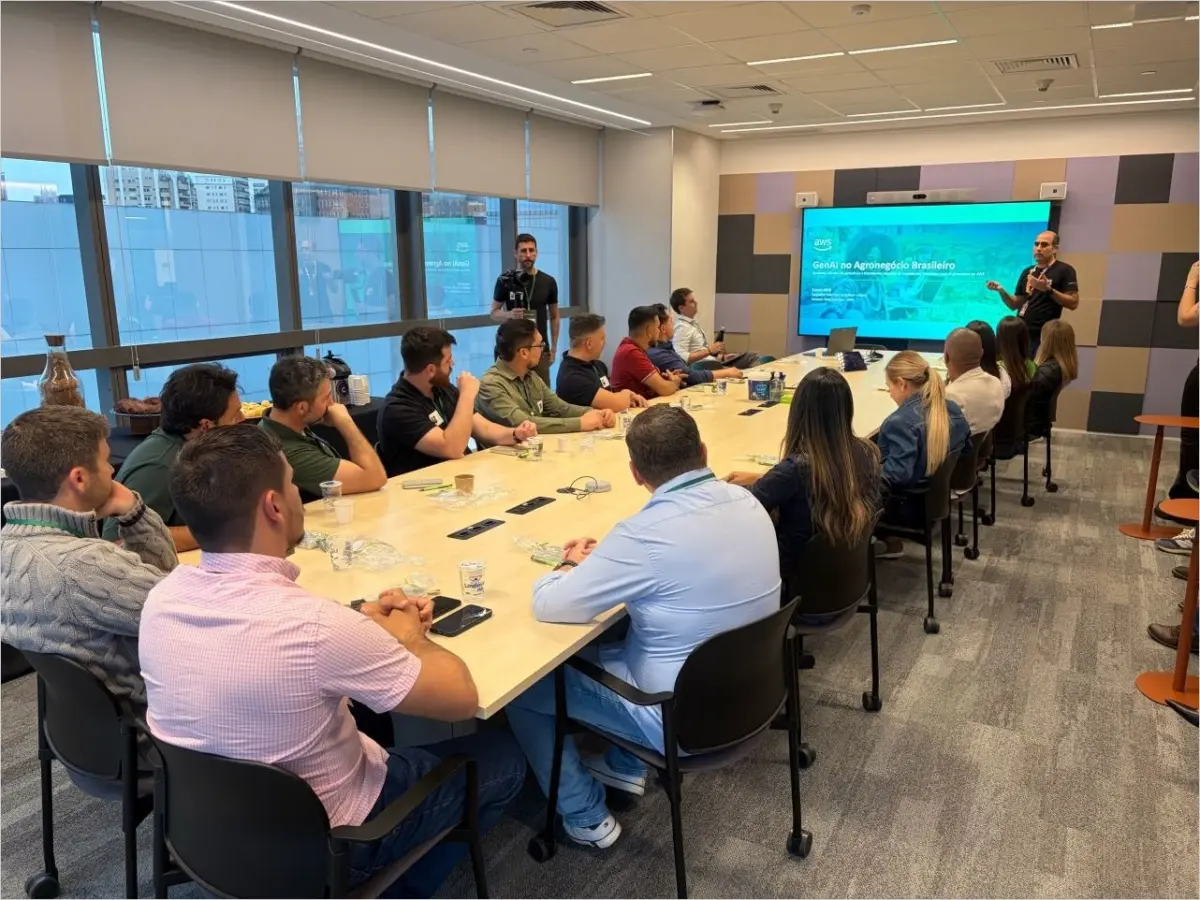
The pace of enterprise infrastructure and cloud architecture evolution has officially accelerated past traditional operational paradigms. In a recent briefing to technology and commercial leaders from the Brazilian agribusiness sector at the Amazon Web Services (AWS) office in São Paulo, the central thesis was clear: generative artificial intelligence (AI) has moved past the experimental phase and is deeply integrated into the operational stack of legacy industries.
For sectors like agriculture, where connectivity and user interaction often occur behind the steering wheel of a tractor or across remote rural expanses, the primary architectural hurdle is no longer model capability—it is interface delivery. When users operate in high-mobility environments, voice becomes the definitive user interface. This reality underscored a major update to the Amazon Polly Generative engine, which introduced 14 new voices, including vital localization support for Brazilian Portuguese.
Yet, while human-computer interfaces become increasingly fluid, the broader operational landscape grows sharply adversarial. Recent intelligence and product releases from AWS highlight a sobering industry reality: the traditional patch window—historically measured in weeks or days following a vulnerability disclosure—has been effectively compressed to zero. Exploits frequently circulate before public disclosures or patches become widely available.
To address this compressed threat landscape, AWS has launched AWS Continuum, fundamentally reframing vulnerability management from a passive reporting mechanism into an automated, context-driven remediation pipeline. Alongside this security paradigm shift, this week’s deployment wave spans serverless application networking with Amazon ECS Gateway, native PyTorch support for AWS Trainium via TorchNeuron, serverless database migrations, and advanced agentic architecture tools. This executive briefing provides a comprehensive analysis of these developments, detailing their architectural implications, operational metrics, and strategic positioning for enterprise cloud architects.
Detailed Chronology & Technical Breakdown
1. Security Architecture: AWS Continuum and the Collapse of the Patch Window
The most critical enterprise risk highlighted this week is the operational reality that vulnerability disclosure dates no longer align with initial exploitation timelines. Amazon Threat Intelligence telemetry captured a PHP2Shell exploitation attempt (tracked via MadPot) on October 17, a full four days before CVE-2026-109618 and CVE-2026-109619 were publicly disclosed. Worse still, proof-of-concept (PoC) exploits were actively circulating on public networks roughly twelve hours before the official embargo lifted.
[Threat Discovered in Wild] ──(4 Days)──> [CVE Disclosed] ──(12 Hours)──> [Public PoC Explosion]
      ▲                                                                         │
      └──────────────────────────[Traditional Patch Window: BROKEN] ────────────┘
This temporal compression renders legacy vulnerability scanners—which drop massive lists of unranked CVEs onto engineering teams—obsolete. In response, AWS has generally released AWS Continuum, a service designed to treat vulnerability management as an end-to-end operational pipeline rather than a static reporting chore.
How AWS Continuum Operates
- Context Graph Construction: Continuum maps code repositories directly against the live AWS cloud environment, correlating infrastructure topology with application dependencies.
- Evidence-Based Ranking: Findings are prioritized based on how closely an active attack path runs to business-critical systems, cutting through the noise of raw CVSS severity scores.
- Isolated Sandbox Reproduction: Exploitable findings are safely reproduced inside an isolated sandbox using generated proof-of-concept code. Security and engineering teams do not look at a severity label; they witness the exploit vector directly.
- Automated Pull Request Remediation: Once verified, the service generates and opens a remediation pull request.
Crucially, AWS has maintained a strict control boundary: every remediation currently requires explicit human approval. Engineers review and merge the pull request, establishing a safe bridge toward future autonomous mitigation gated by strict confidence thresholds. Currently, AWS Continuum is available in the US East (N. Virginia) and US West (Oregon) regions.
2. Application Networking: Scaling Microservices with Amazon ECS Gateway
Managing ingress, TLS termination, and traffic routing for hundreds of microservices running on Amazon Elastic Container Service (ECS) has historically forced platform teams into complex load balancer topologies. Amazon ECS Gateway solves this structural friction by cleanly dividing operational responsibilities between network platform teams and application developers.
                   ┌────────────────────────────────────────┐
                   │        Platform Team Controls:         │
                   │  Subnets, Security Groups, TLS, WAF    │
                   └───────────────────┬────────────────────┘
                                       │
                                       ▼
                         ┌───────────────────────────┤
                         │    Amazon ECS Gateway     │
                         └─────────────┬─────────────┘
                ┌──────────────────────┼──────────────────────┐
                ▼                      ▼                      ▼
        ┌──────────────┐       ┌──────────────┐       ┌──────────────┐
        │  Service A   │       │  Service B   │       │  Service C   │
        └──────────────┘       └──────────────┘       └──────────────┘
          (App Teams opt-in via Gateway Connector)
Operational Mechanics
- Platform Team Provisioning: Platform engineers define a single centralized gateway containing the organization’s subnets, security groups, TLS certificates, listener settings, and AWS WAF web access control lists (ACLs).
- Application Team Opt-In: Application teams simply attach a gateway connector to their service definitions. Amazon ECS automatically provisions an ACM certificate, generates a unique DNS hostname, configures listener rules, establishes target groups, and applies a security group that restricts inbound traffic exclusively to the Application Load Balancer (ALB).
Economic and Scale Metrics
- Resource Density: Up to 25 distinct services can securely share a single Application Load Balancer.
- Lifecycle Automation: ECS dynamically provisions the first ALB upon initial connection and safely decommissions ALBs when services scale down to zero usage.
- Cluster Capacity: A single gateway can associate with up to 10,000 clusters, with a maximum of five gateways permitted per cluster.
- Migration Path: Teams can adopt the gateway incrementally using the
UpdateServiceAPI without taking down existing load balancers.
Amazon ECS Gateway is available at no additional charge across all commercial AWS regions where Amazon ECS operates.
3. Machine Learning and Silicon: TorchNeuron and Generative Engine Upgrades
TorchNeuron: Native PyTorch Support for AWS Trainium (Public Beta)
Hardware choices should never lock software architectures into proprietary silos. To ensure maximum model portability, AWS announced TorchNeuron, an open-source PyTorch backend designed to run deep learning models on AWS Trainium chips with minimal friction.
Instead of rewriting model architectures, developers can target Trainium hardware simply by changing code calls to .to('neuron'). Eager execution and torch.compile remain fully intact. TorchNeuron integrates deeply with the Neuron Kernel Interface for custom operators and supports both Trainium2 and Trainium3 instances, launching alongside the release of AWS Neuron 2.33.
Amazon Polly Generative Engine Upgrade
The Amazon Polly text-to-speech service received a major architectural upgrade to its Generative engine. The catalog now encompasses 57 generative voices across 11 languages and 25 locales. This release introduces 14 new voices across 9 locales, bringing Hindi and Finnish to the platform for the first time, alongside two distinct Brazilian Portuguese voices: Leo and Carolina. Because this is deployed as a drop-in upgrade, existing API calls (SynthesizeSpeech), voice identifiers, and pricing tiers remain unchanged while delivering significantly more natural prosody.
Supporting Context, Metrics, & Ecosystem Updates
Custom Model Training on Amazon SageMaker AI
Managing distributed GPU clusters for post-processing and reinforcement learning loops has long created infrastructure overhead for data science teams. SageMaker AI now offers generally available Training Sessions, allowing engineers to retain full programmatic control over custom loss functions, training loops, and reward signals while AWS abstracts away GPU allocation, distributed cluster execution, fault recovery, and checkpoint persistence.
Users are billed strictly for the active tokens processed by SageMaker AI; the billing meter pauses while custom reward functions compute batch evaluations. This update coincides with native integration support for Muse Glimmer, Qwen 3.8, and Ministral 3, alongside structured JSON output generation for Anthropic Claude models on Amazon Bedrock. Developers can now extract strictly schema-compliant JSON payloads from Claude models without maintaining complex custom parsing logic or retry loops.
Zero-Downtime Database Migration: ElastiCache Serverless for Valkey
Migrating enterprise in-memory datastores traditionally involves risky cutovers or complex third-party replication layers. Amazon ElastiCache Serverless for Valkey now natively supports online migrations from self-managed Valkey or Redis OSS instances running on Amazon EC2 with zero downtime.
Measured against rigorous SLA availability metrics, the migration pipeline ensures zero dropped client requests during the cutover phase. Administrators prepare the migration configuration, initialize continuous background data synchronization, and execute either a manual or automatic cutover. This capability is now available across all commercial, China, and AWS GovCloud regions.

Official Statements & Industry Insights
The convergence of security automation, agentic tooling, and high-performance machine learning highlights a broader philosophy within modern cloud engineering: reducing undifferentiated heavy lifting so developers can focus entirely on resilience and business logic.
"When your user has both hands on a steering wheel crossing a remote farm, the interface is a voice. Traditional markets are precisely where keeping up with AI tooling dictates who stays ahead of the curve."
— AWS Cloud Technology Strategist (during the São Paulo Agribusiness Briefing)
Furthermore, recent findings from Amazon Threat Intelligence regarding zero-day exploitation velocity underscore the inadequacy of static perimeter defenses:
"A patch window measured in days assumes an operational delay that adversaries no longer respect. Investigations and automated remediation loops must originate from the earliest recorded exploitation telemetry, not the public disclosure date."
Future Outlook & Upcoming Events
As cloud architectures prepare for the close of the 2026 calendar year, engineering organizations must evaluate their readiness for agentic workflows, automated remediation pipelines, and high-density microservice networking.
- AWS Community Day Brasil Norte: Scheduled for October 31 in Belém, closing out the vibrant 2026 Brazilian developer community season.
- AWS re:Invent 2026: Running from November 30 to December 4 in Las Vegas, Nevada. With over 2,200 technical sessions scheduled and session catalog reservations now live, enterprise cloud architects are advised to finalize their schedules to secure access to deep-dive workshops on Trainium scaling, agentic architectures, and automated cloud security.
Organizations that proactively integrate automated context-driven security services like AWS Continuum, modernize their ingress topologies with ECS Gateway, and leverage decoupled training sessions on SageMaker AI will be best positioned to outpace the rapid compression of modern threat and operational lifecycles.