In an era saturated by hyper-curated, algorithmic monotony, the global fashion landscape occasionally throws up an anomaly: a creator so distinct, so unapologetically disruptive, that they force the entire digital ecosystem to pause and recalibrate. Enter Rico Akhtar. Operating under the digital moniker @prettygangslr, the 23-year-old creator hailing from Oldham, Greater Manchester, has swiftly evolved from a regional social media curiosity into a cult fixture of the Dazed Fashion Network.
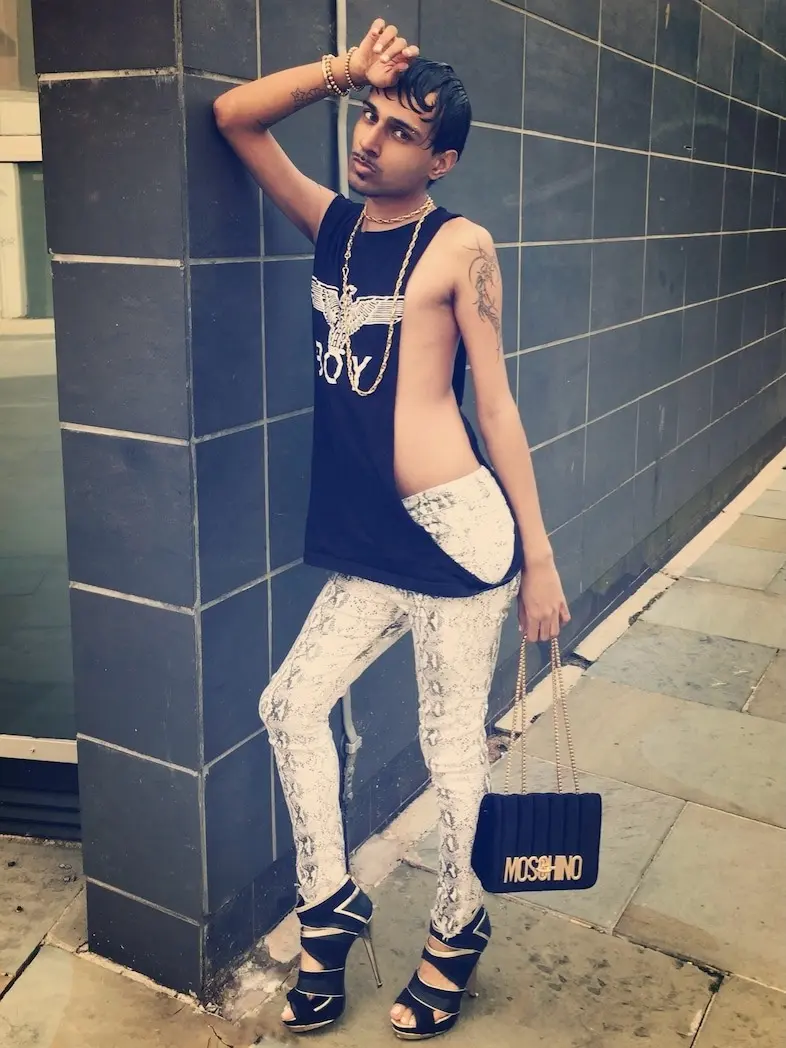
Akhtar’s aesthetic is a masterclass in temporal friction. He seamlessly marries the aggressive, high-glamour rock sensibilities of the early 2010s Balmain era with the nostalgic, internet-native bravado of early-YouTube subcultures and the raw, unadulterated energy of #SWAG. His wardrobe is a treasure trove of sartorial contradictions—YMCMB snapbacks sit comfortably alongside Jeffrey Campbell Shadow Spike heels, while cut-up BOY London t-shirts are elevated by Jeremy Scott-era Moschino. Shot through the nostalgic lens of an iPhone 6 running a Valencia filter, Akhtar’s content is more than just throwback bait; it is a sophisticated re-contextualization of historical subcultures through a razor-sharp, contemporary 2026 style lexicon.
This profile explores the ascent of one of Britain’s most compelling digital fashion figures, examining the convergence of internet subcultures, regional working-class roots, and the democratization of style in the age of Vinted archives and TikTok algorithm mechanics.
Detailed Chronology: From Oldham Bedrooms to Global Digital Renown
To understand Rico Akhtar’s current cultural footprint, one must trace the trajectory of his sartorial awakening—a journey rooted as much in regional isolation as it was in the boundless expanses of the early-2010s internet.
The Formative Years: Subversive High School Extravagance
Growing up in Greater Manchester, Akhtar displayed an acute awareness of clothing’s transformative power from an early age. Long before the term "baddie" entered his vocabulary, he was pushing the boundaries of juvenile self-expression.
“I always had style—maybe not the cuntiest at the start, but I cared about my looks,” Akhtar reflects. “I remember changing into two outfits for non-uniform day at high school—I was too extra. My mum said I used to be so picky. I was very certain about specific things. I went through a stage where I only wore skinny jeans.”
This uncompromising attitude toward dress codes and personal presentation set him apart from his peers. While suburban secondary school fashion in the UK often leaned toward utilitarian conformity, Akhtar was already treating everyday life as a testing ground for performance art.

The Digital Discovery: iPods Under Pillows and the Early 2010s Blueprint
For many Gen-Z creatives outside major metropolitan hubs, the internet served as a lifeline to worlds previously inaccessible. For Akhtar, this window into high fashion was opened by an older sister who lived through the seismic shifts of early-2010s street and runway culture in real-time.
Through her, Akhtar was introduced to the foundational pillars of the era: Hood By Air, Thrasher, and the whimsical, pop-culture-infused maximalism of Jeremy Scott. Simultaneously, his education was supplemented by clandestine late-night media consumption.
“I also remember staying up on school nights and sneaking my iPod under my pillow to secretly watch America’s Next Top Model episodes,” he recalls.
These foundational touchstones coalesced during his time studying creative media in college. Tasked with a final assignment that demanded an interrogation of the modern fashion industry, Akhtar found his epiphany not in traditional print media or brick-and-mortar storefronts, but in the digital presentation format. He points specifically to the Mugler SS22 collection film—directed by Torso and helmed by creative director Casey Cadwallader—as the turning point. When fashion officially migrated from physical runways into cinematic, digital-first narratives, Akhtar realized where his future lay.
The Breakthrough: 2024 and the Codification of the "Baddie" Aesthetic
While Akhtar’s appreciation for fashion spanned years, his distinctive contemporary look crystallized relatively recently. In 2024, at the age of 21, he unlocked the final formula of his signature aesthetic.
Central to this breakthrough was the integration of extreme footwear—specifically, towering baddie heels, a collection built through aggressive Vinted searches, generational hand-me-downs, and thoughtful gifts from friends, including pairs from Gwen Stefani’s iconic L.A.M.B. label. Alongside footwear, the mechanical act of deconstruction became a core design philosophy. By aggressively slicing t-shirts to make them sleeveless, Akhtar established a silhouette that combined raw industrial grit with hyper-feminine camp.
Supporting Context & Metrics: Decoding the Nostalgia Economy
Akhtar’s rise cannot be viewed in isolation; it is intrinsically linked to how contemporary audiences consume history, memory, and digital media.

The Economics of the Vinted Wardrobe
Unlike traditional influencers who rely on high-end PR packages or massive corporate sponsorships, Akhtar’s wardrobe is heavily curated through peer-to-peer resale marketplaces like Vinted. This grassroots approach to luxury and archival streetwear aligns with a broader macroeconomic shift among Gen-Z consumers. Facing economic constraints coupled with a desire for hyper-individuality, young creators are turning thrift and resale platforms into high-fashion hunting grounds.
By sourcing pieces like Jeffrey Campbell heelless spike shoes (which he affectionately notes are notoriously difficult to navigate physically) and vintage designer remnants, Akhtar bypasses the seasonal gatekeeping of traditional fashion houses, constructing an authentic archive that money alone cannot buy.
Challenging the 2016 Misconception
As a self-described fashion connoisseur, Akhtar has frequently used his platform to push back against the historical flattening of digital aesthetics, particularly the internet’s obsession with mislabeling eras under the broad umbrella of "2016."
“Unfortunately, when a trend emerges, people get the wrong impression of it,” Akhtar observes. “2016 to me was very different [than how it’s being portrayed]. It was less colourful and more mixing high fashion with streetwear. Green MA1 bomber jackets and skinny jeans, or a baggy tee with knee-high heels would be good examples.”
This nuance is crucial. While casual internet users paint the mid-2010s with a broad brush of pastel minimalism or generic festival wear, Akhtar remembers it as a period of distinct stylistic tension—the friction between the underground grime-meets-high-fashion movement and the burgeoning influencer economy.
Furthermore, Akhtar connects this collective longing for the past to a deeper cultural exhaustion. “I feel the reason why everyone loves 2016 is due to the fact that it was the last year when the world felt free. Many bad things have happened, and it started to feel more dystopian.” In this light, his nostalgic styling acts as a form of protective armour—a wearable reclamation of pre-dystopian optimism.
Official Statements & Industry Perspectives
The validation of creators like Rico Akhtar points to a massive structural shift in how the fashion industry scouts and legitimizes talent. For decades, geographic location was a primary barrier to entry; if you weren’t based in London, Paris, New York, or Milan, breaking into the inner circles of fashion was an uphill battle. Akhtar’s journey from Oldham dismantles this geographic hegemony entirely.

“A lot of people claim social media is bad, but for me it was my strongest way of being seen,” Akhtar reflects. “I’ve had love shown to me by multiple people within the industry, such as models, influencers, designers—more than what I did by stepping outside my home and going to events. We live in a generation where social media is the biggest platform to be seen. Who knew a boy from Oldham would have this much attention?”
This sentiment is echoed by industry analysts who note that legacy houses are increasingly turning to digital-native subculture curators to understand shifting youth demographics. Rather than relying on traditional trend forecasting agencies, brands are monitoring grassroots platforms where creators like Akhtar dictate micro-trends in real-time. By utilizing low-fi production methods—such as the aforementioned iPhone 6 Valencia-filtered aesthetic—Akhtar deliberately rejects the sterile, over-produced gloss of corporate advertising, offering instead an intimate, raw diary entry that builds profound trust with his audience.
Future Outlook: The Next Chapter for the Digital Vanguard
As Rico Akhtar continues to expand his presence within the global fashion consciousness, his trajectory offers a blueprint for the future of independent creative expression. The traditional gatekeepers of style are losing ground to individuals who possess not only deep historical knowledge of garments, but also the digital fluency to package that knowledge into compelling, shareable narratives.
For those looking to carve out their own path in fashion, Akhtar offers pragmatic, albeit blunt, advice:
“Advice for people finding their style? You are not going to be fab in the first instant, no shade. I feel like you have to get ugly in order to express your style. I look back at my earlier years and actually feel grateful. You have to be experimental, and you need to see what works for you. I have gone through many eras of my life—different colours, different aesthetics. That’s what it’s all about. Versatility! You will find it as long as you stay true to yourself.”
As the fashion industry looks toward the latter half of the 2020s, creators like Rico Akhtar prove that the future belongs to those who dare to look backward with intention, deconstruct the archives with irreverence, and wear their identities—however "extra" they may be—with absolute, unwavering conviction. Whether navigating the cobblestones of Greater Manchester in precarious spike heels or curating his next viral Vinted haul, Akhtar remains a vital reminder that true style is forged not in the boardroom, but in the bedroom.