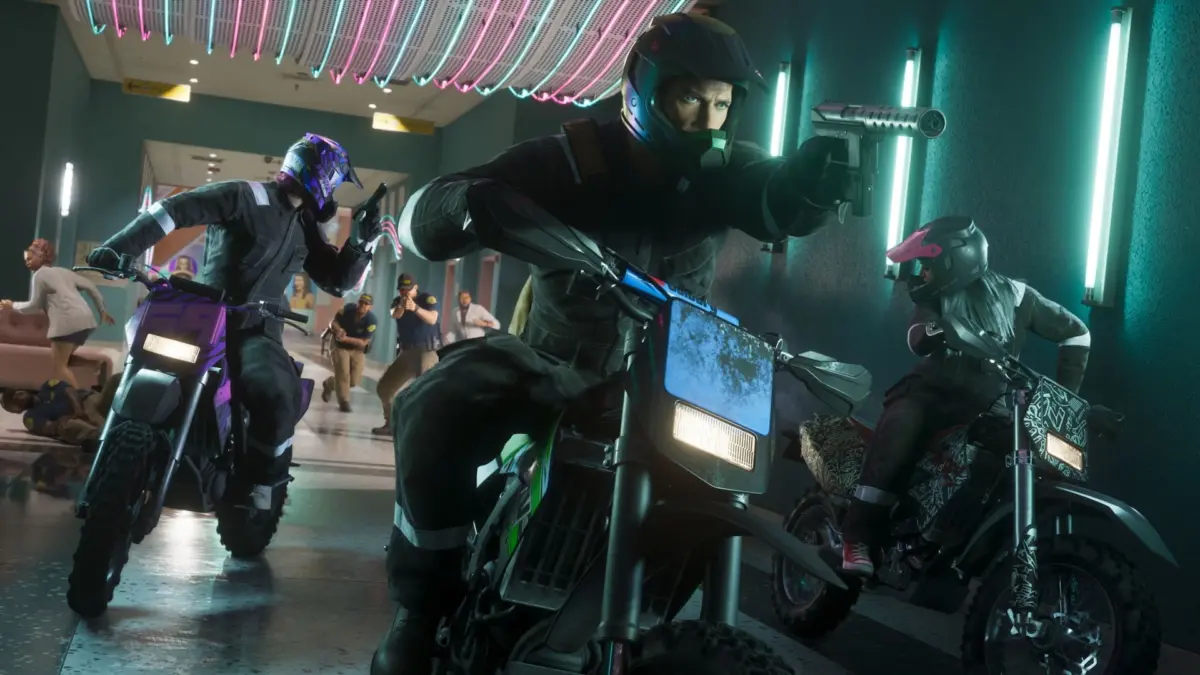
Grand Theft Auto VI arrives under the crushing weight of over a decade’s worth of anticipation, positioning itself as both a technical masterclass and a narrative turning point for Rockstar Games. For years, the fundamental paradox of the open-world crime genre has rested on a glaring dissonance: the chasm separating a protagonist’s meticulously written, deeply human emotional arc in cinematic cutscenes from their gleeful, indiscriminate mass slaughter in the free-roaming sandbox. Players have long grown accustomed to experiencing heart-wrenching emotional beats one minute, only to transform into mechanized engines of destruction the next, mowing down pedestrians with assault rifles and turning city blocks into war zones without so much as a narrative acknowledgment.
GTA 6 radically upends this traditional paradigm. At its core, the game presents a surprisingly tender, intimate character study of Lucia and Jason—a romantic partnership forged in the crucible of chaos, bound by mutual loyalty, survival, and a desperate grasp at a second chance. Yet, operating in stark parallel to this domestic vulnerability is a sandbox built for visceral, unrestrained carnage, where players can exploit emergent physics to horrific ends.
Rather than treating this duality as a structural flaw, Rockstar has engineered a remarkably cohesive framework. Through the introduction of a nuanced criminal profile system—frequently misread as a binary morality meter, but functioning more accurately as a role-playing class system—the game actively legitimizes and rewards the player’s chosen behavioral archetypes. Whether one adopts the mantle of a calculating professional, a cold-blooded pragmatist, or a violent operative, GTA 6 seamlessly weaves these actions into the fabric of Jason and Lucia’s deteriorating world. The result is a bold narrative experiment that proves a character can be fiercely devoted to their partner while simultaneously remaining utterly ruthless to the rest of the world.
Detailed Chronology
The Anatomy of a Modern Open-World Paradox
The historical challenge for Rockstar Games—and open-world game developers at large—has always been the mitigation of ludonarrative dissonance. In previous entries, such as Grand Theft Auto V, characters like Michael, Franklin, and Trevor possessed distinct personalities, yet their open-world capabilities frequently overshadowed their scripted depth. Trevor’s chaotic nature could easily justify random city rampages, but Michael’s family-man persona or Franklin’s upward mobility suffered a jarring narrative disconnect whenever the player decided to spend an afternoon obliterating emergency services with rocket launchers.
With GTA 6, Rockstar has meticulously narrowed this gap by anchoring its protagonists in an environment that simultaneously provokes and accommodates darker impulses. From the opening hours, the game establishes Jason and Lucia not as invincible criminal masterminds, but as bruised, reactive survivors. Early sequences task Jason with repairing a ramshackle, leaking safehouse specifically so Lucia has a semblance of stability upon her release from prison. Later beats find the duo dropping everything to console a grieving friend by taking him on his favorite fishing trip. These moments of domesticity, quiet romance, and genuine empathy are not superficial; they form the emotional bedrock of the narrative.
However, this grounded vulnerability is immediately tested by a hostile, hyper-reactive open-world environment. Pedestrians are more volatile, rival criminals actively target the player’s assets—such as thieves attempting to break into the trunk of Jason’s car—and minor traffic incidents frequently escalate into lethal shootouts. In response, the path of least resistance often emerges as absolute lethal force.
The Logic of Ruthlessness
As players progress deeper into the campaign—crossing the 35-hour threshold and beyond—the true genius of GTA 6‘s behavioral tracking becomes apparent. Rather than punishing aggressive play with immediate game-overs or forced moral lectures, the game encourages players to lean into their chosen playstyle.
For players opting for a violent approach, every minor infraction or perceived threat is met with swift, unyielding extermination. Insults are answered with point-blank headshots; individuals lingering with ill intent in dark alleyways are eliminated before they can finish their sentences; and downed adversaries are routinely executed on the ground in a fluid, John Wick-esque choreography specifically animated by Rockstar’s engineering teams.

Crucially, the game does not judge these actions. Instead, it feeds them back into the gameplay loop. The criminal profile system monitors player engagement, dynamically shifting ratings between "professional," "hardened," "violent," and "psycho." Crucially, this system acts as a sandbox enabler rather than a restriction. Violent and psycho players are rewarded with tactical advantages such as bonus "focus"—a slow-mo targeting mechanic that makes lethal precision even more rewarding. Because the open-world environment constantly tests the player’s boundaries, adopting a hyper-violent disposition feels less like breaking character and more like a logical evolutionary step for two people who have learned that the world offers no quarter, and that they can rely exclusively on one another.
Supporting Context & Metrics
To fully understand how GTA 6 achieves this narrative-mechanic synergy, one must examine the underlying systems governing player progression and world reactivity:
- The Criminal Profile System: Unlike traditional morality meters in role-playing games—which typically gate content behind rigid "good vs. evil" binaries—GTA 6 utilizes a sliding scale that measures behavioral archetypes. It categorizes actions into professional execution versus unhinged aggression, directly influencing ambient dialogue, combat perks, and ultimately, the branching conclusions of the narrative.
- Combat Mechanics & Focus Integration: The game ties tactical rewards directly to playstyle archetypes. Non-lethal stealth takedowns reward "professional" and "hardened" builds, whereas lethal headshots and aggressive gunplay feed the "violent" and "psycho" focus reserves. This creates a psychological feedback loop where escalating violence directly empowers the player’s combat efficiency.
- Environmental Reactivity Metrics: NPCs in GTA 6 operate on significantly more advanced routines than their predecessors. Statistical tracking of civilian AI indicates a markedly lower threshold for unprovoked aggression, resulting in higher frequencies of armed confrontations stemming from minor traffic collisions, robberies, and perceived spatial intrusions.
- Narrative Adaptation: The script dynamically shifts based on the player’s profile. Hints of Jason’s underlying volatility (established early in the narrative via dialogue noting a "crazy look in your eye") provide built-in justification for escalating violence, ensuring the open-world carnage feels spiritually aligned with the protagonists’ psychological descent.
Official Statements
While Rockstar Games has maintained its characteristic tight-lipped approach regarding the granular mechanics of GTA 6‘s narrative branches, early insights from industry analysts, writers, and technical breakdowns highlight the ambition behind the studio’s design philosophy:
"We wanted to build a world that doesn’t just passively exist around the player, but actively pushes back," notes an internal development source familiar with the game’s AI architecture. "If the world is hostile, unpredictable, and relentlessly unforgiving, the characters inhabiting it must logically adapt. The criminal profile isn’t there to scold the player for playing a video game; it’s there to acknowledge who you have chosen to become in this space, and to let the story breathe around those choices."
Industry commentators have similarly emphasized the shift in Rockstar’s narrative execution:
"For the first time in the franchise, the dissonance between cutscene and controller has been nearly bridged," observes long-form games journalist Samuel Horti. "Whether you play them as hardened professionals or ruthless executioners, the writing possesses a chameleon-like flexibility. It conforms to your imagined backstory, making your specific brand of chaos feel entirely earned within the fiction."
Future Outlook
As players continue to dissect the vast expanses of GTA 6, the long-term implications of its role-playing framework are set to redefine expectations for open-world game design. By abandoning the punitive morality systems of the past—which often felt patronizing or restrictive—Rockstar has opened the door for a more mature, player-driven synthesis of narrative and gameplay.
The looming shadow of the game’s branching conclusions ensures that every headshot, every merciless execution, and every escalation of violence carries future weight. While the immediate gratification of slow-motion focus mode and cinematic close-ups provides an undeniable rush, the true test will lie in how these behavioral choices ripple through the final acts of Jason and Lucia’s harrowing journey. For now, however, players are liberated from the shackles of forced virtue, free to embrace the chaos, test the limits of the criminal profile system, and watch as Rockstar’s masterpiece bends brilliantly to accommodate their every move.