Executive Overview
When cultural cartographers map America’s creative capitals, the geographic coordinates have historically gravitated toward the coasts. New York and Los Angeles have long dominated the national imagination as the primary epicenters of art, fashion, cinema, and design. However, a profound cultural tectonic shift is currently underway, quietly rewriting the map of American innovation. In the southeastern corner of the country, Georgia has emerged as a powerhouse of artistic output, anchored by two dynamic urban centers: the historic, willow-draped elegance of Savannah and the vibrant, metropolitan pulse of Atlanta.
At the very heart of this Southern creative renaissance is the Savannah College of Art and Design (SCAD). Founded in 1978 with a bold vision to establish a specialized, comprehensive art university, SCAD has evolved into an international incubator for artistic excellence. Today, it boasts more degree programs and specialized fields of study than any other art and design institution in the world. From traditional studio arts and conservation to emergent disciplines like sneaker design, immersive gaming, and UX architecture, the university has cultivated an academic ecosystem that attracts a diverse, global community of forward-thinking visionaries.
More than just an educational institution, SCAD operates as a catalytic engine for professional development and industry integration. Through initiatives like SCADpro—an elite collaborative research lab and prototype generator where students solve real-world problems for Fortune 500 companies—and the SCAD School of Fashion’s Style Lab, students are granted direct access to industry titans. Mentorship programs led by luminaries such as Christopher Brumfield, Tremaine Emory, Bruce Pask, and Yu Fukumoto bridge the gap between academia and the global marketplace.
The result of this rigorous, immersive approach is a generation of creators whose work transcends traditional collegiate boundaries. SCAD students are producing mature, commercially viable, and critically acclaimed work well before graduation. To understand the future of American design, one must look directly to Savannah and Atlanta. Here, we profile three extraordinary emerging talents—Jane Jurchak, Kehua Wu, and Mike Posner—whose groundbreaking works encapsulate the spirit, diversity, and uncompromising vision of this modern Southern renaissance.
Detailed Chronology: The Evolution of SCAD and the Georgia Creative Economy
To fully comprehend the magnitude of Georgia’s current cultural renaissance, it is essential to trace the historical trajectory that transformed Savannah and Atlanta into magnets for global talent.
- 1978 (The Foundation): Co-founded by Paula S. Wallace, Richard G. Rowan, Paul E. Poetter, and May L. Poetter, the Savannah College of Art and Design opens its doors with just 71 students in the historic Savannah Volunteer Guards Armory. The founding mission is clear: to establish a specialized art college that combines professional career preparation with historic preservation, breathing new life into Savannah’s architectural heritage.
- The 1980s–1990s (Architectural Preservation and Expansion): Rather than building a conventional, suburban campus, SCAD anchors itself within the urban fabric of Savannah, systematically acquiring, restoring, and repurposing historic structures—from 19th-century mercantile buildings to former gymnasiums and railroad depots. This strategy not only preserves the city’s architectural identity but also creates an immersive studio environment for students of historic preservation, architecture, and fine arts.
- The 2000s (The Atlanta Expansion): Recognizing the burgeoning creative economy of Georgia’s capital, SCAD opens its Atlanta campus in Midtown. This strategic move connects students directly to Atlanta’s booming film, television, music, advertising, and digital media industries, establishing a powerful dual-city academic network across the state.
- The 2010s (Global Outreach and Industry Partnerships): SCAD expands its international footprint with campuses in Lacoste, France, and robust online education offerings, drawing students from over 100 countries. During this decade, the launch of institutional powerhouses like SCADpro cements the university’s reputation as a top-tier corporate innovation partner, collaborating with global brands such as Google, NASA, Microsoft, and Chanel.
- The Present Era (A Global Creative Capital): Today, SCAD stands as a titan in art and design education. Savannah and Atlanta have evolved into thriving, interconnected cultural hubs where graduates routinely launch global brands, exhibit in international biennials, and redefine the parameters of contemporary art and design.
Supporting Context & Metrics: The Anatomy of an Artistic Boom
The transformation of Savannah and Atlanta from regional outposts into global creative capitals is backed by staggering economic and institutional metrics. The cultural sector in Georgia is no longer an ancillary economy; it is a primary driver of state growth, bolstered heavily by the influx of creative talent originating from academic institutions like SCAD.
Institutional Scale and Diversity
SCAD currently offers over 100 degree programs across more than 40 majors and numerous minors, providing an unmatched breadth of multidisciplinary study. This vast curriculum encourages cross-pollination between disparate fields—such as a photography major collaborating with an industrial design student, or a fashion designer integrating wearable technology developed by a software engineering cohort.
Economic Impact and Industry Integration
- Corporate Collaborations: Through SCADpro, students have completed hundreds of collaborative projects with industry giants. These partnerships provide corporate partners with fresh, avant-garde perspectives while giving students professional credits before they even receive their diplomas.
- Alumni Employment: According to recent institutional outcome surveys, 99% of reporting SCAD graduates were employed, pursuing further education, or both within 10 months of graduation. This statistic significantly outpaces national averages for higher education arts programs.
- Geographic Reach: While rooted deeply in the rich historical soil of the American South, SCAD’s student body represents all 50 states and over 100 countries, turning Savannah and Atlanta into melting pots of global artistic dialogue.
Profiled Innovators: Shaping the Future of Art and Design
Jane Jurchak: Deconstructing Southern Gothicism and Queer Identity
As a fashion and textile designer hailing from Belmont, North Carolina, Jane Jurchak arrived at SCAD already intimately attuned to the complexities of the American South. However, rather than romanticizing the region’s pastoral tropes, Jurchak turned her critical eye toward its haunting historical undercurrents.
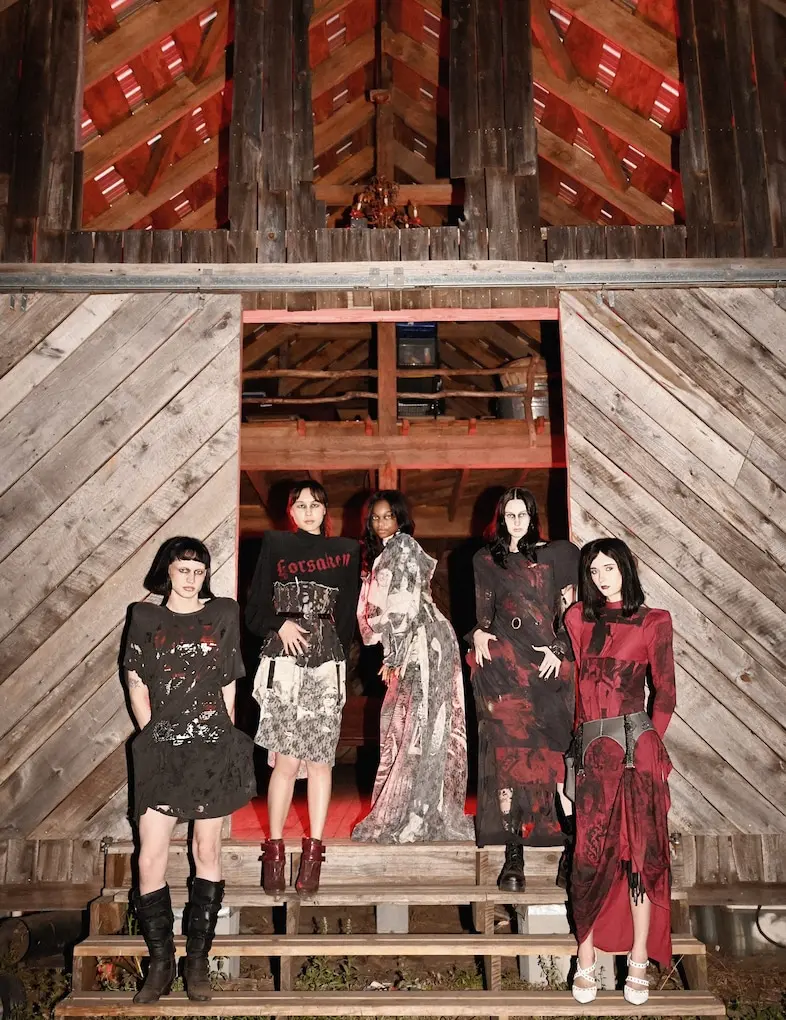
Her senior thesis collection, Forsaken, serves as a masterclass in narrative-driven fashion design, deeply rooted in Southern Gothic imagery and the psychological landscape of queer adolescence. For Jurchak, the creative process is an act of reclamation and psychological excavation. Presented this past May at SCAD’s prestigious SCAD FASHION runway showcase, the collection immediately captured the attention of critics and industry insiders alike.
"The collection allowed me to set free my anxieties of identity and step into discovery myself," Jurchak reflects.
Technically speaking, Forsaken is a triumph of material experimentation and structural subversion. Jurchak eschews conventional textiles in favor of distressed corsetry, exaggerated, looming silhouettes, and intricate latex detailing. Each garment functions as a physical manifestation of psychological states—exploring themes of isolation, inherited shame, and spiritual tension. By channeling personal vulnerability into haute couture, Jurchak positions herself at the vanguard of a new generation of designers who refuse to separate garment construction from emotional storytelling.
Kehua Wu: Bridging Continents and Mediums through Meditative Art
Traveling nearly 8,000 miles from Changsha, China, to Savannah, Georgia, Kehua Wu arrived at SCAD to pursue a Master of Fine Arts degree with a profound sense of geographic and cultural displacement. This journey across hemispheres became the conceptual bedrock of Wu’s critically acclaimed graduate exhibition, Home.
Encompassing mixed-media paintings, immersive video pieces, and expansive spatial installations, Home serves as a visual archive of longing, belonging, and the fluid nature of cultural identity. Rather than abandoning traditional techniques upon relocating to the United States, Wu chose to integrate their heritage with contemporary Western methodologies. The resulting works seamlessly blend the meticulous ink-wash traditions of China—utilizing traditional materials such as delicate rice paper and rich, carbon-based inks—with modern Western abstraction and spatial installation art.
"I regard my act of creating art as a cultivation," Wu explains. "Through the process, I engage in deep introspection—exploring, unearthing, and ultimately embracing myself—while simultaneously seeking the truth of life and coming to terms with the world."
Wu’s work demonstrates how institutional environments like SCAD can foster cross-cultural synthesis. By providing the technical resources and conceptual freedom necessary to merge Eastern philosophy with contemporary Western fine art, the university has helped launch a distinct, globally resonant voice in modern painting and installation.
Mike Posner (Fictiveillusion): Redefining Photography Through Digital Worldbuilding
In an era saturated with billions of smartphone images and conventional portraiture, recent SCAD photography graduate Mike Posner—working professionally under the moniker Fictiveillusion—uses his camera not merely to record reality, but as a portal to entirely new dimensions.
Posner’s artistic trajectory is defined by a lifelong obsession with narrative structure. His adopted professional name is a deliberate nod to his fascination with fiction, worldbuilding, and speculative storytelling. While Posner frequently collaborates with prominent musicians and recording artists, his portfolio shatters the boundaries of standard promotional portraiture. Instead of placing subjects against neutral studio backdrops, Posner immerses them within hyper-detailed, otherworldly digital landscapes.
Mastering a sophisticated fusion of traditional optical capture, advanced cinematic lighting, and cutting-edge post-production techniques, Posner crafts images that demand prolonged contemplation. His photographs challenge viewers to question where physical reality ends and digital illusion begins. Through a razor-sharp aesthetic and a cinematic command of light and shadow, Posner illustrates the expansive potential of modern photographic education—proving that the camera, when paired with boundless imagination, can rewrite the rules of visual culture.
Future Outlook: The Next Chapter of the Southern Renaissance
The stories of Jane Jurchak, Kehua Wu, and Mike Posner are not isolated anomalies; they are indicators of a broader, structural transformation in the American creative landscape. As traditional coastal hubs grapple with skyrocketing living costs, institutional stagnation, and oversaturation, cities like Savannah and Atlanta offer a compelling alternative: an environment defined by historical depth, institutional support, collaborative innovation, and boundless room for experimentation.
At the center of this movement, the Savannah College of Art and Design continues to refine its pedagogical model, continually adapting its curriculum to meet the demands of an evolving global economy. By fostering an environment where traditional craftsmanship coexists with digital disruption—and where students are given direct pipelines to industry leaders before graduation—SCAD ensures that the American South will remain a primary engine of cultural innovation for decades to come.
As these graduates step out of the studio and into the global arena, they carry with them more than just degrees; they carry the ethos of a new renaissance. The geographic center of American creativity is shifting, and the world is watching what Savannah and Atlanta do next.