Executive Overview
In the fast-moving world of enterprise software, few market narratives have been as persistently pessimistic as the "bear case" leveled against Atlassian heading into the summer. With the meteoric rise of generative artificial intelligence and autonomous coding agents, Wall Street sentiment had effectively written off the traditional "system of work" category. The logic was seemingly inescapable: if AI agents are going to write the code, file the tickets, and autonomously orchestrate project workflows, the collaborative software tracking those tasks will inevitably be squeezed out of the middle.
By early July, this prevailing narrative had beaten Atlassian’s stock down to roughly $84 a share. Investors were pricing in an existential threat, assuming that a 25-year-old incumbent was ill-equipped to survive the generative AI revolution.
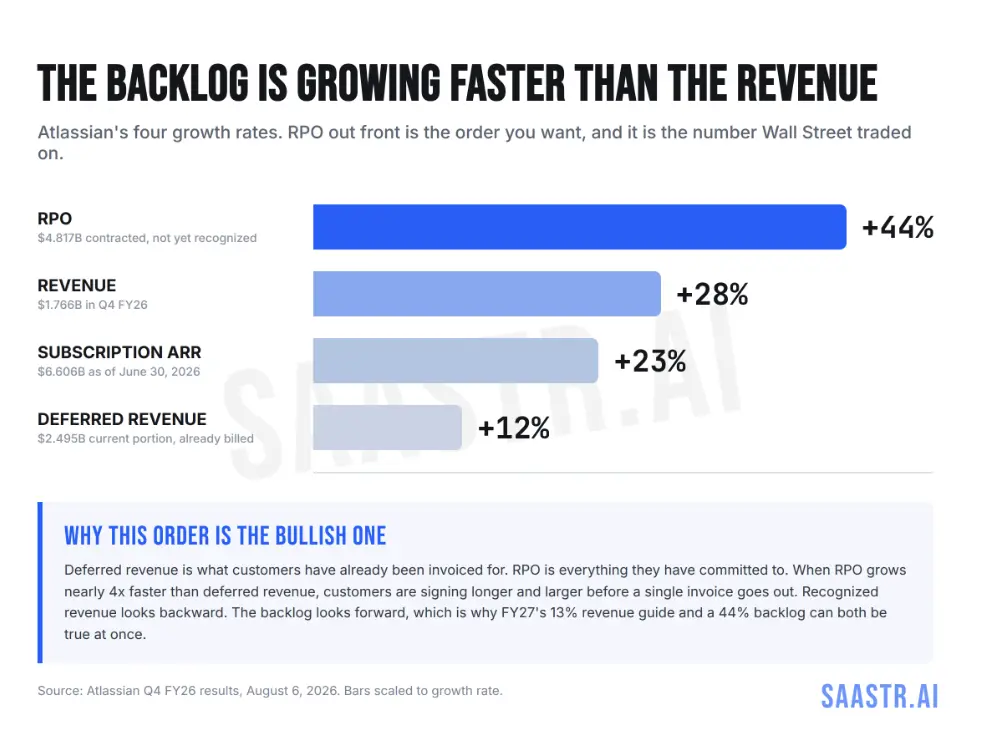
Then, Atlassian reported its Q4 and fiscal year-end results for the period ending June 30, delivering a masterclass in enterprise resilience. Total revenue surged 28% year-over-year to $1.766 billion, while cloud revenue accelerated by 31% to hit $1.213 billion. Subscription Annual Recurring Revenue (ARR) climbed to $6.6 billion, and Remaining Performance Obligations (RPO)—the gold standard for contracted future revenue—skyrocketed 44% to $4.8 billion. Meanwhile, GAAP operating income swung dramatically to a profit of $211 million, a stark reversal from a $28 million loss during the same period a year prior.
The market reaction was immediate and historic. Atlassian’s stock closed at $110.17 on August 6 and gapped up the following morning on its way to $146—a staggering 35% single-day move. For a mature technology giant operating at a $6.6 billion ARR scale, accelerating growth is a statistical anomaly. Most B2B leaders past the $5 billion threshold spend their time managing decay curves, not reversing them.
Yet, beneath the headline-grabbing financial metrics lies a far more profound story about the actual mechanics of AI-driven enterprise transformation. Atlassian’s earnings report provides a rare, transparent roadmap of what it truly costs an incumbent to defend its category against autonomous agents: bundling advanced AI capabilities for free, deliberately absorbing margin compression, transforming a bottoms-up distribution model into a high-touch enterprise sales motion, and monetizing accumulated institutional context rather than raw user interfaces.
Detailed Chronology: The Pivot That Shocked Wall Street
The sequence of events leading up to Atlassian’s blockbuster Q4 earnings release highlights a profound disconnect between public market sentiment and fundamental business momentum.
Early July: The Depth of the Bear Case
Entering the final month of its fiscal year, Atlassian was widely characterized as a vulnerable legacy player. The prevailing consensus held that software tools designed to track human labor would become obsolete in an era where AI agents could self-organize, write software independently, and manage administrative overhead without human intervention. Trading at approximately $84 per share, the market had aggressively written down the valuation multiples of virtually every collaborative system of work.
August 6: The Q4 Print and Market Shock
When Atlassian published its fiscal year results on August 6, the numbers instantly dismantled the bear case. Far from decelerating, the company’s cloud growth had actually picked up speed, jumping from a 28% full-year rate to 31% in the final quarter. Subscription ARR hit $6.6 billion, growing at an impressive 23%.
The velocity of enterprise commitment was equally evident in the RPO line, which jumped 44% to $4.8 billion. Wall Street analysts and institutional investors realized they had severely mispriced the durability of Atlassian’s platform. The stock responded with a massive 35% single-day re-rating, vaulting past $146 as short sellers scrambled to cover positions and long-only funds piled into the stock.
The Nuance Behind the Numbers: ARR vs. Reported Revenue
Beneath the celebratory headlines, sophisticated operators noted a critical distinction in the financial plumbing. Reported revenue grew by 28%, while Subscription ARR grew by 23%. In this context, reported revenue served as a lagging indicator, flattered by favorable contract timing and legacy Data Center renewals. Subscription ARR at 23% provided a much truer reading of the underlying, organic run-rate of the business—a reality further corroborated by the company’s fiscal year 2027 guidance.
Supporting Context & Metrics: Decoding the AI Margin Equation
One of the most valuable takeaways from Atlassian’s earnings call—especially when analyzed alongside design-software leader Figma’s Q2 report delivered just days prior—is the harsh reality of the AI cost structure.
AI Is Free; The Margin Isn’t
Atlassian made the strategic decision to bundle its advanced agentic capabilities—such as the orchestration of third-party coding agents like Claude Code, Cursor, and GitHub Copilot—directly into paid Jira Cloud tiers at no additional charge. Its proprietary AI assistant, Rovo, is now utilized by over 80% of the Fortune 500, with Rovo-assisted actions growing by a remarkable 50% quarter-over-quarter.
However, this generosity comes with a distinct financial tradeoff. Atlassian posted its highest operating margin quarter ever in Q4, only to immediately guide away roughly 11 points of operating margin for fiscal year 2027 to fund ongoing AI investments and enterprise go-to-market expansions. Non-GAAP gross margins are also projected to compress from 88% in FY26 to 86.5% in FY27.
This mirrors precisely what happened to Figma, which reported 48% growth at a $1.5 billion run rate, only to see its stock slide 15% due to gross margin compression (dropping to 84% GAAP). The culprit for both companies is the same: inference is a real, recurring per-request cost in a way that traditional software hosting never was.
The fundamental lesson for software operators is clear: AI compute and inference costs land in the P&L one to four quarters before the corresponding AI revenue materializes.
The divergence in market reactions between Atlassian and Figma boiled down to pricing strategy and messaging. Figma meters its AI directly because its AI output is the primary deliverable. Atlassian, conversely, gave the AI capability away to make the core seat stickier, monetizing instead through higher-tier collections that carry roughly 10x the Rovo credit allocation, alongside upcoming consumption overages and flexible commitment models. Customers adopting Rovo are currently growing ARR at more than twice the rate of non-adopters, validating Atlassian’s overarching underwriting thesis.

The Enterprise Paradox: 85% Penetration, 10% Revenue
Perhaps the most striking metric revealed in the report is that Atlassian’s software is deployed within 85% of the Fortune 500. Yet, those same elite enterprises account for roughly 10% of total company revenue.
For 25 years, Atlassian mastered a legendary bottoms-up, self-serve distribution model that achieved near-universal presence with minimal monetization. However, converting free and cheap adoption into seven-figure enterprise contracts requires an entirely different operational muscle. Consequently, sales and marketing spend grew by 36% in FY26—significantly outpacing the 26% revenue growth rate.
For founders and enterprise operators, the lesson is universal: bottoms-up adoption is not synonymous with monetization. If a product is embedded across a target account list but Average Contract Values (ACVs) remain stuck in the four-figure range, the bottleneck is a go-to-market deficit, not a product deficiency. Closing that gap requires investing heavily in an enterprise sales motion.
RPO Growth and Free Cash Flow Realities
Remaining Performance Obligations (RPO) grew 44% to $4.817 billion, vastly outpacing reported revenue growth (28%) and Subscription ARR growth (23%). This massive spread indicates that incremental growth is increasingly driven by long-term, multi-year enterprise contracts that have been legally signed but not yet billed or recognized.
This explains how Atlassian’s FY27 revenue growth guide (projecting 13% total revenue growth) can comfortably coexist with a 44% backlog expansion. Revenue recognition looks backward at rolling-off legacy Data Center contracts, while RPO looks forward at locked-in enterprise commitments.
At the same time, Free Cash Flow (FCF) fell 7% year-over-year to $1.319 billion in FY26 (down from $1.416 billion in FY25), causing the FCF margin to drop from 27% to 20%. Accounts receivable surged 63% to $1.270 billion—nearly 2.5 times the rate of revenue growth. Large enterprises demand custom billing terms paid in arrears, meaning the company must front the capital to service these massive accounts long before cash hits the balance sheet.
Official Statements & Strategic Insights
Atlassian’s leadership team addressed these profound operational shifts directly during their earnings communications, emphasizing that context—not raw user interfaces—is the ultimate defensive moat in the age of artificial intelligence.
The Rise of the Teamwork Graph
Atlassian highlighted that its Model Context Protocol (MCP) server and Teamwork Graph CLI recently surpassed 1 million monthly active users, doubling in size in a single quarter to become the fastest-growing integration surface in company history.
Rather than forcing users to open proprietary applications, Atlassian is providing an interface that lets external tools query Atlassian data seamlessly. Underpinning this interface is the Teamwork Graph, which maps more than 200 billion organizational objects and connections.
Co-founder and CEO Mike Cannon-Brookes framed this strategic advantage explicitly: Context is the ultimate edge in the AI era. Building deep organizational context is exceptionally difficult, and it cannot be easily replicated or hired.
While application user interfaces and software wrappers can be easily replaced by autonomous agents, the accumulated historical context of a company’s decisions, workflows, ownership structures, and interdepartmental relationships cannot. AI agents require this contextual foundation to function accurately; Atlassian’s Teamwork Graph reportedly returns up to 44% more accurate answers while consuming 48% fewer tokens.
Future Outlook: FY27 and the Battle for the Enterprise Budget
Looking ahead, fiscal year 2027 represents the ultimate crucible for Atlassian’s strategy.
The company’s forward guidance paints a picture of a deliberate transition: Subscription ARR growth is projected at 18%, total revenue growth at 13%, and cloud growth at a robust 25.5%, even as legacy Data Center revenue declines by 17%. Operating margins are intentionally being handed back to the P&L to fund aggressive AI development and enterprise sales expansion.
The central question for the quarters ahead is whether surging AI usage will successfully convert into high-margin ARR. Right now, widespread Rovo adoption, MCP utilization, and Teamwork Graph queries are enormous by design and largely unmonetized at the base level. Management is betting that this massive engagement will drive seamless collection upgrades, which in turn will fuel net enterprise expansion sufficient to offset the secular decline of legacy Data Center products.
If this thesis holds true, Atlassian’s 35% stock market rally will look less like a temporary relief bounce and more like the moment Wall Street finally recognized a masterclass in category defense. If it falters, FY27 will serve as a cautionary tale of heavy AI inference costs arriving long before enterprise monetization catches up.
Regardless of the eventual outcome, Atlassian has delivered a masterclass for the entire B2B software sector. Defending a multi-billion-dollar enterprise software category against autonomous AI agents requires boldness: giving core capabilities away to secure the platform, willingly sacrificing near-term margins to fund innovation, and converting accidental bottoms-up distribution into high-value enterprise contracts.