Published: February 7, 2018
Author: Rachel Leah (Enriched & Expanded Edition)
Executive Overview
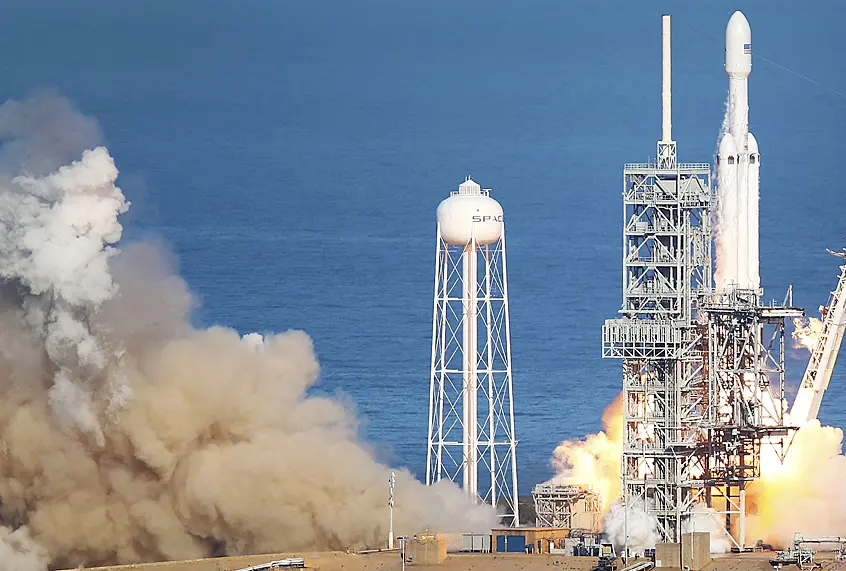
On February 6, 2018, the aerospace industry crossed a monumental threshold. From historic Launch Complex 39A at the Kennedy Space Center in Florida—the very site from which humanity once departed for the Moon—Elon Musk’s private space corporation, SpaceX, successfully executed the maiden flight of the Falcon Heavy. Billed as the world’s most powerful operational rocket, the heavy-lift vehicle roared into the Florida sky, carrying an unconventional, yet deeply symbolic payload: a cherry-red Tesla Roadster driven by a spacesuit-clad mannequin known only as "Starman."
While the sheer engineering marvel of the launch captured global headlines—most notably marked by the synchronized, vertical touchdown of two reusable side boosters back at Cape Canaveral—the event inadvertently triggered a cultural and digital phenomenon. As the rocket punched through the stratosphere and beamed back breathtaking, high-definition live feeds of the Tesla drifting against the black canvas of the cosmos, the curvature of the Earth was laid bare for millions of viewers in real-time.
Almost immediately, social media platforms erupted. Millions celebrated the technological triumph, while a loud, digitally native faction of internet users pointed the cameras toward a persistent, modern anomaly: the flat-Earth community. Sarcastic cheers, viral memes, and pointed queries flooded timelines: Would this finally be the definitive proof to silence flat-Earthers once and for all?
This report examines the historic launch of the Falcon Heavy, the technological leaps it represents for commercial space exploration, the immediate public and digital reaction to the stunning visual proof of a spherical Earth, and the psychological fortress of the flat-Earth movement, which historically remains entirely impervious to physical reality.
Detailed Chronology: February 6, 2018
The countdown to the Falcon Heavy launch was fraught with years of delays, technical redesigns, and public skepticism from aerospace veterans who doubted whether strap-on heavy boosters could successfully synchronize and re-enter the atmosphere. Elon Musk himself had repeatedly dialed back expectations, publicly estimating only a 50% chance of success for the maiden flight, warning spectators that any catastrophic failure could obliterate the launch pad.
T-Minus Zero and Liftoff
At 3:45 PM EST, the countdown clock hit zero. The combined thrust of 27 Merlin engines—equivalent to roughly eighteen 747 aircraft at full power—ignited simultaneously. The ground shook across Brevard County as the 230-foot-tall rocket lifted off the pad, slowly clearing the tower before accelerating at a blistering pace through the troposphere.
The Booster Miracle
Roughly two and a half minutes into the flight, the two side boosters successfully separated from the central core, executed their flip maneuvers, and began their powered descent back toward Landing Zones 1 and 2 at Cape Canaveral. Moments later, millions watched in awe as the twin boosters touched down side-by-side in a synchronized ballet of controlled retro-propulsion—a cinematic milestone that instantly redefined the visual lexicon of modern rocketry. (While the experimental center core ultimately missed its landing drone ship due to ignition liquid shortages, the primary technological objectives were triumphantly met).
Reaching Deep Space and the "Starman" Reveal
As the upper stage continued its ascent, it coasted into Earth orbit before executing a final burn that propelled the payload out of standard Earth-orbit trajectories and onto a heliocentric path intersecting the orbit of Mars. It was during this prolonged coast phase that SpaceX activated multiple exterior cameras mounted to the chassis of the Tesla Roadster.
Suddenly, live feeds broadcasted across YouTube, Twitter, and major news networks displayed a surreal, awe-inspiring view: a terrestrial automobile floating peacefully in the vacuum of space, with the vibrant blue-and-white sphere of planet Earth curving dramatically in the background. It was an unmistakable, unedited, cinematic validation of centuries of astronomical consensus.
Supporting Context & Metrics: The Falcon Heavy and the Rise of Commercial Space
To understand why the February 2018 launch was such a watershed moment, one must contextualize the sheer capacity and economic disruption represented by the Falcon Heavy.
Key Performance Metrics of the Falcon Heavy:
- Total Height: 70 meters (229.6 feet)
- Maximum Payload to Low Earth Orbit (LEO): 63,800 kilograms (140,660 lbs)
- Maximum Payload to Mars: 16,800 kilograms (37,000 lbs)
- Total Engine Count: 27 Merlin 1D engines across three booster cores
- Total Liftoff Thrust: ~5 million pounds at sea level
Prior to SpaceX’s entry into the heavy-lift market, launching payloads of this magnitude was the exclusive, highly expensive domain of national space agencies like NASA or international consortia like the European Space Agency. By pioneering vertical landing and booster reuse, SpaceX drastically slashed the cost-per-pound to orbit, laying the groundwork for future lunar bases, Martian colonization, and deep-space science missions.
Yet, despite the rigorous physics, mathematical modeling, and multi-billion-dollar investments driving modern aerospace engineering, a parallel digital subculture has thrived in the 21st century, flatly rejecting these very truths.
The Digital Reaction: Memes, Sarcasm, and the "Flat Earth" Meme
The instant the live feed from the SpaceX upper stage hit social media, the internet’s collective wit went to work. The juxtaposition of undeniable visual evidence against one of the internet’s most infamous conspiracy theories created a viral storm.
Twitter user Sebastian Bell tweeted bluntly: "Suck it Flat Earthers. #Starman"
Another user, Skyler, posted: "Look you can see the curvature of the Earth, I bet the flat Earthers are pissssed."
Comedian and internet personality Dave Days chimed in: "Flat earth conspiracy officially debunked… with style @SpaceX #FlatEarth."
Others leaned heavily into dry irony. Darin (@darink) shared the live stream link with the caption: "Look at that flat earth."
These reactions highlighted a broader cultural exhaustion with anti-science rhetoric in the digital age. For years, the flat-Earth movement had migrated from obscure fringe forums to mainstream social media platforms, leveraging YouTube recommendation algorithms to radicalize users into scientific skepticism. To the mainstream internet, the Falcon Heavy wasn’t just a win for space exploration; it felt like an undeniable mic-drop moment that would decisively put an end to pseudoscientific nonsense.
Official Statements and Industry Impact
In the wake of the launch, leadership across the scientific and aerospace communities reflected on both the technical success and the cultural symbolism of the day.
Elon Musk, speaking to reporters during a post-launch press conference at Kennedy Space Center, reflected on the absurdity and beauty of the payload:
"Life can’t just be about solving one miserable problem after another. There need to be things that inspire you, that make you glad to wake up in the morning and be a part of humanity. That is why we did this. We wanted to get people excited."
When questioned about skeptics and detractors, Musk and his engineering team emphasized that space exploration is ultimately designed to expand human consciousness, not to engage in online debates. However, astrophysicists and science communicators pointed out that visual evidence alone rarely converts those embedded in conspiratorial belief systems.
Future Outlook: Why Conspiracy Theories Persist in the Age of HD Video
Will high-definition, live-streamed footage from the edge of space finally dismantle the flat-Earth movement?
Sociologists and psychologists who study conspiracy theories offer a sobering answer: almost certainly not.
The Psychology of Denial
Believers in the flat-Earth model—who contend that the planet is a disk surrounded by an ice wall (Antarctica) and that governments orchestrate a global deception via fake CGI and manipulated imagery—do not operate on a foundation of empirical logic. Instead, flat-Eartherism is rooted in profound institutional distrust, community belonging, and confirmation bias.
If presented with raw video footage showing the curvature of the Earth, true believers do not adjust their worldview. Rather, they integrate the new evidence into their conspiracy framework, claiming that:
- The camera lenses used by SpaceX utilize "fisheye" distortion to artificially create a curve where none exists.
- The live feeds are pre-rendered animations broadcast from a terrestrial studio.
- Corporate entities like SpaceX are simply co-conspirators in a global cover-up orchestrated by space agencies worldwide.
The Road Ahead
As commercial spaceflight accelerates throughout the 2020s and beyond—with upcoming crewed Artemis missions to the Moon, private commercial space stations, and eventual crewed flights to Mars—the window for denying the spherical nature of our planet will theoretically narrow. More private citizens, civilian astronauts, and independent researchers will witness the majesty of our planet with their own eyes.
Yet, as the aftermath of the Falcon Heavy launch demonstrated, technology can bridge the physical gap to the stars, but bridging the psychological gap to objective reality remains one of humanity’s most enduring challenges. The Tesla Roadster continues its silent, lonely orbit around the Sun, playing David Bowie’s Space Oddity on an endless loop—a brilliant testament to human ingenuity, orbiting a round Earth that some people, against all visual evidence, still refuse to see.