Executive Overview
For early-stage founders and scaling startup executives, hiring a Vice President is one of the most high-stakes decisions on the corporate roadmap. Move too slowly, and the business stalls out, choked by bottlenecked operations and founders stretched thin across too many functional domains. Underhire, and you fail to secure a true owner who can autonomously architect and drive a department. Overhire, and you risk burning through precious runway with an expensive executive whose enterprise-grade playbook sinks a nimble startup.
Yet, the most dangerous scenario of all is getting the hire wrong and waiting too long to course-correct. A misaligned VP can easily set a company back a full year—or worse, terminal velocity—through compounding operational friction, cultural erosion, and missed market opportunities.
To demystify this critical juncture, veteran venture capitalist and SaaStr founder Jason Lemkin recently proposed a rigorous, no-nonsense framework for evaluating executive hires. The premise is stark: if a newly minted VP cannot pass a precise four-part test within their first 60 days, they simply are not good enough. In an ecosystem where early-stage startups cannot afford prolonged ramp-up periods or costly executive experiments, Lemkin’s framework serves as an authoritative diagnostic tool for founders seeking to ruthlessly optimize their leadership teams.
Detailed Chronology: The Evolution of the VP Evaluation Framework
The challenge of executive onboarding has plagued entrepreneurial ventures for decades. Traditionally, founders relied on vague intuition, quarterly performance reviews, or lengthy grace periods—often lasting six months to a year—to determine whether an executive hire was working out. By the time a definitive conclusion was reached, the damage to morale, pipeline, and product velocity was already profound.
In mid-2025, amidst a macroeconomic climate that prioritizes capital efficiency, sustainable growth, and immediate operational execution over speculative expansion, the tolerance for executive underperformance evaporated. Addressing this industry-wide pain point, Jason Lemkin formalized a rapid-response diagnostic model shared across digital and venture capital networks.
The evaluation timeline is compressed by design:
- Days 1–30: The honeymoon phase concludes. The executive is integrated into the operational cadence, and early indicators of cultural alignment, team perception, and directional momentum become visible.
- Days 31–60: The execution phase. The VP must demonstrate tangible movement on core metrics, recruit initial talent, and alleviate founder workload.
- Day 60 and Beyond: The decision gate. If the executive fails to clear the framework’s benchmarks, the founder must initiate an immediate transition.
This chronology shifts the traditional corporate paradigm from passive observation to active, high-frequency accountability.
Supporting Context & Metrics: The Four-Part Diagnostic Test
To operationalize this evaluation, founders must look past corporate charisma, polished resumes, and buzzword-laden interview presentations. Performance in the real-world theatre of a growing startup demands concrete results. Lemkin’s four-part test deconstructs executive competence into indisputable pillars:
Criterion #1: Did They Hire Someone Great in the First 60 Days?
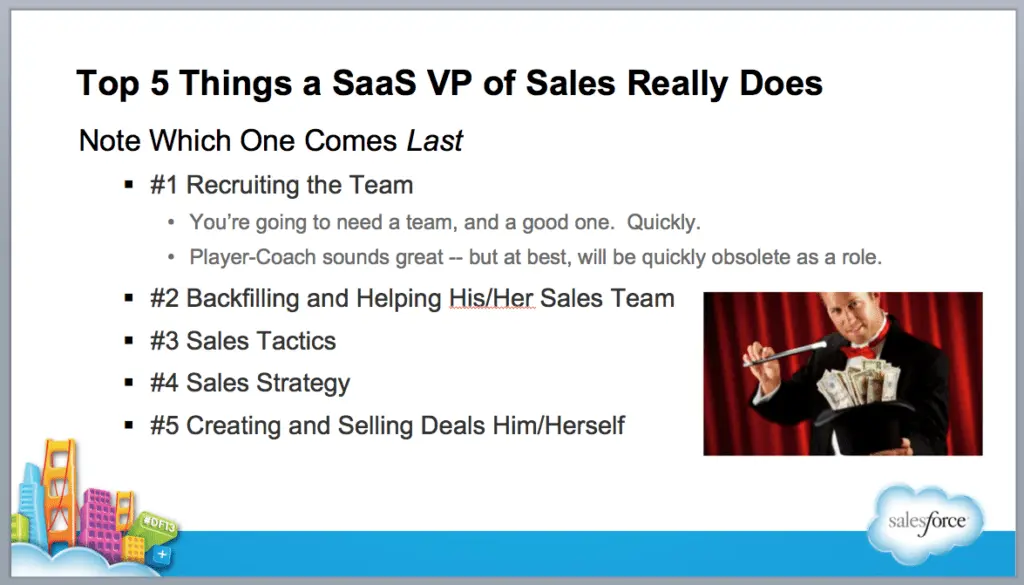
Recruiting is not an ancillary duty delegated exclusively to human resources or talent acquisition partners; it is the core responsibility of a true executive. Real VPs understand that 50% of their job involves building and scaling their team.
The best leaders operate with a persistent talent pipeline, often entering a new organization with one or two exceptional candidates already in their back pocket. If a newly hired VP has not attracted, sourced, and successfully closed at least one high-caliber hire within their first 30 to 60 days, it is a glaring red flag. A leader who cannot recruit during their motivational peak will rarely build a high-performing team later.
Criterion #2: Did Their #1 Key Metric Improve?
Founders cannot expect overnight miracles, but they can—and must—expect early momentum. Within the first 60 days, a functional leader must register measurable progress on their primary key performance indicator (KPI):
- VP of Sales (VPS): Closed deals, pipeline velocity, and conversion efficiency.
- VP of Marketing (VPM): Lead generation quality, top-of-funnel volume, and pipeline contribution.
- VP of Customer Success (VPCS): Customer satisfaction (CSAT), Net Promoter Score (NPS), or early indicators of net retention improvement.
- VP of Engineering or Product (VPE/VPP): Deployment frequency, release velocity, or backlog reduction.
Crucially, this principle applies equally during turbulent market conditions or struggling company phases. In fact, while exceptional market tailwinds can sometimes mask operational mediocrity, challenging environments reveal true executive caliber. A great VP looks at constrained resources, limited leads, or existing client bases and immediately extracts higher efficiency.

While a VP of Sales may not transform 20% year-over-year growth into 100% overnight amidst a downturn, they can reliably optimize sales motions to push that figure to 30% or 35% through disciplined execution. Conversely, underperforming hires frequently default to excuses, explaining at length why progress is impossible under current conditions.
Criterion #3: Did They Take Part of the Job Off Your Plate?
In the early days of a startup, founders act as the ultimate utility players, owning sales, product strategy, customer onboarding, and marketing. When a VP is brought on board, the explicit goal is functional delegation.
While a founder may still maintain high-level oversight or participate in strategic enterprise deals when a VP of Sales joins, the structural ownership of the function must shift. If the founder finds themselves working just as many hours micromanaging, firefighting, and carrying the operational weight as they did before the hire, the executive has failed to absorb the burden. Functional relief must manifest early.
Criterion #4: Does the Team Believe?
Internal organizational sentiment serves as an invaluable, highly accurate barometer of executive effectiveness. Existing team members—those who have been in the trenches building the company—possess acute radar for authentic leadership.
They know immediately whether a new arrival is adding genuine value, driving clarity, and elevating execution, or simply coasting on corporate jargon and superficial activity. When a leadership appointment is successful, team confidence visibly builds within the first 30 days. If employee skepticism persists or deepens, the hire has likely missed the mark.
Official Statements and Industry Perspectives
The discourse surrounding executive execution in high-growth startups has garnered significant commentary across the venture capital ecosystem. Industry veterans consistently emphasize that human capital missteps are the leading cause of early-stage corporate mortality.
"If they don’t pass the 4-part test, they aren’t good enough," asserts Jason Lemkin, emphasizing the binary nature of early-stage executive assessment. "No excuses. No thinking meeting three out of four, or two out of four points is okay for now. Especially no giving them more time."
Venture capitalists note that founders frequently fall into the trap of the "expensive resume fallacy"—retaining an underperforming executive simply because they boast an impressive pedigree from a tier-one tech giant or public enterprise. However, enterprise playbooks rarely translate cleanly to early-stage, resource-constrained startup environments.
As market analysts point out, founders are permitted to hire "stretch candidates"—professionals who have not yet held the exact title of VP elsewhere but possess immense hunger, raw capability, and a track record of outperformance. Hiring for trajectory rather than polished pedigree is a valid, often superior strategy. However, even stretch candidates must clear the core functional thresholds outlined in the four-part framework. If they fail to execute the fundamentals, the emotional attachment of the founder must be severed to protect the broader organization.
Future Outlook: Navigating the Cost of Indeccision
As the startup ecosystem continues to evolve through shifting capital availability and heightened expectations for operational profitability, the margin for error in executive hiring is shrinking. Founders can no longer afford the luxury of prolonged probationary periods for senior leaders.
Looking ahead, successful early-stage management will rely on proactive talent diagnostics. By implementing ruthless clarity around the 60-day window, founders can transform hiring from an unpredictable gamble into a disciplined, measurable science.
The psychological hurdle remains the hardest part: admitting a mistake and moving on quickly requires immense fortitude. Yet, the data is unequivocal. Cutting ties early with a misaligned executive prevents toxic cultural erosion, saves dwindling runway, and clears the path to find the transformational leader the enterprise truly requires. In the relentless arena of scaling businesses, speed, accountability, and uncompromising standards are the ultimate competitive advantages.