Executive Overview
When the legendary grunge band Soundgarden penned their psychedelic anthem "Black Hole Sun" in 1994, they captured the imagination of millions with a surreal, apocalyptic dreamscape. Three decades later, modern astrophysics has caught up with rock-and-roll mythology.
In a landmark paper published in the journal Nature, an international team of astrophysicists has chronicled the discovery of a bizarre, unprecedented cosmic phenomenon: a "black hole star." Roughly the size of our entire solar system and glowing with a deep, ruby-red intensity in the darkest reaches of space, this object is challenging foundational assumptions about stellar evolution and cosmic chronology.
The groundbreaking findings rely on deep-field observations captured by the James Webb Space Telescope (JWST), an instrument that has continually rewritten astronomy text books since its deployment. By peering further back in time than ever before, researchers have zeroed in on some of the most distant observable phenomena in the universe. What initially appeared through early-generation optics to be simply a massive, ancient star is, in reality, something far more exotic.
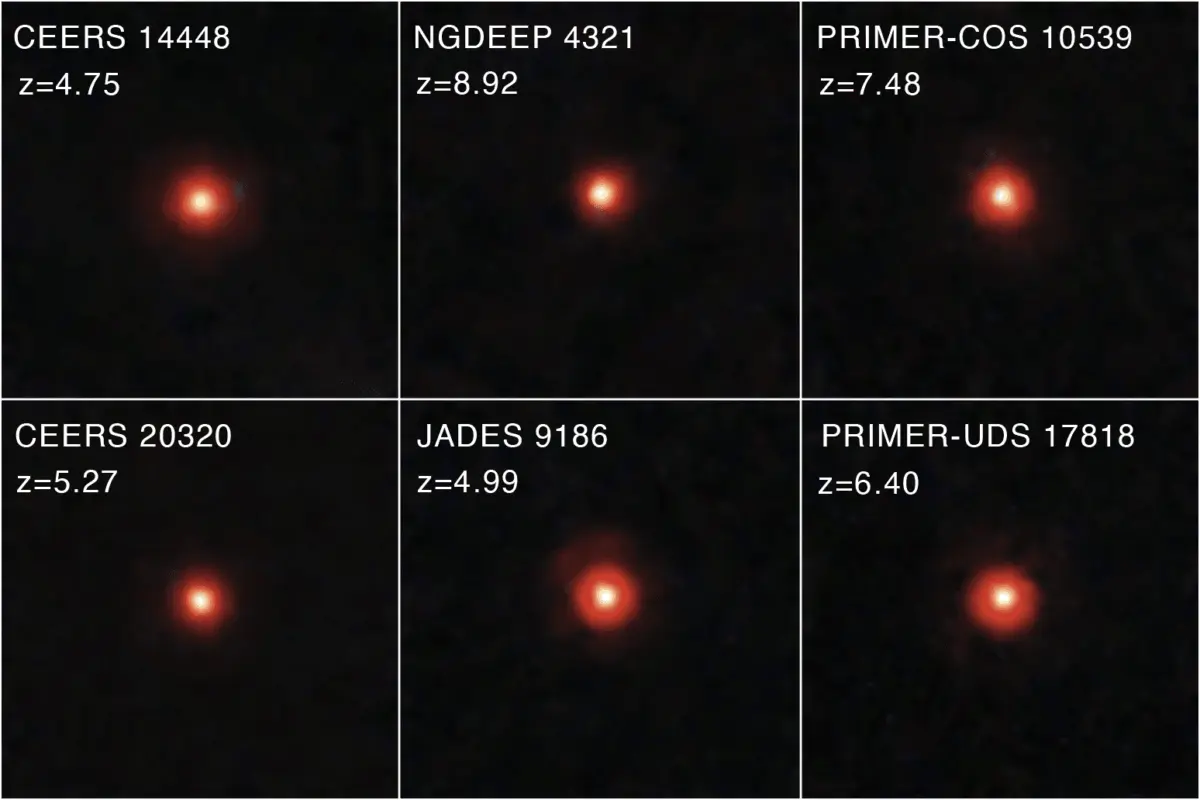
Based on spectroscopic analysis of the light they emit, these anomalies share surface characteristics with giant stars. However, astronomers suspect they are something entirely different: primordial black holes cloaked inside an extraordinarily dense, hyper-luminous envelope of gas. Dubbed "black hole stars," these hypothetical objects may finally explain a persistent puzzle that has baffled astronomers since the JWST began beaming data back to Earth: the abundance of enigmatic "little red dots" populating the early universe.
Detailed Chronology: Unraveling the Primordial Signal
The narrative of this discovery begins not in a modern laboratory, but billions of light-years away and nearly 14 billion years in the past. The specific signal at the heart of the Nature study originates from an era when the universe was in its absolute infancy—just 660 million years old, compared to its current ripe age of nearly 14 billion years.
The JWST Deep-Field Revolution
Ever since the James Webb Space Telescope became fully operational, its infrared capabilities have allowed scientists to pierce through cosmic dust and look at light emitted by the earliest galaxies. Among the most perplexing discoveries made by the $10 billion observatory are scores of compact, intensely red spots scattered across the primordial cosmos.
When researchers first isolated the object now cataloged as *MoM-BH-1**, it blended into this mysterious tapestry of red spots. To the untrained eye, it appeared as little more than a smudge of infrared pixelation. However, high-resolution spectral data soon revealed that this was no ordinary galaxy or standard star.
The Anatomy of MoM-BH*-1
From a distance of billions of light-years, MoM-BH*-1 mimics the optical profile of a gigantic star. Yet, upon closer inspection by the research team, the object displayed physical properties that violated standard stellar mechanics:
- Energy Output Exceeding Nuclear Fusion: The object emits roughly 100 billion times more energy than any known star could possibly produce through conventional nuclear fusion. Even within the hyper-energetic environment of the early universe, its luminosity is anomalous.
- The Spectral Drop-Off: A portion of the object’s emitted light abruptly and mysteriously disappears. While normal stars can produce absorption lines when their outer atmospheres filter specific wavelengths of light, the suppression effect observed in MoM-BH*-1 is exponentially too intense to be explained by stellar behavior alone.
These contradictions forced astrophysicists to think outside the traditional boxes of stellar classification, leading directly to the resurrected and refined hypothesis of the "black hole star."
Supporting Context & Metrics: The Physics of a Cosmic Hybrid
To understand why MoM-BH*-1 has sent shockwaves through the astrophysical community, one must examine the extreme mechanics governing these theoretical hybrid objects.
What is a Black Hole Star?
In traditional astrophysics, stars are powered by outward-pushing thermal pressure from nuclear fusion at their cores, which battles against the inward pull of gravity. Black holes, conversely, are regions of spacetime where gravity is so intense that nothing—not even light—can escape.
A "black hole star" merges these two concepts into a terrifyingly efficient cosmic engine:

- The Core: At the absolute center of MoM-BH*-1 sits a rapidly feeding black hole, voraciously devouring surrounding primordial matter.
- The Gas Envelope: Surrounding this gravitational abyss is a massive, incredibly dense envelope of gas.
- The Energy Transformation: As the black hole consumes matter, it releases torrential amounts of energy. This energy violently surges outward, forcing its way through the surrounding gas envelope before finally escaping into the vacuum of space.
During this arduous journey through the gas, the radiation is filtered, scattered, and modified. By the time the energy breaks free and reaches the lenses of the James Webb Space Telescope, it has acquired many of the optical signatures one would normally expect to find in starlight. It is, essentially, a black hole wearing the disguise of a star.
Solving the "Little Red Dot" Paradox
For the past few years, the JWST’s deep-field imagery has routinely exposed a population of small red spots in the early universe that simply refuse to conform to established models. These objects are too bright and too compact to be easily explained.
Before the black hole star hypothesis gained traction, scientists proposed several alternative explanations:
- Compact Starburst Galaxies: Galaxies extraordinarily dense with rapidly forming, short-lived massive stars.
- Dust-Obscured Quasars: Supermassive black holes hidden behind thick curtains of cosmic dust.
- Exotic Physics: Entirely new classes of stellar systems or dark matter interactions that have no parallel in the modern, contemporary universe.
The confirmation—or growing validation—of black hole stars provides a unified theoretical framework that neatly resolves these anomalies. If many of these red dots are actually black holes cloaked in glowing gas envelopes, astronomers can begin to reconcile how supermassive black holes grew so massive, so quickly, in the early history of the cosmos.
Official Statements & Expert Analysis
The publication of the Nature paper has sparked intense debate, peer review, and excitement across the global astronomical community. While lead authors and independent researchers remain cautious about calling the mystery entirely solved, the implications of the data are profound.
Dr. Dale Kocevski of Colby College, a prominent astronomer and co-contributor to early-universe JWST studies, notes that the sheer frequency of these red spots demands a radical rethink of cosmic evolution.
"We are looking at an epoch in cosmic history that behaves completely differently than the universe we inhabit today," independent astrophysical theorists point out. "Objects like MoM-BH*-1 challenge our understanding of how matter aggregated when the universe was only a fraction of its current age. The rules of gravity, accretion, and light emission were being pushed to absolute extremes."
Other astrophysicists emphasize that while the "black hole star" model is mathematically viable, proving it definitively will require follow-up observations. Current instruments can capture the light profile, but teasing apart the exact geometry of a gas envelope located billions of light-years away pushes even the JWST to its technical limits.
Future Outlook: The Next Frontier of Cosmic Discovery
The identification of MoM-BH-1 and the publication of the Nature* study mark the beginning of a new chapter in observational cosmology, rather than its conclusion. As the scientific community digests these findings, a roadmap for future research is already taking shape.
Upcoming JWST Campaigns
Astronomers have already petitioned for extended observation time on the James Webb Space Telescope to target MoM-BH*-1 and its sibling red spots with higher-resolution spectroscopy. By analyzing finer variations in the infrared spectrum, researchers hope to map the velocity and density of the surrounding gas envelope with greater precision.
Synergy with Future Observatories
To truly confirm the nature of these objects, upcoming ground-based and space-based instruments will need to corroborate the JWST’s findings:
- The Nancy Grace Roman Space Telescope: Set to launch later this decade, Roman will possess a wide-field view that can survey thousands of these red spots simultaneously, helping astronomers determine whether MoM-BH*-1 is a cosmic outlier or a common phase in early galactic evolution.
- Next-Generation Ground Telescopes: Extremely large ground-based telescopes currently under construction will offer complementary optical data that could help separate the light signature of the central black hole from its gaseous disguise.
Rewriting the Textbooks
Ultimately, the discovery of black hole stars serves as a humbling reminder of how little we truly know about the universe’s formative years. Just as Soundgarden’s lyrics imagined a celestial body consuming everything in its path, reality has proven to be stranger, more luminous, and far more complex than fiction. As the James Webb Space Telescope continues its mission, humanity stands on the precipice of a deeper understanding of gravity, light, and the very dawn of time itself.