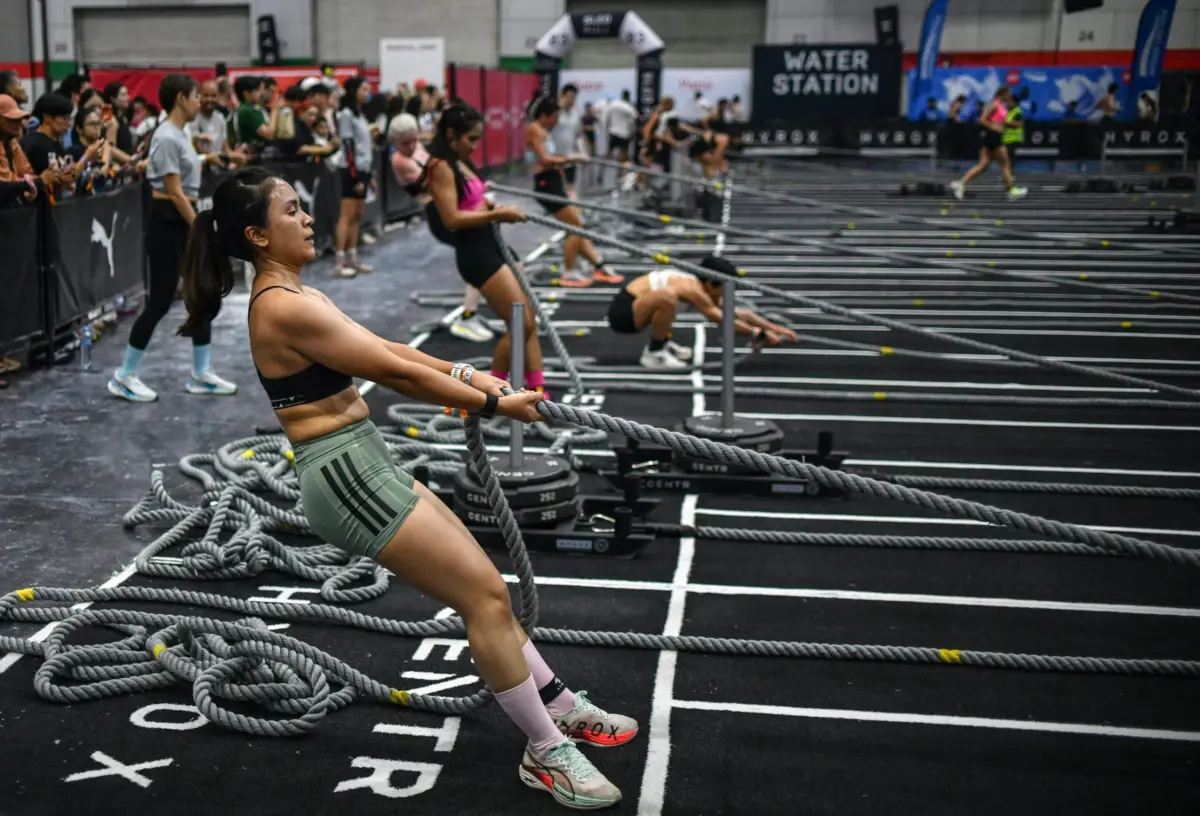
Exercise has always been a humbling enterprise. A simple push-up can reduce the most dignified human to a helpless, floor-bound state; squats and lunges can leave their practitioners trembling against the unyielding laws of physics. Yet, for a surging global demographic, physical exhaustion is not a deterrent—it is an irresistible market. Enter Hyrox, the high-octane fitness race that has quietly weaponized millennial nostalgia, community yearning, and status-seeking into a $270 million juggernaut.
Stylized in all-caps to evoke a permanent state of being yelled at—reminiscent of military boot camps or dreaded high school physical education classes—Hyrox is part endurance test, part social club, and part luxury vacation. Launched in Germany in 2017 with a modest gathering of 650 participants, the organization projects a staggering 1.5 million participants across 121 events in 34 countries by 2026.
More than just a race, Hyrox has transcended traditional athletic boundaries to become a lifestyle brand. By allowing everyday exercisers to microdose the feeling of being an elite athlete, the company has tapped into a profound psychological desire: the adult craving for structured recognition, validation, and a medal. This comprehensive investigative report explores the cultural phenomenon, financial architecture, and psychological underpinnings of the workout craze taking over the modern world.
Detailed Chronology: The Evolution of a Fitness Phenomenon
To understand how Hyrox achieved its current ubiquity, it is necessary to trace its trajectory from a niche European competition to an international cultural powerhouse.
Phase 1: Inception and European Roots (2017–2019)
Conceived in Germany in 2017 by Christian Toetzke and hockey legend Moritz Fürste, Hyrox was designed to bridge a glaring gap in the fitness market. While marathons catered strictly to runners and CrossFit catered to weightlifting purists, there was no standardized, global indoor race that combined functional strength with endurance for the average gym-goer. The inaugural event drew just 650 participants. However, the foundational blueprint—eight rounds of alternating running and functional movements—proved immediately sticky among early adopters.
Phase 2: Pandemic Resilience and Digital Amplification (2020–2022)
While the global COVID-19 pandemic crippled traditional brick-and-mortar fitness centers, it simultaneously accelerated the appetite for hybrid, goal-oriented training. As restrictions lifted, participants emerging from lockdowns craved tangible, in-person communities. Hyrox leveraged the boom of social media fitness culture, using TikTok and Instagram reels of sled pushes and wall balls to drive viral engagement. Affiliated gyms began adopting Hyrox-specific training templates, embedding the race directly into daily fitness curriculums.
Phase 3: Explosive Global Scaling (2023–Present)
By the mid-2020s, Hyrox transformed into an economic juggernaut. In June 2026, industry reports highlighted the brand’s meteoric rise to 1.5 million projected participants. The logistical demand began breaking records: during its initial 24-hour ticket release for the New York City race, competitors snapped up 42,000 passes—a massive leap from the roughly 12,700 athletes registered the previous year. Today, Hyrox events span major metropolitan hubs across North America, Europe, Asia, and Australia, turning race weekends into localized economic booms for hospitality and tourism sectors.
Supporting Context & Metrics: The Anatomy of a Hyrox Race
Unlike highly technical sports requiring years of specialized skill acquisition—such as tennis, gymnastics, or competitive swimming—Hyrox’s genius lies in its accessibility. It asks a simple question: How good are you at the gym?
The Course Mechanics
Technically speaking, Hyrox is a timed competition divided into eight standardized legs. Competitors—who may race as individuals, in same-sex or mixed doubles, or as part of a four-person relay—must complete the following sequence:
1-Kilometer Run followed by 1,000 meters on a SkiErg
1-Kilometer Run followed by a weighted 50-meter sled push
1-Kilometer Run followed by a weighted 50-meter sled pull
1-Kilometer Run followed by 80-meter burpee broad jumps
1-Kilometer Run followed by a 1,000-meter row
1-Kilometer Run followed by a 200-meter Farmers Carry (lugging heavy weights at your sides)
1-Kilometer Run followed by 100 meters of sandbag lunges
1-Kilometer Run followed by 100 wall balls (squat thrusts launching a medicine ball into the air)
The Financial Ecosystem
Hyrox’s revenue model is multifaceted, drawing capital from several distinct streams:
Event Entry Fees: Standard tickets typically range upward of $200 per race, excluding optional add-ons like professional $35 photo packages.
Licensing & Affiliations: Over 15,000 gyms worldwide pay for Hyrox-affiliated status, integrating specialized training classes into their schedules that can cost upwards of $600 for multi-session packages.
Merchandise & Equipment: A thriving micro-industry supplies consumers with branded gear, apparel, shoes, and home-gym equipment—ranging from official competition sandbags ($87) and power ropes ($275) to commercial-grade turf starting at $1,799.
Destination Tourism: Because races are hosted in premier global cities like Rome, Berlin, Miami Beach, Oslo, Bangkok, and Brisbane, participants frequently turn race weekends into vacations, pumping thousands of dollars into flights, accommodations, and local dining.
Official Statements & Insider Perspectives
To unpack the psychological appeal of this grueling pastime, we turn to the participants, coaches, and industry leaders who live inside the Hyrox ecosystem.
The Lived Experience: A "Hostile Takeover" of Daily Life
For many practitioners, training for Hyrox is all-consuming. Abby Roskind, a 35-year-old project manager from Washington, D.C., who has completed two races, notes that the preparation quickly subsumes normal routines.
"Because you are always with other people doing these things, it becomes a little bit of a hostile takeover of your life," Roskind explains. "You meet up with your ‘fitness’ friends, and then they become your actual friends, and all you end up doing when you’re not training for Hyrox is talking about Hyrox."
Serious competitors frequently overhaul their diets, abstain from alcohol leading up to race day, and schedule dawn workouts at 5:30 AM. This intense focus naturally curtails traditional social outings, replacing nightlife with localized community training blocks.
The Culture Shock of Elite Competition
While many approach Hyrox casually alongside friends, stepping onto the arena floor can be an eye-opening experience. LJ, a 34-year-old participant who competed alongside a small circle of peers, described his initial reaction to the main event:
"When I got to the actual venue day of the race, I felt like Hillary Clinton walking through that apartment—what the hell is going on here?" LJ remarked. "Because there are a lot of people where this is a big chunk of their life. I saw people walking around showing all the badges that they had collected from all the different cities where they competed."
Microdosing Greatness
According to fitness industry insiders, the core psychological driver of Hyrox is the scarcity of adult achievement markers.
"Once you become an adult, how many times are you going to get a sticker? How many times are you going to get a reward? How many times are you going to get a medal?" asks James McMillian, president and trainer at New York City’s Tone House strength facility, who has completed six Hyrox races. "People just want to be part of something. They want to feel close to greatness."
McMillian points out that while 99% of humanity will never experience what it feels like to be a sporting icon like Lionel Messi or A’ja Wilson, Hyrox allows everyday professionals to "microdose" that reality: the discipline of a strict training regimen, the game-day adrenaline, and the roar of thousands of spectators.
Bobby McMullen, founder of the fitness app Adonis and a four-time Hyrox finisher, draws a direct parallel to modern pop culture phenomena:
"Look, it’s the fitness space’s Eras Tour. If you travel for Hyrox, just like if you travel for Taylor [Swift] or if you travel for Disney, that’s fine. But the thing I learned about Disney adults is they’re rich. It’s so expensive. Same with Hyrox."
Future Outlook: Sustainability and the Scaling of "Gym Culture"
As Hyrox surges toward its 2026 milestones, industry analysts are evaluating whether this "fake Olympics for millennials" possesses long-term structural durability or if it represents a cyclical fitness bubble destined to plateau.
Several factors suggest long-term viability:
Low Injury Barrier Relative to Alternatives: Unlike CrossFit, which often incorporates complex, high-impact Olympic lifts under heavy fatigue, or Ironman triathlons, which carry drowning risks and grueling swimming requirements, Hyrox relies on accessible, lower-impact functional movements. Coaches emphasize that participants can safely complete a race with relatively short training windows compared to a full marathon.
Inclusivity by Design: Because there are no qualifying times required to purchase a ticket, the psychological barrier to entry is remarkably low. Anyone with a gym membership can practice sled pushes, wall balls, and rowing.
The Experience Economy: Modern consumers—particularly millennials and older Gen Z cohorts—increasingly prioritize experiential spending over material possessions. Hyrox delivers a built-in travel excuse, a community network, and a quantifiable fitness metric all packaged into a weekend getaway.
Ultimately, the triumph of Hyrox lies in its profound self-awareness. Participants will readily complain about the burning sensation in their lungs during burpee broad jumps, curse the strictness of the movement judges, and laugh at the self-deprecating absurdity of paying hundreds of dollars to push heavy sleds across convention center floors. Yet, they keep returning.
Even when individuals are exceptionally fit, exercise retains an uncanny ability to humble them—and in the case of Hyrox, millions of people are more than willing to pay for the privilege.