For modern eCommerce brands, scaling an ad account on Meta can often feel like navigating a high-stakes maze. Advertisers are routinely inundated with conflicting advice: chase elusive vanity metrics, lean entirely on the algorithm, or over-engineer campaigns with complex, fragmented account structures. Yet, many businesses find themselves trapped in a frustrating cycle—generating thousands of clicks but failing to convert them into meaningful, predictable profit.
To cut through the digital noise, industry experts Sam Piliero and Michael Stelzner recently dissected the underlying mechanisms that separate stagnant ad accounts from those scaling past eight figures. Central to this discussion is the M4 Method—a proprietary, four-stage architectural framework designed to bring methodical precision back to Facebook advertising.
Rather than obsessing over surface-level metrics like Return on Ad Spend (ROAS) or Cost Per Acquisition (CPA) in isolation, the M4 Method reframes Facebook ads as a compound growth engine. By aligning account structure, creative asset development, deep-dive behavioral analysis, and disciplined scaling protocols, brands can systematically turn ad spend into sustainable contribution margins and long-term customer lifetime value (LTV).
Detailed Chronology: The Anatomy of Ad Account Growth
To understand how high-growth eCommerce brands scale from modest budgets into the $50 million-plus revenue tier, it is necessary to examine the evolution of modern media buying and the precise chronological stages of the M4 Method.
The Shift from Efficiency Traps to Profit Margins
Historically, media buyers fell into two primary traps: obsessing over short-term efficiency metrics or relinquishing total control to Meta’s algorithm while hoping for the best.
Sam Piliero, drawing from his extensive background scaling major brands like BarkBox, emphasizes that efficiency metrics such as ROAS are merely guardrails—they do not reveal what is actually putting cash in the bank. The ultimate objective is contribution margin. While chasing a 10x ROAS might look impressive on paper, a healthy 2.2 ROAS that allows an advertiser to spend aggressively, capture market share, and compound customer lifetime value will almost always build a larger, more resilient business.
To unlock this level of growth, Piliero developed the M4 Method. The chronological implementation of this system moves through four distinct, interdependent phases: Account Structure, Creative, Deep Dive Analysis, and Scale.
Stage 1: Establishing the Foundation (Account Structure)
Account structure acts as the structural foundation of a house; even the most compelling creative and high-converting products will underperform if poured into a disorganized, chaotic ad account.
A simplified, all-in-one setup leaves advertisers with only one blunt instrument: the pause button. Conversely, a structured approach utilizing Campaign Budget Optimization (CBO) introduces critical control mechanisms.
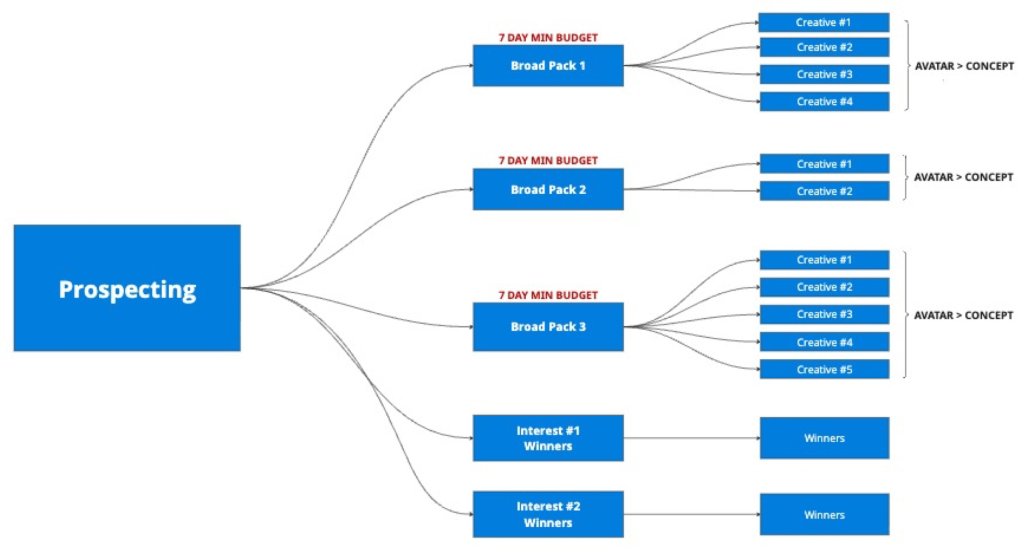
The Prospecting Campaign: The core of the M4 architecture is a single prospecting campaign configured to CBO. Within this campaign, advertisers house multiple ad sets known as "packs," where each fresh wave of creative is organized. The CBO setting allows Meta’s algorithm to fluidly distribute budgets toward whichever ads are demonstrating immediate conversion potential.
The Retention Campaign: Operating alongside the prospecting CBO is a dedicated retention campaign targeting existing customers. This separation ensures financial transparency, cleanly separating spend directed at brand-new buyers from dollars spent re-engaging past purchasers.
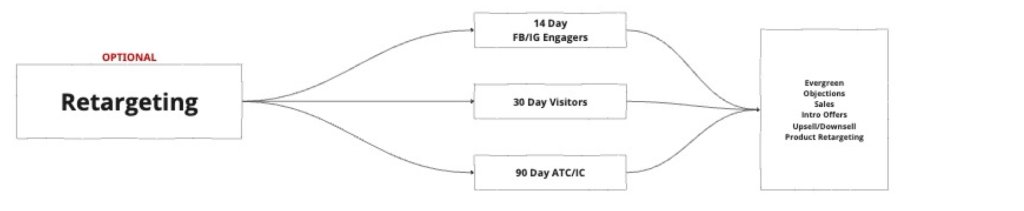
Optional Support Campaigns: Two additional campaigns round out the framework: a specialized retargeting campaign for warm, un-converted prospects, and a scaling campaign designed to force-feed budget directly into the top three to five proven creative assets.
Stage 2: Fueling the Vehicle (Creative Strategy)
With the engine (structure) securely in place, creative becomes the body of the vehicle—the primary driver of performance.
Following Meta’s algorithmic shifts (such as the Andromeda update), traditional targeting parameters have taken a back seat. Today, the content of the ad itself acts as the primary targeting mechanism. Broad, generic creatives routinely underperform because they speak to everyone and no one simultaneously.
Instead, high-performing brands deploy problem-solution specific creative: identifying a precise customer avatar, speaking directly to their unique pain points, and positioning the product as the definitive solution. Furthermore, advertisers must focus on manufacturing "hits"—ads that exceed ROAS targets while capturing 10% or more of total account spend—by leveraging continuous iterations of proven formats like semi-professional User-Generated Content (UGC).
Many media buyers make the mistake of maintaining flat daily budgets across all seven days of the week, inadvertently leaving substantial revenue on the table.
Drawing from his tenure at BarkBox—where he noticed consistent weekend revenue spikes for pet products—Piliero highlights that every business possesses unique behavioral rhythms. Gift-related products often surge on Mondays and Tuesdays as consumers plan ahead, while pet and lifestyle brands frequently peak over the weekend.
By pulling 90 to 180 days of baseline data (excluding major outlier events like Black Friday) and segmenting performance by day of the week, placement, age, gender, and geography, brands can identify actionable 20–30% performance deltas. Rather than cutting underperforming days entirely (which can disrupt the funnel’s momentum), advertisers can dynamically reallocate budgets to capitalize on high-conversion windows.
Stage 4: Executing the Scale
Scaling should only occur when underlying metrics justify the expansion. True scaling is categorized into three distinct operational vectors:
Vertical Scaling: Incrementally increasing the budget of an existing, profitable campaign by 10% to 30% every two to three days, allowing the algorithm to recalibrate without triggering a disruptive learning phase reset.
Horizontal Scaling: Launching short-term, separate campaigns (running three to ten days) specifically tailored for promotional events, product launches, or limited-time offers without contaminating the always-on prospecting baseline.
Twin Engine Scaling: The simultaneous execution of vertical and horizontal scaling, where winning creative iterations are injected directly back into the primary prospecting CBO while overall campaign budgets are systematically ramped up.
Supporting Context & Metrics
To contextualize the practical impact of the M4 Method, industry case studies highlight the profound financial shifts possible when brands commit to structural discipline over fleeting tactical hacks.
Among the client roster managed by Piliero’s agency, Moonlighters, five distinct eCommerce businesses arrived roughly a year apart operating under restrictive parameters: spending less than $30,000 per month on ads and generating under $100,000 in monthly revenue. By implementing the M4 framework, focusing intensely on customer lifetime value, and treating creative output as an ongoing manufacturing process, all five brands successfully scaled into the $50 million-plus revenue tier.
Key Performance Benchmarks and Indicators:
Contribution Margin Target: A healthy target for modern eCommerce brands rests at a 10% to 20% profit margin on revenue.
The "Hit" Threshold: In creative production, a "hit" is defined as any ad that comfortably clears the established ROAS target while capturing a minimum of 10% of total account spend.
Statistical Significance Threshold: When performing deep-dive data analyses across ad placements, days of the week, and demographic segments, advertisers should look for a 20% to 30% variance in core efficiency metrics to separate actionable behavioral patterns from random statistical noise.
Budget Adjustment Increments: During vertical scaling phases, budget increases should be restricted to 10% to 30% intervals every 48 to 72 hours to preserve algorithm stability.
Official Statements and Industry Insights
The insights driving the M4 Method stem directly from frontline media buying realities shared by industry veterans Sam Piliero and Michael Stelzner.
On the danger of metrics obsession, Piliero notes:
"Return on ad spend and cost per acquisition are useful guardrails, but they don’t tell you what’s actually going into your pocket. The real goal is profit, more specifically, contribution margin… Chasing a 10x ROAS might feel impressive, but a 2.2 ROAS that lets you spend aggressively, acquire a large customer base, and benefit from the lifetime value and word-of-mouth that compounds over time will often build a far larger business."
Addressing the delicate balance required in campaign organization, Piliero adds:
"Many advertisers either over-engineer their accounts with dozens of campaigns pulling in different directions, or they do the opposite and hand everything to the algorithm, hoping it figures things out. There’s a deliberate sweet spot between those two extremes, and getting it right is what makes scaling possible."
On the evolution of Meta’s targeting capabilities post-Andromeda, the methodology emphasizes content-driven reach:
"What your ad says determines who it reaches. This means broad, generic creative underperforms. The ads that work are problem-solution specific: identify a specific customer avatar, speak directly to their problem, and position your product as the unique solution to that particular problem."
Finally, regarding the operational compass of an enterprise, Piliero references the foundational rule learned during his time at BarkBox:
"Every business should have one single north star metric, the number that defines success… If cost per click looked strange or CPMs were high but the king goal (say, a ROAS of 2) was being met, the right call was to ignore the noise and keep spending."
Future Outlook: Navigating Constraints and Emerging Frontiers
As the digital advertising landscape continues to mature in an era dominated by advanced machine learning algorithms and privacy-centric data updates, the playbook for eCommerce success is undergoing a permanent evolution. Advertisers who rely on crude, set-it-and-forget-it tactics will find themselves squeezed out by rising acquisition costs and creative fatigue.
Looking forward, the differentiator for hyper-growth brands will not be secret targeting hacks or algorithmic exploits, but rather operational rigor and creative velocity. Brands that master the integration of structured CBO architecture, systematic creative iteration, and behavioral deep-dive analysis will be uniquely positioned to capture dominant market share.
The Supply-Chain Caveat
Crucially, future execution must account for operational reality. A vital exception to aggressive scaling applies to supply-constrained operations—such as artisanal or boutique manufacturers who cannot physically produce inventory fast enough to meet inflated demand. For these brands, the scaling playbook must invert: rather than chasing raw customer growth, the priority must shift strictly toward maximizing contribution margins and efficiency per order on a controlled volume of sales.
For brands with robust fulfillment capabilities, however, the path forward is clear. By treating the ad account as a dual-engine system where creative volume, structural organization, and deep analytical insights work in seamless harmony, eCommerce businesses can turn ad spend into a predictable, compounding machine capable of driving unprecedented enterprise value.