Executive Overview
Six years ago, the ecommerce software landscape looked fundamentally different—yet strangely familiar. Standing proudly as the credible, independent runner-up to Shopify was BigCommerce. It was not positioned as a niche player scraping by in the shadows; rather, it was the only standalone, pure-play public alternative available to public market investors who wanted direct exposure to the digital commerce boom without buying into a massive, multi-product conglomerate.
While BigCommerce leaned heavily into the B2B sector, an underlying anxiety persisted: it wasn’t growing faster on a percentage basis, even though it was starting from a significantly smaller base. In July 2020, Meritech’s definitive IPO breakdown famously labeled the company “a very distant #2”—and at the time, that was considered the bull case. Every other competitor in the category was merely a division of something much larger: Magento resided safely inside Adobe, Commerce Cloud was tucked beneath Salesforce, and WooCommerce was a engine humming inside Automattic.
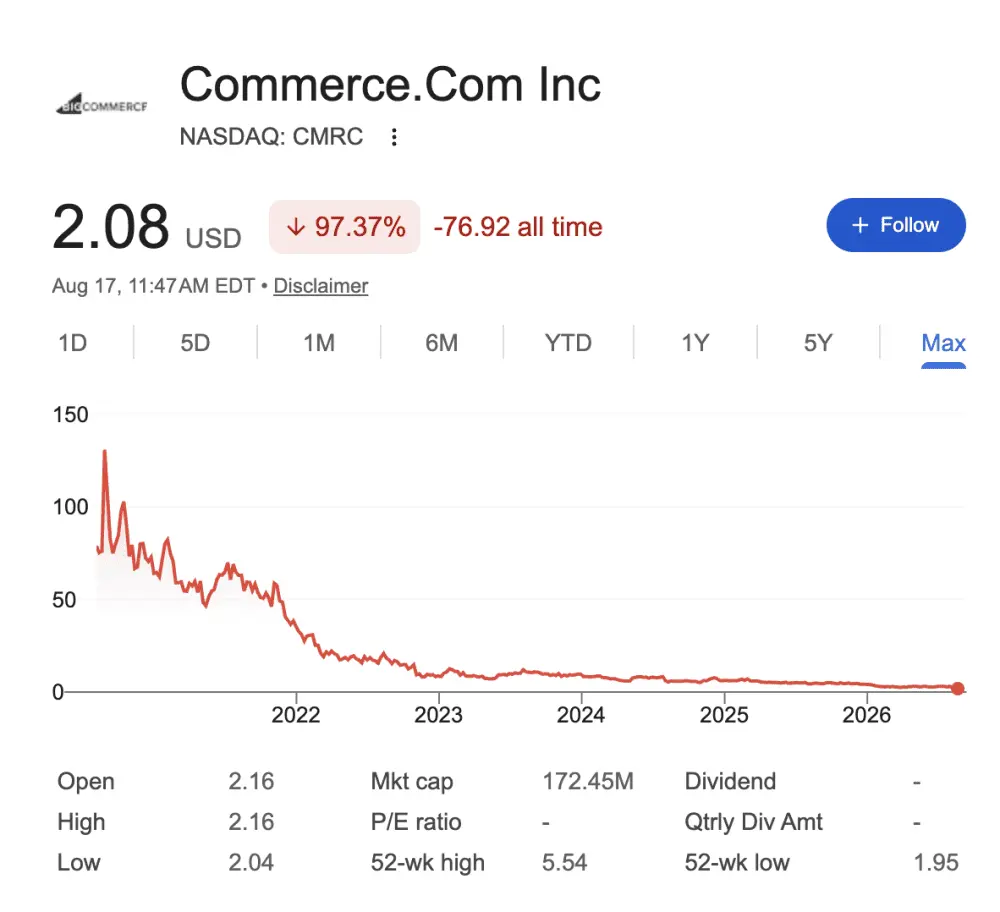
The turning point came just a month before BigCommerce’s public debut, when software giant Intuit reportedly tabled a $1.5 billion acquisition offer. BigCommerce turned it down, opted for the public markets, priced its IPO at $24, and closed its first trading day at an explosive $72.27. It secured the crown for the biggest IPO pop of 2020, touching a market capitalization of roughly $4.8 billion.
Today, that same company—now rebranded as Commerce.com and trading under the ticker CMRC—commands a market capitalization of roughly $200 million, valuing it at less than 1x its Annual Recurring Revenue (ARR). It is currently fighting off a hostile takeover bid from a much smaller competitor and recently issued full-year 2026 revenue guidance with a midpoint sitting below its actual 2025 performance.
Back in 2020, everyone knew Shopify was winning. But looking back, what proves truly invaluable for modern operators, founders, and investors is analyzing the shape of the decay. The unfolding trajectory of BigCommerce offers a masterclass in what actually compounds in the unforgiving world of B2B software, serving as a sobering reminder that second place is rarely a defensive moat.
Detailed Chronology: From the 2020 IPO Peak to the 2026 Slowdown
The Summer of 2020: A Crossroads
The mid-pandemic digital acceleration supercharged online retail, making ecommerce infrastructure the most sought-after asset class on Wall Street. BigCommerce’s decision to reject Intuit’s $1.5 billion buyout in favor of an independent public debut felt bold, even visionary. When the stock skyrocketed over 200% on its first day of trading, it validated management’s thesis that public markets hungered for a pure-play alternative to Shopify.
For the next twenty-four months, the narrative held firm. The revenue gap between the two giants sat relatively flat at around 20x. To most market observers, it looked like a classic duopoly—a massive ecosystem where two winners could comfortably coexist, capturing distinct segments of the expanding global retail pie.
The Quiet Unraveling
Unlike many tech flameouts characterized by sudden disasters—such as a catastrophic data breach, a botched platform migration, or a corporate scandal—BigCommerce’s descent featured no single catastrophic quarter. Instead, deceleration did all the heavy lifting.
Year after year, the growth rates slipped. BigCommerce stepped down from 27% growth to 11%, then to 7%, and finally to a meager 3%. Meanwhile, a competitor twenty times its size managed to stubbornly hold onto 26% to 30% growth year-over-year. The gap widened not because BigCommerce imploded overnight, but because its momentum quietly evaporated while Shopify accelerated at an unprecedented scale.
The Desperate Pivot and Present Day
In a bid to reverse its fortunes, the company executed the standard playbook for a stalling enterprise: it brought in a new CEO, executed a sweeping corporate rebrand from BigCommerce to Commerce.com, and reorganized its workforce around AI-driven automation.
These measures bore fruit on the balance sheet. The company notched two consecutive quarters of positive GAAP net income, posting a Q2 non-GAAP operating income of $8.1 million against internal guidance of $4 million to $5 million.
Yet, the market remained entirely unimpressed. Alongside those glowing profitability metrics, management slashed its full-year revenue guidance by $18 million at the midpoint. The stock plummeted. Wall Street analysts at Barclays and UBS adjusted their price targets down to a dismal $3.00–$3.50 range. To add insult to injury, Rezolve AI—a company a fraction of Commerce.com’s size—launched a hostile takeover bid, with its executive leadership publicly labeling Commerce.com’s growth rate as "embarrassing."
Supporting Context & Metrics: The Mechanics of the Decay
To truly understand how a $4.8 billion market darling deteriorates into a sub-1x ARR asset, one must examine the hard metrics that chart the divergence between the industry leader and the perpetual runner-up.
1. The Divergence of Growth Rates at Scale
Growth rate at scale remains the single most predictive metric in B2B software. While BigCommerce’s top-line expansion steadily ground to a halt, Shopify achieved the nearly impossible: it accelerated while already operating as a behemoth.

Shopify’s 2025 revenue growth hit 30%—four full percentage points higher than its 2024 performance. By Q2 2026, growth accelerated further to 34%. In practical terms, that single quarter represented roughly $900 million in incremental quarterly revenue. To put that in perspective, Shopify adds the equivalent of 2.7 times Commerce.com’s entire annual revenue every single ninety days.
2. Software vs. The Transaction: The Fatal Business Model Flaw
The core divergence between the two companies ultimately boiled down to monetization architecture.
- BigCommerce Sold Software: Subscription solutions accounted for $63.1 million out of an $84.5 million quarter—roughly 75% of total revenue. BigCommerce was paid a flat fee for its platform, meaning it generated the exact same revenue whether a merchant processed $1 million or $50 million through the storefront.
- Shopify Sold the Transaction: Shopify embedded itself into the commercial flow of the business. As merchant merchandise volumes scaled, Shopify’s revenue scaled directly alongside them through integrated payments, shipping, financial services, and app-store take-rates.
Over six years, compounding on that foundational architectural choice created a 40x divergence in revenue and a nearly 1,000x gap in market capitalization. Commerce.com’s CFO explicitly acknowledged this blind spot during a recent earnings call, designating the integration of payments, cross-selling, and attach rates as the primary company priority. Shipping BigCommerce Payments alongside PayPal yielded volume metrics running 30% ahead of internal projections—a vital fix, arriving a full six years after Shopify made it the central pillar of its business model.
3. The Illusion of the Defensible Niche
Conventional startup wisdom dictates that if you cannot win the broad market against a dominant category king, you should carve out a defensible niche, dominate it, and protect your margins.
BigCommerce followed this advice to the letter. They targeted the complex enterprise and B2B segments, constructed a more open, flexible API architecture, and consistently outperformed competitors in head-to-head feature comparisons. In fact, BigCommerce swept the board, winning 24 out of 24 medals in the 2026 Paradigm B2B Combines—marking its fourth consecutive year of analyst dominance.
However, the financial scoreboard exposed the fatal flaw in this strategy: Revenue per account was rising while total account count was falling. This dynamic represents price capture on a shrinking base. It works effectively for a couple of years to prop up margins, but eventually, it hits a hard wall. Winning analyst scorecards in a shrinking segment while the market leader captures that exact same segment four times faster isn’t a defensible niche—it’s simply a slower loss wrapped in superior marketing collateral.
Official Statements & Market Reactions
The tension between internal operational discipline and external market sentiment has rarely been more pronounced. During recent earnings calls, executive leadership has heavily emphasized cost discipline, efficiency gains, and margin expansion.
"The cost discipline and margin expansion are real. We have optimized our workforce, embraced automation, and delivered consecutive quarters of positive GAAP net income," management noted, pointing to Q2 non-GAAP operating income outperforming initial guidance by nearly double.
Yet, public markets and financial analysts have remained brutally indifferent to these efficiency metrics. Wall Street’s message has been unambiguous: Profitability cannot fix a growth problem.
As Barclays and UBS analysts slashed their price targets to the $3.00 range, external vultures began to circle. The hostile takeover bid launched by Rezolve AI sent shockwaves through the industry, punctuated by harsh public critiques from rival executives who highlighted the stark reality of a public software company guiding full-year revenue below prior-year levels. The market has priced in the structural reality: cost-cutting buys time to fix a broken growth engine, but without top-line momentum, that time eventually runs out.
Future Outlook: Lessons for B2B Operators
Most B2B software companies will not become the undisputed #1 in their category, and that financial reality is entirely acceptable. However, the cautionary tale of BigCommerce proves that second place is not a structural moat. A runner-up position only retains its value if the company grows at least as fast as the category leader.
For founders, operators, and institutional investors navigating the next generation of enterprise software, the trajectory of Commerce.com offers five definitive takeaways:
- Monetize the Flow, Not Just the Seat: Flat-rate SaaS subscription models lack the compounding velocity of usage-based, transactional, or embedded financial models. If your customer grows 10x, your revenue needs a mechanism to scale alongside them.
- Niche Leadership Is Not a Strategy Without Growth: Winning analyst awards in a specialized segment is a hollow victory if the overarching market share is consolidating around a faster-moving platform leader.
- Deceleration Is a Silent Killer: Sudden crises force immediate turnarounds, but slow, steady deceleration lulls organizations into a false sense of security until the valuation gap becomes insurmountable.
- Profitability Buys Time, Not Valuation: Margin optimization and positive GAAP earnings are essential cushions, but they cannot sustainably re-rate a stock in the absence of top-line expansion.
- Business Model Alignment Trumps Feature Parity: Having superior enterprise features or a more open architecture means nothing if the underlying economic engine is misaligned with how value is created and captured in the market.
Ultimately, Shopify and BigCommerce looked at the exact same burgeoning digital economy at the same time, armed with comparable product surfaces. Both were entirely correct in predicting that ecommerce would reshape global commerce. But while Shopify built a commercial engine that prospered when its merchants succeeded, BigCommerce built a model designed simply to collect a toll at the door.
The digital retail market was undeniably large enough to accommodate two successful companies. As history has brutally proven, however, it simply wasn’t large enough to support two fundamentally flawed business models.