Executive Overview
The landscape of modern commerce has crossed a definitive threshold. For years, artificial intelligence was framed through the lens of corporate speculation, venture-backed hype cycles, and enterprise-level transformations that felt distant to the average main street entrepreneur. Today, that narrative has been utterly upended.
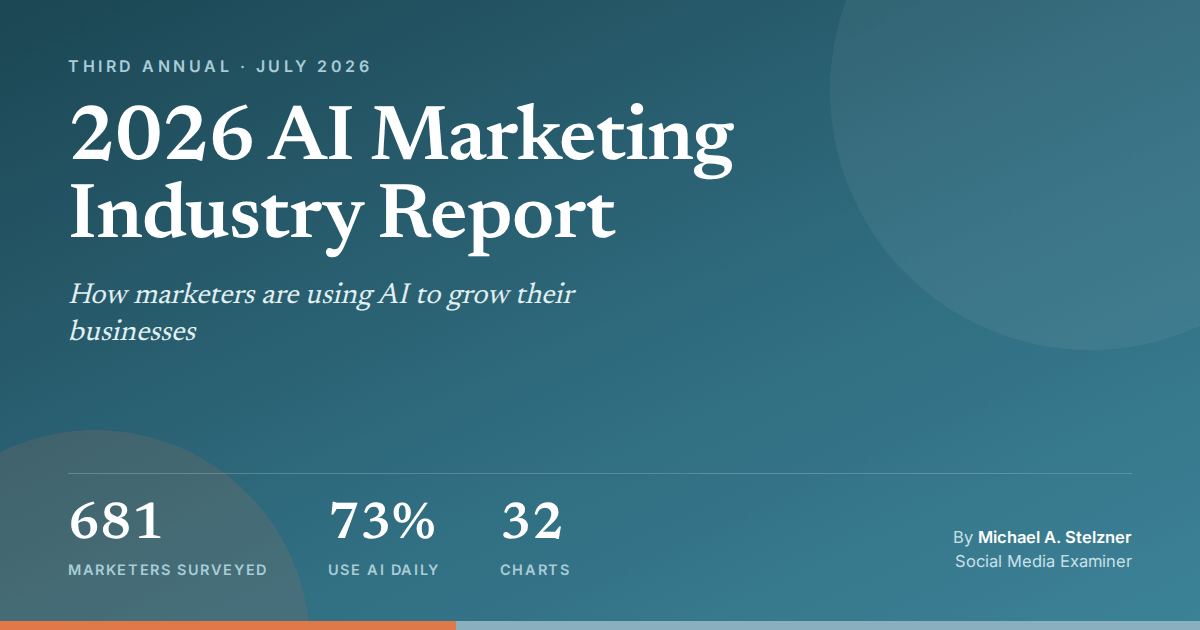
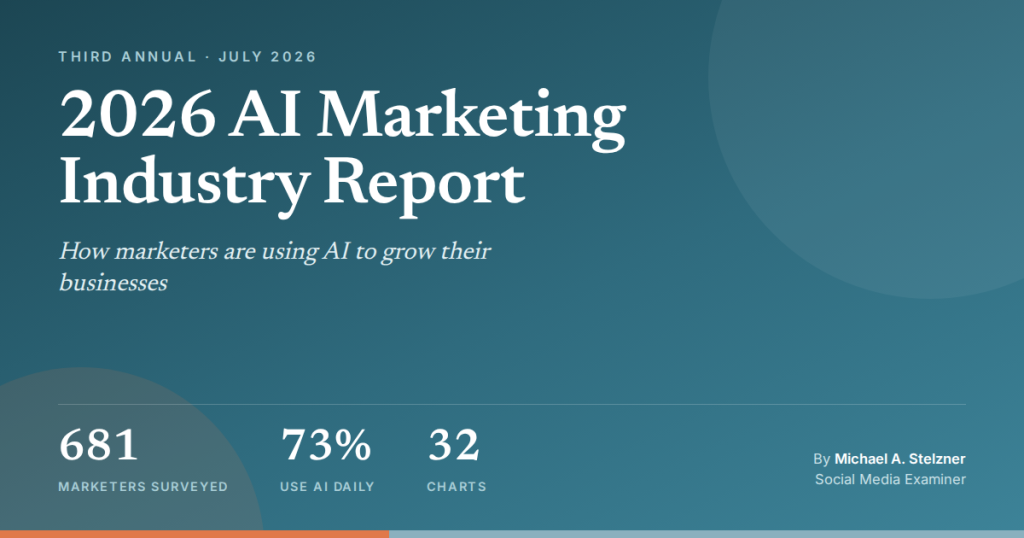
According to the newly released 2026 AI Marketing Industry Report from Social Media Examiner—compiled through comprehensive surveying where 60% of respondents hail from organizations with ten or fewer employees—AI is no longer an experimental luxury. It is the operating system of the modern lean enterprise.
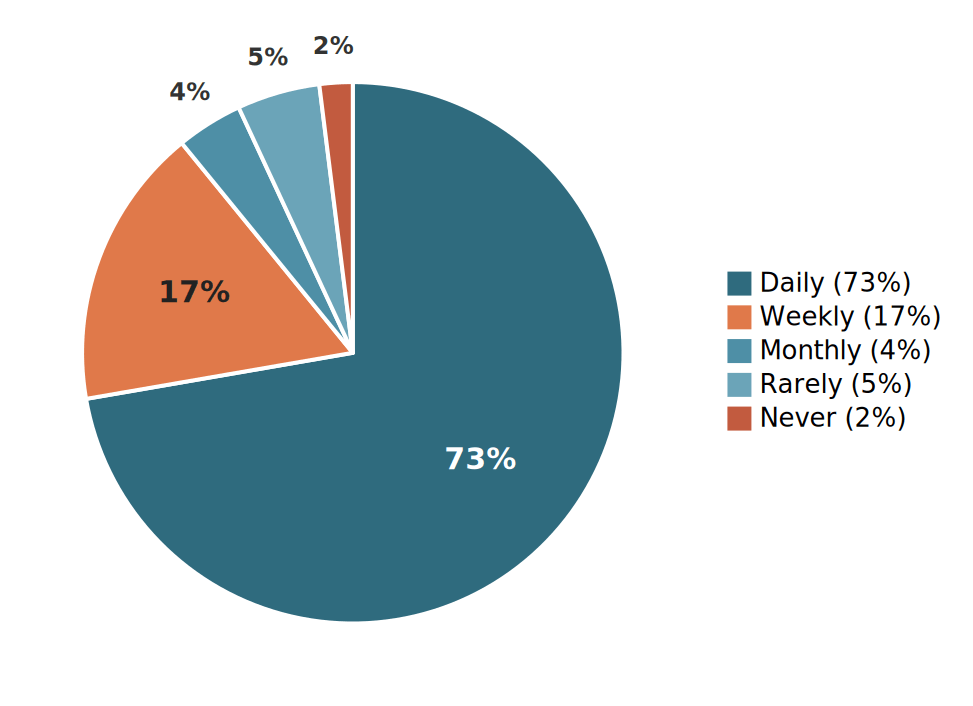
The data reveals a stark reality: daily usage among marketers has surged from roughly one-third just two years ago to nearly three out of four today. Far from being driven by massive corporate training budgets or centralized IT departments, this revolution is grassroots, self-taught, and fiercely pragmatic. Small business owners and solo operators are not waiting for permission or structured corporate onboarding; they are rolling up their sleeves, experimenting on their own dime, and fundamentally reshaping how marketing work gets done.
Yet, beneath this staggering adoption curve lies a complex matrix of operational triumphs and persistent blind spots. While the vast majority of practitioners report monumental gains in time-management and everyday productivity, a staggering measurement gap remains, with most struggling to quantify hard ROI. Furthermore, as the industry stands on the precipice of a new era dominated by AI video production and autonomous agent software, the competitive window for early adopters is narrowing fast. This report unpacks five eye-opening findings from the 2026 data, offering an investigative look at how small businesses are actually wielding artificial intelligence in the real world.
Detailed Chronology: The Rapid Ascent of Practical AI
To understand where small business marketing stands today, one must trace the rapid acceleration of AI tooling over the past twenty-four months. The trajectory has transformed from cautious curiosity into an indispensable professional utility.
The 2024 Baseline: The Era of Trial and Skepticism
Two years ago, the adoption curve looked vastly different. In the 2024 industry benchmarks, only 37% of marketers incorporated artificial intelligence into their daily workflows. At that time, a significant 23% of professionals admitted they rarely or never touched AI applications. The market was characterized by generalized text generation, basic brainstorming queries, and an overwhelming sense of caution. Tools were largely perceived as novelty writing assistants rather than core infrastructure components. Training was virtually nonexistent, and the financial barrier—though low due to freemium pricing models—was met with hesitation regarding data privacy, output quality, and brand voice integrity.
The 2025 Transition: The Normalization Phase
By the middle of last year, the friction of adoption began to give way. As model capabilities expanded—shifting from simple pattern-matching text engines to sophisticated multimodal systems capable of analyzing context, images, and basic code—daily usage rates climbed steadily. The free tier era began its inevitable retreat as advanced features, higher token limits, and professional plugins required paid subscriptions. Marketers stopped asking whether AI could write a passable blog post and began integrating it into content calendars, email sequence drafting, and customer segmentation strategies.
The 2026 Reality: The Ubiquity of the New Normal
Today, the data collected from the 2026 cohort paints a portrait of total integration. Daily usage has skyrocketed to 73%, while an astonishing 90% of marketers now utilize AI at least on a weekly basis. The segment of professionals who rarely or never touch AI has plummeted to a negligible 7%. Momentum shows no signs of plateauing: 84% of respondents report that their usage has actively increased over the past year, and 78% expect their reliance on these tools to expand further in the near term. The transition from a disruptive technological trend to foundational utility is officially complete.
Supporting Context & Metrics: Five Eye-Opening Findings
The 2026 AI Marketing Industry Report digs deep into the operational realities of lean teams. Five core findings stand out, offering profound implications for small business survival and scale.
[2026 AI Adoption Metrics at a Glance]
--------------------------------------------------
Daily AI Usage:             73% (Up from ~37% in 2024)
Weekly AI Usage:            90%
Self-Taught Learners:       85%
Self-Funded Tool Purchases:  53%
Claimed Time/Prod. Savings: 86%
Measurable ROI Documented:  30%
AI Video Adoption:          37%
AI Agent Adoption/Exp.:     35% (79% planning or using)
--------------------------------------------------
1: AI Isn’t a "Nice-to-Have" Anymore — It’s the New Normal
The most glaring metric in the 2026 data is the normalization of daily interaction. With 73% of marketers relying on AI every single day and 90% touching it weekly, the technology has transitioned from an auxiliary asset to the central hub of creative and operational execution.
Crucially, this is not an enterprise-driven phenomenon. Because 60% of the survey participants operate within micro-businesses of 10 or fewer people, these figures reflect the daily grind of solo entrepreneurs, boutique agencies, and localized retail brands. The data suggests that the penalty for non-adoption is no longer falling behind competitors; it is operating at a fatal structural disadvantage regarding speed and output volume.
2: The Death of the Corporate Training Department
How do professionals acquire the skills necessary to navigate complex artificial intelligence ecosystems? The answer dismantles traditional notions of professional development.
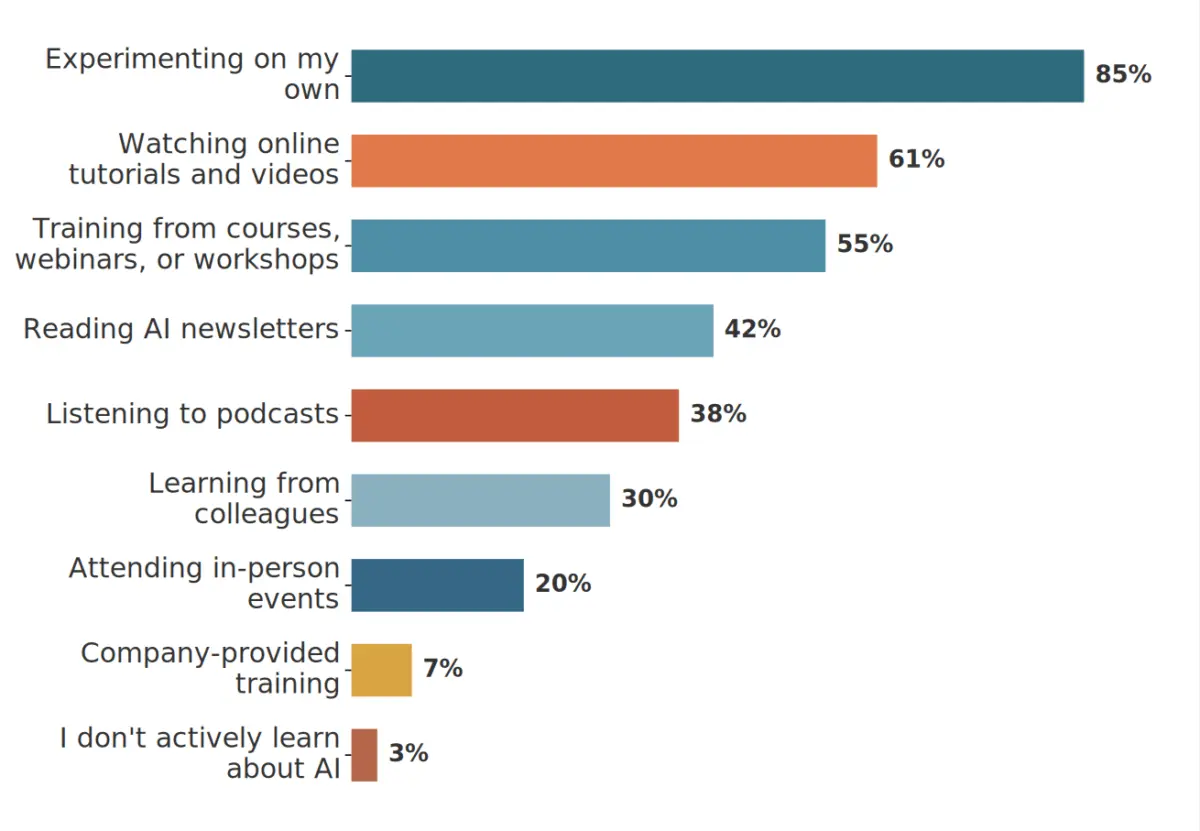
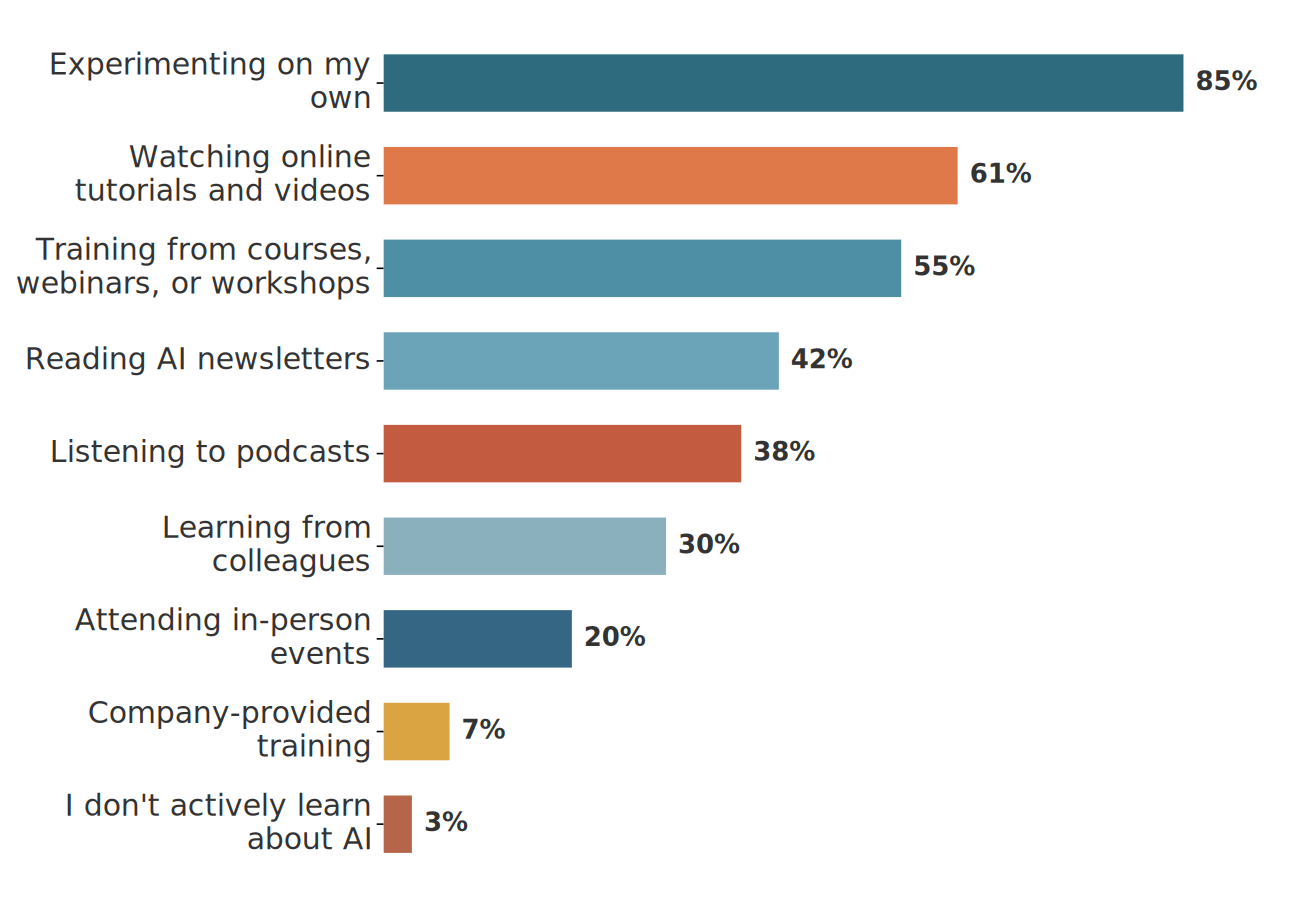
According to the report, 85% of marketers learn by experimenting on their own. In stark contrast, a mere 7% receive company-provided training. Furthermore, when it comes to financing these technological assets, 53% of marketers pay out of their own pockets, and 85% contribute financially in some capacity. The era of the corporate-sponsored software rollout is absent here; instead, the driving force is individual initiative.
When asked who owns AI adoption within their organizational structure, 55% of respondents answered simply: "Me." This DIY ethos has always been the defining characteristic of small business management. In the AI era, larger corporations are belatedly adopting the agile, self-reliant methods that small business owners have practiced for decades.
3: The Great Measurement Gap: Feeling Value vs. Proving ROI
Perhaps the most intriguing tension exposed in the research is the disconnect between subjective utility and objective measurement.
- 86% of marketers strongly agree that AI saves them time.
- 86% confirm that it directly boosts their day-to-day productivity.
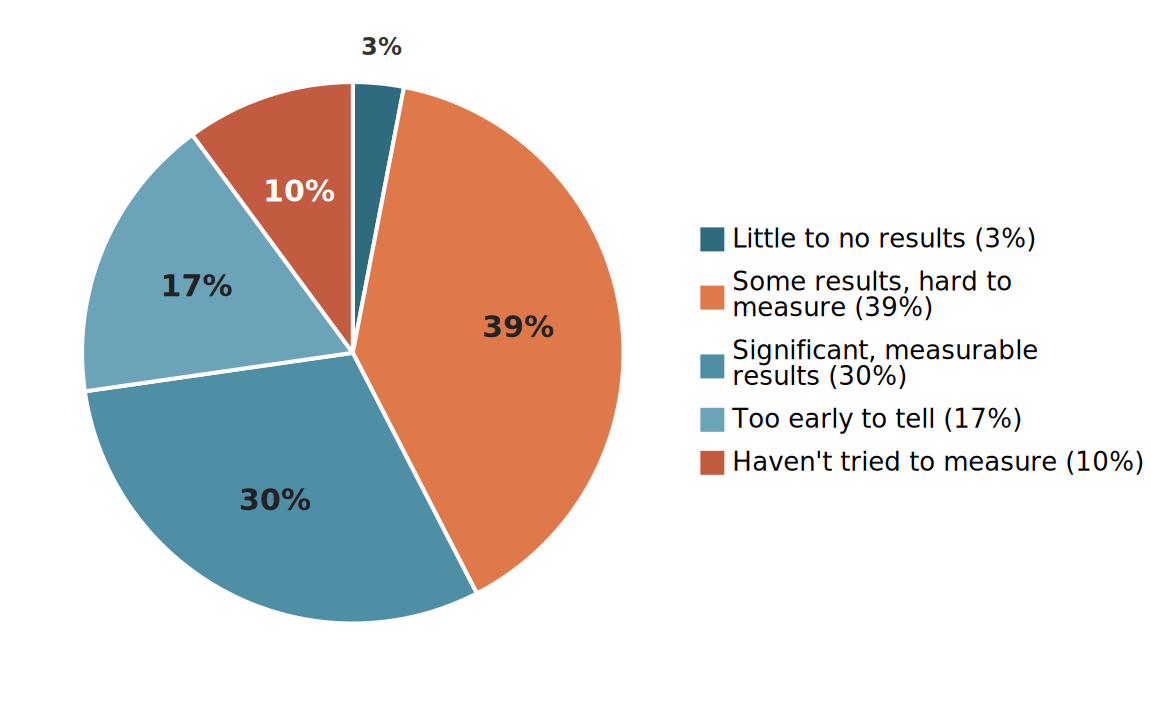
Yet, when asked to provide hard evidence of these gains through trackable metrics, only 30% could point to significant, quantifiable results. Another 39% acknowledged that they sense positive outcomes but lack the mechanisms to measure them, while 10% have made no attempt to track ROI whatsoever.
This phenomenon highlights a critical operational vulnerability—and an immediate opportunity. Most businesses are experiencing the qualitative relief of automated workflows without establishing quantitative benchmarks. Entrepreneurs who implement basic tracking systems to monitor hours saved, content output velocity, or conversion rate lifts will instantly pull ahead of the 70% majority operating in the dark.
4: The Massive Runway in AI Video Production
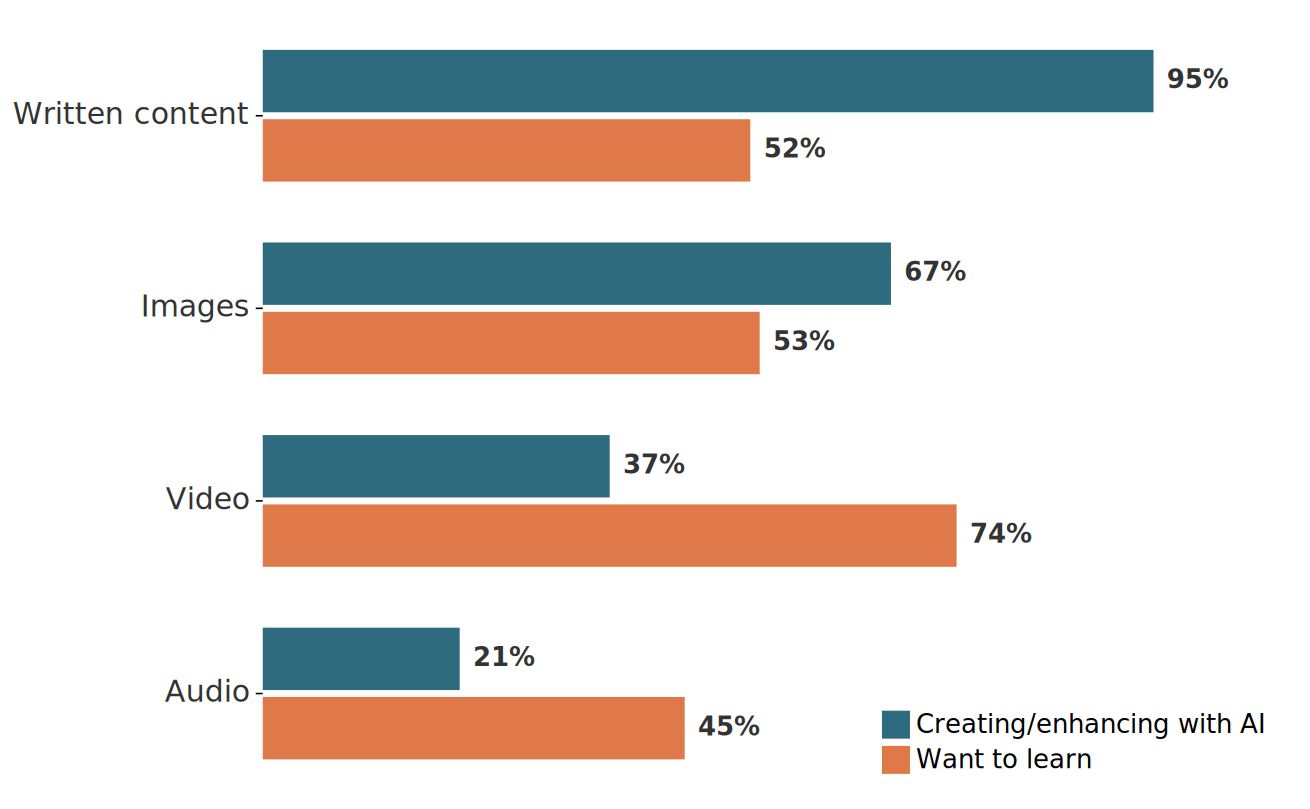
While text-based generation has achieved near-universal saturation—with 95% of marketers utilizing AI for written content—multimodal applications remain heavily lopsided.
- AI Image Creation: Surged dramatically, growing from 39% adoption in 2024 to 67% today.
- AI Video Creation: Stagnates at just 37% adoption.
This disparity creates a fascinating market inefficiency. When surveyed on future learning priorities, 74% of marketers named video as the #1 content type they want to learn to create with AI. This reveals a staggering 37-point gap between consumer demand/ambition and actual execution. For small business owners willing to climb the initial learning curve of AI-assisted video editing, scripting, and generation, the competitive advantage in social media engagement and digital advertising is immense.
5: The Dawn of AI Agents and Autonomous Workflows
Looking toward the immediate horizon, the survey introduced a new metric tracking the emergence of AI agents—autonomous software systems capable of executing multi-step workflows without constant human intervention.
While only 11% of marketers currently use agents regularly, and 24% are actively experimenting, a massive wave is building: 44% plan to adopt agents soon, bringing total current and planned adoption to 79%. Moreover, mastering AI agents ranks as the top educational priority for professionals moving forward.
For lean teams, the implications are profound. Moving beyond simple prompt-and-response text generation into delegating complete operational sequences—such as automated lead nurturing, dynamic customer service triage, and programmatic analytics monitoring—represents the ultimate leverage point. It allows a three-person team to operate with the output capacity of a thirty-person enterprise.
Official Insights and Industry Perspectives
Michael Stelzner, founder of Social Media Examiner and architect of the 2026 study, emphasizes that the primary goal of this research is to strip away the industry hype and deliver actionable intelligence to everyday operators.
"We surveyed marketers to find out how they’re actually using AI," Stelzner notes in the report’s executive summary. "Not the hype. Not the headlines. The real story. And since 60% of our respondents come from businesses with 10 or fewer people, this isn’t enterprise research. This is your world."
Stelzner points out that the transition from general-purpose tools like ChatGPT toward specialized ecosystems—such as the notable market share shift toward models like Anthropic’s Claude—demonstrates a maturing user base. Marketers are no longer dabbling; they are matching specific operational tasks with the exact model architecture best suited to execute them.
Furthermore, industry analysts observing the report’s data suggest that the small business sector is uniquely positioned to capitalize on these shifts. Unburdened by legacy software contracts, bureaucratic approval layers, or risk-averse compliance departments, lean teams can pivot overnight, test emerging video tools, and deploy autonomous agents with unprecedented agility.
Future Outlook: Navigating the 2026 AI Landscape
As the digital economy pushes deeper into 2026, the data from Social Media Examiner’s comprehensive industry report serves as both a validation and a warning.
The validation is clear: small business marketers have successfully integrated artificial intelligence into the fabric of their daily operations. They have done so through resourcefulness, personal investment, and relentless self-teaching. They have proven that survival in modern commerce does not require a million-dollar IT budget; it requires curiosity and adaptability.
The warning, however, is equally clear. The window of effortless differentiation is closing. As daily usage solidifies at 73% and competitors begin closing the gap in advanced verticals like video production and autonomous agent deployment, baseline usage will no longer guarantee a competitive edge.
To thrive in the next phase of the AI revolution, lean business operators must take three deliberate steps:
- Bridge the Measurement Gap: Implement simple tracking metrics to move beyond the feeling of productivity and scientifically verify where AI drives top-line revenue and bottom-line savings.
- Conquer the Video Deficit: Capitalize on the 37-point adoption gap in AI video generation to dominate visual marketing channels before the market saturates.
- Prepare for Autonomy: Begin experimenting with AI agents to automate routine administrative and marketing tasks, freeing up human capital for high-level strategy and authentic customer connection.
The tools are accessible, the path is illuminated by hard data, and the market rewards the proactive. For the small business owner willing to embrace this autonomous shift, the future has never been more promising.