
Executive Overview
In the ever-evolving landscape of cyber warfare, state-sponsored threat actors continually search for structural vulnerabilities in the global digital infrastructure. In 2017, investigative reports revealed that "Fancy Bear"—a prolific cyber-espionage collective widely attributed to Russian military intelligence (GRU)—weaponized a high-profile web standard to compromise targeted accounts. The group successfully manipulated Google’s Accelerated Mobile Pages (AMP) framework, turning a technology designed to speed up the mobile internet into an elite vehicle for credential-harvesting spear-phishing campaigns.
The core vulnerability rested within how Google implemented AMP caching. To provide instantaneous loading times for mobile search users, Google pre-rendered and hosted third-party web content on its own infrastructure, displaying trusted google.com URLs in browser address bars. For sophisticated attackers, this design flaw presented an irresistible opportunity: phishing links that appeared to originate directly from Google. Despite repeated, urgent warnings from independent web developers and security researchers, Google officials initially defended the architecture, dismissing concerns that everyday users—and even technical professionals—could be deceived.
The fallout was immediate and severe. While everyday internet users faced risks from generalized scams, high-profile targets—including investigative journalists and researchers tracking Russian state corruption—were specifically targeted. Among the victims was prominent Russia analyst and journalist David Satter, whose compromised Gmail inbox led to the public leak and manipulation of sensitive documents. This investigative piece explores the architecture of the AMP vulnerability, the timeline of Fancy Bear’s targeted assaults, the tech giant’s controversial response, and the broader implications for the open web.
Detailed Chronology: The Evolution of the AMP Exploit
The intersection of state-sponsored espionage and Google’s AMP standard was not an overnight accident, but rather a convergence of aggressive web optimization and sophisticated adversary tactics.
The Birth of AMP and Early Warnings
Launched by Google in late 2015, Accelerated Mobile Pages was marketed as an open-source initiative to optimize web performance on mobile devices. By stripping web pages down to simplified HTML frameworks, AMP allowed content to load almost instantly on constrained mobile networks and processors.
To achieve this lightning-fast delivery, Google introduced a pre-rendering mechanism. Search results featuring AMP content were pre-fetched and stored on Google’s own servers. When a user clicked a link, the page loaded instantly from a cache, bearing a google.com domain structure in the address bar.
Almost immediately, technical critics raised alarms. Programmers like John Gruber and independent developers noted that this approach obfuscated true Uniform Resource Locators (URLs). Security-minded developers recognized that the user interface effectively trained web surfers to trust a google.com wrapper, even when viewing third-party content.
By late 2016, these theoretical concerns graduated to active warnings. In November 2016, web programmer Ray Etornam filed a bug report on GitHub (ampproject/amphtml/issues/6210), detailing how the architecture could be exploited to grant malicious sites undue credibility. Developer Christian Gloddy and others joined the thread, explicitly warning Google that users are taught to look at the address bar to avoid phishing scams.
Despite these warnings, Malte Ubl, the tech lead for the AMP project, pushed back against the criticism. Insisting that the originating domain was clearly visible at the top of the content viewer, Ubl publicly maintained that unsophisticated users would not be easily fooled.

Fancy Bear’s Campaign Against Investigative Journalists
While tech leads debated standards on GitHub, Fancy Bear (also tracked as APT28, Sofacy, or Strontium) was putting the vulnerability into practice. The group—notorious for its role in the 2016 Democratic National Committee hacks and a massive portfolio of zero-day exploits—turned its sights toward investigative journalists exposing Russian government corruption.
A primary target was Aric Toler, a researcher and writer for Bellingcat, known for investigating Russian media operations and the downing of Malaysia Airlines Flight 17 over Ukraine. Toler’s digital footprint made him a high-value target for Russian intelligence operations.
- October 11–13, 2016: After Toler tweeted about receiving a legitimate security warning from Google regarding "government-backed attackers," the threat actors struck.
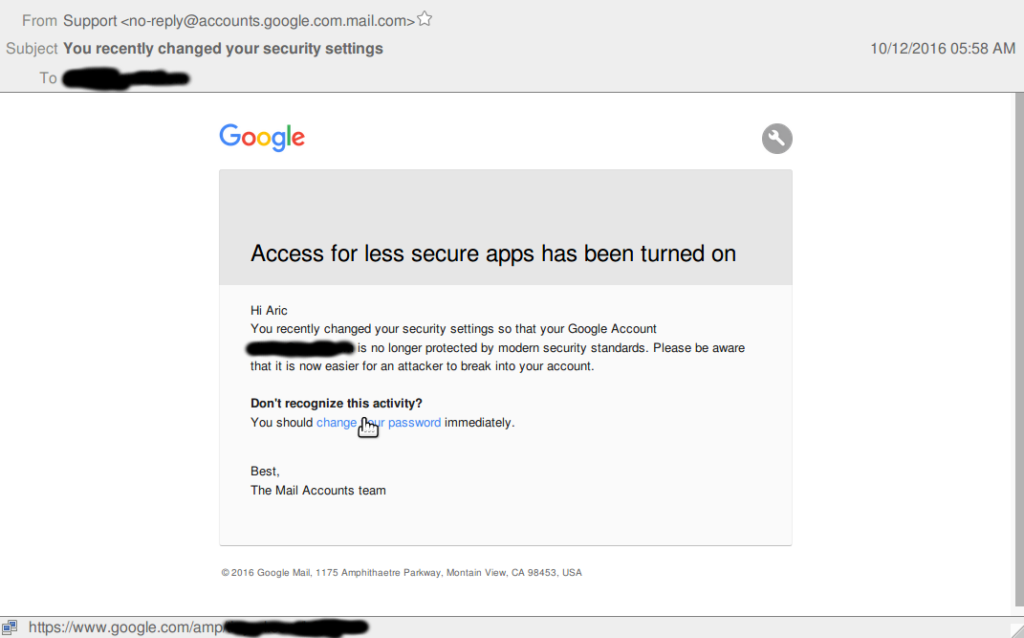
- The First Malicious Hook: Toler received an email masquerading as a security alert from Google, warning that older email programs could access his account and inviting him to click a link. This initial attempt utilized an AMP URL that redirected to a credential-harvesting phishing page.
- Escalation: The following day, a second spear-phishing email arrived, mimicking Google’s "government-backed attackers" warning—a direct mirror of the tweet Toler had published hours prior.
Forensic analysis conducted by cybersecurity firm ThreatConnect revealed that these emails originated from infrastructure tied directly to Fancy Bear, reusing a free email address ([email protected]) linked to prior state-sponsored campaigns. While Toler recognized the threat and evaded the trap, not all targets were as fortunate.
The Compromise of David Satter
Journalist David Satter, a vocal critic of the Russian government and an expert on post-Soviet affairs, was subjected to a similar AMP-driven spear-phishing attack utilizing the exact same infrastructure ([email protected]).
Unlike Toler, Satter was successfully tricked into visiting the malicious AMP-wrapped phishing page and entering his credentials. Within moments of the compromise, automated scripts downloaded the entire contents of his Gmail archive. Weeks later, according to reports by the digital rights group Citizen Lab, the stolen documents surfaced online—some of which had been altered and weaponized in a targeted disinformation campaign designed to defame critics of Russian leadership.
Supporting Context & Metrics: The Mechanics of Modern Phishing
To fully understand why the AMP vulnerability was so potent, one must examine the psychology and mechanics of modern social engineering. Phishing attacks rely heavily on cognitive shortcuts. For decades, cybersecurity awareness training has drilled a single golden rule into the minds of internet users: Always check the domain name in the address bar.
| Defense Mechanism | Traditional Phishing | AMP-Vector Phishing |
|---|---|---|
| Address Bar Display | Obvious typo-squatting (e.g., g00gle.com) |
Legitimate root domain (google.com) |
| Visual Indicators | Often lack standard HTTPS certificates or branding | Pre-rendered with trusted Google framing and speed |
| Evasion Tactics | URL shorteners (Bitly, TinyURL) | Deep-linked cache structures passing security heuristics |
| User Trust Level | Low (trained users spot anomalies quickly) | High (relies on institutional trust in the Google brand) |
When an attacker wraps a credential-harvesting login portal inside an AMP cache, the address bar displays google.com. Even seasoned web developers and cybersecurity professionals admitted that verifying the authenticity of such links at a glance was exceptionally difficult. By hiding the true destination beneath layers of Google’s mobile optimization framework, the attack neutralized the most reliable defense mechanism available to everyday internet users.
Official Statements and Corporate Response
As public scrutiny mounted following reports by Salon and other outlets, Google faced mounting pressure to address the structural flaws in its flagship mobile web standard.
Google’s Defensive Stance
Initially, project leaders minimized the risk. Malte Ubl and other Google representatives maintained that the inclusion of the originating domain label at the top of the viewing area provided sufficient transparency. However, as independent researchers demonstrated real-world exploits—such as the compromise of David Satter—the company quietly adjusted its security posture without fully disclosing the mechanics of its patches.
When contacted for comment during the investigation, Google representatives asserted that AMP links had long been protected by its global Safe Browsing infrastructure. Clarifying statements later revealed that automated security scanners only began screening AMP-associated URLs for malicious content in early January 2017.
Furthermore, Google introduced a "redirect notice" for pages that had not been pre-screened by its security crawlers. This notice warned users that they were navigating away from the Google domain and offered an option to return. Critics, however, pointed out that the notice was written in technical developer jargon, failing to clearly articulate the security risks of proceeding to the external site.
Silencing Criticism
As technical debate intensified on public forums, Google’s handling of dissent drew sharp criticism. Notably, as media inquiries began pouring in regarding the GitHub bug report (#6210), project lead Malte Ubl exercised administrative controls to block public comments on the thread, effectively closing the door on transparent peer review regarding the security implications of the platform.
Future Outlook: The Open Web at a Crossroads
The exploitation of Google AMP by state-sponsored actors like Fancy Bear exposed deep vulnerabilities inherent in corporate-driven web standards. While AMP was ostensibly designed to democratize fast mobile access, critics argued it fundamentally centralized control over web traffic, placing tech platforms as arbiters between publishers and their audiences.
Jason Kint, CEO of the digital publishing trade association Digital Content Next (representing major outlets including The New York Times, The Washington Post, and major broadcast networks), captured the sentiment of the publishing industry:
"This report of an ongoing security issue is troubling and exactly why consolidation of power and closed standards are problematic. The sooner AMP migrates to the open web and becomes less tied to the interests of Google, in every way the better."
Though Google ultimately implemented background mitigations—such as Safe Browsing integrations and redirect warnings—the episode served as a watershed moment for internet governance. It demonstrated that speed and optimization, when pursued at the expense of URL transparency and architectural security, can inadvertently hand powerful weapons to state-sponsored threat actors. As the digital ecosystem continues to grapple with centralization, the lessons of the Fancy Bear AMP exploits remain a stark reminder: convenience must never outpace security on the open web.