Executive Overview
The landscape of enterprise technology is undergoing a fundamental transformation, driven increasingly by collaborative open-source ecosystems. In August 2026, Amazon Web Services (AWS) reinforced its deep-seated commitment to open-source communities by participating prominently in two of the region’s premier technical gatherings: the Open Source Summit Korea 2026 and the MCP DevSummit Seoul 2026. Over the course of four dynamic days, AWS contributors, global technologists, and local community leaders convened in Seoul to share technical insights, collaborate on cutting-edge architectures, and propel the evolution of pivotal Linux Foundation projects, specifically OpenSearch and Valkey.
This engagement highlights more than mere corporate participation; it underscores a strategic alignment between enterprise cloud infrastructure and community-driven innovation. As organizations grapple with escalating volumes of unstructured data, demanding real-time caching needs, and intricate multi-tenant workloads, the demand for scalable, high-performance, open-source alternatives has never been more critical. By integrating the latest versions of OpenSearch and Valkey into managed cloud services—such as Amazon OpenSearch Service and Amazon ElastiCache—AWS bridges the gap between raw, community-built software and enterprise-grade reliability, security, and scale.
This report provides an in-depth examination of the events, technical breakthroughs, and strategic implications stemming from AWS’s recent presence in Seoul. We explore the architectural advancements of OpenSearch 3.7 and Valkey 9.1, evaluate the localized impact of community-led networking, and chart the future trajectory of these foundational technologies as they shape the next generation of cloud computing.
Detailed Chronology: Inside the 2026 Seoul Summits
The convergence of Open Source Summit Korea 2026 and MCP DevSummit Seoul 2026 created a rare collaborative nexus for developers, system architects, and maintainers across Asia and beyond. Throughout the four-day event, attendees immersed themselves in a rich agenda of technical sessions, hands-on workshops, and collaborative brainstorming forums.
Day-by-Day Engagement and Community Leadership
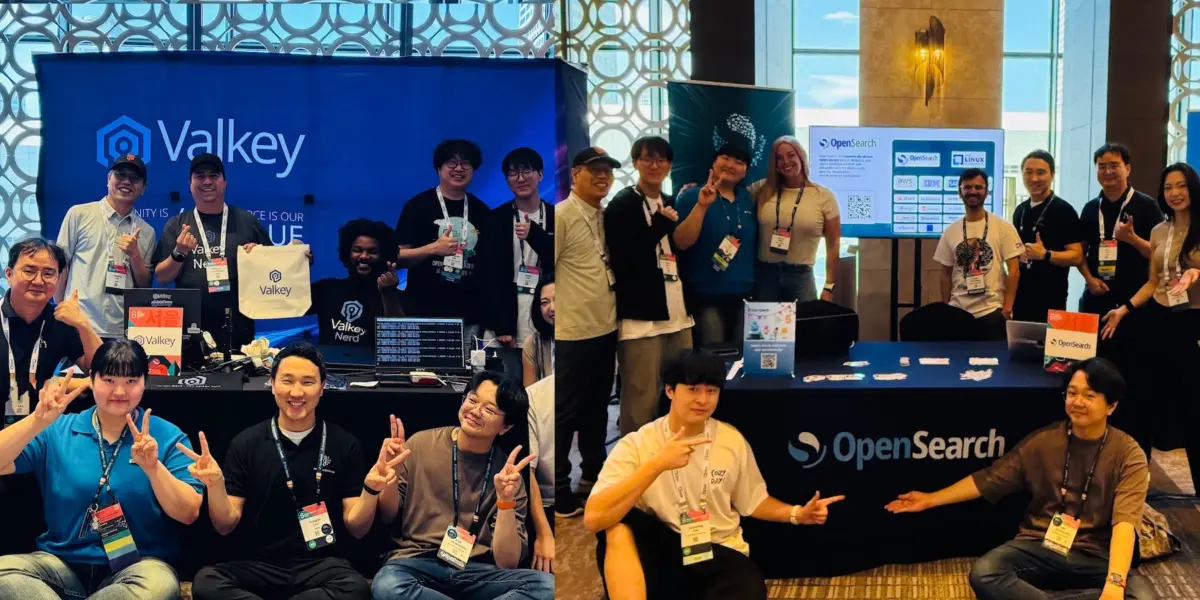
From the opening keynotes to the closing panel discussions, AWS engineering contributors stood shoulder-to-shoulder with community volunteers at the dedicated OpenSearch and Valkey booths. Rather than a top-down corporate showcase, the event floor operated as a peer-to-peer knowledge exchange. Leaders of the Korean OpenSearch communities played a central role, volunteering their time to guide attendees through architectural diagrams, troubleshooting tips, and best practices for large-scale deployments.
A major highlight of the week was the dedicated OpenSearch Project Seoul User Group Meetup, which took place concurrently during the summit week. This meetup provided an intimate yet expansive venue for local developers to discuss real-world production challenges. Attendees shared telemetry pipelines, discussed migration strategies from legacy search systems, and debated tuning parameters for high-throughput vector search workloads.
The Synergy of MCP DevSummit and Open Source Summit
The co-location of the MCP DevSummit Seoul alongside the broader Open Source Summit added an extra layer of technical depth. Model Context Protocol (MCP) and modern developer tooling initiatives attracted specialized engineers focused on the intersection of artificial intelligence, context management, and systems engineering. Throughout these sessions, AWS participants demonstrated how managed infrastructure can support emerging AI frameworks, ensuring that data retrieval engines like OpenSearch and caching layers like Valkey can seamlessly feed context to large language models (LLMs) with minimal latency.
Supporting Context & Metrics: Under the Hood of OpenSearch 3.7 and Valkey 9.1
To fully appreciate the excitement generated at the Seoul summits, one must examine the recent technical milestones achieved by OpenSearch and Valkey. Both projects have rolled out major updates in mid-2026, delivering substantial performance gains that directly benefit cloud-scale architectures.
OpenSearch 3.7: Redefining Search, Observability, and Vector Performance
Released on June 9, 2026, OpenSearch 3.7 introduced a suite of transformative capabilities designed to streamline enterprise observability and artificial intelligence workflows.
- Unified Observability Interface: OpenSearch 3.7 empowers organizations to query logs, traces, and metrics through a single, cohesive interface. This release introduces advanced tools for automated alerting and Service Level Objective (SLO) tracking, significantly reducing the mean time to detect (MTTD) and resolve (MTTR) production incidents.
- Accelerated Vector Search: Recognizing the explosive growth of generative AI and semantic search applications, OpenSearch 3.7 engineering teams optimized vector retrieval algorithms. The result is a staggering up to 5.5x faster vector retrieval performance compared to previous iterations, allowing enterprises to execute complex similarity searches over millions of high-dimensional embeddings without compromising latency.
- Managed Integration: Building upon these open-source advancements, AWS launched support for OpenSearch version 3.7 on Amazon OpenSearch Service on July 30, 2026. This managed offering brings immediate enhancements in vector search performance, search relevance tuning, and the sophisticated analytics capabilities of Query Insights, allowing cloud architects to deploy enterprise-grade search clusters with automated patching, scaling, and robust security frameworks.
Valkey 9.1: Unleashing High-Performance Caching and Multi-Tenancy
For workloads demanding microsecond-level response times, Valkey has firmly established itself as the premier open-source, high-performance key/value datastore. Capable of powering caching layers, messaging queues, and primary databases, Valkey took a massive leap forward with the release of Valkey 9.1 on May 19, 2026.
- Redesigned I/O Threading Model: Valkey 9.1 introduced a modernized I/O threading architecture that re-architects how network operations and request parsing are distributed across CPU cores. This redesign yields up to a 17% increase in overall throughput, making it exceptionally well-suited for high-velocity transaction processing.
- Optimized Memory Footprint: Efficiency is paramount in large-scale caching deployments. Valkey 9.1 optimized internal data structures for string allocations, successfully reducing memory usage by up to 20% for strings under 128 bytes. This optimization translates into substantial infrastructure cost savings for applications managing vast quantities of small metadata keys, session tokens, or user profiles.
- Managed Deployment via Amazon ElastiCache: On June 23, 2026, AWS extended these performance dividends to its user base by introducing Valkey 9.1 in Amazon ElastiCache for node-based clusters. This managed integration delivers the heightened throughput and memory efficiency of Valkey 9.1 while coupling it with AWS-grade access controls, multi-tenant isolation, automated failover, and seamless scaling.
Official Statements and Industry Perspectives
The collaborative ethos of the Open Source Summit Korea 2026 was captured in reflections shared by community leaders, AWS developers, and open-source advocates.
"Open-source projects thrive not merely on code contributions, but on the vibrant, face-to-face connections forged within regional communities," noted a senior AWS open-source contributor during the Seoul event. "The technical sophistication and enthusiasm witnessed at Open Source Summit Korea and MCP DevSummit demonstrate that the developer ecosystem in Asia is driving some of the most innovative use cases for OpenSearch and Valkey today."
Local community organizers echoed this sentiment, emphasizing the value of direct dialogue with upstream maintainers. By bridging the gap between local enterprise developers and global engineering teams, events like these ensure that real-world deployment challenges in fast-growing markets directly influence the product roadmaps of foundational open-source projects.
Furthermore, industry analysts have pointed out that AWS’s active stewardship and integration of projects like OpenSearch and Valkey represent a maturation of the cloud provider’s open-source strategy. Rather than creating proprietary forks, AWS continues to invest heavily in upstream open governance, ensuring that customers enjoy vendor-agnostic portability combined with the operational excellence of managed cloud services.

Future Outlook: The Road Ahead for Open-Source Cloud Infrastructure
As Open Source Summit Korea 2026 and MCP DevSummit Seoul 2026 draw to a close, the momentum generated in the South Korean capital is already reverberating across global developer communities. The roadmap for both OpenSearch and Valkey points toward deeper AI integration, even tighter security compliance for multi-tenant enterprise environments, and continuous micro-optimizations for cloud-native hardware architectures.
Upcoming Community Touchpoints
For developers and architects eager to continue these technical dialogues, the engagement does not stop in Seoul. AWS contributors will maintain an active presence at upcoming global and regional community events:
- OpenSearch Community Events: Ongoing virtual and in-person meetups, hackathons, and contributor workshops hosted globally. (Refer to the official OpenSearch Events Calendar).
- Valkey Community Gatherings: Developer-focused sessions exploring high-availability patterns, data persistence tuning, and clustering strategies. (Refer to the official Valkey Events Page).
Broadening Your AWS and Developer Journey
To stay abreast of the rapid pace of cloud innovation, developers are encouraged to leverage a wide array of ongoing educational and networking resources:
- AWS What’s New: Regularly monitor the AWS What’s New Page for the latest feature rollouts, service expansions, and infrastructure updates.
- AWS Blogs & Technical Deep Dives: Explore architectural patterns, serverless paradigms, and data analytics deep dives on the AWS Blogs Portal.
- Live and Virtual Events: Discover upcoming learning opportunities by browsing AWS-Led In-Person and Virtual Events, specialized Startup Events, and regional AWS Summits and AWS Community Days.
- The AWS Builder Center: Connect directly with fellow builders, share reference architectures, and access community-driven content by joining the AWS Builder Center.
As the boundaries between application logic, search intelligence, and distributed caching continue to blur, the active collaboration between cloud providers and open-source communities remains the ultimate catalyst for technological progress. Stay tuned for next week’s roundup as we continue to track the cutting edge of cloud engineering.
— Channy