Executive Overview
Two decades ago, a single blog post penned by Jeff Barr quietly altered the trajectory of the technology industry. On this day twenty years ago, the Amazon Elastic Compute Cloud (Amazon EC2) Beta was introduced to the world. At its inception, the offering was deceptively simple: a way for developers to spin up resizable Linux virtual servers in the cloud, billed strictly by the hour, hosted within a single instance type (m1.small) across just one region (US East).
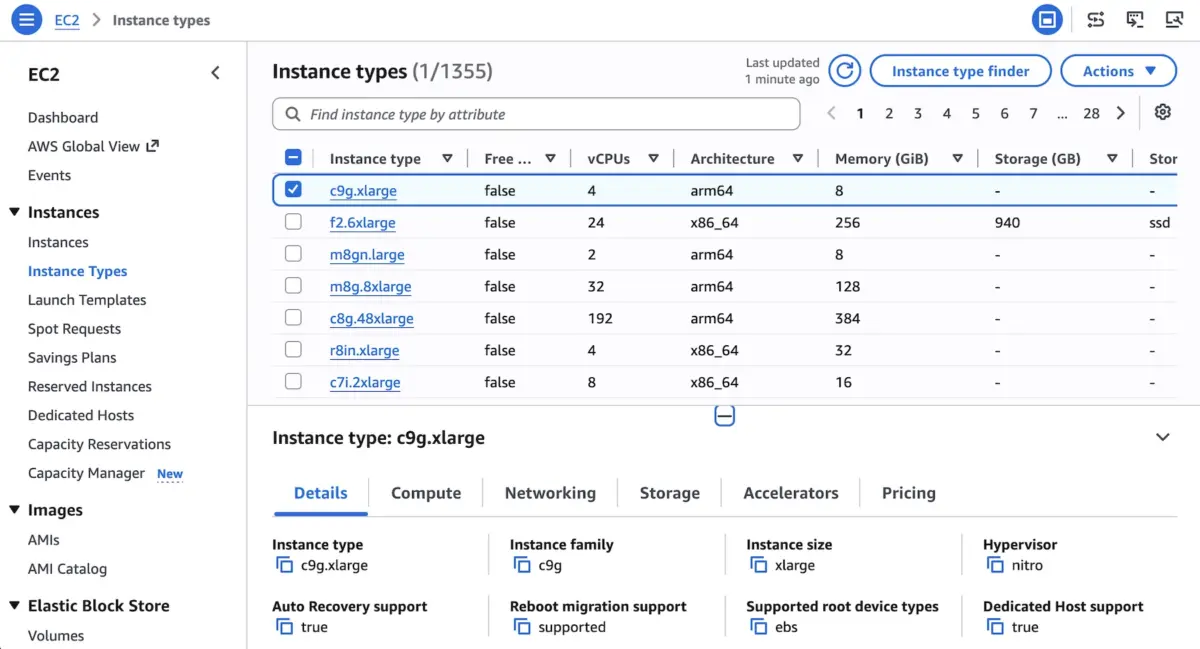
What began as a minimal yet remarkably useful tool for early-adopting developers has since ballooned into the invisible engine powering a vast segment of the modern internet. Over the past twenty years, Amazon EC2 has transformed from an experimental cloud utility into the bedrock of global digital infrastructure. Today, it encompasses more than 1,200 distinct instance types spanning general-purpose, compute-optimized, memory-optimized, storage-optimized, accelerated computing, and high-performance computing (HPC) families. Its footprint has expanded from a solitary region to 39 geographical regions worldwide, extending even further into on-premises data centers, edge computing networks, and 5G telecommunications infrastructure.
More than just a pioneer of Infrastructure-as-a-Service (IaaS), EC2 established the economic and architectural blueprints for modern software development. By turning physical hardware into an on-demand, software-defined utility, it liberated enterprises from the heavy capital expenditures and protracted provisioning cycles of traditional data centers. As the industry now pivots toward massive artificial intelligence workloads, trillion-parameter model training, and distributed edge computing, Amazon EC2 remains the foundational substrate upon which virtually all modern cloud architectures—from serverless containers to advanced machine learning platforms—ultimately rely.
Detailed Chronology: A 20-Year Evolution of Cloud Infrastructure
The history of Amazon EC2 is a masterclass in iterative product development. By launching with a foundational, minimum-viable product in 2006, Amazon established a flexible framework that allowed engineering teams to continuously stack new capabilities atop the core compute engine.
The Foundational Years (2006–2009)
- August 2006 (The EC2 Beta): Jeff Barr announces the availability of Amazon EC2. Developers are given the unprecedented ability to boot Linux virtual machines in minutes, paying only for the hours they consume without signing long-term leases.
- 2008 (Persistent Storage): The introduction of Amazon Elastic Block Store (EBS) solved one of the early limitations of cloud virtual servers: ephemeral storage. EBS provided reliable, persistent block storage volumes that could be attached to running EC2 instances, making database deployments and stateful applications viable in the cloud.
- 2009 (Elasticity and Monitoring): AWS introduced a triad of services that cemented the cloud’s dynamic nature—Elastic Load Balancing (ELB), Auto Scaling, and Amazon CloudWatch. Together, these tools allowed applications to automatically scale out or scale in based on traffic demands while providing deep operational visibility.
- 2009 (Enterprise Isolation): With the launch of Amazon Virtual Private Cloud (VPC), enterprises gained the ability to provision logically isolated sections of the AWS cloud. This crucial security milestone allowed corporate data centers to bridge seamlessly into the cloud using Virtual Private Networks (VPNs), opening the floodgates for large-scale enterprise cloud adoption.
The Era of Hardware and Custom Silicon (2010–2018)
As the scale of AWS operations multiplied, off-the-shelf hypervisors and processors began to present performance bottlenecks. AWS responded by investing heavily in custom hardware engineering.
- 2017 (The AWS Nitro System): AWS reimagined virtualization by offloading I/O virtualization functions to dedicated Nitro hardware and software cards. This radically reduced virtualization overhead, delivering near-bare-metal performance, enhanced security isolation, and rapid delivery of new instance types.
- 2018 (Custom ARM-Based Processing): The launch of A1 instances powered by AWS Graviton processors marked a major shift in compute efficiency. Designed internally by AWS, these ARM-based chips targeted scale-out workloads with significantly better price-performance ratios than traditional x86 processors.
- 2018 (Hybrid and Edge Expansion): Recognizing that not all workloads could immediately move to the public cloud, AWS introduced AWS Outposts, extending native EC2 infrastructure and operational tooling directly into customer on-premises data centers.
The Edge, Telecommunications, and AI Scale (2019–Present)
- 2019 (Local Zones and Wavelength): AWS pushed compute closer to end users. AWS Local Zones placed cloud compute capacity in major metropolitan areas to minimize latency, while AWS Wavelength embedded EC2 directly inside 5G telecommunications carrier networks for ultra-low-latency mobile and edge applications.
- The Modern Era (2021–2026): Over the past five years, AWS has pushed the boundaries of what cloud infrastructure can deliver, integrating massive GPU and accelerator clusters to support the generative AI explosion. Custom silicon efforts expanded to include Trainium and Inferential chips, all integrated seamlessly into the EC2 ecosystem to train and deploy foundational models at scale.
Supporting Context & Metrics: EC2 by the Numbers
To truly grasp the scale of Amazon EC2, one must look at the quantitative metrics that define its growth over the last two decades. What began as a single server type in a single location has matured into a planetary-scale utility.
| Metric Category | 2006 Benchmark | Current Scale (2026) |
|---|---|---|
| Global Footprint | 1 Region (US East) | 39 Geographic Regions worldwide |
| Instance Variety | 1 Instance Type (m1.small) |
Over 1,200 specialized instance types |
| Compute Families | General-purpose Linux only | General, Compute, Memory, Storage, Accelerated, and HPC |
| Processor Architectures | x86 (Standard) | x86, ARM (Graviton), Custom AI Accelerators |
| Deployment Models | Public Cloud Regions | Public Regions, Local Zones, Wavelength (5G), Outposts (On-premises) |
The Ubiquitous Foundation
It is a common misconception among casual technology observers that higher-level cloud services operate independently of foundational virtual machines. In reality, Amazon EC2 remains the absolute substrate of the entire AWS portfolio.
Every major architectural pattern deployed on AWS traces its lineage back to an EC2 instance:

- Containers: Amazon ECS (Elastic Container Service) and Amazon EKS (Elastic Kubernetes Service) orchestrate containerized workloads running directly on EC2 nodes or via serverless abstractions.
- Serverless and Functions: AWS Lambda and AWS Fargate abstract away server management, yet their underlying execution engines run on optimized EC2 capacity pools managed by AWS.
- Big Data and AI: High-performance data processing frameworks like Amazon EMR, machine learning operations via Amazon SageMaker AI, and enterprise foundation model hosting through Amazon Bedrock all depend heavily on specialized, high-bandwidth, GPU- and accelerator-backed EC2 instances.
Official Insights & Architectural Philosophy
Reflecting on the milestone, internal leadership and veteran builders at AWS have highlighted the core design principles that enabled EC2 to survive and dominate for twenty years. The philosophy has consistently centered on giving builders raw, flexible building blocks rather than rigid, monolithic solutions.
Channy Yun, Principal Developer Advocate at AWS, notes that the fundamental value proposition of Amazon EC2 has remained entirely consistent since day one: "Customers use it to get secure, resizable compute capacity in minutes, pay only for what they consume, and scale on demand without long-term commitments." This core promise has endured even as the underlying workloads shifted from simple static web applications to complex, trillion-parameter artificial intelligence training clusters.
Furthermore, AWS engineering leadership attributes the platform’s longevity to three primary tenets established in 2006:
- Minimal Yet Useful: Launching with a focused, highly reliable product that solved an immediate, painful customer problem (server provisioning delays).
- Rapid Iteration: Listening closely to customer feedback to layer on essential enterprise capabilities—such as persistent storage, private networking, and load balancing—incrementally over time.
- Hardware-Software Co-design: Continuously innovating at the silicon and systems level (via the Nitro system and Graviton processors) to squeeze maximum performance and efficiency out of physical infrastructure.
These strategic choices left ample room for the service to grow organically, ensuring that architecture decisions made two decades ago did not paint the platform into a corner when paradigm shifts like containerization and generative AI arrived.
Future Outlook: The Next Twenty Years of Cloud Computing
As Amazon EC2 enters its third decade, the computing landscape is undergoing another seismic transformation. The rise of autonomous agents, real-time multimodal artificial intelligence, quantum computing integrations, and ubiquitous edge telemetry will demand capabilities that are presently difficult to fully conceptualize.
Yet, the core mission of Amazon EC2 remains unaltered. As organizations worldwide grapple with the computational demands of training next-generation foundation models and processing planetary-scale data streams, the requirement for secure, elastic, and high-performance compute infrastructure is more acute than ever.
The past twenty years proved that abstracting physical hardware into an on-demand software utility could democratize software development and accelerate global innovation. As AWS continues to expand its custom silicon initiatives, refine its sustainable energy practices for data centers, and push compute deeper into 5G networks and local zones, Amazon EC2 is exceptionally well-positioned to serve as the foundational engine for the next generation of technological breakthroughs. Whatever the future of computing holds, the journey will almost certainly begin with a familiar engineering decision: launching an instance.