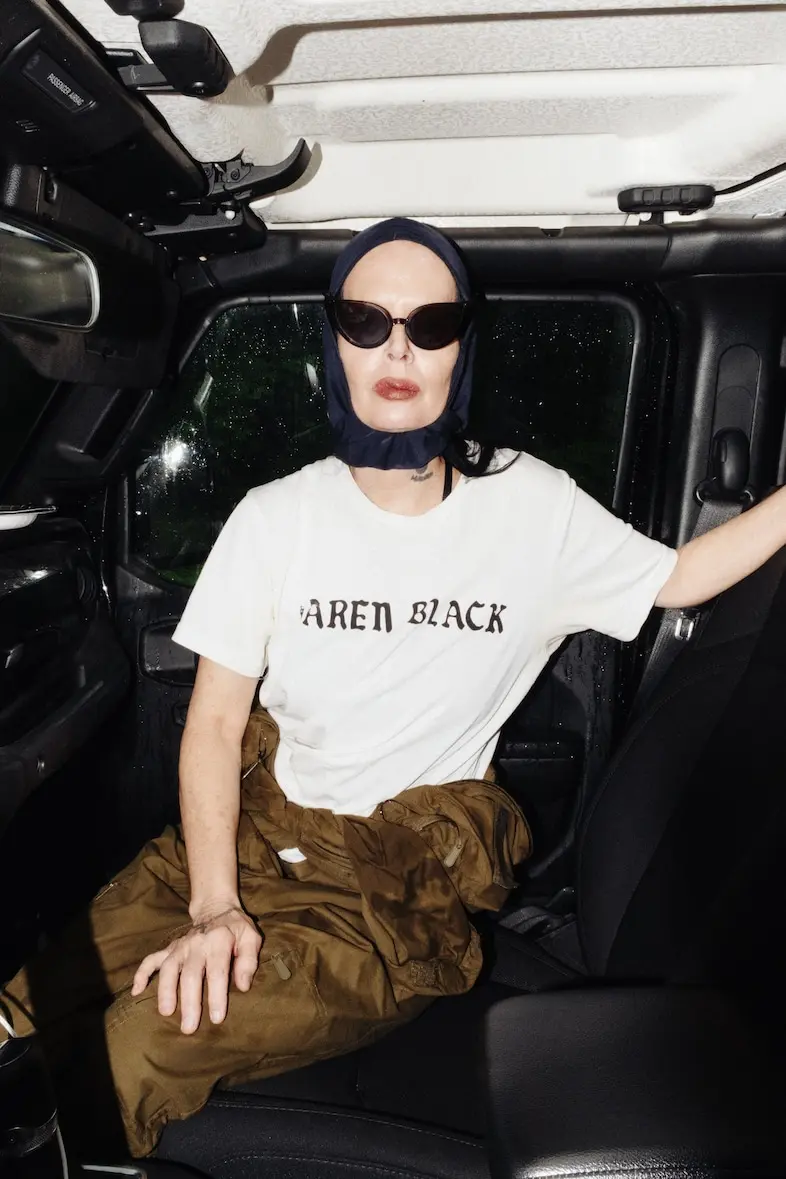
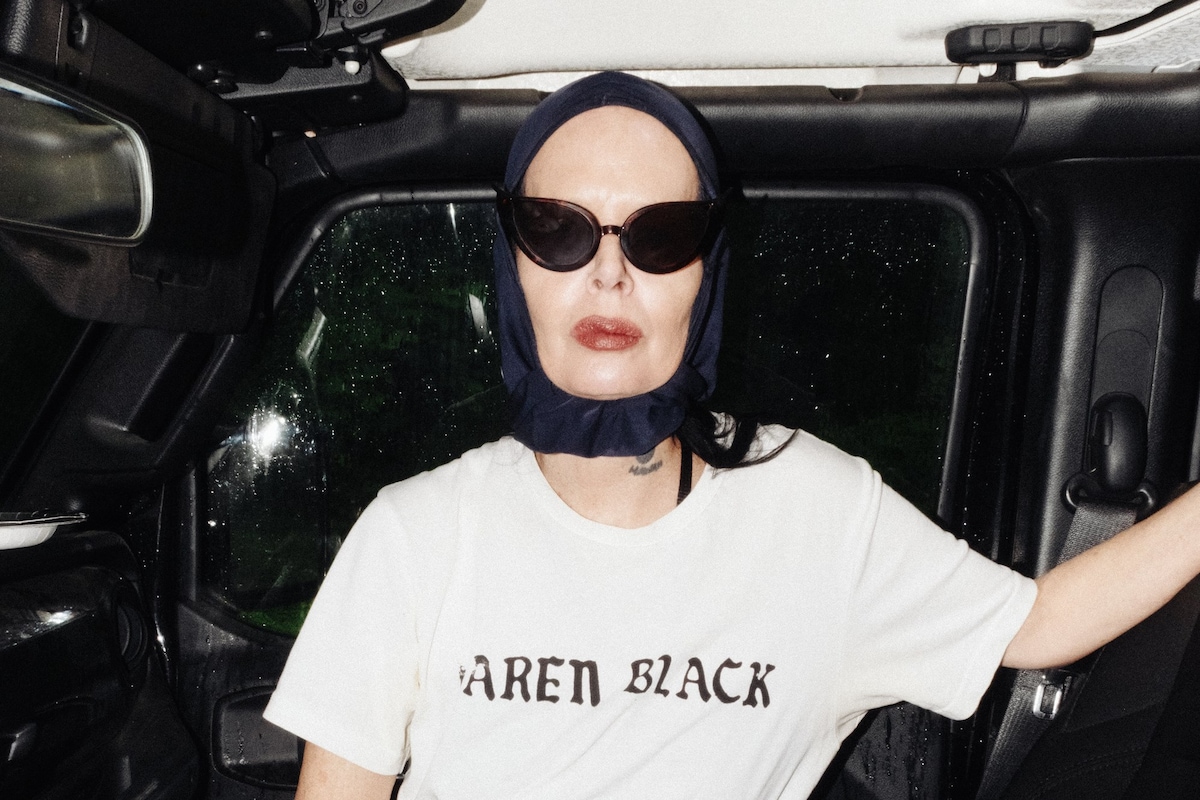
When legendary rock star, multidisciplinary visionary, and performance art icon Kembra Pfahler enters a room today, she typically does so behind a shield of anonymity—often wearing a tactical balaclava, oversized sunglasses, and rich, dark lipstick. Yet, even in disguise, her presence is undeniable. For more than four decades, Pfahler has remained an unyielding fixture of New York City’s Lower East Side underground, carving out a cultural footprint that has quietly informed and disrupted decades of contemporary art, fashion, and music.
As the magnetic frontwoman and high priestess of the cult-legend art-punk band The Voluptuous Horror of Karen Black, Pfahler famously weaponized the shock of the naked human form. On stages across the world, she routinely appeared entirely nude, caked from head to toe in single-color body paint, with her teeth blackened out, anchored by her signature three-tiered raven wig and towering stiletto boots. Her performances merged high theory with visceral horror, confronting audiences with raw, unapologetic expressions of feminism, disgust, beauty, and autonomy.
Who better, then, to instruct the next generation on the untamable mechanics of performance art?
In late July, under the sprawling canopy of Art Omi—a non-profit arts center and 120-acre sculpture and architecture park nestled in Ghent, New York—Pfahler stepped out of her iconic stage persona to lead a Performance Art 101 workshop. Her mission was simple yet radical: to demystify the creative process, strip away the paralyzing need for institutional validation, and pass down the hard-earned philosophy of an artist who has survived and thrived entirely on her own terms.
Detailed Chronology: From the School of Visual Arts to Lower East Side Royalty
To understand Pfahler’s pedagogy is to understand a career forged in opposition to traditional artistic frameworks. Her journey into the avant-garde began in the late 1970s and early 1980s, a period marked by both creative explosion and economic devastation in New York City.
The origin of her lifelong artistic philosophy can be traced back to a fateful exchange at the School of Visual Arts (SVA). When her instructor, renowned conceptual artist Joseph Kosuth, asked the 17-year-old Pfahler what kind of artist she was, she bristled.
“I’m an availabist, I make the best use of what’s available,” she famously retorted, taking deep offense at being forced into an academic box before she had even discovered her own voice.
Shortly after that interaction, Pfahler dropped out of formal art school. Fortunately, she found an immediate, adoptive sanctuary in the gritty, fiercely independent underground community of New York City.
One of her earliest defining moments arrived when she organized The Extremist Show—a sprawling, nine-day multidisciplinary event held at the legendary ABC No Rio arts space on the Lower East Side. The exhibition synthesized performance art, live music, drawings, paintings, and large-scale sculpture. Looking back, Pfahler notes the unique privilege of that era: ABC No Rio operated as a free, autonomous zone handed over to younger generations to curate and occupy. Yet, true to her uncompromising nature, Pfahler admits that while she had the vision and the community in her youth, it took her another decade to fully comprehend the profound cultural weight of what she was doing.
Throughout the 1980s and 1990s, Pfahler pushed the boundaries of bodily autonomy and shock value. She funded her early underground film projects by working at an independent adult film studio—an experience that fueled her early artistic anger, which she eventually channeled into uncompromising feminist performance.
Her works were frequently harrowing and physically demanding. In 1992, she collaborated with underground filmmaker Richard Kern on Sewing Circle, a performance piece that involved sewing her own labia shut—an act of extreme body modification that she later had to explain to her eleven-year-old nephew.
Far from viewing these extreme physical displays as sensationalist or adult-oriented, Pfahler viewed them through a lens of profound transcendence. Coming to terms with a personal history of severe body dysmorphia and intense shame, Pfahler utilized absolute exposure not to titillate, but to reclaim beauty, power, and space. These investigations ultimately paved the way for The Voluptuous Horror of Karen Black, cementing her status as a titan of transgressive art.
Supporting Context & Metrics: The Philosophy of "Availabism"
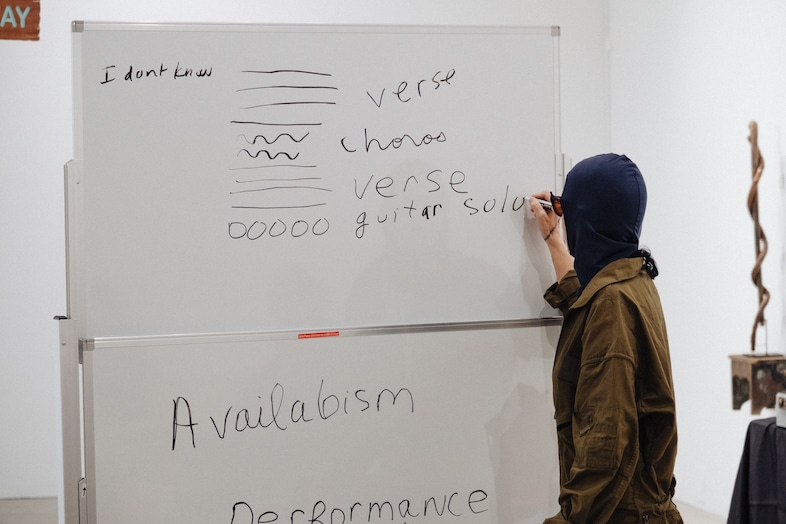
At Art Omi, Pfahler’s masterclass was anchored by a single word scrawled in thick marker across a classroom whiteboard: AVAILABISM.
Coined during her youth, Availabism is both an aesthetic and an existential framework centered on extracting maximum creative output from immediate, zero-budget circumstances. On stage, availabism might manifest as wrapping oneself in a makeshift plastic sheet rather than wearing expensive, designer costumes. In everyday life, however, it serves as a psychological blueprint for self-acceptance.
During the workshop’s opening introductions, a participant nervously admitted to being painfully shy. Rather than attempting to "fix" or coax the student out of their shell, Pfahler offered a piece of counter-intuitive advice:
“Hold onto your shyness. Being shy is a good thing.”
Pfahler elaborated that she is fundamentally distrustful of individuals who obsessively crave the spotlight. In the ecosystem of Availabism, performance is collaborative, multifaceted, and decentralized.
“You don’t have to be the performer,” Pfahler explained during a post-class interview. “You could be the director, you could be the costume maker, or you could be the person that’s filming your friend.”
This egalitarian approach extends directly into her mentorship model. Unlike institutional educators who maintain strict professional boundaries, Pfahler actively dismantles the hierarchy between master and student. At the conclusion of the Art Omi workshop, she invited every attendee to join her on stage at her next live performance, boldly writing her personal phone number on the whiteboard and insisting that students call her "anytime"—a promise she genuinely intends to keep.
Her wisdom has recently been cataloged in a definitive monograph published by Rizzoli, a monumental publishing project she worked on for approximately seven years alongside senior editor Loren Olsen. The book serves as a visual archive of decades of radical performance, documenting an era when performance artists were widely dismissed by the traditional art market.
Official Statements & Direct Wisdom from Kembra Pfahler
Throughout the masterclass and subsequent reflections, Pfahler dispensed hard-won maxims accumulated over four decades at the bleeding edge of American counterculture. Here are her core tenets in her own words:
1. On the Illusion of the Art World Hierarchy
“Don’t do a performance because you want to go straight to the top. You’re doing a performance to share new ideas. I think I learned from the punk generation in the early 70s in Los Angeles that you are going to give yourself a nervous breakdown if every time you do something, you want to go straight to the top.”
2. On Provocation and Touring the American Heartland
During the 1990s, when The Voluptuous Horror of Karen Black faced complete incomprehension from mainstream American audiences, Pfahler deliberately chose to tour the United States rather than seek easy validation in Europe.
“I never toured in Europe with my band because Europeans always treated New Yorkers so openly and positively. I thought to myself, ‘I have to tour in the US where they hate my guts because they don’t have anything like us.’”
Before Marilyn Manson popularized shock rock, mainstream American crowds routinely derided Pfahler and her bandmates as "homosexual heroin addicts" who wore too much makeup. Yet, the tours succeeded in their true objective: finding the isolated subculture kids.
“We’d end up playing in cities where there were three punk rock gay kids who would always be waiting for us during soundcheck.”
3. On Public Vulnerability and Accountability
While Pfahler encourages emerging artists to explore radical bodily exposure, she issues a stark warning regarding the social reality of the internet age.
“You always have to be prepared to talk about your performance at the dinner table with your grandmother at a Jewish, Buddhist, or Muslim holiday. It’s impossible to do things in secret.”
Furthermore, she cautions artists to respect their physical vessels, having learned safety protocols the hard way. Early in her career, she hospitalized herself using toxic household paints and nearly blinded herself with glass-based glitter.
“I had to learn the hard way about materials. A breakthrough came to me during a conversation with Sharon Stone, who said something along the lines of, ‘We all have to be careful.’ I was like, ‘Jesus Christ, you’re absolutely right.’”
4. On Rejecting Algorithmic Conformity
In an era dominated by artificial intelligence, digital curation, and algorithm-driven art markets, Pfahler issues a rallying cry to step away from the screen and engage with the physical, living world.
“Availabism can be confusing if there’s an excess of applicants [her term for application-driven intelligence], but if you ask AI how to build a lemonade stand, it’s going to give you 50 thousand different ways to build it, and that can be confusing. The internet is a handful of rich white guys’ opinions.”
Instead, she urges creators to pursue real-world connection: reaching out to living artists, requesting studio visits, and physically immersing themselves in community.
Future Outlook: Escaping the Algorithm and Showing Up
As the art world becomes increasingly professionalized, sanitized, and mediated through digital portfolios and grant applications, Kembra Pfahler’s philosophy of Availabism reads as a vital, anarchic antidote. Her teachings at Art Omi signal a necessary return to grass-roots urgency.
Pfahler’s roadmap for the future is disarmingly simple: pick a date, make a physical flyer, schedule a solo performance or start a band, and "figure it all out later." Availabism challenges creators to invent performance spaces out of thin air—whether by repurposing leftover wedding fabric or occupying abandoned storefronts.
Concluding her masterclass with a deeply human sentiment, Pfahler reminded the room that monumental cultural shifts do not require corporate backing, elite residencies, or algorithmic optimization. They require physical presence and the courage to look foolish in public.
“We don’t know who is going to save the world or change the world. I think all of us do in our own little ways just by showing up.”
For the artists sitting in that Ghent classroom—and for the broader cultural landscape desperately seeking authenticity—Kembra Pfahler’s message is clear: stop waiting for permission, drop the digital facade, and make something out of nothing.