In the current digital marketing landscape, professional networks are flooded with generic, automated, and artificial intelligence-generated prose. Amid this digital noise, a massive structural advantage exists for human-centric content creators. Industry data reveals a startling statistic: only 1% of LinkedIn’s massive user base actively creates content.
This profound supply-and-demand gap means the platform aggressively rewards those who show up with genuine, high-value insights. However, publishing consistently is no longer enough to cut through the clutter. To capture high-value attention, creators must master the psychology of engagement.
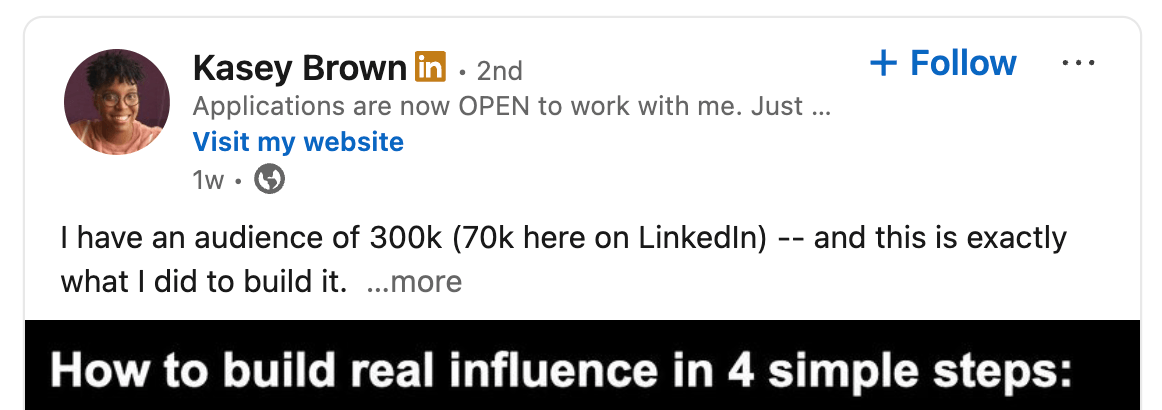
Co-created by LinkedIn growth strategist Kasey Brown and industry authority Michael Stelzner, the Triple S Framework offers a masterclass in organic content creation. This comprehensive methodology focuses on three distinct dimensions of user interaction—Stop, Stay, and Share—providing a blueprint for professionals who want to build influence, generate leads, and drive business growth without relying on automated content generators.
Detailed Chronology: Foundations of Winning LinkedIn Content
Before applying advanced frameworks, creators must establish foundational alignment. According to Brown, bypassing these prerequisites leads to content that is consistently ignored, regardless of how cleverly it is written.
1. Defining the Laser-Focused Ideal Client Profile (ICP)
The first foundational component is an uncompromisingly specific Ideal Client Profile. Most creators rely on vague demographic sketches—such as "people who want to build a brand online"—that fail to inform content creation.
An effective ICP must be specific enough that a virtual assistant could plug its keywords directly into LinkedIn’s search engine and instantly return qualified prospects. Instead of broad categories, Brown advocates for definitions like:
"Speakers, coaches, and consultants earning at least $20K per month who need systems for organic content so they can scale their impact and their business."
2. Identifying the 30-Day Transformation
Paired with the ICP is the transformation component. Every content strategy must answer a critical question: What tangible transformation will a 30-day follower walk away with? This singular outcome frames every post before a single word is typed, ensuring that content serves as a vehicle for real-world change rather than fleeting entertainment.
3. Shifting From Self-Serving to Reader-Centric Metrics
The final foundational principle requires a psychological shift: content must be created for the reader, not the author.
Many creators publish while subconsciously prioritizing self-serving questions: Did I sound smart? Did I share enough client wins? Will this drive immediate sales? When creators pivot to asking what the ideal reader gains from the post, the content begins generating the kind of engagement that compounds long-term business growth.
The Triple S Framework in Action
With foundational elements locked in, the Triple S Framework becomes fully actionable. This system breaks down audience engagement into three critical psychological milestones.
1: Stop: Pause a Viewer’s Scroll With Images and Hooks
The immediate objective of any LinkedIn post is to make users stop scrolling. Brown identifies two primary levers for achieving this: the attached visual asset and the first two lines of text. Together, these elements account for roughly 80% of a post’s total impressions.
Leveraging Unpolished Visuals for Pattern Interrupts
Most creators instinctively reach for professional headshots or polished speaking photos. Because this pristine aesthetic is so common, it creates an incredible opportunity to stand out through contrast. The goal is not to post a better version of what everyone else is sharing, but to post something fundamentally different.
Brown tested this hypothesis directly. Following a speaking engagement, she captured a wide-angle selfie using her phone’s back camera at 0.5x zoom. The resulting image was casual, unpolished, and revealed the entire audience behind her. Paired with a caption offering her presentation slides in exchange for a comment, this single post generated 3,000 leads. When she subsequently reposted the exact same offer alongside a professionally lit, high-resolution photo of herself on stage, that post generated only 200 leads.
"We don’t have to be better. We have to be different," Brown notes.
Tactically, vertical images consume more screen real estate in the LinkedIn feed and resist automatic cropping, dramatically increasing the likelihood of a paused scroll. Furthermore, wide-angle shots create natural curiosity about the surrounding environment, pulling the reader’s eye into the frame.
Crafting Hooks Using the Five Cs Framework
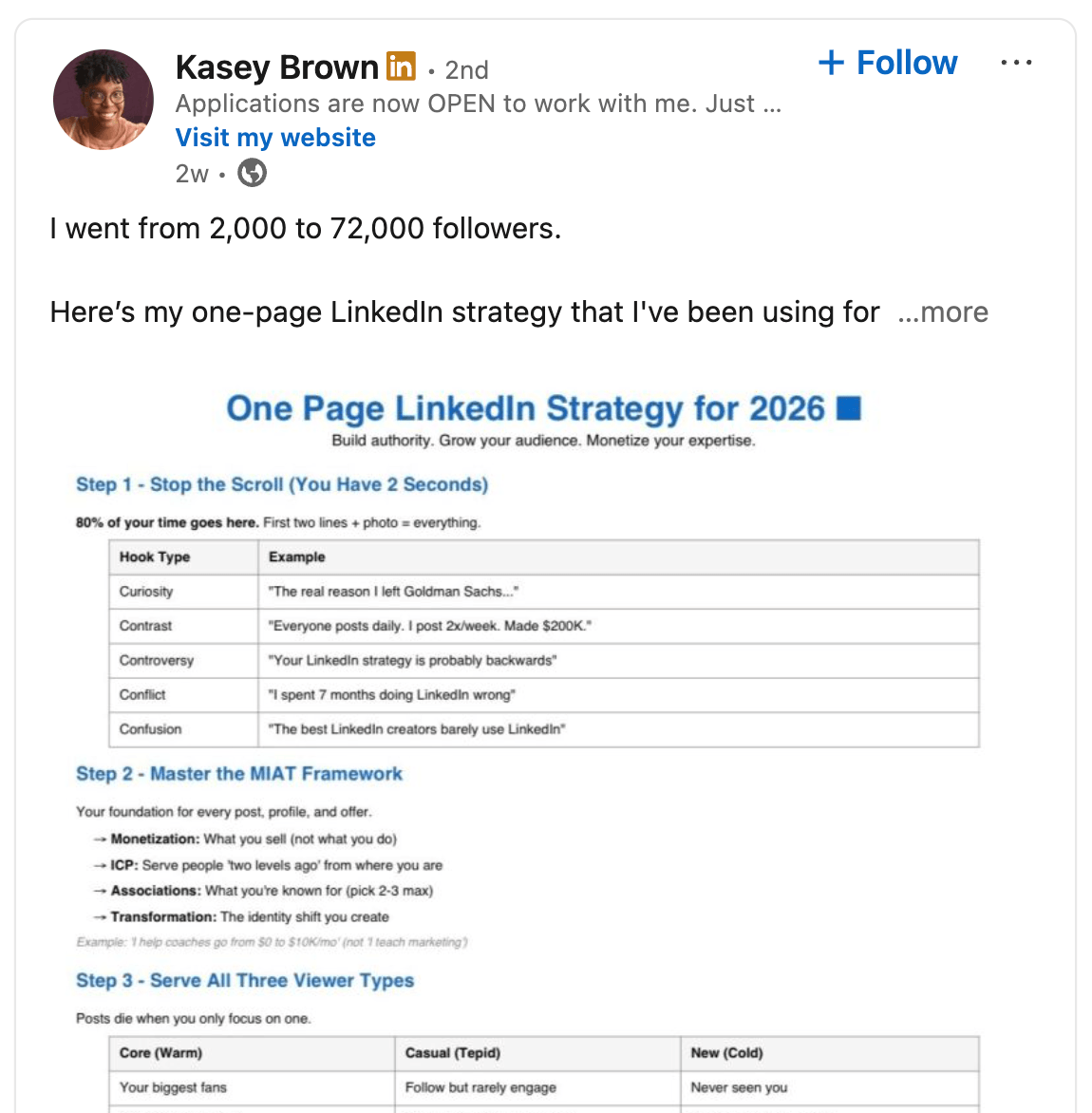
The text accompanying the image must instantly earn the click on the "see more" button. Brown evaluates hook strength through the Five Cs framework—a concept adapted from short-form video strategy:
Curiosity: Creating an unanswered question in the reader’s mind.
Contrast: Highlighting a stark difference between two states or realities.
Contradiction: Presenting ideas that appear to conflict with conventional wisdom.
Controversy: Addressing polarizing industry truths.
Confusion: Introducing a detail that temporarily disrupts expectations.
A powerful hook successfully triggers two or three of these elements simultaneously, transforming mundane updates into compelling narratives.
2: Stay: Keep Readers Engaged From Hook to Finish
Once a user clicks "see more," the challenge shifts from capturing attention to holding it. This requires executing a flawless "re-hook."
The Anatomy of a Powerful Re-Hook
When a reader clicks to expand a post, the third line must confirm that their action was worthwhile. Crucially, it must build more tension rather than resolving the narrative prematurely.
The Wrong Approach: Immediately satisfying the reader’s curiosity ("I’m here in Bali with the family. I took five weeks off, and my business is thriving without me."). This deflates the narrative arc before the reader is invested.
The Right Approach: Extending the tension ("It was a wild dream I had last February. I never thought I could actually leave my business and spend this kind of money… especially with so many fires burning internally and everything feeling like it was about to fall apart.").
By delaying the resolution, the author forces the reader to stay invested through to the end of the post.
Optimizing Readability and Rhythm
Beyond narrative tension, structural readability dictates whether a reader finishes the post:
Rhythm: Alternate between single-sentence lines and multi-sentence blocks. Short sentences land key punchlines, while blocks develop complex ideas.
Reading Level: High-performing content consistently scores at a fourth-to-seventh-grade reading level. Tools like the Hemingway App help verify clarity before publishing.
Mobile Optimization: Because 70% of LinkedIn consumption happens on mobile devices, formatting must be previewed using tools like Authored Up or verified directly inside the LinkedIn mobile app to prevent dense, unreadable paragraphs.
3: Share: Transforming Readers Into Amplifiers
The ultimate indicator of high-performing content is the share, or repost. While views and comments are relatively easy to generate, a share represents an endorsement powerful enough for a user to attach their personal reputation to the content and broadcast it to their own network.
Tracking the Share-to-Impression Ratio
Brown utilizes a specific metric to evaluate content viability: shares per impression.
A ratio of 0.3 is considered solid.
A ratio of 0.5 or higher is exceptional.
Any post hitting a 0.5 ratio enters a rotation to be republished every 60 to 90 days using identical text and imagery. Conversely, underperforming posts serve as diagnostic tools, indicating that the content either lacked intrinsic value or failed to provide a clear, actionable takeaway.
The "Goodie Bag" Closing Strategy
To drive shares, a post must conclude with a concrete transformation—what Brown describes as handing the reader a "goodie bag" at the end of a party. By breaking down a complex narrative into step-by-step, actionable takeaways (e.g., "Step 1: Audit your time. Step 2…"), creators give readers a compelling reason to forward the post to colleagues, save it for later reference, or comment to secure a lead magnet. When this substantive value is present, explicit calls-to-action—such as tagging a peer—feel natural and yield high conversion rates.
Supporting Context & Metrics
To contextualize the urgency of organic LinkedIn strategies, industry metrics highlight several critical realities:
The Content Deficit: Only 1% of LinkedIn users actively publish content, leaving the remaining 99% as consumers. This leaves a vast, open market for active thought leaders.
Visual Real Estate: Utilizing vertical imagery and unpolished, authentic behind-the-scenes photography can multiply lead generation efficiency by over 1,000% compared to traditional stock imagery or polished corporate headshots.
Algorithmic Longevity: Long-form posts that utilize comment continuations (posting excess thoughts in the first comment rather than violating platform limits) signal sustained engagement to LinkedIn’s algorithmic distribution engine.
Future Outlook
As artificial intelligence tools continue to flood professional networks with homogenized text and synthetic imagery, the digital pendulum is swinging violently back toward authenticity. Platforms are adapting their algorithms to penalize low-effort, automated output while rewarding genuine human insight, raw storytelling, and deeply practical frameworks.
For founders, executives, consultants, and coaches, the path forward is clear. Success on LinkedIn will no longer belong to those who post the most frequently using generative tools. Instead, it will belong to the strategic minority who embrace rigorous Ideal Client Profiling, master the psychology of the Triple S Framework, and treat their audience’s attention as a precious, earned commodity. By focusing on human connection, distinct visual branding, and actionable educational value, creators can turn the platform’s vast content gap into their greatest competitive advantage for years to come.