Executive Overview
For nearly as long as Kubernetes has reigned as the undisputed standard for container orchestration, upgrading its control plane has been classified by infrastructure engineers as a classic "one-way door." In the open-source Kubernetes ecosystem, a control plane upgrade is virtually irreversible. Once a cluster transitions to a new minor version, there is no native, supported mechanism to turn back the clock.
To mitigate this absolute constraint, organizations have historically been forced to engineer complex, resource-heavy safety nets. Platform engineering teams deploy elaborate compensating mechanisms—ranging from exhaustive bake periods and canary stagger groups to manual executive sign-offs and grueling months-long upgrade testing cycles.
Given that the Kubernetes community releases three new minor versions annually, this structural rigidity creates an operational bottleneck. Organizations managing hundreds of clusters, particularly those bound by strict regulatory compliance frameworks, often stall their upgrade paths entirely. Paralyzed by the fear of unmitigated failure and the inability to quickly recover from unforeseen runtime regressions, they leave clusters marooned on older versions. These clusters eventually miss critical security patches and risk running up against unforgiving extended support timelines.
Addressing this industry-wide anxiety head-on, Amazon Web Services (AWS) has announced the official launch of Kubernetes version rollbacks for Amazon Elastic Kubernetes Service (Amazon EKS). This landmark feature provides cluster administrators with a robust, native safety net, fundamentally changing how cloud-native environments manage lifecycle updates.
With EKS version rollbacks, administrators can seamlessly reverse a Kubernetes version upgrade within a mandatory seven-day window if unforeseen compatibility issues emerge. Instead of forcing teams into complex technical workarounds or forcing them to rebuild clusters from scratch under extreme production pressure, AWS has effectively delivered an enterprise-grade "undo" button for Kubernetes control plane and managed node upgrades.
Detailed Chronology and Technical Architecture
The journey toward a reliable rollback mechanism for Kubernetes has been long and fraught with architectural hurdles. In the broader open-source community, real progress is slowly being made; notably, projects like KEP-4330 (Kubernetes Enhancement Proposal 4330) are introducing the concept of "emulated versions" to ease the pain of rollbacks. However, emulated versions often keep a cluster trapped in a transitional holding state, adding operational overhead and cognitive load for the engineers managing them.
AWS has taken a decisively different architectural route with Amazon EKS. Rather than relying on simulated environments or transitional states, the new EKS version rollback mechanism restores a cluster to a fully validated previous version that previously ran successfully in production.
How the Rollback Mechanism Operates
When an administrator updates an EKS cluster—for instance, jumping from Kubernetes version 1.34 to 1.35—and subsequently discovers a critical plugin failure, a breaking API change, or an application compatibility issue, they have up to seven days to initiate a rollback.

- Incremental Version Control: The feature strictly adheres to the incremental design patterns used by EKS, supporting rollbacks of one minor version at a time. This guarantees that state transitions remain predictable and mathematically sound.
- Proactive Health Checks: Before any action is taken, EKS automatically evaluates the cluster’s overall rollback readiness via its integrated Cluster Insights tool. This system scans for potential roadblocks, such as node version compatibility mismatches or lingering add-on dependencies, flagging them for remediation before the downgrade begins.
- Emergency Bypass: For seasoned administrators operating in high-urgency scenarios who have already meticulously verified their environment, the system includes a
--forceflag to bypass these readiness checks and execute the rollback immediately.
Special Considerations for EKS Auto Mode
While control plane rollbacks apply universally across all EKS clusters (regardless of whether the underlying nodes are managed by the user or AWS), the feature hits a new level of sophistication for users who have adopted EKS Auto Mode.
EKS Auto Mode provides one-click provisioning of production-ready Kubernetes environments, abstracting away the heavy lifting of compute, networking, and storage management. However, because Auto Mode tightly couples the lifecycle of the control plane and managed nodes, a version rollback requires a synchronized orchestration of both components.
Because node rollbacks must strictly honor pre-configured Pod Disruption Budgets (PDBs) to prevent application downtime, this synchronization can sometimes introduce latency. To prevent operations teams from being locked into a slow-moving workflow, AWS introduced a dedicated Cancel API.
If an engineer determines that a node rollback is proceeding too slowly—perhaps due to overly conservative PDBs—they can invoke the cancel API at any point during the process. This allows them to adjust their disruption budgets on the fly to accelerate node drainage, or pivot to an entirely different remediation strategy. By default, EKS prioritizes workload stability above all else, never intentionally violating a PDB unless explicitly commanded to do so by the operator.
Hands-On Implementation: A Step-by-Step Practical Walkthrough
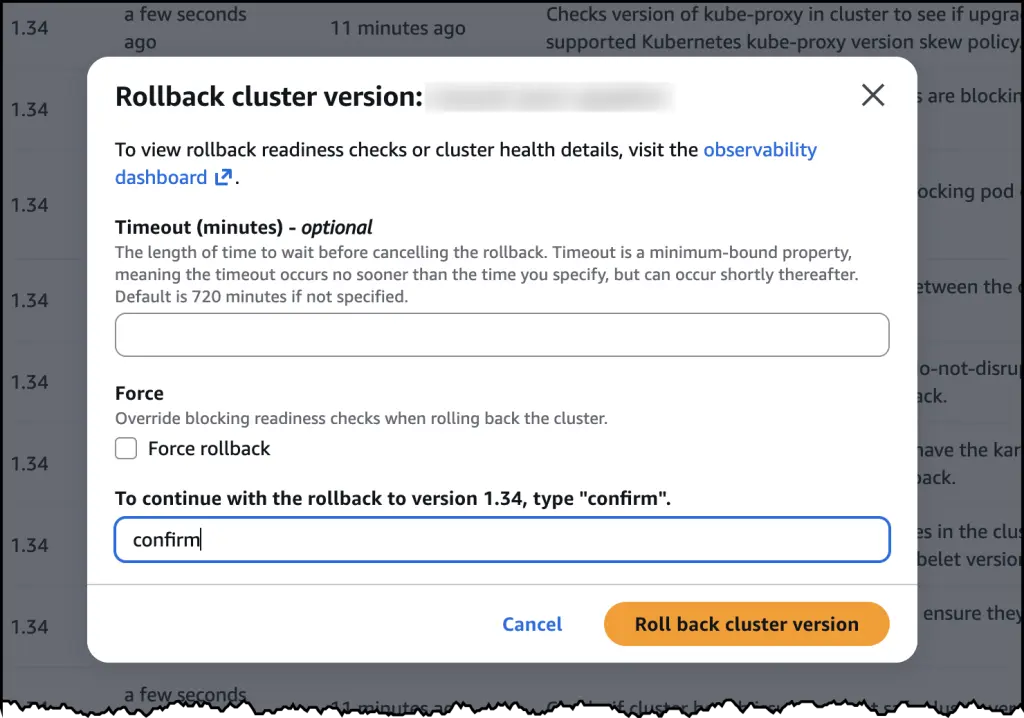
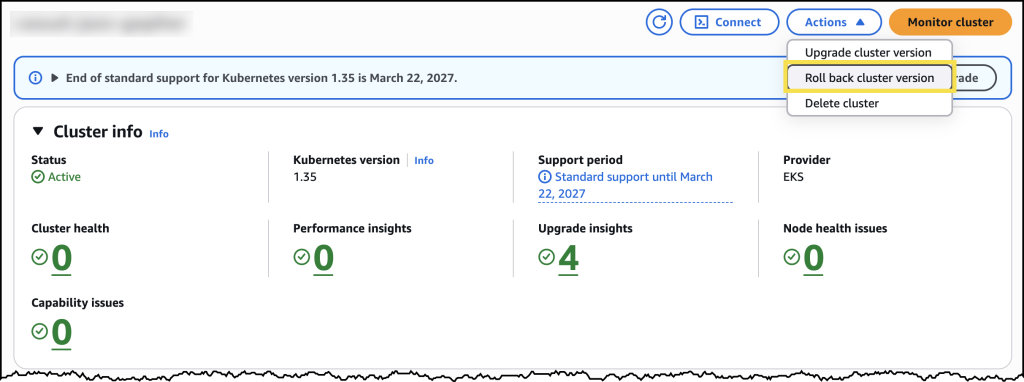
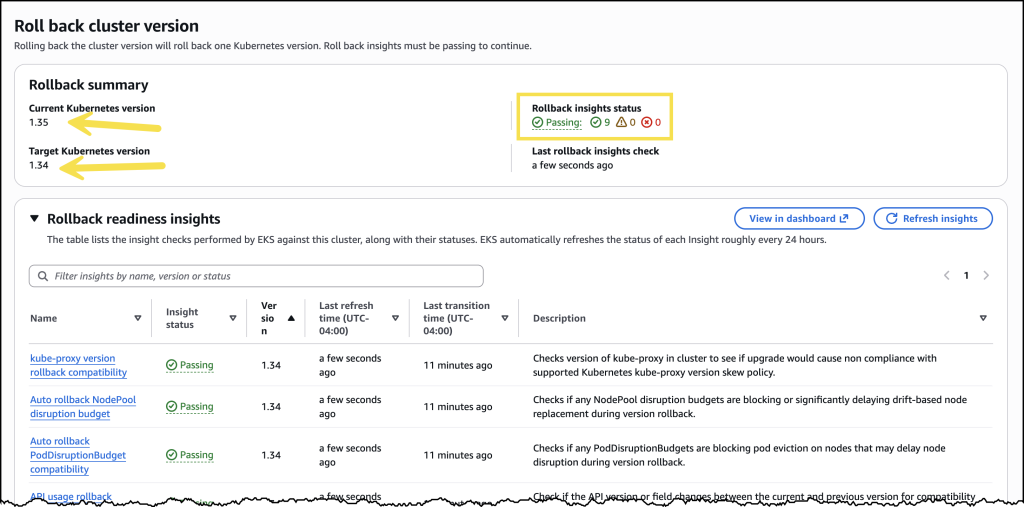
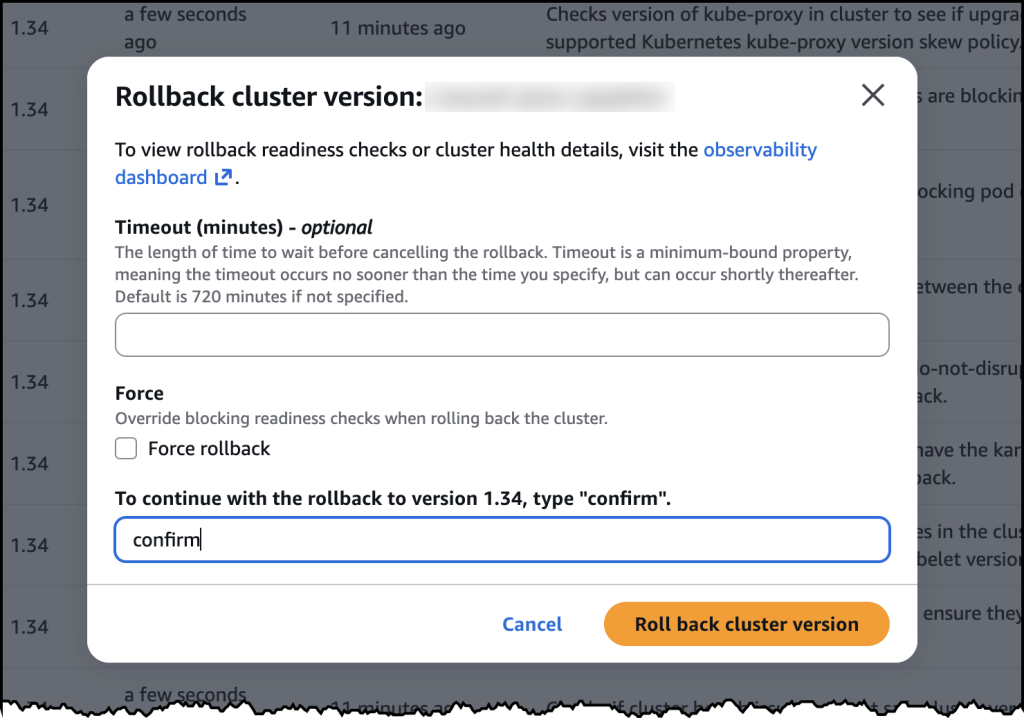
To better understand how this feature functions in the wild, we can look at the operational workflow executed inside the AWS Management Console during a test rollback.
- Navigating the Console: An administrator logs into the Amazon EKS console and selects a target cluster that has undergone a recent version upgrade within the permitted seven-day window.
- Reviewing the Configuration Page: The cluster’s primary management dashboard clearly displays the new version rollback option, along with a transparent countdown indicator detailing the remaining days left in the active rollback window.
- Analyzing Rollback Insights: Prior to pushing the trigger, the administrator opens the Cluster Insights panel. The system surfaces a clean diagnostic report verifying the health of the worker nodes and highlighting any third-party controllers or add-ons that might require attention.
- Executing the Rollback: Upon confirmation, the rollback sequence is initiated. Throughout the downgrade procedure, the cluster remains fully operational. The control plane rollback typically finalizes within approximately 20 minutes—mirroring the timeline of a standard upgrade.
- Node Drainage and Completion: For clusters running EKS Auto Mode, worker nodes systematically and gracefully roll back to the previous AMI and Kubernetes binaries, meticulously respecting the active Pod Disruption Budgets. Once the operation concludes, the cluster settles back onto its prior, stable Kubernetes version with zero data loss or structural corruption.
Supporting Context & Metrics: Solving the Enterprise Upgrade Dilemma
The introduction of native rollbacks targets a pervasive, quantifiable pain point within enterprise IT departments. Industry surveys consistently reveal that upgrade paralysis is one of the leading causes of technical debt in modern cloud-native environments.
The Cost of Stagnation
- Security Vulnerabilities: When organizations delay upgrades out of fear of breaking changes, they expose their infrastructure to unpatched Common Vulnerabilities and Exposures (CVEs).
- Support Cliffs: Kubernetes minor versions have a relatively short support lifecycle (typically around 12 to 14 months). Clusters left stranded on older versions quickly cross the support threshold, forcing emergency, high-stress migrations when extended support expires.
- Engineering Overhead: Before EKS version rollbacks, engineering organizations routinely spent hundreds of cumulative man-hours building custom automation scripts, staging parallel shadow clusters, and conducting weeks of rigorous QA testing just to move up a single minor version.
By shrinking the risk envelope to a safe, seven-day window, EKS version rollbacks dramatically lower the barrier to continuous delivery. Teams can now approach minor version upgrades with an iterative, agile mindset rather than treating them like high-stakes, once-a-year engineering expeditions.
Official Statements and Industry Perspective
The launch of EKS version rollbacks has been met with widespread enthusiasm from the global cloud-native architecture community. Industry leaders note that this feature bridges a long-standing philosophical gap between traditional infrastructure management (where rolling snapshots and instant rollbacks have been standard for decades) and container orchestration.
"For years, upgrading a Kubernetes cluster meant walking a tightrope without a safety net," notes a senior cloud architect at a Fortune 500 financial institution. "By providing a native, fully validated rollback path that honors our production workloads and Pod Disruption Budgets, AWS has removed the single greatest psychological barrier to keeping our clusters patched, secure, and up to date."
AWS engineering leads emphasize that this feature aligns directly with their broader mission to reduce operational toil. By automating the safety checks via Cluster Insights and introducing granular controls like the Auto Mode Cancel API, AWS is shifting the burden of cluster resilience from custom-built enterprise scripts back into the foundational platform layer where it belongs.
Future Outlook: The Next Evolution of Kubernetes Lifecycle Management
As Kubernetes continues to evolve at a breakneck pace, the release of EKS version rollbacks signals a mature shift in how managed cloud services interact with open-source software. Rather than waiting for the upstream open-source community to slowly ratify complex enhancements like KEP-4330, enterprise cloud providers are stepping in to build robust, production-ready operational layers.
Looking ahead, industry analysts expect this feature to catalyze several broader trends in cloud-native engineering:
- Accelerated Upgrade Cadences: With a reliable safety net in place, enterprises will likely abandon multi-year upgrade delays, moving toward an automated, continuous upgrade model that mirrors the release velocity of the upstream Kubernetes project.
- Tighter Integration with GitOps: Future iterations of continuous delivery pipelines (such as ArgoCD and Flux) may soon incorporate native hooks for EKS rollback telemetry, allowing automated systems to instantly detect a failed post-upgrade health probe and trigger an automated EKS rollback via the AWS API.
- Broader Ecosystem Adoption: As AWS sets a new benchmark for cluster recoverability, competing managed Kubernetes offerings will undoubtedly feel market pressure to develop equivalent, non-emulated native rollback primitives.
Availability and Pricing
Kubernetes version rollbacks for Amazon EKS are available today at no additional cost across all commercial AWS Regions where Amazon EKS is operational. Customers pay only for their standard EKS control plane fees and underlying compute consumption, with zero premium charged for invoking the rollback capability.
The feature supports control plane rollbacks across all standard EKS deployments, node rollbacks for clusters leveraging EKS Auto Mode, and fully covers all Kubernetes versions currently maintained under EKS standard and extended support schedules.
To begin exploring this transformative feature, platform engineers and cluster administrators can consult the comprehensive Amazon EKS Documentation or navigate directly to the Amazon EKS Console to inspect their active clusters and evaluate their current upgrade pathways.