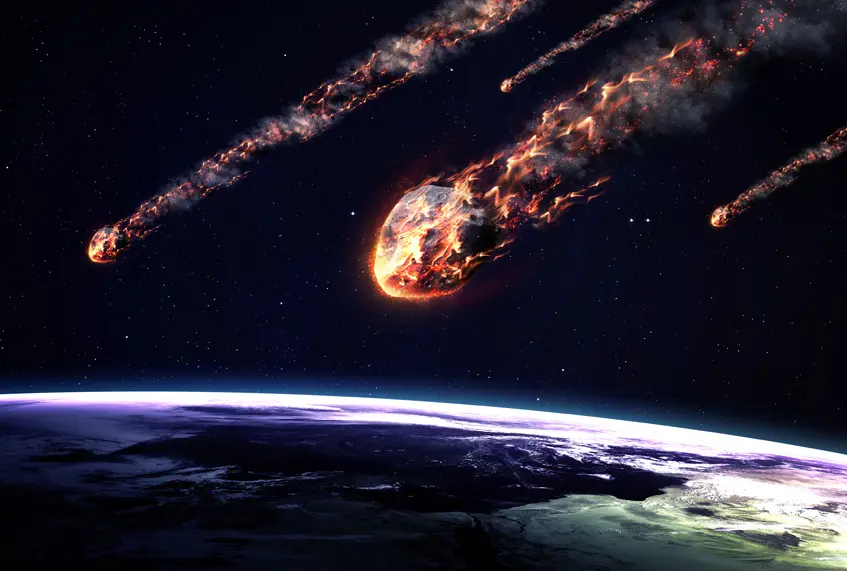
Executive Overview
In September 2017, the digital ecosystem hummed with a familiar yet uniquely amplified brand of existential dread. As conspiracy theories mutated across social media platforms, alternative news sites, and fringe religious broadcasts, a single date—September 23, 2017—was anointed by a subset of believers as the precipice of global transformation, if not outright annihilation. At the epicenter of this viral prophecy was David Meade, a self-described Christian numerologist and researcher who successfully wove together disparate threads of biblical scripture, astrological alignments, and the perennial internet myth of "Planet X" (or Nibiru).
Meade’s hypothesis posited that a catastrophic convergence of celestial bodies—sparked by the "Great American Solar Eclipse" of August 21, 2017, and keyed to the numerological significance of the number 33—would usher in the apocalyptic events described in the biblical Book of Revelation. While mainstream media outlets, science communicators, and space agencies like NASA routinely dismissed the claims as mathematically baseless and physically impossible, the narrative struck a profound cultural nerve.
This report examines the anatomy of the September 2017 doomsday panic. By investigating the chronology of the rumor, the specific mechanics of Meade’s numerology, the role of digital media echo chambers in amplifying fringe science, and the definitive pushback from the scientific community, we explore why manufactured apocalypses continue to thrive in the modern age—and why the mythology of Nibiru refuses to fade into obscurity.
Detailed Chronology: From the Summer Sky to the September Deadline
To understand how a localized astronomical event transformed into an international headline, it is necessary to trace the precise timeline of events that led up to the autumn of 2017.
August 21, 2017: The Great American Solar Eclipse
The catalyst for the September doomsday scenario occurred in broad daylight across the North American continent. Millions of observers donned cardboard eclipse glasses to witness the first total solar eclipse to sweep across the contiguous United States from coast to coast since 1918. While astronomers and casual stargazers celebrated a rare and awe-inspiring scientific spectacle, pockets of the religious right and esoteric researchers viewed the shadow sweeping the land through an apocalyptic lens.
For some, the eclipse was a sign of impending divine judgment upon the United States. For David Meade, however, the eclipse was merely the starting gun of a sophisticated cosmic countdown.
Late August to Early September 2017: The Viral Ascent
In the weeks following the eclipse, Meade’s theories—initially floated in obscure corners of the internet and picked up by British tabloids like the Daily Star—began to cascade across mainstream aggregators and social media networks. Evangelical broadcasters, such as those associated with Pat Robertson’s Christian Broadcasting Network (CBN), featured figures like Gary Ray, who popularized the "Revelation 12 sign"—the alignment of the constellation Virgo with the sun, moon, and planets on September 23.
Simultaneously, YouTube videos detailing the impending arrival of the mythical planet Nibiru garnered millions of views. The digital marketplace quickly adapted to the demand, spawning monetized books, sensationalized video packages, and specialized forums where users could trade theories about the "end of the world as we know it."
September 15–20, 2017: Mainstream Media Pick-up and Scientific Silence
As the self-imposed September 23 deadline approached, mainstream news outlets—ranging from Fox News to The Washington Post—published features on the viral prophecy. In many cases, these profiles tread a fine line between journalistic curiosity and uncritical amplification, often devoting thousands of words to biblical exegesis while relegating scientific debunking to a solitary sentence or omitting it entirely.
Meanwhile, professional astronomers and space scientists watched the unfolding hysteria with a mixture of fatigue and amusement. Having addressed identical claims regarding the year 2012 and earlier iterations of the Nibiru myth, space agencies reiterated that no such planet existed, though their technical rebuttals struggled to compete with the viral velocity of doomsday content.
September 23, 2017 and Beyond: The Aftermath
When September 23 arrived and passed without planetary collisions, global cataclysms, or the sudden vaporization of human civilization, Meade deftly shifted the goalposts. Clarifying his position to interviewers, Meade explained that the date did not mark the physical destruction of the Earth, but rather the beginning of a prolonged period of tribulation—asserting that the true transformation of the world would unfold gradually throughout October and beyond.
Supporting Context & Metrics: The Mechanics of a Manufactured Prophecy
The endurance of the September 2017 doomsday claim relies on a fascinating fusion of numerology, biblical literalism, and modern media dynamics. Understanding how Meade constructed his argument reveals the blueprint behind many contemporary conspiracy theories.
The Obsession with the Number 33
At the core of Meade’s chronological calculations was a heavy reliance on numerology, specifically centered around the number 33. Meade argued that this digit held supreme mystical and historical importance:
- Jesus of Nazareth is traditionally held to have lived for 33 years.
- The name Elohim, used as a primary designation for God in early biblical texts, appears 33 times in the opening chapters of Genesis.
- Geographically, the total solar eclipse of August 21 made its initial landfall in Oregon—the 33rd U.S. state—and concluded its path near the 33rd parallel in South Carolina.
By bridging these disparate facts, Meade established a pseudo-mathematical bridge between the solar eclipse and a 33-day countdown, landing precisely on September 23, 2017.
The Virgo Alignment (Revelation 12)
The astrological cornerstone of the prophecy relied on a specific passage from the Christian New Testament: Revelation 12:1–2, which describes a "woman clothed with the sun, with the moon under her feet and a crown of twelve stars on her head," who is pregnant and cries out in pain as she gives birth.
Conspiracy researchers argued that on September 23, 2017, a rare astronomical configuration would occur in the constellation Virgo (the "virgin"). The sun would be positioned in Virgo, the moon would be at her feet, and the constellation Leo, along with the planets Mercury, Venus, and Mars, would sit atop her head like a crown of twelve stars.
Astronomers noted, however, that while planetary alignments occur regularly due to the mechanics of our solar system, similar configurations had happened numerous times throughout history—none of which had resulted in global apocalypse.
The Myth of Nibiru (Planet X)
No modern doomsday scenario is complete without the inclusion of Planet X, or Nibiru. Originally popularized in the late 20th century by self-proclaimed contactee Zecharia Sitchin—who claimed to translate ancient Sumerian texts describing an extra planet with a 3,600-year elliptical orbit—Nibiru became a catch-all explanation for fringe theorists seeking a physical agent of destruction.
In Meade’s hands, Nibiru was cast as a massive brown dwarf star accompanied by seven orbiting bodies, currently sneaking up on our solar system from an angle obscured by the sun’s glare.
Metrics of Engagement: Science vs. Sensationalism
A telling metric of the 2017 panic lies in the stark contrast between digital engagement metrics for scientific facts versus sensationalized myths:
- The Myth: YouTube videos promoting the Nibiru and Revelation 12 prophecies routinely surpassed 2 million views.
- The Fact: Educational videos produced by NASA scientists—such as veteran space scientist Dr. David Morrison systematically explaining why Nibiru is physically impossible—struggled to clear 20,000 views.
This disparity highlights a structural vulnerability in the modern information ecosystem: compelling narratives framed as hidden truths consistently outperform dry, empirical reality.
Official Statements & Scientific Consensus
Faced with mounting public inquiries and anxious citizens calling space agencies for reassurance, scientists and theologians alike weighed in to debunk the hysteria.
NASA and the Astronomical Community
The scientific consensus on Nibiru and Planet X has remained absolute for decades: the planet does not exist.
Dr. David Morrison, a senior astrobiologist and space scientist at NASA who spent years fielding public queries regarding apocalyptic hoaxes, addressed the persistent myth directly:
"Nibiru is not real and is not a danger… If it were up there, you could see it. All of us could see it. It would be bright. It would be easily visible to the naked eye."
Astronomers emphasized that if a planetary body of the scale described by conspiracy theorists were entering the inner solar system, its gravitational influence would already have disrupted the orbits of the outer planets, comets, and asteroids. Furthermore, thousands of amateur astronomers scanning the night sky with modest consumer telescopes would have tracked its trajectory years in advance.
Theological Critiques
Even within Christian theological circles, mainstream scholars and prominent pastors distanced themselves from Meade’s calculations. Biblical warnings regarding the end times explicitly caution against date-setting. In the Gospel of Matthew (24:36), Jesus states: "But about that day or hour no one knows, not even the angels in heaven, nor the Son, but only the Father."
Critics pointed out that commercializing biblical prophecy—often through the sale of self-published books, survivalist gear, and monetized video content—reveals a financial motive underpinning many contemporary doomsday movements.
Future Outlook: Why Doomsday Theories Persist
As the dust settled on September 24, 2017, the world continued to spin, and David Meade pivoted toward new interpretive frameworks, asserting that the true spiritual and physical trials of the end times were merely unfolding behind the scenes.
The ephemeral nature of these prophecies does little to diminish their popularity; instead, it demonstrates the cyclical nature of human anxiety and millenarian belief. From the 2000 Y2K bug to the 2012 Mayan calendar panic, and onward through the 2017 solar eclipse, society has continuously generated frameworks that project modern uncertainties onto cosmic canvases.
Looking forward, the proliferation of artificial intelligence, algorithmic amplification, and decentralized media platforms guarantees that future astronomical events—such as solar eclipses, planetary conjunctions, or newly discovered comets—will inevitably trigger renewed waves of apocalyptic speculation.
Ultimately, the 2017 Nibiru panic serves as a valuable case study in media literacy. It illustrates how ancient mythology, modern scientific ignorance, and digital virality can combine to manufacture widespread panic out of thin air—reminding us that while the planets in our solar system follow predictable, immutable laws, the human imagination remains entirely unpredictable.