Executive Overview
In the fast-paced ecosystem of modern cloud engineering, iteration speed is the ultimate currency. Whether human developers are prototyping complex architectures or autonomous AI agents are rapidly generating and testing infrastructure-as-code (IaC) pipelines, the bottleneck has historically been the waiting game. Traditional cloud provisioning frameworks operate on a strict "trust, but heavily verify" paradigm, halting execution flows while prolonged stabilization checks confirm that every underlying component is fully online, responsive, and ready to receive traffic.
Enter AWS CloudFormation Express Mode—a paradigm-shifting deployment option designed to cut through this architectural friction. Announced today by Amazon Web Services, Express mode fundamentally redefines how CloudFormation manages the lifecycle of cloud stacks. By decoupling the application of resource configurations from extended stabilization checks, this new mode accelerates deployments by up to four times.
Crucially, Express mode does not compromise the underlying provisioning logic or resource integrity. Instead, it alters when a deployment is signaled as complete, allowing resources to achieve operational readiness asynchronously in the background while developers and automated tools instantly receive the green light to proceed. For iterative development workflows, local testing, and high-frequency AI-assisted infrastructure engineering, this capability transforms a frustratingly slow feedback loop into a near-instantaneous experience. Available immediately across all AWS commercial regions at no additional cost, Express mode integrates seamlessly into existing tooling—including the AWS CLI, SDKs, AWS Cloud Development Kit (CDK), and AI builders utilizing the AWS Model Context Protocol (MCP)—heralding a new era of hyper-efficient cloud development.
Detailed Chronology: The Evolution of Cloud Provisioning and the Birth of Express Mode
To understand the profound impact of CloudFormation Express mode, one must examine the chronological progression of infrastructure-as-code deployment philosophies and the persistent pain points that modern software engineering teams have faced.
The Era of Declarative Stabilization
When AWS CloudFormation was first introduced, it revolutionized cloud architecture by enabling developers to describe their desired infrastructure state in JSON or YAML templates. CloudFormation would then orchestrate the creation, updating, and deletion of those resources. To ensure safety and reliability, AWS engineered robust "stabilization checks" into the core deployment engine.
These checks were—and remain—essential for production environments. When a load balancer, a database cluster, or an application server pool is provisioned, the system needs absolute verification that the infrastructure can actively handle traffic before shifting production loads. However, as cloud architectures grew more complex, microservice-oriented, and dynamic, these mandatory stabilization checkpoints introduced significant latency into non-production and iterative development scenarios.
The Rise of AI-Assisted Infrastructure and Iterative Friction
In recent years, the software development lifecycle has undergone another radical transformation with the advent of generative AI and autonomous developer tools. Engineers increasingly rely on AI-assisted infrastructure tooling—such as Kiro and specialized MCP servers—to dynamically write, modify, and troubleshoot CloudFormation templates.
Yet, a glaring mismatch emerged: while an AI model can generate an updated infrastructure template in mere milliseconds, deploying and testing that template through traditional CloudFormation pipelines often required waiting minutes for standard stabilization sequences to complete. This latency bottleneck severely hamstrung sub-minute feedback loops, stalling the potential velocity of AI-driven infrastructure engineering.
Recognizing this critical friction point, AWS engineers engineered Express mode. By analyzing developer workflows and recognizing that many iterative tasks do not require synchronous stabilization before moving to the next step, AWS built a solution that re-architects the deployment completion signal. Announced and rolled out globally today, Express mode bridges the gap between rapid code generation and cloud execution, enabling a truly continuous, rapid-fire iteration loop.
Supporting Context & Metrics: Under the Hood of Express Mode
To fully grasp the operational mechanics of CloudFormation Express mode, it is vital to examine how it modifies the provisioning lifecycle, backed by concrete performance benchmarks and configuration mechanics.
How Express Mode Operates
At its core, Express mode changes the completion criteria of a CloudFormation stack operation.
- Immediate Configuration Application: When a stack is deployed using Express mode, CloudFormation applies the resource configurations as requested.
- Asynchronous Stabilization: Rather than holding the deployment thread open until every single resource passes exhaustive health and stabilization checks, Express mode marks the deployment as complete the moment the configuration is successfully applied. The resources continue to stabilize asynchronously in the background.
- Built-in Resilience: Recognizing that asynchronous provisioning can introduce transient timing dependencies between resources, CloudFormation features intelligent, automated retry mechanisms. If a dependent resource encounters a temporary failure during provisioning within the same stack, CloudFormation automatically retries it, completely eliminating the need for manual developer intervention.
Quantifiable Performance Gains
The performance differentials between Standard mode and Express mode are stark, particularly for operations traditionally plagued by long timeout or stabilization phases. Consider the following real-world scenarios highlighted in initial benchmarking:
- Amazon SQS with Dead Letter Queues (DLQ): Creating an Amazon Simple Queue Service queue paired with a DLQ traditionally requires approximately 64 seconds in Standard mode as the service waits for deep structural verification. With Express mode, the deployment completes in up to 10 seconds—an acceleration of over 600%.
- AWS Lambda Functions with Network Interfaces: Deleting an AWS Lambda function that maintains an attached elastic network interface (ENI) has long been a notorious bottleneck in serverless architectures, often requiring anywhere from 20 to 30 minutes for standard cleanup and detachment verification. Express mode slashes this teardown time down to up to 10 seconds.
Configuration and Tooling Integration
Adopting Express mode requires zero changes to existing CloudFormation templates, preserving full backward compatibility. Developers can activate Express mode across multiple interfaces:
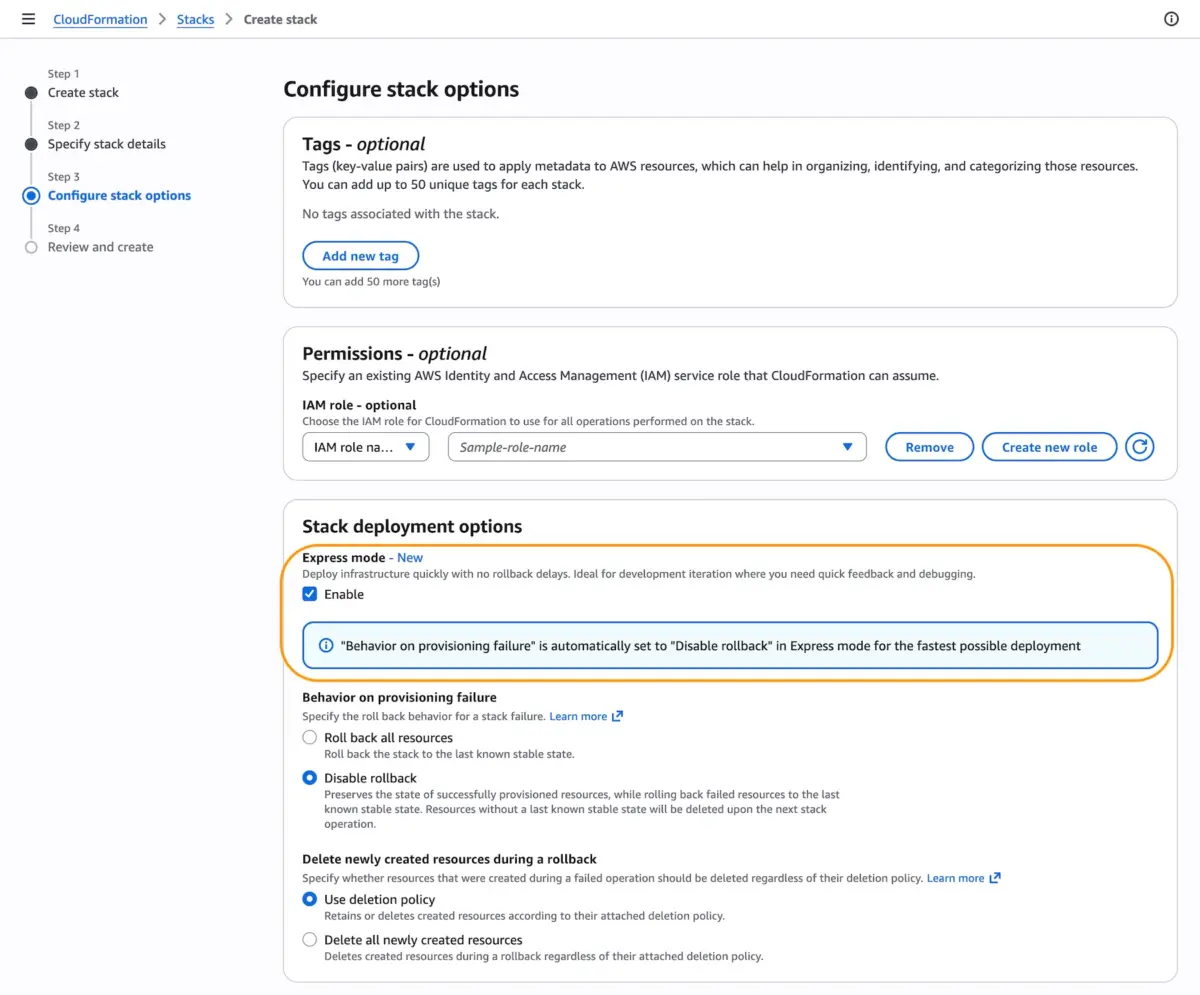
- AWS Management Console: When creating or updating a stack, engineers simply navigate to Stack deployment options and toggle Enable under the Express mode setting.
- AWS CLI and SDKs: By passing the
--deployment-configparameter set toEXPRESSduring stack creation, updates, or deletions, developers can trigger the accelerated flow via command line scripts. - AWS CDK: Infrastructure developers using TypeScript, Python, or other CDK-supported languages can invoke the streamlined deployment using the dedicated command
cdk deploy --express.
Sample CLI Implementation for Iterative Microservice Development:
# Iteration 1: Deploy IAM role
aws cloudformation create-stack
--stack-name my-microservice
--template-body file://iteration1-iam.yaml
--deployment-config '"mode": "EXPRESS"'
--capabilities CAPABILITY_IAM
--role-arn arn:aws:iam::123456789012:role/CloudFormationDeployRole

# Iteration 2: Add Lambda function
aws cloudformation update-stack
--stack-name my-microservice
--template-body file://iteration2-lambda.yaml
--deployment-config '"mode": "EXPRESS"'
--capabilities CAPABILITY_IAM
--role-arn arn:aws:iam::123456789012:role/CloudFormationDeployRole

# Iteration 3: Add SQS queue and event source mapping
aws cloudformation update-stack
--stack-name my-microservice
--template-body file://iteration3-sqs.yaml
--deployment-config '"mode": "EXPRESS"'
--capabilities CAPABILITY_IAM
--role-arn arn:aws:iam::123456789012:role/CloudFormationDeployRole
It is important to note that to achieve the fastest possible iteration experience, Express mode disables stack rollback by default (disableRollback: true). For production workloads where safety guards must remain absolute, developers can explicitly re-enable rollback by setting disableRollback to false within the deployment configuration, or by implementing robust external monitoring and cleanup mechanisms.
Official Statements and Architectural Perspectives
The introduction of CloudFormation Express mode has drawn enthusiastic responses from infrastructure architects, cloud security professionals, and developer advocates alike, emphasizing its alignment with modern agile and AI-assisted workflows.

Industry observers and early testers have pointed out that Express mode solves a fundamental psychological and operational bottleneck in cloud engineering: context switching. When developers—or autonomous AI coding assistants—are forced to wait two to five minutes between minor template adjustments, their operational momentum is broken. By compressing deployment feedback loops into sub-minute intervals, Express mode keeps engineers in the "flow state."
Furthermore, AWS leadership emphasizes that Express mode is designed to complement, rather than replace, standard deployment methodologies. For production pipelines where absolute zero-downtime guarantees and exhaustive synchronous health checks are non-negotiable, the traditional Standard mode remains fully supported and recommended. Express mode shines brightest where agility, rapid prototyping, incremental microservice construction, and high-frequency AI generation intersect.
Future Outlook: What Express Mode Means for the Future of Cloud Infrastructure
The launch of AWS CloudFormation Express mode signals a broader, industry-wide shift in how infrastructure-as-code is consumed and executed. As cloud environments grow increasingly automated and intelligent, the tooling that underpins them must evolve to match the velocity of software engineering.
1. Supercharging Autonomous AI Infrastructure Agents
The most profound long-term implication of Express mode lies in its synergy with generative AI and autonomous agent frameworks. Tools utilizing the AWS Model Context Protocol (MCP) server can now query APIs, parse documentation, and execute infrastructure deployments with unprecedented speed. With Express mode eliminating artificial wait times, AI agents can engage in true trial-and-error debugging loops—deploying a template, detecting a misconfiguration, and correcting it in real time—without hitting the multi-minute brick walls of traditional stabilization checks.
2. Redefining Local Prototyping and CI/CD Pipelines
In CI/CD environments, pipeline duration dictates how frequently teams can run integration and smoke tests. By integrating Express mode into non-production staging pipelines, enterprise engineering organizations can drastically reduce total test suite runtimes. Developers prototyping complex serverless architectures locally can test component additions—such as adding SQS queues, EventBridge rules, or Lambda permission mappings—in seconds rather than minutes.
3. Broad Regional Availability and Continued Adoption
Available today across all AWS commercial regions at zero additional cost, CloudFormation Express mode is primed for rapid enterprise adoption. As developer communities provide feedback through channels like AWS re:Post and direct support conduits, AWS is expected to expand configuration options and monitoring integrations tailored specifically to asynchronous provisioning models.
Conclusion
AWS CloudFormation Express mode represents a masterclass in listening to developer pain points. By intelligently decoupling configuration application from synchronous stabilization, AWS has eliminated one of the most stubborn bottlenecks in modern cloud development. For engineering teams striving for hyper-agile iteration, and for the burgeoning wave of AI-assisted infrastructure builders, Express mode is not merely an incremental feature update—it is the catalyst for a faster, smarter, and infinitely more responsive cloud future.