Executive Overview
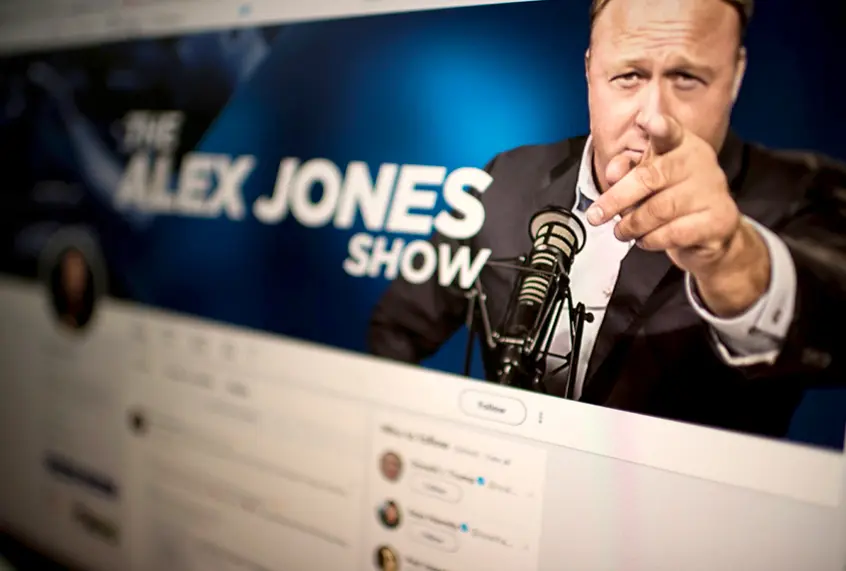
In August 2018, the digital public square underwent a fundamental transformation. For years, major technology companies operated under a laissez-faire philosophy regarding user-generated content, framing themselves as neutral platforms rather than publishers. However, a coordinated industry-wide reckoning culminated when Twitter—long the most reluctant among the Silicon Valley giants to enact severe moderation policies—announced a temporary seven-day suspension of Infowars founder and extreme right-wing conspiracy theorist Alex Jones.
This decision marked a stark reversal for Twitter and its CEO, Jack Dorsey. Prior to the penalty, Dorsey and his moderation teams had steadfastly defended leaving Jones’s accounts active, arguing that his inflammatory rhetoric had not explicitly violated the platform’s rulebook. The tipping point arrived when Jones posted content encouraging his followers to ready "battle rifles" against mainstream media organizations and other perceived adversaries—a direct and unambiguous violation of Twitter’s policies prohibiting the use or promotion of violence against civilians.
While Apple, Facebook, Pinterest, Spotify, and YouTube had already banned or severely restricted Jones for violating hate speech and harassment guidelines earlier that week, Twitter’s action introduced a nuanced debate over temporary punitive measures versus permanent deplatforming. This comprehensive report examines the sequence of events surrounding Twitter’s penalty, the public defense and subsequent clarifications offered by Jack Dorsey, the broader pattern of harmful hoaxes propagated by Jones, and the long-term implications of this enforcement shift for digital governance, free expression, and online safety.
Detailed Chronology: The Week Infowars Lost Its Digital Empire
The swift unravelling of Alex Jones’s expansive digital footprint in August 2018 stands as a watershed moment in the history of internet moderation. For over two decades, Jones used platforms like Infowars to distribute fringe theories, anti-government narratives, and targeted harassment. Until mid-2018, mainstream tech companies largely shielded themselves behind Section 230 protections and free-expression doctrines, permitting Jones to maintain massive audiences.
Early August 2018: The Industry-Wide Crackdown
The dam broke during the first week of August 2018. Within a span of 48 hours, a cascade of Silicon Valley platforms severed ties with Jones:
- Apple: Removed the vast majority of The Alex Jones Show podcasts from its iTunes and Podcasts directories, citing violations of guidelines against objectionable content and hate speech.
- Spotify: Pulled multiple episodes of Jones’s podcasts for violating policies prohibiting content that incites hatred or violence.
- Facebook: Took down four primary pages associated with Alex Jones and Infowars—including The Alex Jones Channel and the Infowars News page—for repeatedly violating community standards regarding hate speech and harassment.
- YouTube (Google): Terminated Jones’s primary channel, which boasted over 2.4 million subscribers, alongside several secondary channels, after determining that his content breached policies against harassment and bullying.
- Pinterest: Erradicated accounts tied to Jones and Infowars for violating anti-hate policies.
The Twitter Holdout and the Final Violation
Amid this unprecedented digital exile, Twitter remained the conspicuous holdout. While users and advocacy groups flooded Twitter with demands for similar action, CEO Jack Dorsey resisted. He maintained that penalizing users based purely on public outcry or subjective disagreement would compromise the platform’s integrity as an open forum.
However, that defense collapsed on Tuesday, August 14, 2018. Jones posted a video link to his Twitter account in which he explicitly urged his followers to get their "battle rifles" ready and prepare for physical conflict against mainstream media outlets and political opponents. This call to arms crossed an unambiguous red line within Twitter’s regulatory framework, which explicitly forbids individuals or organizations from using, inciting, or promoting violence against civilians to advance ideological causes.
Faced with an undeniable rules violation, Twitter suspended Jones’s personal and organizational accounts for a mandatory seven-day "timeout."
Supporting Context & Metrics: A History of Harassment and Deceptive Hoaxes
To fully understand the necessity and controversy surrounding the deplatforming of Alex Jones, one must examine the sustained, real-world harms caused by his broadcasting career. Long before his clash with Twitter over "battle rifles," Jones built an enterprise predicated on peddling harmful hoaxes and targeting vulnerable communities.
The Sandy Hook Defamation Lawsuits
Among Jones’s most egregious actions was his multi-year campaign claiming that the 2012 mass shooting at Sandy Hook Elementary School—which claimed the lives of 20 first-graders and six educators—was a "false flag" operation staged by the government utilizing crisis actors.
This malicious falsehood subjected the grieving families of the victims to years of unrelenting harassment, death threats, and intimidation by Jones’s followers. The psychological toll eventually manifested in significant legal repercussions, most notably multiple defamation lawsuits filed against Jones in Texas and Connecticut. These legal actions ultimately exposed Infowars to crippling financial liabilities, proving that the consequences of online disinformation extend far beyond virtual spaces into physical danger and emotional trauma.
A Catalog of Conspiracies
Jones’s broadcasting record is defined by a consistent pattern of defamatory accusations:
- 9/11 "Trutherism": For years, Jones popularized claims that the September 11 terrorist attacks were orchestrated by elements within the United States government.
- Targeted Harassment of Public Figures: Jones leveled baseless accusations of pedophilia against numerous public figures and investigators, including Special Counsel Robert Mueller during his investigation into Russian interference in the 2016 election.
- Health and Safety Disinformation: Infowars frequently served as a vector for medical disinformation, ranging from fringe anti-vaccine rhetoric to fraudulent commercial products marketed as cures for various diseases.
By August 2018, the cumulative weight of these activities made it untenable for major technology platforms to continue granting Jones unmitigated access to their infrastructure without facing severe reputational and ethical backlash from advertisers, civil rights organizations, and the general public.
Official Statements and Clarifications: Jack Dorsey’s Public Defense
The decision to impose a temporary timeout rather than a permanent ban ignited a fierce public debate. Critics argued that a seven-day suspension was a slap on the wrist for a serial violator of platform rules. Conversely, free-speech advocates scrutinized Dorsey’s justification for his moderation philosophy.
The NBC News Interview
In an exclusive interview with Lester Holt on NBC Nightly News on Wednesday, August 15, 2018, Jack Dorsey defended the company’s measured approach. He explained that his initial hesitation to ban Jones stemmed from a desire to maintain ideological neutrality.
"We can’t build a service that is subjective just to the whims of what we personally believe," Dorsey told Holt.
Dorsey articulated a philosophical belief in the rehabilitative potential of temporary suspensions. He asserted that penalizing accounts—whether temporarily or permanently—forces bad actors to reflect on their conduct.
"I feel any suspension, whether it be a permanent or a temporary one, makes someone think about their actions and their behaviors," Dorsey stated.
When pressed by Holt on whether he genuinely believed a weeklong timeout would alter Jones’s deep-seated behavioral patterns, Dorsey acknowledged the uncertainty:
"Whether it works within this case to change some of those behaviors and change some of those actions, I don’t know. But this is consistent with how we enforce."
Social Media Clarifications
Following the broadcast of the interview clip, Dorsey took to Twitter to refine his messaging and correct potential misinterpretations regarding his stance on enforcement escalation. Recognizing that his comments about "timeouts" might be misconstrued as leniency, Dorsey tweeted:
"To clarify: I was speaking broadly about our range of enforcement actions, when asked why we timeout functionality on Twitter. I don’t assume everyone will change their actions. Enforcement gets tougher with further reported violations."
This clarification was critical in signaling to the public that Twitter’s rules enforcement was not a static one-off event, but part of a progressive disciplinary ladder that could culminate in permanent removal should subsequent infractions occur.
Future Outlook: The Evolution of Content Moderation
The August 2018 suspension of Alex Jones served as a crucial bellwether for the digital media landscape. It exposed the vulnerabilities of the modern internet to coordinated, malicious disinformation campaigns and forced technology executives to redefine their corporate responsibilities.
The Shift from Passive Host to Active Arbiter
Before 2018, platforms like Twitter, Facebook, and Google preferred to operate under the safe harbor provisions of Section 230, positioning themselves as neutral conduits for speech. The Jones case demonstrated that absolute neutrality is unsustainable when platforms are weaponized to incite real-world violence, harass trauma victims, and disseminate dangerous falsehoods.
By taking collective—albeit staggered—action against Infowars, Big Tech signaled the dawn of a new era: one characterized by proactive content moderation, clearly defined boundary lines regarding hate speech and incitement, and a willingness to penalize high-profile, high-traffic accounts.
The Ongoing Dilemma of Enforcement
Despite these strides, the handling of Alex Jones highlighted ongoing industry challenges:
- Inconsistency Across Platforms: While competitors like Apple, Facebook, and YouTube enacted permanent bans, Twitter’s initial choice of a seven-day timeout illustrated a lack of unified industry standards for handling severe policy breaches.
- The "Whack-a-Mole" Phenomenon: Even as major social networks closed their doors, peripheral platforms—such as Periscope, where Jones retained live-streaming capabilities immediately following his Twitter suspension—remained vulnerable to exploitation.
- The Free Speech vs. Safety Tightrope: Tech companies continue to grapple with the delicate balance between protecting open discourse and shielding users from targeted harassment and stochastic terrorism.
Conclusion
Twitter’s seven-day suspension of Alex Jones in August 2018 was more than a routine disciplinary action against a single rule-breaker; it was a profound institutional admission that digital platforms possess moral and social responsibilities that transcend raw user engagement metrics. As online discourse continues to evolve in complexity, the lessons learned from the deplatforming of Alex Jones remain foundational to the ongoing struggle for a safer, more accountable internet.