Executive Overview
In the rapidly evolving landscape of vertical SaaS, few companies can claim a transformation as total and rapid as Owner.com. Over the past three years, the company has systematically rebuilt its entire technological and operational stack around artificial intelligence. Transitioning from a traditional website builder and online ordering platform for independent restaurants, Owner.com has evolved into an AI-native ecosystem where more than 83% of new customer journeys begin inside an autonomous AI product.
This elective overhaul was not a reaction to desperation; it was executed while the company was already exceeding the elite "triple-triple-double-double" growth trajectory. Today, Owner.com has rocketed past $100 million in Annual Recurring Revenue (ARR), achieving triple-digit growth that outpaces its pre-transformation velocity.
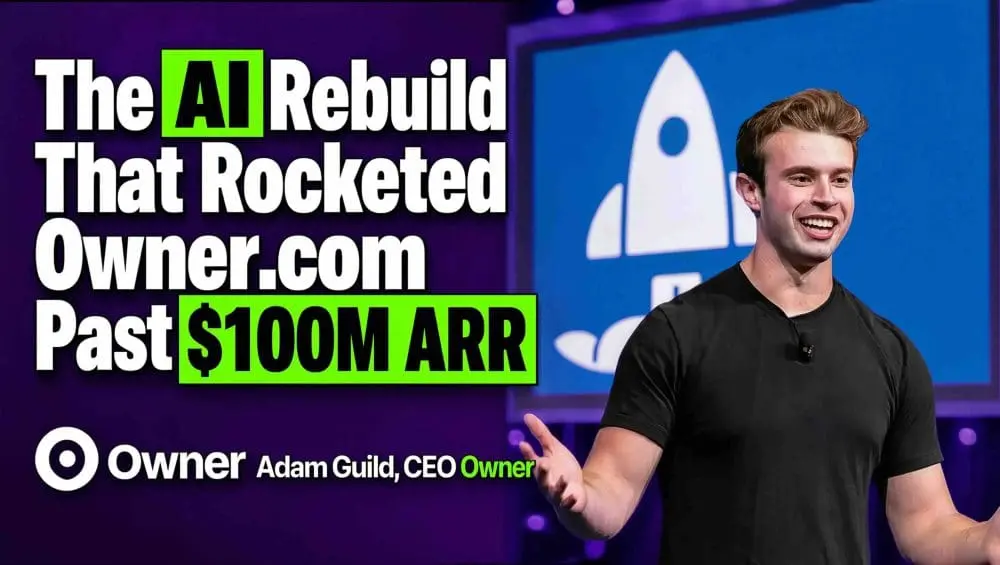
At the SaaStr AI 2026 conference, Owner.com CEO Adam Guild delivered a masterclass on navigating the seismic shift from traditional software-as-a-service to autonomous, outcome-driven AI infrastructure. His insights challenge foundational SaaS dogma—from how customer research is gathered to how internal engineering teams coordinate and scale. This report investigates the seven core operational shifts that propelled Owner.com to vertical market leadership, examining the metrics, missteps, and strategic frameworks that define the new era of B2B software.
Detailed Chronology: From Legacy SaaS to Autonomous AI Ecosystem
The story of Owner.com’s transformation is a study in calculated conviction. Three years ago, the company’s internal product research suggested a sobering reality: restaurant owners feared artificial intelligence. Industry veterans, advisory boards, and customer discovery interviews uniformly warned that pivoting toward automated, AI-first workflows would alienate a traditional, non-technical customer base.
Yet, within three months, that conventional wisdom was rendered entirely obsolete by the rapid acceleration of foundational models and shifting consumer expectations. The turning point—famously referred to internally as the "Pizza Expo moment"—occurred when CEO Adam Guild observed a 55-year-old pizzeria owner from Pennsylvania enthusiastically scanning a QR code on a hastily printed trade show poster to test an early AI website-auditing MVP. What legacy focus groups claimed restaurants feared, real-world behavior proved they desperately wanted.
Recognizing that market decay in the age of generative AI happens in 90 days or less, Guild made the radical decision to cannibalize a thriving, efficiently growing product line to build an unproven AI-first alternative.
The rebuilding process dismantled traditional software interaction models. Instead of forcing restaurant owners into complex configuration dashboards, Owner.com engineered an autonomous pipeline. The system initiates engagement long before a human sales representative ever makes contact. Using advanced lead qualification agents, Owner.com can estimate the gross payments volume of a prospective restaurant it has never previously worked with to within $250—purely through external data instrumentation and predictive analytics.
This capability flipped the traditional SaaS metric of Daily Active Users (DAU) on its head. In Owner.com’s new operational paradigm, if a restaurant owner has to log in manually to fix what the software set up automatically, the software has failed. The company’s focus shifted entirely from human administrative engagement to automated outcome instrumentation.
Supporting Context & Metrics: The Seven Pillars of Owner’s Scale
To achieve vertical dominance, Owner.com instituted seven radical operational departures from standard B2B SaaS playbooks.
1. Eliminating the Log-In Paradigm
Traditional SaaS measures product-market fit through active engagement metrics, rewarding software that requires daily user administration. Owner.com posits that manual log-ins represent operational friction and software failure. By replacing manual configuration with outcome instrumentation, the platform handles end-to-end setup autonomously, measuring its own success through verifiable business results—such as a quantifiable increase in a restaurant’s online order volume and Google discovery metrics—rather than time spent inside a dashboard.
2. Proprietary Outcome Data vs. Public Corpus
While foundational models like Claude or specialized code generation tools can construct a basic restaurant website, they lack contextual intelligence regarding commercial performance. Owner.com’s proprietary "Grader" tool audits roughly 90 SEO and CRO factors by crawling web presence, competitor footprints, Google Business Profiles, and customer reviews. The true moat is not public data (the model has already ingested the corpus), but proprietary outcome data—closing the loop between a specific configuration decision and a commercial result across tens of millions of consumer transactions.
3. Outpacing Stale Customer Research
Stated preferences gathered through traditional customer discovery interviews frequently lag behind technological reality. Owner.com’s experience at the Pizza Expo proved that static surveys create blind spots in hyper-accelerated markets. The company advocates for deploying half-finished, unprompted features into the wild to observe unprompted user behavior, treating revealed preference as the ultimate arbiter of product direction.
4. Automating Internal Coordination with Agents
While most engineering organizations leverage AI for code generation, Owner.com extended autonomous agents to internal coordination overhead. Their internal agent, "Owen," monitors GitHub, Slack, Notion, Linear, and Google Meet transcripts to manage 90% of builder coordination work. Similarly, their Product Insight Command Center aggregates telemetry from Salesforce, Intercom, and call transcripts to auto-assemble the product build priority list. This automation allows senior engineers and product leaders to focus on high-impact building rather than status updates and alignment meetings.
5. Strategic Hiring in High-Demand Markets
Conventional SaaS wisdom preaches radical leanness in the AI era. However, because Owner.com operates in a massive, underpenetrated vertical market with insurmountable inbound demand, they deployed AI leverage not to downsize, but to accelerate. By equipping high-agency builders with advanced tooling, the company compressed a ten-year product roadmap into a fraction of the time, scaling headcount alongside revenue acceleration.
6. Measuring GTM Efficiency Through Revenue Impact
Activity metrics—such as call volume or hours spent on research—are vanity inputs. Under Chief Revenue Officer Kyle Norton, Owner.com evaluated sales AI entirely through output metrics: bookings per representative. By utilizing pre-call research agents that automate 20 to 30 minutes of manual prep work per demo, Owner.com’s sales representatives achieved upwards of $2M in ARR per rep on a $150K OTE, outperforming direct SMB competitors by a factor of four.
7. Compressing Customer-to-Feature Latency
The ultimate diagnostic of an AI-native organization is its customer-to-feature latency. When a restaurant owner named Juliana Vasquez complained about the prohibitive cost of professional food photography, CEO Adam Guild personally built and shipped "Owner Photographer" within 24 hours. By leveraging AI to reduce code deployment cycles from quarterly roadmap commitments to single-day turnarounds, Owner.com established a new benchmark for agile responsiveness.
Official Statements & Industry Perspectives
The implications of Owner.com’s transformation extend far beyond restaurant tech, offering a blueprint for the future of vertical software.
Reflecting on the journey from his dual perspective as lead seed investor, board member, and SaaStr founder, industry leaders have noted that Owner.com’s willingness to cannibalize its own success is the defining characteristic of category-defining companies.
"The rebuild was elective. But it also wasn’t a week too late," observations from the SaaStr Fund emphasize. "In a market where ChatGPT reset what small business owners believed was possible, relying on stale customer research or traditional SaaS playbooks is an existential risk."
The transition has also redefined internal leadership roles. With autonomous agents managing project alignment, ticketing, and administrative overhead, the fundamental responsibilities of engineering managers and product executives are shifting definitively away from context brokering and toward human judgment, mentorship, and creative vision.
Future Outlook: The Next Frontier for AI-Native Vertical SaaS
As Owner.com pushes well beyond its current milestones, the company’s trajectory highlights the permanent divergence between legacy SaaS and AI-native architecture. The old model—characterized by manual configuration, heavy administrative log-ins, multi-quarter release cycles, and bloated coordination overhead—is rapidly losing commercial viability.
The lessons from Owner.com’s $100M ARR surge point toward an unforgiving market reality: possessing proprietary public data is no longer a sustainable moat; outcome-driven instrumentation and compounding operational feedback loops are. For vertical B2B and SMB leaders, the mandate is clear. Survival requires auditing internal operations against customer-to-feature latency, automating coordination layers, and trusting revealed user behavior over legacy customer research.
As autonomous agents continue to absorb administrative and engineering friction, the companies that thrive will not be those that simply use AI to write code faster, but those that fundamentally reimagine software as an autonomous service capable of delivering guaranteed business outcomes without human intervention.