
At 92 years old, avant-garde visionary Yayoi Kusama remains driven by a singular, consuming ambition: self-obliteration. Whether manifested through the hypnotic, infinite spirals of her trademark polka dots, the disorienting, kaleidoscopic expanses of her mirror rooms, or globular soft sculptures designed to swallow entire spatial volumes, Kusama’s life’s work operates as a systematic negation of the ego into the environment. Her ultimate objective is absolute, unadulterated oblivion.
For more than half a century, the polka-dotted tentacles of Kusama’s output have systematically punctured the global cultural consciousness. This sustained cultural disruption has imbued the Japanese artist with a transcendent celebrity, translating in recent decades into immense contemporary social cachet. In 2017, the sheer volume of pilgrims queuing for hours to experience Yayoi Kusama: Infinity Mirrors forced an exhibiting Los Angeles gallery to institute a draconian 30-second selfie rule to keep the crowds moving. That same year, at a Washington D.C. installation, an eager visitor attempting a poorly staged photo-op tripped, fell directly into, and shattered one of Kusama’s resplendent pumpkin sculptures.
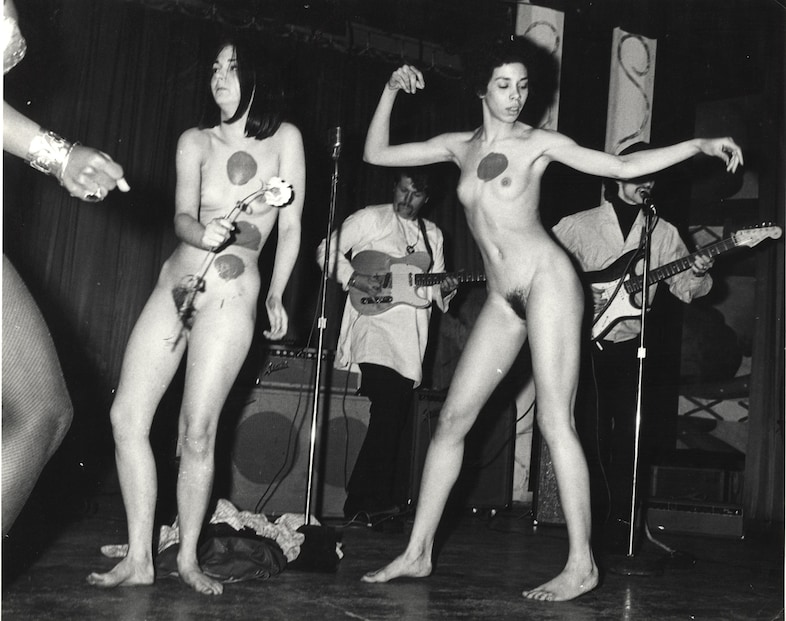
Yet, there was an era when Kusama’s universe was far less Instagram-friendly. During the turbulent 1960s, she sat at the helm of New York’s avant-garde vanguard, celebrated—and hunted—for orchestrating wild happenings, illegal gay marriages, and impromptu public displays of nudity. These confrontational performances drew the active pursuit of the FBI, multiple trials, and occasional imprisonment.
Crucially, throughout her extensive forays into radical counter-culture, fashion has served as a vital, yet frequently overlooked, red thread. Long before her permanent return to Japan in 1973, her commercial enterprise, Kusama Fashions Ltd., produced garments that brazenly dismantled traditional tailoring and design. Her presentations regularly descended into sensory-heavy spectacles, yet her boundary-pushing collections were simultaneously stocked in hundreds of commercial boutiques across the United States.
From the deconstructed silhouettes of Martin Margiela to the avant-garde conceptualism of Rei Kawakubo, Kusama’s outré garments predate many of modern fashion’s most celebrated innovators. "My costumes invariably suggest the path of the new generation," she once remarked to The Guardian. Her sartorial footprint extends far beyond the humble polka dot. This investigation delves deep into Yayoi Kusama’s intricate, enduring relationship with clothing and the profound, under-explored legacy she has etched onto the runways of contemporary fashion.

Detailed Chronology: From the Avant-Garde Fringe to Global Dominance
The 1950s–1960s: Radical Happenings and the Weaponization of Identity
The curation of a hyper-specific self-image has long functioned as both an extension of Kusama’s artwork and an aggressive medium of public relations. In the early 1960s, despite frequently dressing in sleek, contemporary styles during her time in Japan, Kusama deliberately appeared at New York gallery openings and public happenings enveloped in sumptuous, traditional kimonos. Within a post-war American art scene heavily intoxicated by domestic triumphalism and national pride, the kimono became a potent tool of exoticized self-display and satirical performance.
This strategy found its peak in works like Walking Piece (1966), which captured the artist wandering forlornly through the industrial concrete canyons of Manhattan wearing a blossoming pink kimono and holding an ornate parasol. The performance served as a sharp, critical satire of the Westernized, subservient geisha archetype popularized by Hollywood war films of the era, such as Sayonara or The Barbarian and the Geisha.
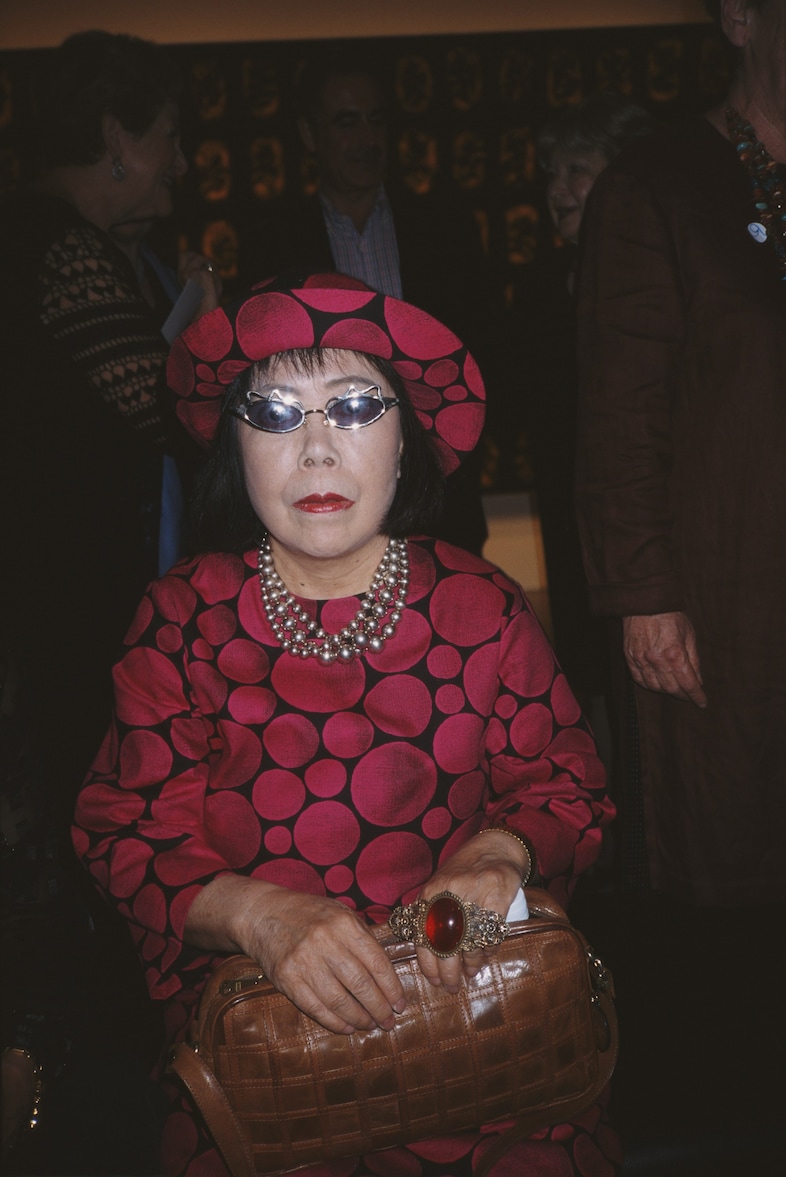
Navigating the xenophobic and patriarchal realities of the Western art market taught Kusama how to weaponize her "exotic" appearance to secure visibility, while simultaneously mastering the mechanics of personal branding. As she expanded into immersive spatial installations, her wardrobe—intricately calibrated to blend seamlessly into her exhibited environments—became yet another device to obliterate physical space and disrupt perceptual fields. Much like Andy Warhol (who Kusama famously accused of appropriating her ideas) weaponized his silver wig, striped T-shirt, and leather jacket to forge an unshakeable iconographic persona, Kusama is rarely seen today without her hyper-vibrant red wig and dotted dress—the ultimate culmination of a decades-long exercise in self-packaging.
1968: The Rise of Kusama Fashions Ltd.
By 1968, having spent years designing bespoke, conceptual costumes for her radical happenings, Kusama formalized her commercial ambitions by establishing the Kusama Fashions Company Ltd. Sensing a wave of copycats attempting to capitalize on her aesthetic innovations, she took a characteristically direct approach. In a later interview, Kusama recounted tracking down and forming an unexpected alliance with the president of a manufacturing firm who had been illicitly reproducing her designs.
"The mass media reported us big time… Buyers from big department stores came and selected 100 of this, 200 of that," she recalled. Within months, Kusama’s avant-garde apparel was distributed across 400 commercial stores and boutiques throughout the United States. Bloomingdale’s even constructed a dedicated "Kusama Corner," and in April 1969, she launched a short-lived, high-concept boutique on the corner of Sixth Avenue.
The brand specialized in daring, subversive garments that riffed on Kusama’s artistic fixations with orgiastic liberation and the human form. There was the infamous "Squid Dress," a hooded, avant-garde piece featuring explicit breast cut-outs and revealing flaps; the "Homo Dress," tailored with a strategically placed aperture in the rear; and an array of evening gowns fitted with convenient, exhibitionist peep-holes. True to her experimental ethos, however, Kusama later confessed that "the radical vanguard items that I poured my energy into sold little in the end."
In her autobiography, Infinity Net, Kusama articulated a unifying philosophy: "Clothes should bring people together, not separate them." Driven by this ethos, she launched the Nude Fashion Company as an offshoot of Kusama Fashions, designed to integrate "fresh ideas for enjoying sex into the mainstream." This initiative yielded items like the "Couples Dress"—a massive, sleeping-bag-like garment intended for multiple bodies—and the "Party Dress," engineered to simultaneously accommodate up to 25 people. Unsurprisingly, every square inch of these communal garments was saturated in her signature polka dots.
Supporting Context & Metrics: Historical Influences on Contemporary Runways
The Accumulation Series and Rei Kawakubo
For her "Homosexual Wedding" spectacle in 1968—proclaimed in press releases as the first such public ceremony performed in New York—Kusama donned a violently pink "Phallic Dress." Draped and covered entirely in soft, stuffed tendrils, the garment could easily have been lifted directly from her canonical Accumulation Series, a body of work featuring household objects, furniture, and canvases erupting with repeating, phallic soft-sculptural appendages.
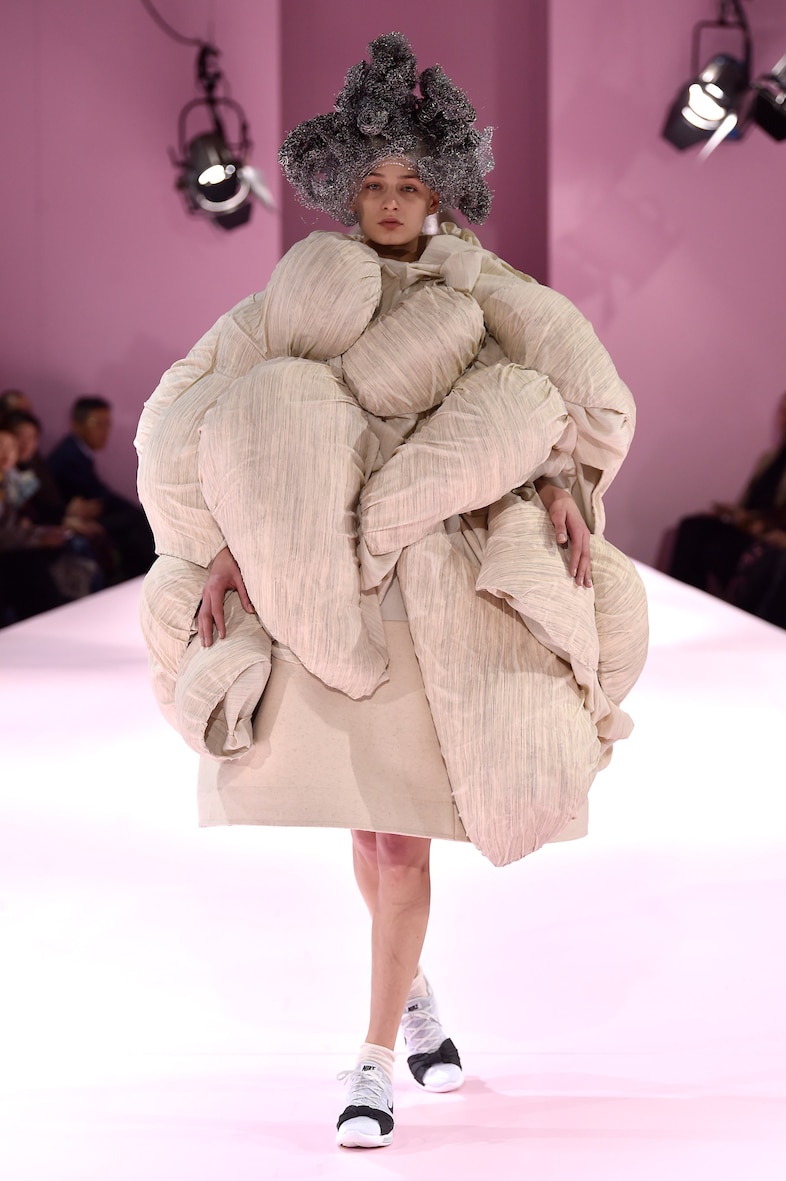
While commercial fashion history frequently overlooks these radical garments, they stand as undeniable stylistic precursors to Rei Kawakubo’s most disruptive conceptual moments at Comme des Garçons. Whether through convoluted padded tubing, amoebic sprouts of foreign fabric, or obsessively mapped protrusions, Kawakubo and Kusama share an unwavering rejection of conventional bodily limits and sculptural silhouettes.
Both designers utilize whorls of swollen, distorted fabric to redraw the contours of the human form, conjuring unsettling shapes that evoke organic growth, disease, and structural deformity. Kawakubo has frequently described her design philosophy as confronting the "fear of going beyond common sense"—an ethos that mirrors Kusama’s lifelong artistic mission.
This lineage extends beyond mere aesthetic coincidence. Kawakubo has openly expressed profound admiration for Kusama; the two collaborated on a joint, LED-dotted exhibition titled Room to Grow in 2009. Furthermore, direct homages are visible in collections like Comme des Garçons’ AW12 runway, which featured unmistakable red-wig and polka-dot ensembles. Today, the rippling, textural echoes of Kusama’s Accumulation Series reverberate heavily across the runways of Noir Kei Ninomiya, Iris van Herpen, and the sculptural knitwear of rising design star Chet Lo.
Food Obsessions and Martin Margiela
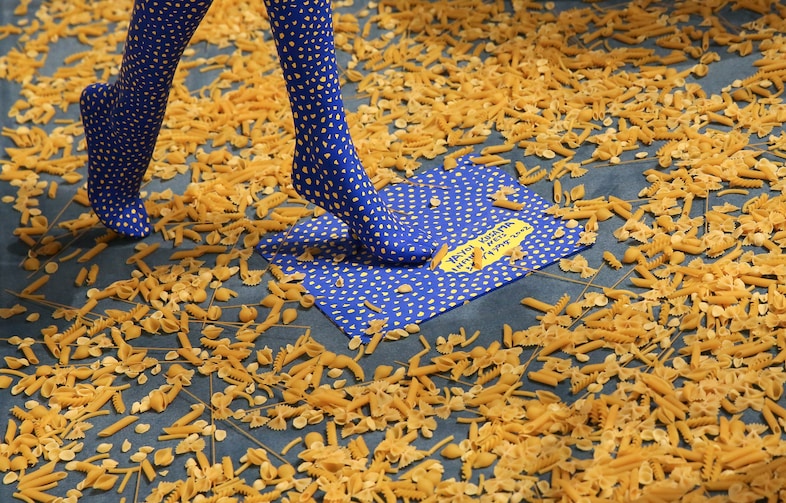
"As an obsessional artist, I fear everything I see," Kusama once stated. In her visceral Food Obsession sculptures, this existential terror manifested as a reaction against the vast, industrialized quantities of food consumed by a human over a lifetime.
"The thought of continually eating something like macaroni, spat out by machinery, fills me with fear and revulsion, so I make macaroni sculptures. I make them and make them and then keep on making them, until I bury myself in the process. I call this obliteration."
This psychological compulsion materialized as shirts, dresses, handbags, and shoes festooned entirely in dried pasta. Entire ensembles were dipped in gold and silver paints or aggressively sprayed with chrome, resembling hardened, calcified relics.
Decades later, this exact tactile vocabulary surfaced in the crusty, silver-coated garments of Martin Margiela. For both creators, the application of viscous paint unifies clothing and sculpture into a singular, unsettling experiment. An undercurrent of revulsion pervades these works; through dried globs of paint and fabric frozen mid-motion, fashion is reframed as an uncanny artifact rather than a utilitarian second skin. Elsewhere, the House of Margiela paid direct homage to Kusama’s meticulously clustered affixions during John Galliano’s landmark debut haute couture collection, which featured lacquered shells bulging aggressively from the front of structured coats.
Louis Vuitton and the Global Network of Intermediaries
To the uninitiated, it may appear contradictory for an artist forged in anti-establishment, anti-capitalist performance art to partner with the world’s most valuable luxury conglomerates. Yet for Kusama—who has never shied away from embracing commercial success—corporate collaboration represents the ultimate method of global self-obliteration. Just as her interminable polka dots consume gallery walls, canvases, and pumpkins, commercial tie-ins allow her aesthetic footprint to colonize the globe simultaneously.
In 2012, Kusama and then-artistic director Marc Jacobs unveiled the largest brand collaboration in Louis Vuitton’s history. Coinciding with Kusama’s major retrospective at the Whitney Museum of American Art (generously sponsored by Vuitton), Jacobs and Kusama deployed a comprehensive womenswear collection spanning fine jewelry, leather goods, ready-to-wear, pajamas, and outerwear, all consumed by Kusama’s clinically precise, dotted spirals. The collection was distributed across international Vuitton flagships alongside immersive, site-specific pop-up installations.
Simultaneously, Kusama’s graphic dots echoed across contemporaneous collections by David Koma, Diane von Furstenberg, and Stella McCartney. While attributing every polka-dot print directly to Kusama would overstate the case, the influence is undeniable in designers like Charles Jeffrey, whose freehand, bacteria-like prints and chaotic graphics bear a striking resemblance to Kusama’s unconscious, googly-eyed paintings.
Official Statements & Archival Insights
Kusama’s worldview, captured across decades of interviews, autobiographical texts, and manifestos, underscores a unified philosophy bridging her fine art and wearable creations:
- On the democratization of art through dress: "Clothes should bring people together, not separate them." — Infinity Net: The Autobiography of Yayoi Kusama
- On the prophetic nature of her apparel: "My costumes invariably suggest the path of the new generation." — Interview with The Guardian
- On the psychological roots of her repetitive motifs: "As an obsessional artist, I fear everything I see… I make them and make them and then keep on making them, until I bury myself in the process. I call this obliteration." — BOMB Magazine / Infinity Net
Beyond her landmark partnership with Louis Vuitton, Kusama has maintained a selective, highly curated roster of institutional and commercial collaborations. She has partnered with beauty giant Lancôme, champagne house Veuve Clicquot (reimagining La Grande Dame limited editions), Japanese mobile phone manufacturers, and Sonic Youth bassist Kim Gordon’s seminal streetwear brand, X-girl. Through these diverse ventures, Kusama established a vast, intricate network of cultural intermediaries tasked with disseminating her polka-dotted artifacts across the globe—a masterclass in executing an artist’s lifelong quest for total domination, mass consumption, and ultimate self-obliteration.
Future Outlook: The Indelible Blueprint
As Yayoi Kusama’s monumental retrospective exhibitions continue to break attendance records worldwide, her legacy within the fashion industry is undergoing a well-deserved reassessment. Long marginalized as a whimsical footnote to her primary studio practice, Kusama’s ventures into apparel—ranging from the anarchic happenings of 1960s New York to her clinical, hyper-commercialized luxury partnerships—have proven foundational to contemporary design.
The structural innovations pioneered by Kusama Fashions Ltd. and her radical body-sculptures anticipated the conceptual deconstruction championed by Rei Kawakubo, Martin Margiela, and a new wave of experimental designers. By treating garments not merely as commercial commodities, but as sculptural extensions of the psychological landscape, Kusama permanently expanded the vocabulary of modern dress.
Ultimately, Kusama’s pursuit of self-obliteration has achieved its paradoxical opposite: through clothing, consumer culture, and uncompromising artistic vision, she has ensured that she can never truly be erased. Her polka dots have effectively blanketed the cultural topography, guaranteeing that Yayoi Kusama remains permanently, inescapably present.