Executive Overview
For millions of drivers navigating daily commutes, road trips, and unpredictable seasonal shifts, Apple CarPlay has long served as the gold standard for in-vehicle infotainment integration. By seamlessly bridging the gap between the iPhone and the dashboard display, CarPlay provides intuitive access to navigation, music, podcasts, and messaging apps. Yet, despite its expansive ecosystem supporting hundreds of third-party applications, a glaring omission has persisted for years: Apple’s native Weather app remains conspicuously absent from the CarPlay interface.
To bridge this functionality gap, drivers have historically relied on third-party workarounds, dashboard glances, or smartphone mounts. However, the automotive software landscape is shifting dramatically. In a significant development for connected-car technology, The Weather Channel has officially rolled out comprehensive CarPlay integration for its flagship Storm Radar application.
Marked by the release of version 4.0.19, this update transforms the driving experience by bringing real-time meteorological tracking, dynamic map overlays, and advanced travel-safety features directly to the dashboard screen. Rather than serving as a passive weather display, Storm Radar functions as an active co-pilot, offering real-time radar layers, route-based precipitation forecasting, automatic rerouting capabilities, and live weather alerts that update dynamically as the vehicle moves.
This comprehensive software rollout represents the culmination of a broader strategic push by The Weather Channel to modernize its platform across the entire Apple ecosystem—following on the heels of AI-powered forecasting tools for iOS and iPadOS, as well as a redesigned Apple Watch companion app. As drivers increasingly demand granular, real-time safety data inside their vehicles, the arrival of Storm Radar on CarPlay establishes a new benchmark for automotive weather tracking and positions the app as an essential utility for modern motorists.
Detailed Chronology: The Evolution of Storm Radar on Apple Platforms
The integration of Storm Radar into Apple CarPlay did not happen overnight; it is the result of a calculated, multi-phase platform modernization strategy deployed by The Weather Channel throughout the year. Understanding how Storm Radar evolved from a standard mobile weather application into a cross-platform automotive dashboard powerhouse requires examining the key milestones of its development timeline.
Early 2026: The AI-Powered Mobile Overhaul
The foundation for the CarPlay integration was laid earlier in the year when developers overhauled the core iPhone and iPad versions of Storm Radar. In a push to modernize meteorological reporting, The Weather Channel introduced cutting-edge artificial intelligence features. Most notably, the update allowed users to build and customize their own AI-powered weather presenters. This feature utilized advanced machine learning models to synthesize complex radar data, localized forecasts, and atmospheric trends into digestible, personalized video briefings. By modernizing the mobile app’s data architecture and user interface, the engineering team established the robust backend framework required to stream high-resolution geospatial data onto external displays.
Mid-2026: Expanding to the Wrist
Following the mobile software refresh, development efforts shifted to Apple’s wearable ecosystem. The introduction of a dedicated Apple Watch app allowed users to monitor localized storm tracking, get immediate precipitation alerts, and view glanceable weather complications directly from their wrists. This phase proved critical for testing how Storm Radar handled lightweight, high-frequency data streams—a technical requirement that directly informed the optimization work needed for the demanding bandwidth and safety constraints of Apple CarPlay.
August 2026: The CarPlay Debut (Version 4.0.19)
The culmination of these multi-device efforts arrived with the official release of version 4.0.19. Available now on the App Store, this major update officially brings Storm Radar to the dashboard. Designed specifically within the strict human-interface guidelines mandated by Apple for CarPlay applications, the software balances deep data visualization with distraction-free driving principles. Alongside the CarPlay integration, the version 4.0.19 package also includes modernized home screen widgets for iOS and a fully redesigned Apple Watch app, cementing a unified, cross-device weather tracking experience for Apple users.
Supporting Context & Metrics: Filling the CarPlay Weather Void
To fully appreciate the significance of Storm Radar’s CarPlay debut, one must examine the current landscape of automotive software and the specific functional gaps it addresses.
The Apple Weather Conundrum
Apple’s native Weather app is widely praised for its clean aesthetic, hyperlocal forecasts, and detailed atmospheric data layers. On iOS, iPadOS, macOS, and watchOS, it serves as the default meteorological hub for hundreds of millions of users. However, Apple has historically restricted the Weather app from appearing on CarPlay. While drivers can ask Siri for a verbal weather update or check conditions on their iPhones before departing, having a live, interactive weather map or predictive radar loop on the dashboard has remained impossible through native software channels.
This limitation left a significant void in the connected-car experience. Driving through rapidly changing weather patterns—such as sudden summer downpours, localized squalls, or fast-moving winter snowstorms—requires timely visual data. While dedicated navigation apps like Apple Maps, Google Maps, and Waze offer basic incident reporting, none provide the granular, predictive meteorological insight required to outmaneuver severe weather cells.
Technical Architecture and Features of Storm Radar for CarPlay
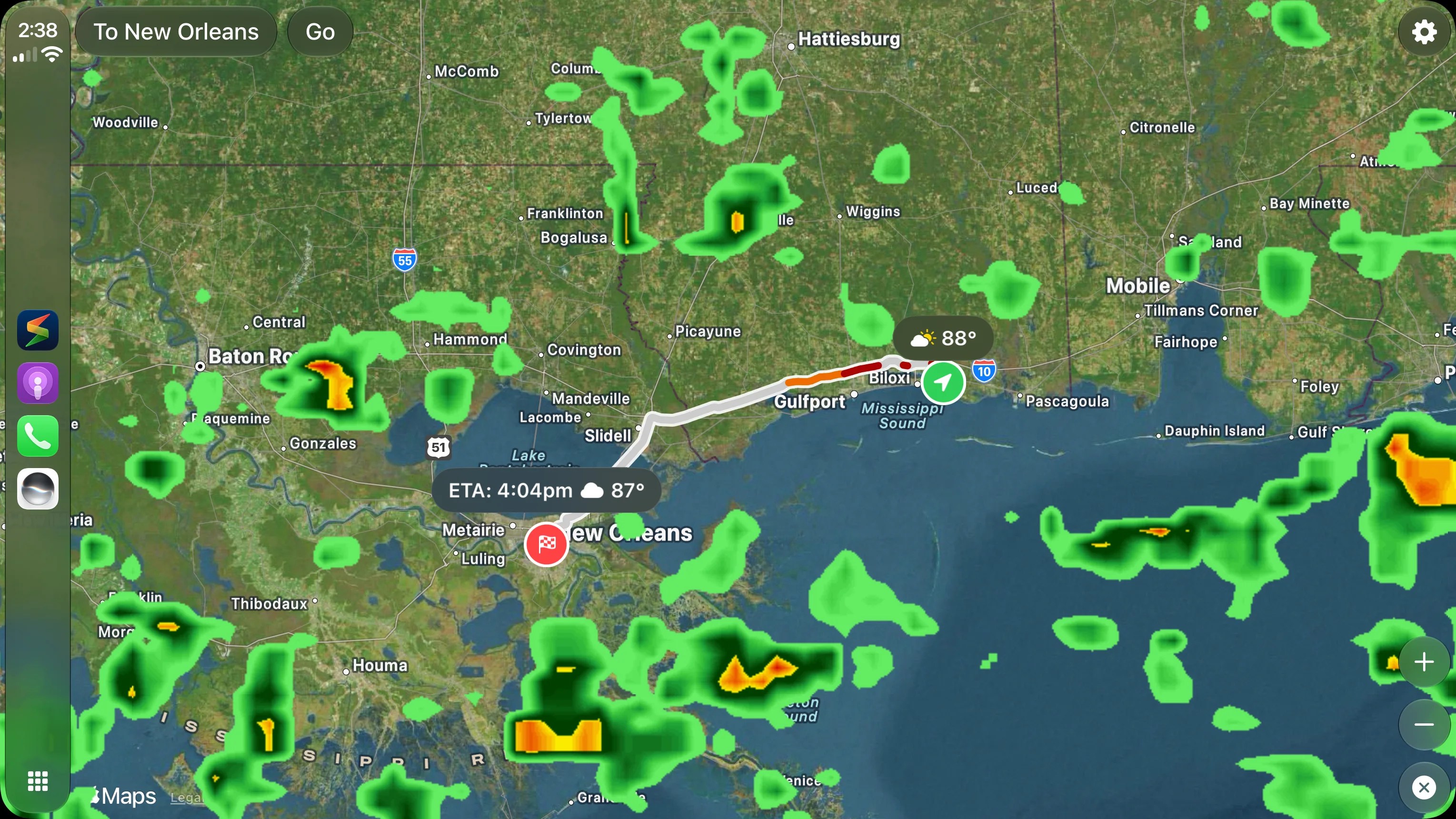
Storm Radar bridges this gap by leveraging CarPlay’s map-rendering frameworks to deliver specialized meteorological data directly to the dashboard screen. Key technical and functional features of the integration include:

- Interactive Mapping and Dual Views: The CarPlay interface renders a localized map centered on the vehicle’s current GPS coordinates. Drivers can seamlessly toggle between a standard map background and a high-contrast satellite view.
- Dynamic Data Layers: Users can overlay critical weather data, including real-time radar reflectivity, cloud cover, and live precipitation intensity. This allows drivers (or more safely, passengers) to assess the trajectory and severity of approaching storms.
- Route-Aware Intelligence: Beyond static mapping, Storm Radar integrates deeply with travel itineraries. The application displays current local conditions alongside the Estimated Time of Arrival (ETA) and the expected weather conditions at the final destination.
- Automatic Rerouting and Live Alerts: Perhaps the most vital safety feature of the CarPlay integration is its dynamic routing engine. As conditions change along the highway, the application issues real-time weather alerts and triggers automatic rerouting suggestions, helping drivers proactively steer clear of flash flooding, heavy wind corridors, or severe convective storms.
Official Statements and Industry Perspective
While Apple has maintained a measured silence regarding its roadmap for native CarPlay weather apps, third-party developers have eagerly stepped in to meet consumer demand. Representatives from The Weather Channel have emphasized that the integration of Storm Radar into CarPlay was driven by an urgent need to enhance driver situational awareness and safety.
In release documentation accompanying version 4.0.19, development leads noted that the goal was to transform weather tracking from a reactive query into a proactive safety measure. "Drivers face increasingly unpredictable weather events due to shifting climatic patterns," noted a product development brief from The Weather Channel. "Bringing Storm Radar to CarPlay ensures that vital meteorological data, live precipitation mapping, and active safety alerts are accessible right where they are needed most—on the dashboard, keeping drivers informed before severe weather impacts their route."
Industry analysts have similarly lauded the move, pointing out that as vehicles evolve into software-defined spaces, third-party apps that enhance safety and navigation utility will dictate consumer preference. With Apple gradually expanding CarPlay’s capabilities—most notably paving the way for next-generation CarPlay systems that integrate deeply with vehicle instrument clusters and climate controls—having a robust, real-time weather application in the ecosystem establishes a critical pillar for comprehensive in-car software.
Future Outlook: The Next Frontier of Connected Weather Tracking
The launch of Storm Radar on CarPlay marks an important milestone, but it also opens the door to broader questions regarding the future of automotive meteorology and Apple’s ecosystem roadmap.

As connected-car platforms mature, the boundary between navigation and environmental awareness will continue to blur. Several key trends are expected to shape the future of weather integration in vehicles:
- Deeper Instrument Cluster Integration: With next-generation CarPlay rolling out to select luxury and mainstream automakers, apps like Storm Radar could soon feed critical weather warnings directly into digital driver displays and heads-up displays (HUDs), minimizing even fractional glances away from the road.
- Predictive AI Modeling: Building upon the AI-powered video presenters introduced earlier this year, future iterations of mobile and automotive weather apps may utilize predictive generative models to offer conversational, audio-based briefings tailored specifically to a driver’s upcoming highway corridor.
- Crowdsourced and Hyperlocal Telemetry: As connected vehicles become rolling sensor suites equipped with exterior temperature gauges, wiper activity monitors, and traction control sensors, upcoming integrations could leverage anonymized vehicle data to feed hyper-accurate, road-level weather intelligence back into tracking applications.
For now, the immediate takeaway for motorists is clear: the days of flying blind into a severe storm while using Apple CarPlay are coming to an end. By bringing professional-grade radar, live precipitation tracking, and intelligent rerouting to the dashboard, Storm Radar’s CarPlay debut transforms the connected car into a safer, more weather-resilient space. Users running compatible iPhones can update to version 4.0.19 via the App Store today to experience the new dashboard integration firsthand.