In the escalating battleground of digital espionage, state-sponsored hacking groups continuously innovate to bypass traditional security perimeters. Among the most concerning vectors exploited in recent years is a design flaw embedded deep within Google’s Accelerated Mobile Pages (AMP) framework.
According to cybersecurity intelligence and internal documentation, "Fancy Bear"—a notorious cyber-espionage collective linked to Russian military intelligence (widely tracked as APT28, Sofacy, or Strontium)—leveraged Google’s own caching and URL rendering mechanisms to execute sophisticated spear-phishing campaigns. Their primary targets: investigative journalists, geopolitical researchers, and watchdogs scrutinizing Russian foreign and domestic policy.
The vulnerability exploited by Fancy Bear stems from the very architecture of AMP. Designed in late 2015 to accelerate mobile web browsing by pre-rendering simplified versions of web content, Google’s system serves these cached pages directly from its trusted google.com domain. While this architecture successfully shaved milliseconds off mobile load times, it created a profound cryptographic and visual paradox: malicious login portals hosted on rogue servers could masquerade behind official Google URLs.
Despite repeated warnings from software developers and security researchers regarding the inherent phishing risks, Google leadership—most notably AMP tech lead Malte Ubl—initially downplayed the concerns. As state-backed actors capitalized on the blind spot to compromise high-profile targets like journalist David Satter, the tech giant faced mounting pressure from publishers, civil society, and privacy advocates. This report provides an in-depth examination of how the AMP exploit functioned, the geopolitical targets caught in the crosshairs, and the broader implications for the open web.
Detailed Chronology: The Evolution of the AMP Phishing Vector
The Architectural Flaw
Launched to streamline mobile web experiences, Google’s AMP framework relies on a caching system that pre-fetches web pages listed in search results. When a user clicks an AMP-enabled link, the content is served instantly via a google.com URL rather than the originating domain.
While the actual content’s originating domain appears temporarily at the top of the webpage content area, the browser’s primary address bar permanently displays a pristine google.com address. Furthermore, as users scroll, the origin disclaimer fades away. For decades, cybersecurity training has hammered home a single rule to defeat phishing: always check the domain in the address bar. Under the AMP architecture, however, that golden rule was rendered obsolete. Attackers realized they could construct malicious credential-harvesting pages and serve them under the unassailable umbrella of a Google-certified URL.
Warnings Ignored
Months before the exploit weaponization became public, the developer community identified the inherent danger. In November 2016, web programmer Ray Etornam filed a bug report on GitHub detailing how fake news publishers could abuse AMP to acquire misplaced digital legitimacy.

Developer Christian Gloddy and credit card system co-founder John Pettitt quickly joined the thread, warning Google that relying on sub-header text while the address bar displayed google.com was a disaster waiting to happen.
Despite these clear, technical warnings, Malte Ubl, Google’s lead for the AMP project, pushed back against the criticism. In public GitHub exchanges, Ubl insisted that the Google Search viewer clearly attributed the original domain and argued that "an unsophisticated user could be fooled" was an exaggeration. Internal warnings were largely dismissed, and the public comment thread was eventually locked by Google personnel as media inquiries began to mount.
Weaponization by Fancy Bear
While Google debated developers, Fancy Bear operatives were operationalizing the flaw. The group, which gained global notoriety for its intrusions into the Democratic National Committee and various international political bodies, turned its focus toward individuals investigating Russian state activities.
Among the primary targets was Aric Toler, a lead researcher for Bellingcat, an investigative collective famous for uncovering the truth behind the downing of Malaysia Airlines Flight 17 over Ukraine in 2014. Beginning in October 2016, Toler became the target of an intense spear-phishing campaign.
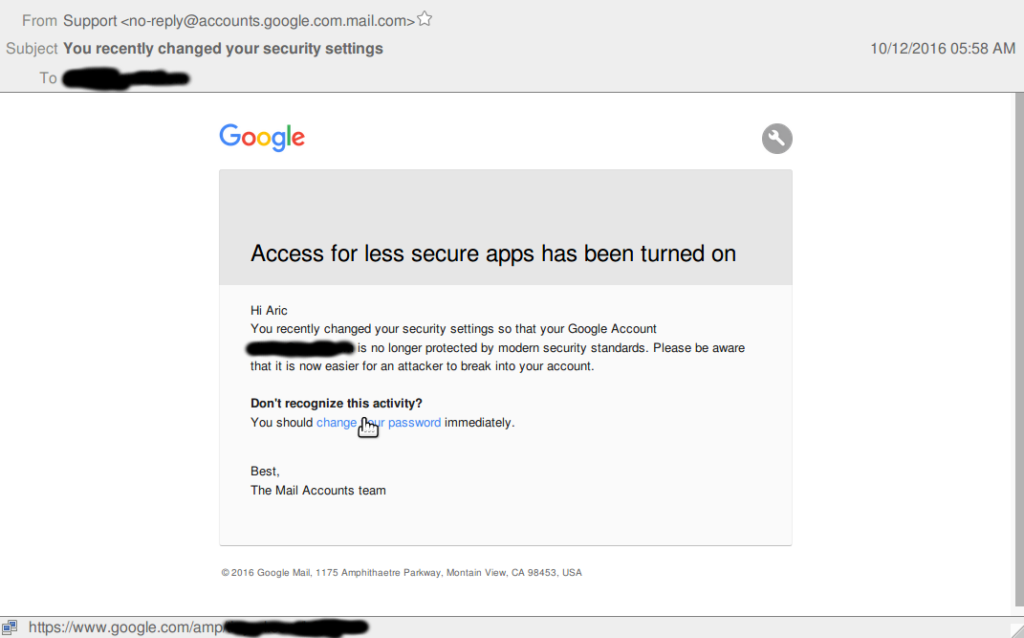
- October 12, 2016: Toler received an email purporting to be a security alert from Google, warning that older email programs had gained access to his account and urging him to review his settings. The link utilized a Google AMP wrapper that redirected to a credential-harvesting clone.
- October 13, 2016: Following a public tweet by Toler acknowledging a legitimate Google warning about "government-backed attackers," the hackers doubled down. They dispatched a second, highly tailored spear-phishing email utilizing the exact same AMP vector, urging him to change his password immediately via a malicious link.
Cybersecurity firm ThreatConnect analyzed the headers and infrastructure of these attacks, linking the [email protected] account used by the perpetrators directly to historical Fancy Bear operations.
While Toler and his Bellingcat colleagues successfully dodged the trap, other high-profile targets were less fortunate. David Satter, an American journalist and author who writes extensively on Russia, fell victim to an identical AMP phishing message sent from the same infrastructural nexus. Once Satter entered his credentials on the forged portal, automated scripts downloaded his entire Gmail archive. Within weeks, the stolen data surfaced online, heavily doctored to defame critics of Russian leadership, as documented by digital watchdog Citizen Lab.
Supporting Context & Metrics: The Broader Fallout
The exploitation of Google AMP highlights a systemic friction point between corporate centralization and open-web security. The controversy surrounding AMP extended far beyond security vulnerabilities, drawing fierce criticism from publishers, software engineers, and media trade associations.
- The Publisher Backlash: Critics argued that AMP coerced publishers into handing over their mobile audiences—often constituting the majority of their web traffic—directly to Google. Prominent programmer John Gruber and book publisher Scott Gilbertson openly criticized the initiative, arguing that it obfuscated true URLs, homogenized web interfaces, and trapped users within Google’s proprietary ecosystem.
- The "Fake News" Convergence: Independent watchdogs noted that because AMP content loaded through Google domains, fringe conspiracy sites and purveyors of disinformation shared the exact same visual authority and polished presentation as legitimate, Pulitzer Prize-winning news organizations. This visual parity eroded user trust and complicated efforts to separate verified journalism from state-sponsored propaganda.
- Industry Alarm: Jason Kint, CEO of the digital publishing trade association Digital Content Next (representing entities like The New York Times, The Washington Post, and major U.S. television networks), voiced grave concern over the incident. Kint noted that the episode demonstrated the inherent dangers of corporate consolidation and closed standards, advocating for an immediate decoupling of AMP from proprietary Google interests.
Official Statements and Corporate Response
As investigative reports and security analyses spotlighted the vulnerabilities, Google faced intense scrutiny regarding its transparency and security protocols.
Initially, Google representatives maintained that AMP pages were adequately protected by the company’s automated infrastructure. However, the exact nature of these safeguards remained opaque. It was only after initial publication waves that Google clarified that its "Safe Browsing" technology had been extended to screen AMP addresses starting in early January 2017.
Under this retrospective framework, Google’s automated scanners attempt to visit and verify AMP pages for malicious code prior to indexing. If an unverified page slips through, the system triggers a "redirect notice"—a warning page advising users that they are navigating away from Google.com.
Critics, however, pointed out critical flaws in this mitigation strategy:
- Developer Jargon: The redirect warnings utilize technical language that confuses average users, failing to explicitly state that the link poses a severe security hazard.
- Opacity: Google’s refusal to publicly disclose the precise nature of its internal security patches fostered an environment of distrust within the cybersecurity community.
- Silencing Debate: The decision by AMP project lead Malte Ubl to lock the original GitHub bug report during active journalistic inquiry reinforced perceptions that the tech giant was more concerned with PR management than transparent vulnerability remediation.
Future Outlook
The exploitation of Google’s Accelerated Mobile Pages by Fancy Bear serves as a watershed moment in the intersection of corporate web optimization and state-sponsored cyber warfare. It demonstrated that even the world’s most sophisticated technology companies can inadvertently construct high-value attack surfaces for hostile foreign intelligence units.
Although Google eventually implemented background checks via Safe Browsing and adjusted parts of its mobile redirect architecture, the psychological and infrastructural scars remained. The incident galvanized debates among internet standards bodies, browser developers, and security architects regarding the dangers of domain-sharing and content pre-rendering.
Ultimately, the Fancy Bear AMP attacks validate a core tenet of modern cybersecurity: convenience and speed must never supersede verifiable authenticity. As nation-state actors continue to weaponize the structural complexities of the modern web, publishers, platform operators, and end-users alike must navigate an ecosystem where trust can no longer be assumed simply because a URL begins with a household name.