Executive Overview
In the contemporary digital marketing landscape, professional networks have become saturated with automated text, generic thought leadership, and formulaic outputs generated by artificial intelligence. Yet, despite—or perhaps because of—this deluge of machine-made noise, a massive opportunity exists for human-centric content creators. With only 1% of LinkedIn’s massive user base actively creating content, a profound supply-and-demand gap continues to favor those who show up with genuine insight, strategic clarity, and authentic perspective.
However, publishing consistently is no longer enough to guarantee visibility or conversion. To break through the algorithmic noise and capture the attention of high-value prospects, creators must move beyond superficial metrics and adopt a systematic approach to audience engagement.
Co-created by digital strategist Kasey Brown and industry authority Michael Stelzner, the Triple S Framework—comprising Stop, Stay, and Share—offers a robust, counter-intuitive roadmap. Rather than relying on AI prompts or generic templates, this methodology teaches founders, executives, coaches, and consultants how to design organic content systems that convert casual scrollers into loyal advocates and paying clients. This report breaks down the foundational shifts, tactical execution methods, and diagnostic metrics required to master LinkedIn content creation entirely through human ingenuity.
Detailed Chronology: Unpacking the Triple S Content Framework
The evolution of modern organic social media strategy has reached a critical inflection point. As algorithms become increasingly adept at filtering out low-effort, AI-generated content, creators must return to first principles of human psychology and narrative architecture. The methodology shared by Kasey Brown outlines a step-by-step chronology of how a user interacts with a LinkedIn post, dividing the journey into three distinct psychological gates.
[ SCROLLER ]
     │
     ▼
 1. STOP  ──► Visual Pattern Interrupt + Hook (First 2 Lines / 5 Cs)
     │
     ▼
 2. STAY  ──► The Re-Hook (Building Tension) + Readable Rhythm
     │
     ▼
 3. SHARE ──► The Tangible "Goodie Bag" / Actionable Transformation
     │
     ▼
[ CONVERSION & ADVOCACY ]
Phase One: Laying the Groundwork
Before a single word of copy is written, structural foundations must be firmly established. Without these parameters, even the most creative hooks will fail to drive business results.
- Precision Ideal Client Profiles (ICPs): Vague demographic sketches—such as "people who want to build a brand online"—are entirely useless for content generation. A functional ICP must possess micro-specificity. For instance: "Speakers, coaches, and consultants earning at least $20K per month who need systems for organic content so they can scale their impact and their business." This level of detail allows even a virtual assistant to run targeted LinkedIn searches and identify exact matches.
- The 30-Day Transformation Arc: Every piece of content should ladder up to a clear transformation that a follower would experience over a 30-day journey. This overarching goal dictates the angle and utility of every individual post.
- The Reader-First Paradigm Shift: Most creators post with self-serving intent: Did I sound smart? Did I highlight my wins? Will this drive immediate sales? High-performing content inverts this paradigm entirely, focusing exclusively on the tangible value delivered to the reader. When the primary question becomes "What does the ideal reader walk away with today?" engagement naturally compounds.
Phase Two: The Triple S Execution Blueprint
Once the foundations are secured, content creators must systematically engineer their posts to pass through the three gates of user engagement:
1. Stop: Pause the Viewer’s Scroll
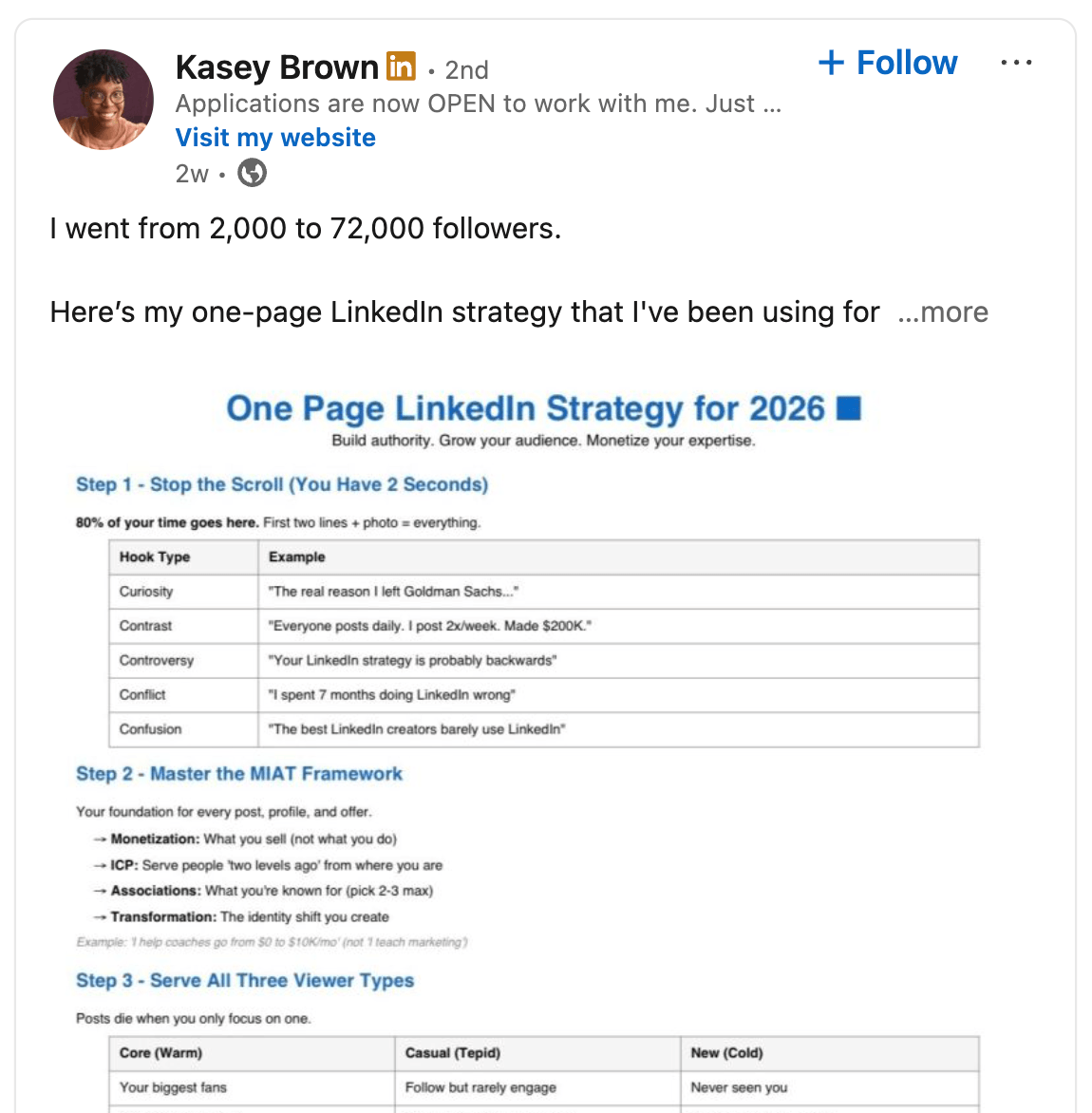
The initial hurdle is arresting the reader’s motion. Roughly 80% of a post’s impressions are determined by two elements working in tandem: the attached visual and the first two lines of text.
- Visual Strategy & The Power of Being Different: While most professionals default to polished headshots or high-production speaking stills, this homogeneity creates a golden opportunity for pattern interrupts. In a famous split-test conducted by Brown, a wide-angle stage selfie taken with a phone’s back camera at 0.5x zoom generated 3,000 leads, whereas a professionally lit, high-resolution presentation photo of the exact same offer yielded only 200 leads. Vertical images and wide-angle environments capture more screen real estate and trigger natural curiosity. Furthermore, embedding dense frameworks inside mock document screenshots or office TV displays outperforms standard title cards.
- The Five Cs of Hook Architecture: Borrowing from short-form video psychology, a compelling hook must create immediate cognitive friction. The five core triggers are curiosity, contrast, contradiction, controversy, and confusion. Weak hooks simply state facts (e.g., "On vacation in Bali, having a great summer"). Strong hooks leverage tension by juxtaposing two conflicting realities (e.g., "I was at a job I hated. 2021." paired with "2026. I just spent $30K to come here…").
2. Stay: Keep Readers Engaged From Hook to Finish
Once a user clicks "see more," the creator has earned a brief window of attention. The objective here is not to resolve the narrative immediately, but to deepen the tension.

- The Re-Hook Mechanism: The third line of text must act as a secondary hook that builds more suspense rather than giving away the punchline. Just like the first 60 seconds of a high-retention YouTube video, the copy must make the reader feel that abandoning the post prematurely means missing a critical insight.
- Rhythm and Readability: Walls of text kill retention. Optimal structure relies on a calculated rhythm: three or four short, punchy one-sentence lines followed by a dense developmental block of two to three sentences. Leveraging tools like the Hemingway App ensures the reading level remains accessible (typically targeting a 4th-to-7th-grade reading level for maximum digestibility). Because 70% of professionals consume content on mobile devices, previewing drafts via platforms like Authored Up or directly on the mobile app prevents formatting failures.
3. Share: Driving Network Amplification
The ultimate litmus test for high-value content is the share (or repost). Views and comments are relatively easy to accumulate, but a share signifies that a reader values the content enough to attach their personal reputation to it and broadcast it to their broader professional network.
- The "Goodie Bag" Ending: Shareable posts consistently conclude by providing a tangible, step-by-step framework or actionable asset. By transforming a personal narrative into a replicable blueprint—such as a structured, chronological breakdown of how a business milestone was achieved—the creator equips the reader with something worth forwarding, saving, or discussing.
Supporting Context & Metrics: Analyzing the Performance Data
To understand why traditional marketing playbooks are failing on LinkedIn, one must examine the macro-economic and platform-specific data governing professional social media.
The Content Creation Gap
Platform analytics consistently reveal that approximately 1% of LinkedIn’s user base creates content, 9% actively engage (commenting and liking), and the remaining 90% lurk. This structural imbalance means that algorithms actively reward consistent, high-utility publishers. However, because the market is flooded with automated, generic AI text, the algorithms and human readers alike have developed sophisticated filters against uninspired posts.
Diagnostic Metrics That Matter
According to advanced content strategists, vanity metrics like raw impressions can easily deceive creators. A more accurate analytical approach involves tracking specific performance ratios:
- Shares-per-Impression Ratio:
- 0.3 Ratio: Solid performance; indicates healthy resonance with core followers.
- 0.5+ Ratio: Exceptional performance; signals viral potential and high utility. Posts achieving this threshold are prime candidates for recycling into the content rotation every 60 to 90 days using identical copy and visual assets.
- The AI Reliance Factor: Industry reports indicate that while marketers are aggressively experimenting with artificial intelligence, audience fatigue toward machine-generated syntax is at an all-time high. Human-led nuances—such as raw personal anecdotes, unfiltered wide-angle photography, and bespoke client-interaction breakdowns—consistently outperform synthesized copy in both click-through rates and high-ticket conversion metrics.
Future Outlook: The Next Era of Organic Professional Branding
As artificial intelligence tools become universally accessible, the competitive advantage on professional networks will no longer lie in speed or volume, but in authenticity and depth of insight.
Predictions for LinkedIn Content Strategy
- The Death of Generic Thought Leadership: As automated posting tools flood feeds with predictable, bulleted summaries of business books and generic motivational quotes, audiences will actively mute or unfollow synthetic accounts. The pendulum will swing heavily toward radical transparency, unpolished real-world imagery, and deeply personal case studies.
- Systems Over Shortcuts: Founders and executives will increasingly transition away from outsourcing content to generic agencies that rely on prompt-engineered AI copy. Instead, the most successful brands will build internal content capture systems—turning everyday client sessions, strategic workshops, and real-time business challenges directly into structured, human-authored frameworks.
- Community-Driven Amplification: With algorithms continuously prioritizing content that sparks genuine peer-to-peer discourse, the focus will shift from broadcasting messages to architecting interactive "goodie bags"—resources so structurally useful that professional communities feel compelled to share them organically.
Ultimately, mastering LinkedIn content without AI is not about rejecting modern efficiency; it is about recognizing that trust cannot be automated. By mastering the Triple S Framework—stopping the scroll with distinct visuals and psychological tension, keeping readers engaged through rhythmic and suspenseful storytelling, and driving shares with actionable, reader-first transformations—creators can build resilient, high-converting organic engines that withstand any algorithmic shift.