Executive Overview
In one of the most rapid valuation accelerations in the artificial intelligence sector this year, robotics data startup XDOF is in late-stage negotiations to secure a Series B funding round at a valuation of approximately $1.2 billion. The round is being led by venture capital firm 8VC, according to multiple sources familiar with the transaction.
The funding talks come less than three months after XDOF emerged from stealth with a $70 million Series A round backed by an elite consortium of venture firms, including Thrive Capital, Andreessen Horowitz (a16z), Lux Capital, and Spark Capital.
XDOF’s dramatic valuation leap—from an undisclosed Series A figure to unicorn status in a matter of weeks—has been propelled by exceptional commercial velocity. Driven by explosive demand from frontier AI research laboratories and physical robotics developers, the startup’s annualized run-rate revenue is approaching $50 million. This unprompted commercial growth led top-tier venture capitalists to proactively target the company with new capital offers, forcing an earlier-than-anticipated return to the fundraising market.
Positioning itself as the essential data pipeline for the physical robotics industry—akin to what Scale AI and Mercor achieved for Large Language Models (LLMs)—XDOF provides the real-world operational data, teleoperation hardware frameworks, and annotation layers necessary to train general-purpose embodied AI.
Detailed Chronology: From Academic Research to Billion-Dollar Enterprise
                       XDOF's Rapid Trajectory

   2024              Early 2026           Late 2026
 [ Founded ] ------> [ Stealth Exit ] ------> [ Series B Talks ]
 Academic roots      $70M Series A            $1.2B Valuation
 (GELLO paper)       20 Customers             $50M ARR Trajectory
The Academic Genesis (2024)
The architectural foundation of XDOF was forged at the University of California, Berkeley, by researchers Philipp Wu and Fred Shentu. While pursuing doctoral research on how autonomous agents learn from massive datasets, Wu encountered a fundamental structural barrier in robotics: unlike digital text or image processing, there was virtually no standardized, high-quality, large-scale dataset available for training hardware to execute physical tasks in unstructured human environments.
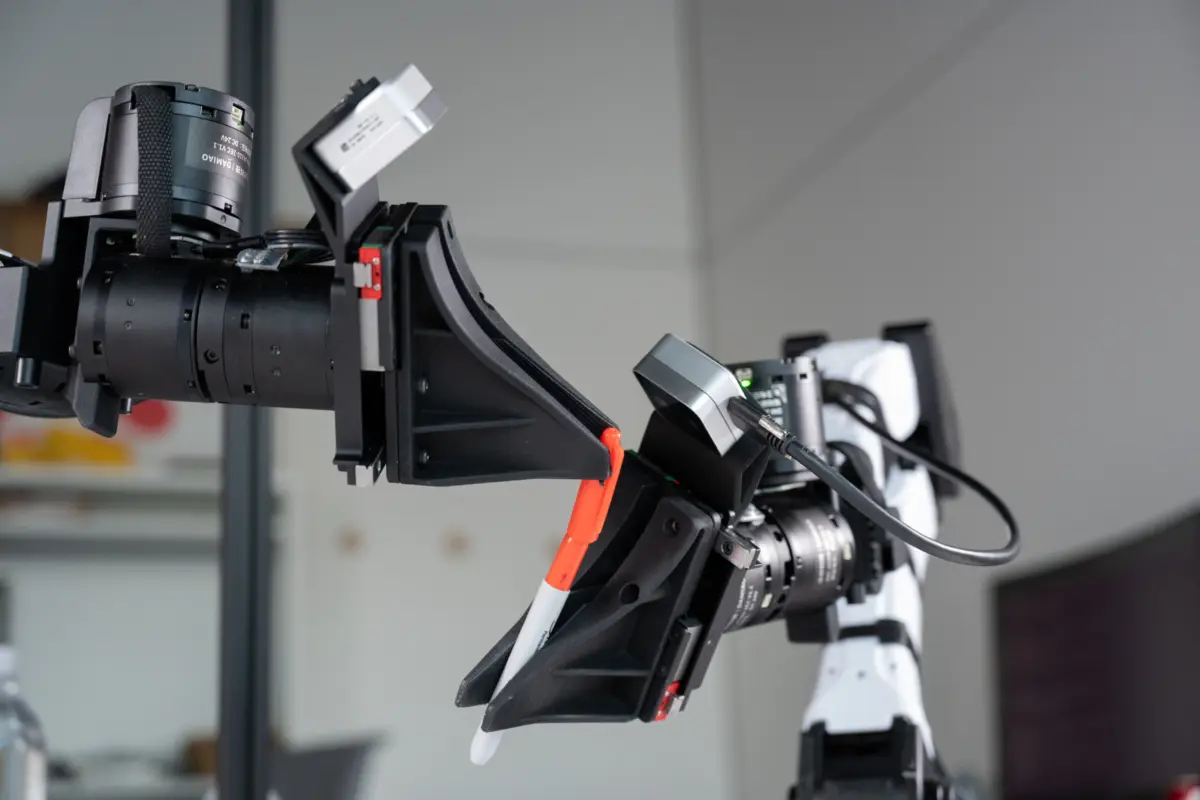
To solve this, Wu and Shentu co-created GELLO, an open-source, low-cost teleoperation interface designed to map human arm and hand movements directly to robotic manipulators. By radically lowering the cost and complexity of collecting precise kinematic and spatial data, GELLO yielded an influential research paper that quickly circulated across robotics and machine learning laboratories worldwide.
Recognizing that academic papers alone could not bridge the massive data deficit facing general-purpose robotics, Wu (serving as CEO) and Shentu (serving as CTO) formally incorporated XDOF in 2024 to turn their research into an industrial-scale data supply chain.
The Series A Inflection Point
Operating largely in stealth, XDOF built bespoke data acquisition tools, edge-capture devices, and proprietary teleoperation software networks. In mid-2026, the company publicly debuted alongside the announcement of a $70 million Series A round.
The round attracted major venture capital firms, led by Andreessen Horowitz, Thrive Capital, Lux Capital, and Spark Capital. At the time of its stealth exit, the company revealed it was already managing data workflows for 20 enterprise customers, including prominent frontier AI development labs racing to build foundation models for embodiment.
The Series B Catalyst
Though XDOF’s executive team had intended to execute on its technology roadmap without immediate capital raising, its post-stealth growth trajectory disrupted those plans. Within months of its Series A disclosure, the company’s annualized revenue approached the $50 million mark.
Recognizing that the bottleneck for general-purpose robotics had firmly shifted from compute capacity to physical data collection, venture firm 8VC moved to lead a massive $1.2 billion valuation round. This investment aims to help XDOF aggressively scale its physical operations across international markets.
Supporting Context & Technical Metrics: Solving the Embodied AI Bottleneck
The Physical vs. Digital Data Paradox
The primary catalyst behind XDOF’s valuation rests on a critical divergence between LLMs and Embodied AI:
- Textual/Digital AI: Large language models were trained on trillions of tokens scraped directly from the internet—spanning digitized books, web pages, code repositories, and public forums.
- Embodied Physical AI: Physical robots operate in continuous 3D environments requiring real-time spatio-temporal reasoning, tactile feedback, kinematic awareness, and edge-case handling. No "internet equivalent" of physical interaction data exists.
       DATA FOUNDATION COMPARISON

  [ Large Language Models ]       [ Embodied Robotics AI ]
  +-----------------------+       +-----------------------+
  | Web Scraped Data      |       | Real-World Sensor Data|
  | Digital Text & Code   |       | Kinematic Trajectories|
  | Low Cost Scaling      |       | Physical Teleoperation|
  +-----------------------+       +-----------------------+
            |                                 |
            v                                 v
   Ubiquitous Pre-training            Data Bottleneck
Because simulated environments (sim-to-real workflows) routinely fail to capture the complex physics and unpredictable chaos of real-world environments, frontier robotics labs are forced to rely on physical demonstration data. Building in-house teleoperation fleets, hiring human data collectors, and managing multi-modal video/kinematic data pipelines is prohibitively expensive and operational intensive for AI software labs. XDOF acts as an outsourced, vertically integrated data supply chain, solving this critical operational bottleneck.
Multi-Modal Data Engine & The "ABC" Dataset
To aggregate physical training data at scale, XDOF utilizes a hybrid data collection model combining hardware, human teleoperators, and egocentric wearable sensing:
- Remote Teleoperation Pipelines: Operators manipulate physical robot arms remotely using specialized controllers, executing fine-motor tasks such as picking, sorting, assembly, and tool manipulation.
- Egocentric Human Operator Capture: Human data collectors wear body-mounted sensor rigs, stereo vision depth cameras, and tactile feedback gloves while performing everyday domestic and industrial tasks (e.g., folding clothes, opening packaging, flattening boxes, handling fragile materials).
- The "ABC" Dataset: In partnership with UC Berkeley’s AI Research (BAIR) lab, XDOF is preparing to publish the ABC dataset, projected to be the largest, highest-quality dataset of physical robot trajectories ever assembled for public and commercial research.
| Operational Metric | Value / Detail |
|---|---|
| Current Annualized Revenue (ARR) | Approaching ~$50 million |
| Series A Raised | $70 million (June 2026) |
| Reported Series B Valuation | ~$1.2 billion |
| Lead Series B Investor | 8VC |
| Early Institutional Backers | Thrive Capital, Andreessen Horowitz, Lux Capital, Spark Capital |
| Active Enterprise Customers | 20+ (including top-tier frontier AI labs) |
| Core Technical Innovations | GELLO low-cost teleop framework, ABC multi-modal dataset |
Competitive Market Dynamics
XDOF operates in an increasingly competitive landscape where traditional data labeling platforms are expanding into physical robotics, while specialized hardware-data startups are simultaneously emerging:
                  EMBODIED DATA LANDSCAPE

  [ Specialized Physical Data ]      [ Legacy Data Scale-Ups ]
  +---------------------------+      +-----------------------+
  | XDOF (Focus: Kinematics)  |      | Scale AI              |
  | Mecka AI                  |      | Micro1                |
+---------------------------+ +-----------------------+- Scale AI & Micro1: Human-in-the-loop platforms that built mega-valuations through text, image, and code annotation are rapidly pivoting resources toward robotics, egocentric video processing, and spatial trajectory labeling.
- Mecka AI: A specialized stealth-adjacent startup attempting to tackle real-world sensor collection and spatial dataset curation.
- In-House AI Lab Efforts: Major AI labs like Tesla, Everyday Robots derivatives, and humanoid makers (e.g., Figure, Boston Dynamics, Unitree) maintain internal data collection fleets, though many increasingly supplement their internal efforts with third-party vendors like XDOF to accelerate model pre-training.
Official Statements and Deal Dynamics
At the time of publication, key entities involved in the transaction maintained strict confidentiality:
- XDOF: Representatives for XDOF did not respond to multiple requests for comment regarding the Series B negotiations or the revenue figures.
- 8VC: Partners and media representatives at 8VC declined to comment on their lead investment position or the finalized valuation structure.
Sources close to the deal emphasized that while talks are in an advanced stage, the final terms, round sizing, and precise closing mechanics remain subject to change. It remains unconfirmed whether the headline $1.2 billion valuation reflects a pre-money or post-money capitalization figure, or what percentage of equity will be issued in the final term sheet.
Future Outlook: Building the Labor Supply Chain for General-Purpose Robotics
Should the $1.2 billion transaction close on the negotiated terms, XDOF plans to deploy the fresh capital to scale its physical operations across multiple international geographies.
                   XDOF DEPLOYMENT ROADMAP

  [ Global Teleop Hubs ] ---> Deploying cross-border teleoperators
            |
  [ Egocentric Networks ] --> Expanding sensor-clad human collectors
            |
  [ Universal Models ] -----> Supplying foundational embodied AI labs
Global Workforce Scaling
XDOF intends to recruit, train, and manage distributed workforces of specialized teleoperators and egocentric data collectors worldwide. Managing a global team of operators executing diverse tasks across different environments is key to producing spatial diversity—a critical factor in preventing neural network overfitting in physical AI.
Hardware-Agnostic Model Training
By building software interfaces compatible with diverse hardware platforms—ranging from low-cost 6-DOF industrial arms to advanced 22-DOF dexterous humanoid hands—XDOF aims to become the foundational data tier for the entire robotics industry.
The Holy Grail of Embodied AI
As frontier labs race toward physical General Artificial Intelligence (GAI), the availability of structured, edge-case-heavy, continuous real-world data remains the single largest operational bottleneck. If XDOF successfully institutionalizes the collection, safety annotation, and distribution of physical interaction data, it stands to secure an indispensable monopoly-like position in the physical AI stack—just as foundational data providers did during the software-driven LLM wave.